
Takakan workshop (Takahashi Morio & Yusa Fukuju)
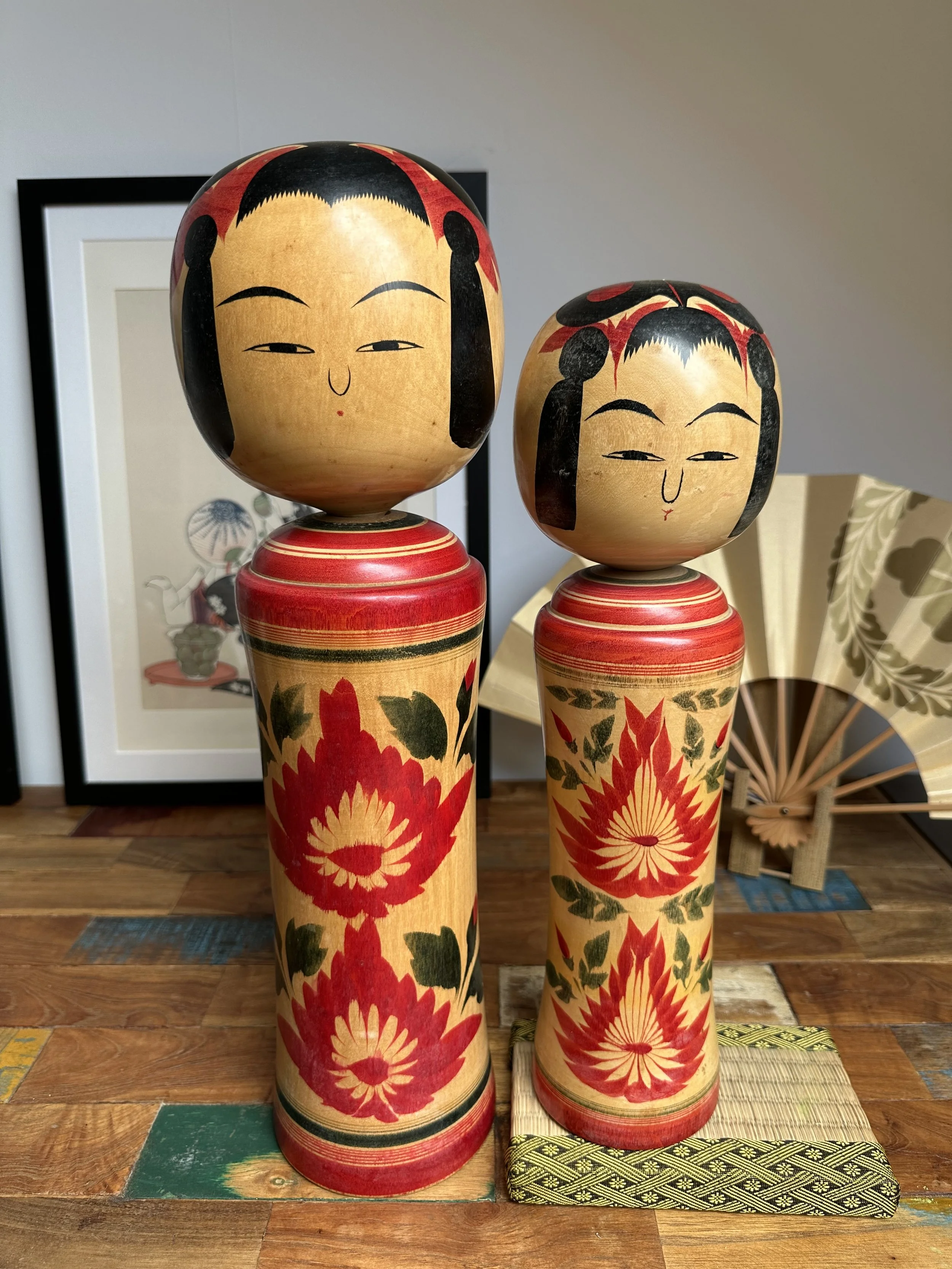
Takakan is a family workshop in Naruko Onsen, started by Takahashi Kanji in 1878. Two of his grandsons, Takahashi Morio and Yusa Fukuju, carried it through the postwar years. Morio ran the workshop and trained a generation of Naruko makers. Fukuju rebuilt Kanji's own kokeshi from the surviving originals and signed it with his name.
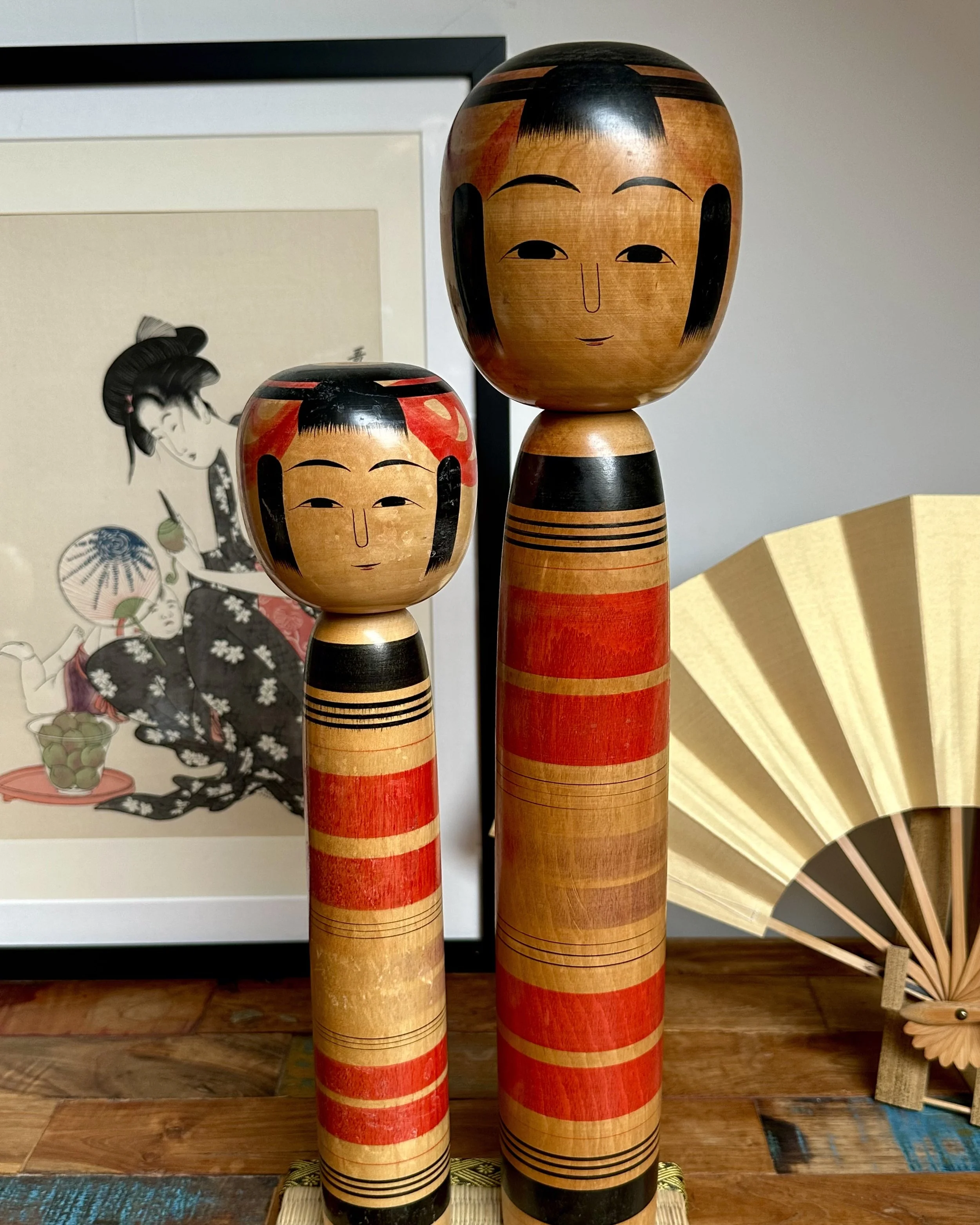
Abe Ichirō, Tsuchiyu kokeshi. Bands of red, black and faded purple, with fine black lines between them.
The Takakan family
Takakan is the Takahashi family workshop in Naruko Onsen, a hot spring town in northern Miyagi Prefecture. It goes back to Takahashi Kanji (高橋勘治, 1860 to 1921), who began training in 1875, at sixteen, under his older sister's husband, the Naruko woodturner Riemon, and set up on his own in 1878.
One kokeshi by Kanji, made around 1906, stands about 35 cm tall. For decades nobody knew who made it. In May 1942 the collector Nishida Minekichi took it to Akita to show Kanji's son Sakari, who confirmed it as his father's work from around 1906 or 1907. Pieces of this size were most likely made for display, for example on the tiered stand of the Hinamatsuri doll festival, rather than as toys for children.
Kanji's second son, Takahashi Sakari (高橋盛, 1890 to 1973), moved the family to Akita in 1939, where he taught woodturning at the prefectural craft institute, and brought them back to Naruko in 1948. In 1952 he reconstructed his father's large kokeshi. The Kokeshi Wiki counts this Kanji-type among the first successful reconstructions of an earlier maker's kokeshi, the start of what became a common way of working among traditional makers. Both of Sakari's sons learned the craft from him.
Takahashi Morio (高橋盛雄), 1917 to 2000
Takahashi Morio was born on 22 July 1917 in Naruko, the eldest son of Takahashi Sakari and his wife Kikue. After higher elementary school he trained as a woodturner under his father, and some of his early kokeshi, painted together with his mother, were sold through a local shop in Naruko.
In 1937 he left for the Yokosuka naval air arsenal, and from 1938 he studied aircraft design at an evening industrial school there, graduating in March 1942. After the war he taught at a prefectural technical school and then worked at the finance bureau in Sendai, handling reparations. He returned to Naruko at the end of 1948, when his father came back from Akita, and took up woodturning again. In 1949 he married Abe Tatsuko, who later painted traditional kokeshi herself.
Morio was more interested in running Takakan than in turning kokeshi himself. He built the workshop into a business that could meet the postwar demand for Naruko kokeshi, taking on apprentices and giving them work as craftsmen. Among those he trained were Moriya Kazuo, Ōba Shigeru, Takahashi Teruyuki, Kakizawa Koretaka, Endō Kinji, Itō Yasuo, Watanabe Kunio, Takahashi Giichi and his own second son, Takahashi Toshifumi. Together with Takahashi Takeo of the Takakame workshop, he is credited with laying the groundwork for Naruko kokeshi after the war. From 1967, when his father's health declined, Morio was the centre of Takakan.
His prewar kokeshi are few in number. His early postwar work had nervous brushwork and a sweet expression with downturned outer eye corners. After seeing one of Kanji's kokeshi in 1952, he adopted the red, rounded stepped shoulder of his grandfather's work, and his kokeshi became heavier and fuller. Around 1960 his style changed again, towards rounder heads, lower bangs and smaller eyes. From around 1965 he concentrated more fully on making kokeshi himself, mainly the Kanji-type and his own type.
In later life he travelled back and forth between Sendai and Naruko, and kept several bottles of shōchū with a mamushi viper steeped inside at the back of the Naruko shop, to share with friends and regular visitors. His son Toshifumi died in May 2000, and Morio died four months later, on 21 September 2000.
Yusa Fukuju (遊佐福寿), 1930 to 2001
Yusa Fukuju was born Takahashi Fukuju on 17 March 1930 in Naruko, the second son of Takahashi Sakari and Kikue. In January 1939 the family moved to Akita, where he finished school in 1944. From July 1945 he trained under his father, and after the war he worked with him at the Yuri Mokkō woodworking workshop in Honjō before the family returned to Naruko in 1948.
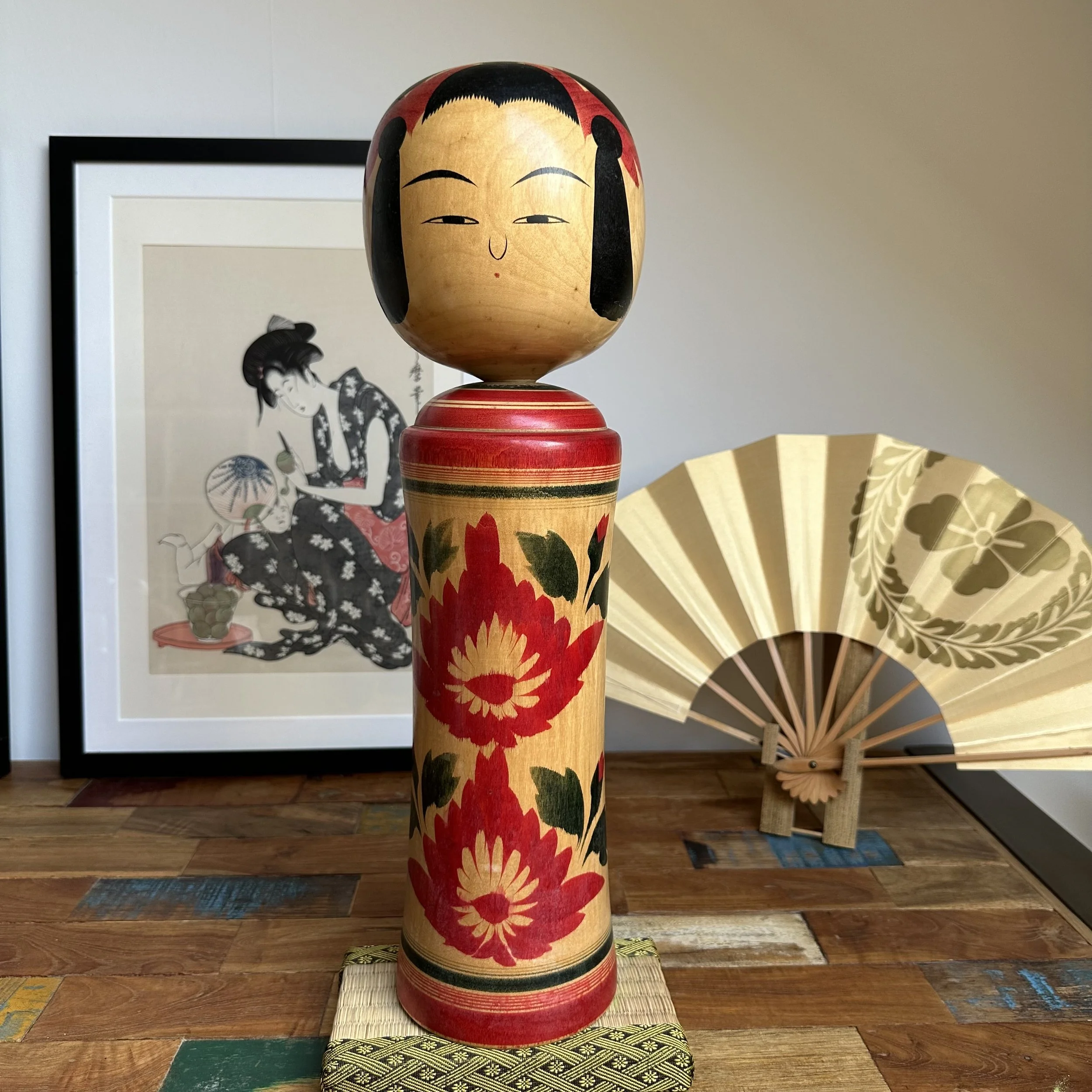
In March 1952 a collector brought one of Kanji's kokeshi from Nishida Minekichi's collection to Naruko and urged Sakari and Fukuju to make the Kanji-type, and Fukuju made his first copy of it that year. Alongside it he made what he himself simply called his "ordinary type" (futsū-gata), the everyday Takakan kokeshi inherited from his father. Through the 1950s much of his energy went into new designs. Kubifuri kokeshi, with a loosely fitted head that nods when touched, won him prizes in 1958 and 1959, and in 1960 his creative kokeshi Hōju won the Prime Minister's Award at the 7th National Kokeshi Doll Concours. Hōju is a slender white figure with a single jewel motif in black and gold, and a nose added in relief, his first step towards a three dimensional face.
In April 1957 he married Setsuko, eldest daughter of the Yusa family, who ran a geta shop, and was adopted into her family. He opened the Yusa kokeshi shop in Yumoto, Naruko, which shared the business with the family's geta shop, and in 1965 moved across the street to a shop of his own, known from then on as Fukuju's shop.
In the early 1960s, as interest in new designs faded and collectors turned back to traditional kokeshi, Fukuju returned to the Kanji-type. Preparing for an exhibition at the Mitsukoshi department store in Nihonbashi, Tokyo, in February 1963, he studied a different original: the Kanji kokeshi the collector Fukazawa Kaname had donated to the town of Naruko, kept at the town hall. From then on his Kanji-type followed that piece. It won first prize at the Mitsukoshi exhibition, the top award at the All-Japan Kokeshi Concours in 1964, and the Minister of Education's Encouragement Award, the highest prize, at the 12th National Kokeshi Festival in Naruko in September 1966. His full size Kanji-type measures one shaku one sun five bu, about 35 cm, the size of his grandfather's original.
Demand rose sharply during the kokeshi boom of the late 1960s and early 1970s, when traditional kokeshi sold as fast as they could be made. The collector Kunie recalls watching a dealer arrive by car at Fukuju's shop and buy everything on the shelves. From the late 1960s Fukuju also reconstructed older family pieces, including a Taishō period kokeshi by his father, and in 1969 a nine sun Kanji kokeshi from a photograph published in 1925. He served as auditor of the Naruko woodturned toy cooperative and, with Okazaki Saiji, Sakurai Shōji, Ōnuma Hideo and Takahashi Shōgo, belonged to the young postwar generation at the centre of Naruko kokeshi making.
In the Heisei period much of his time went into kokeshi and daruma made for a subscription series run by the Sony Family Club, and his ordinary type became rare. His eldest son, Yusa Toshihiko, trained with him from 1976 and turned many of the bodies for kokeshi Fukuju painted and signed, before leaving the craft. Fukuju died on 25 January 2001.
How to recognise the Takakan style
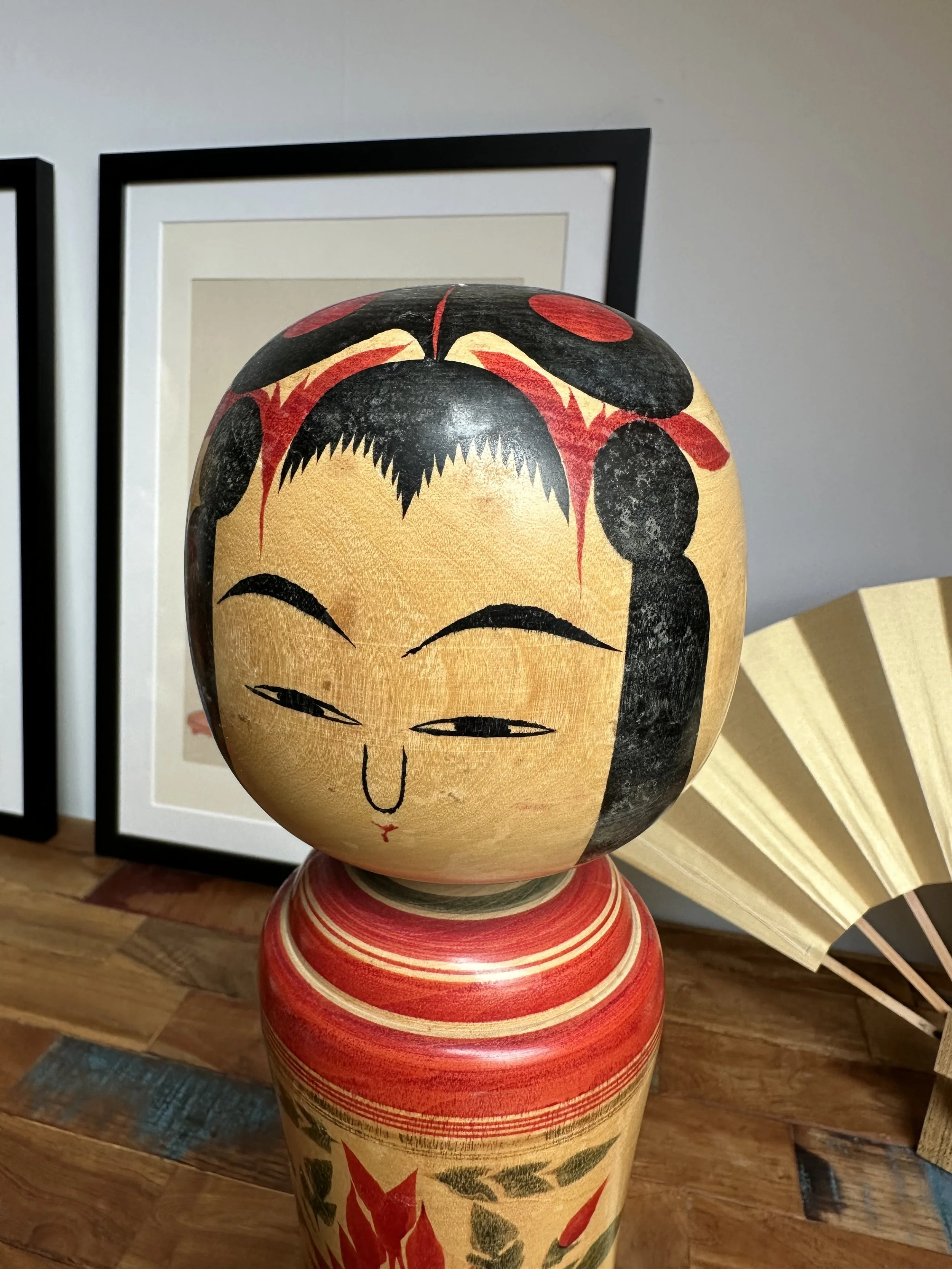
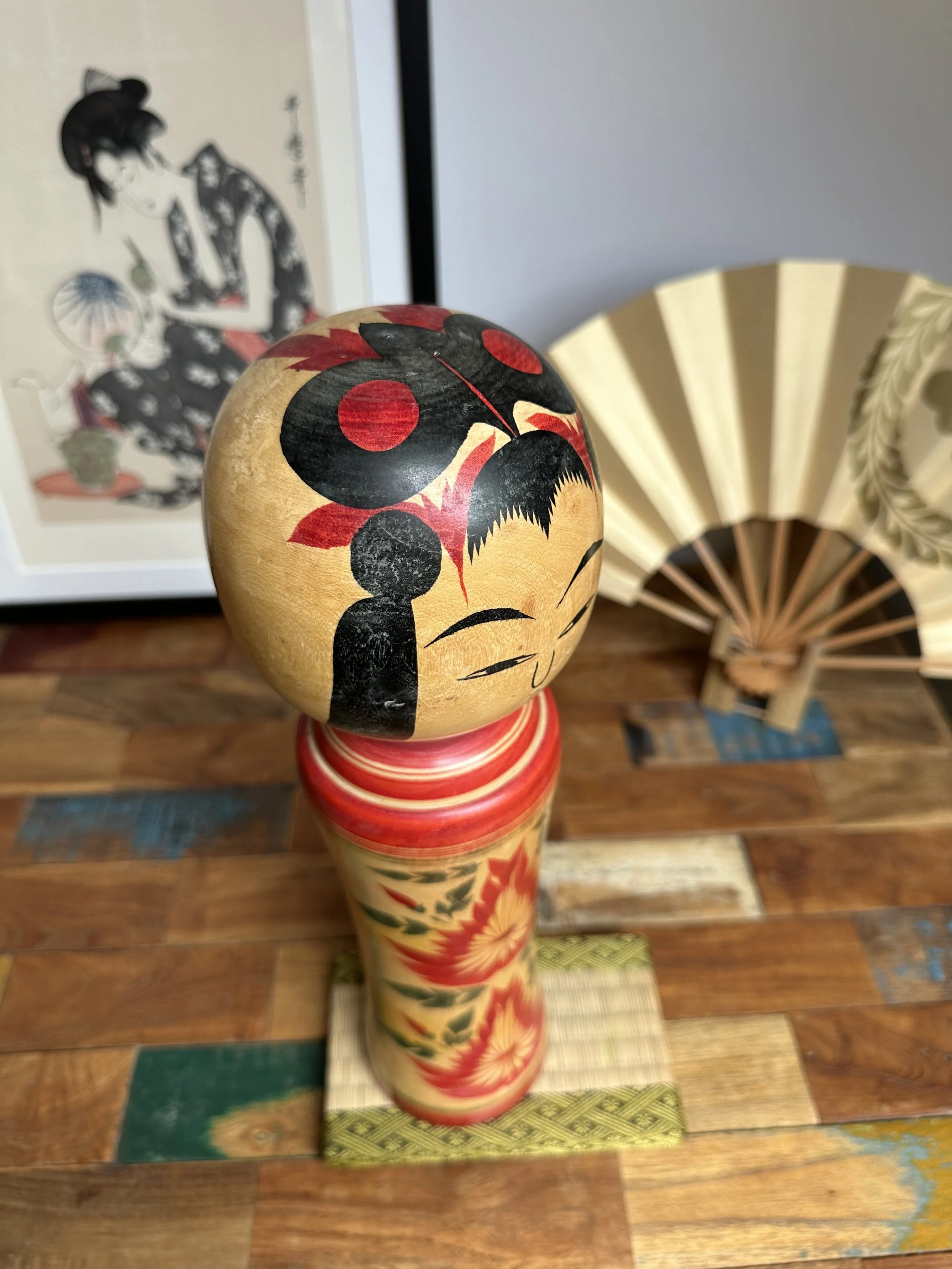
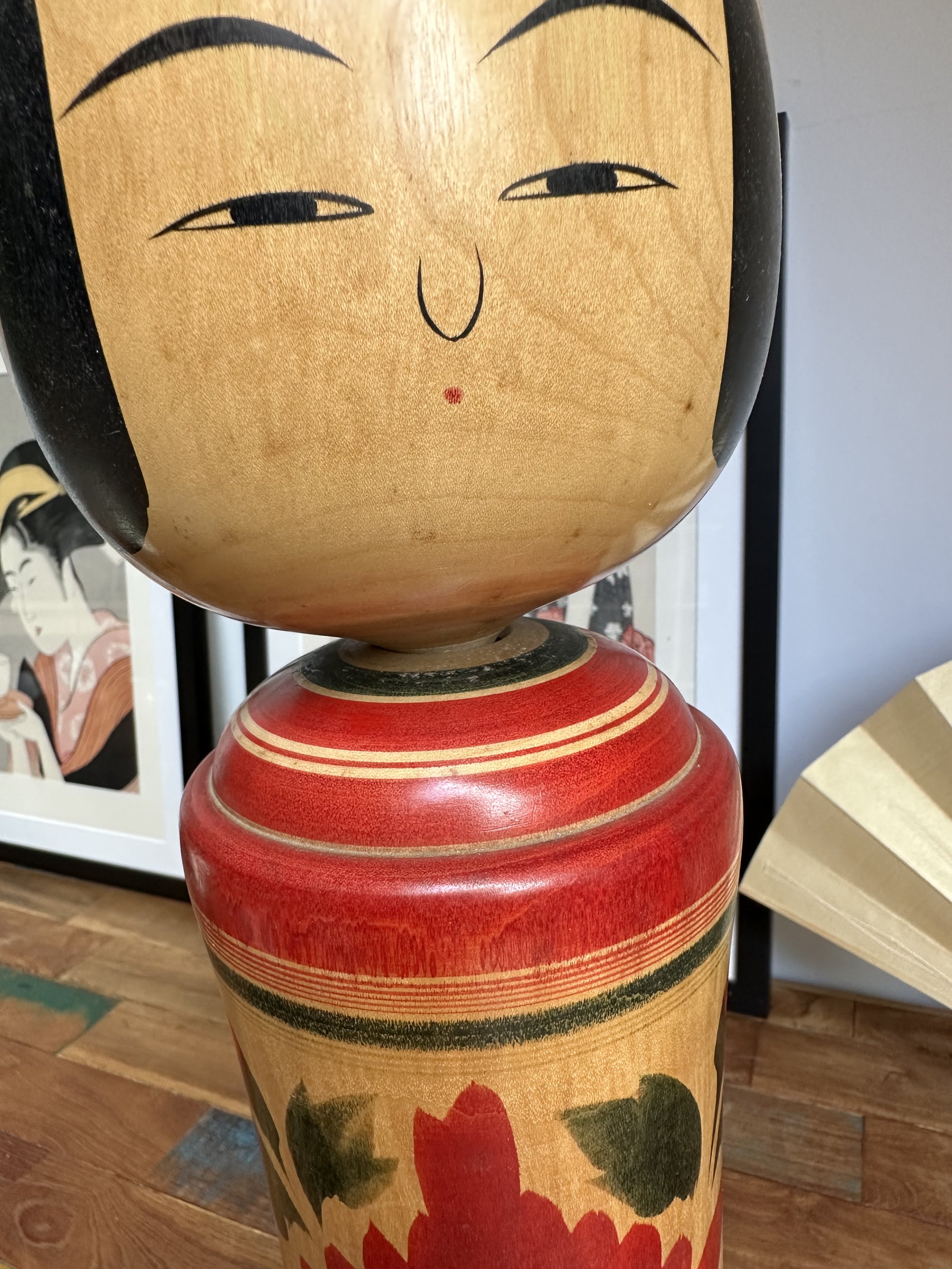
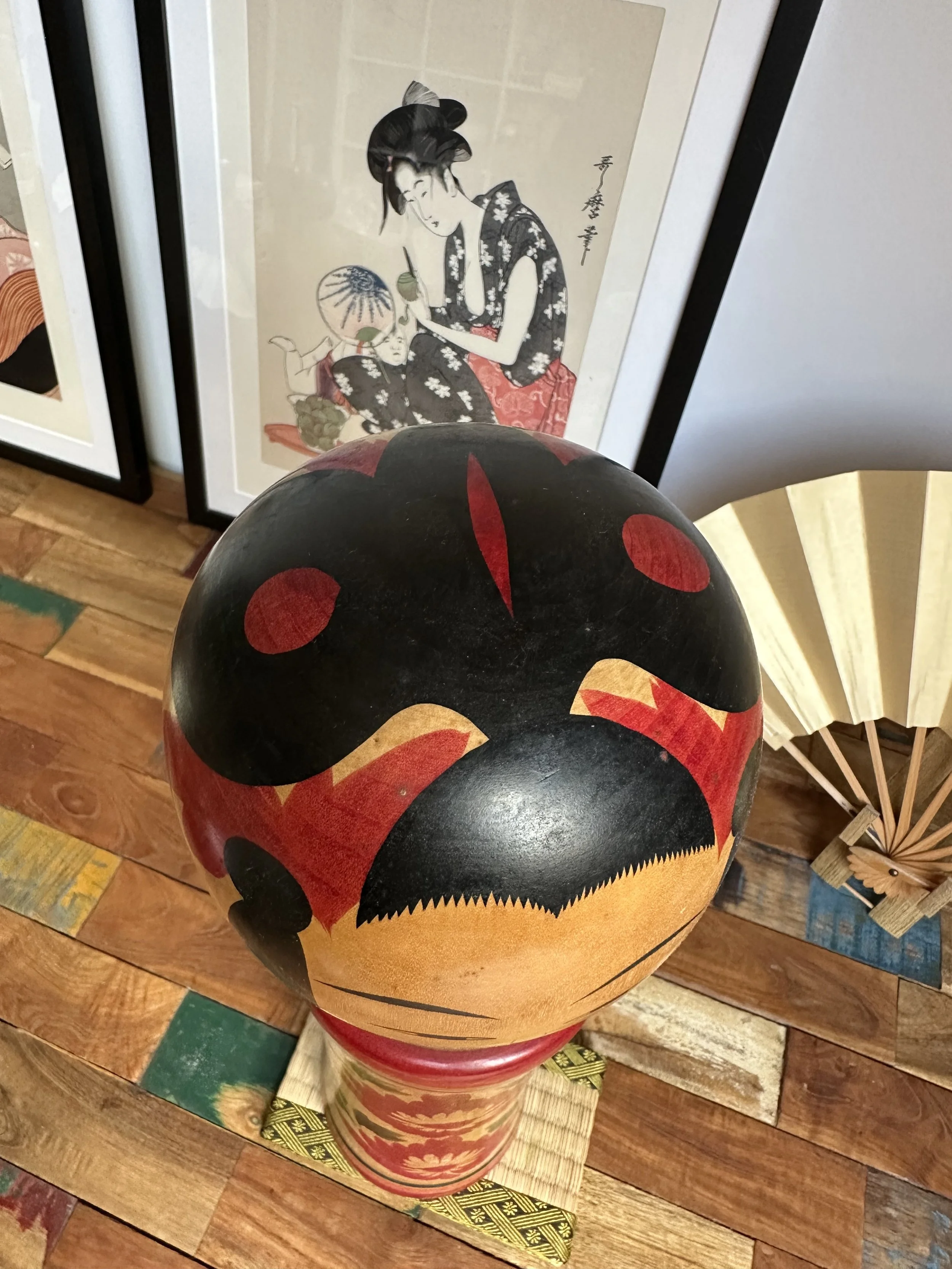
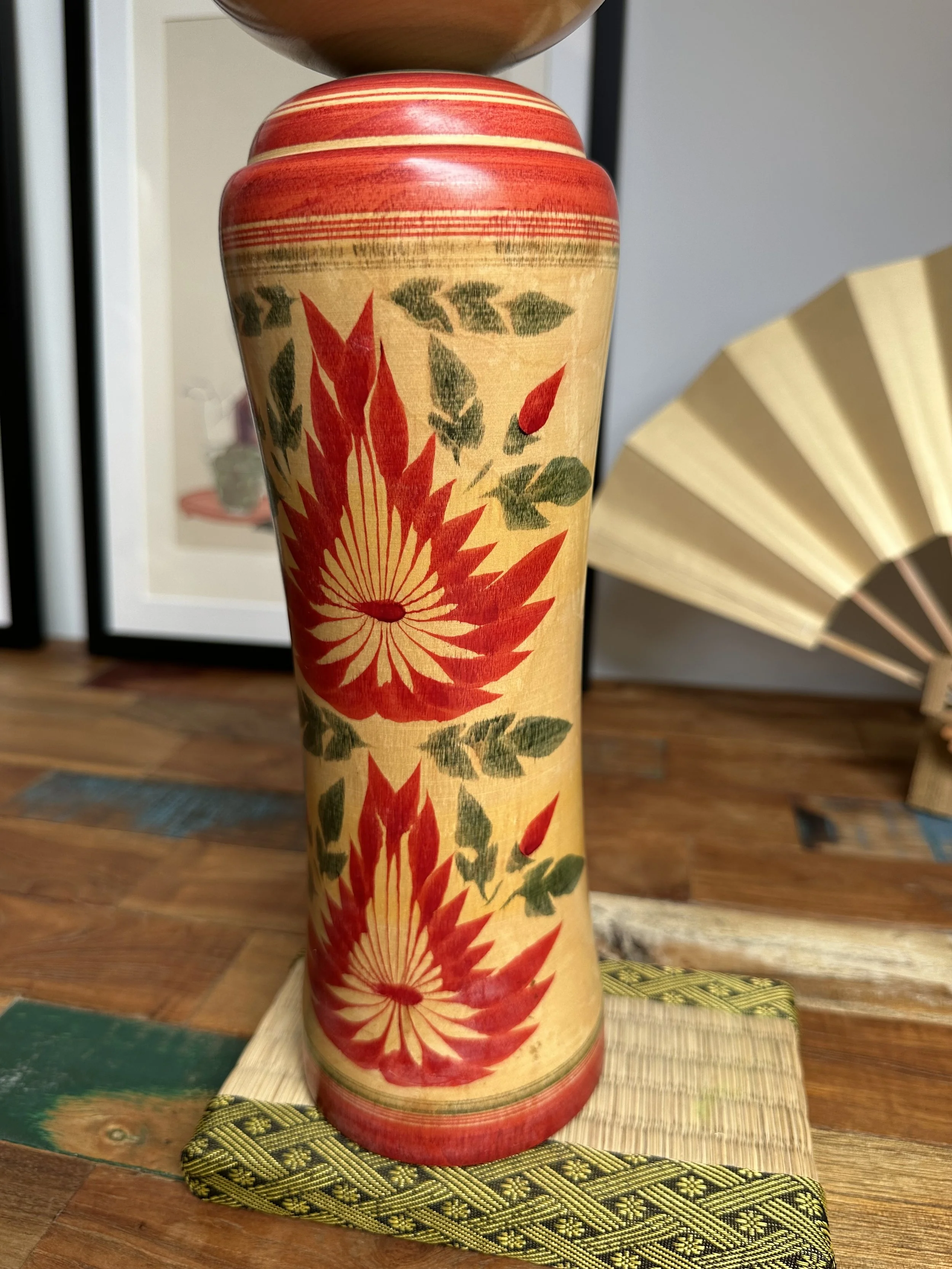
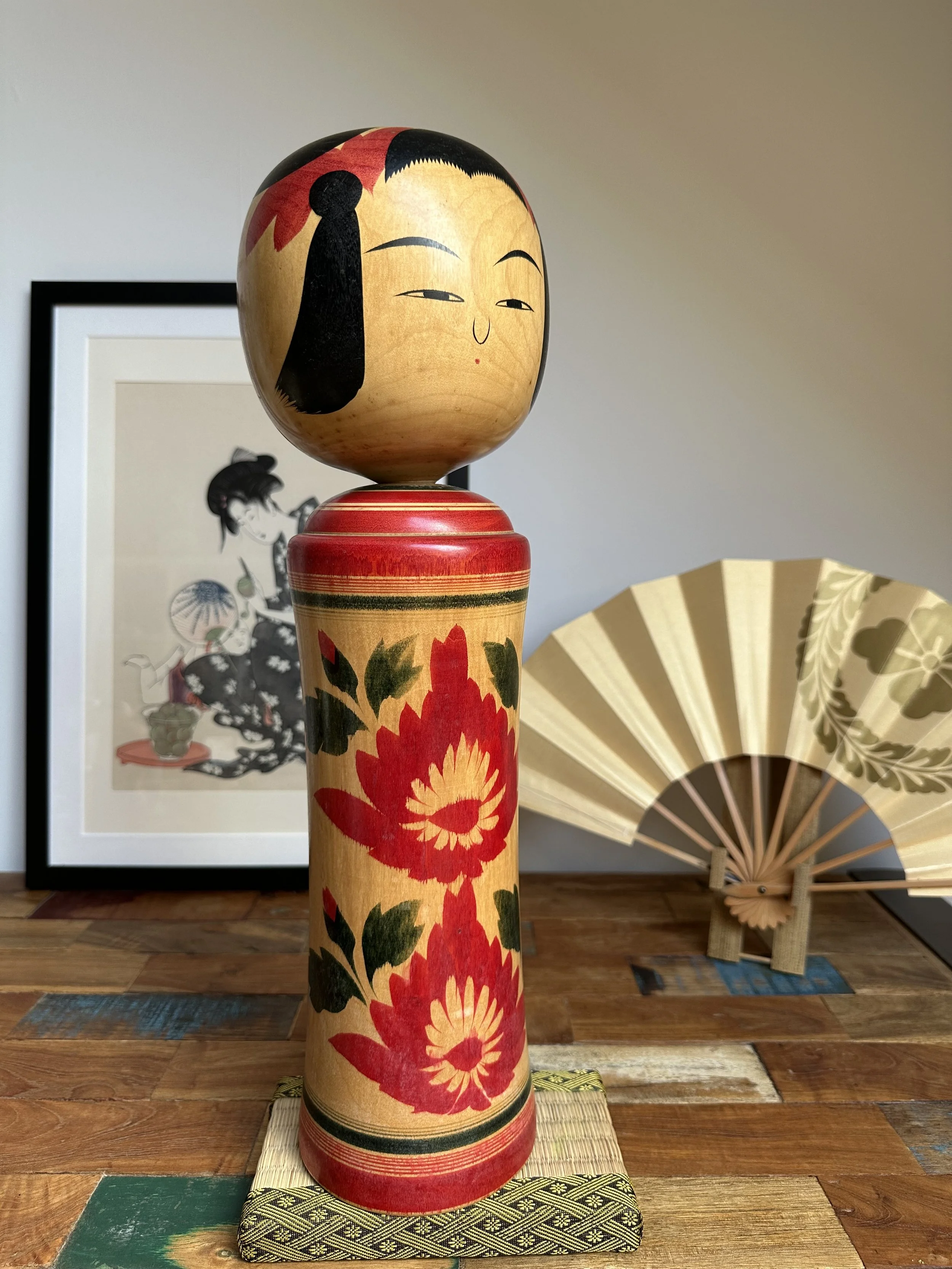
The Kanji-type, as Morio and Fukuju made it, is built around features that trace directly back to their grandfather.
The side locks. Collectors call the shape of the side locks on Kanji's kokeshi mizura (角髪). They are painted as if tied near the top with a cord, then hang down beside the face. Seen from above, the tops of the two locks form round black knots on the crown, with red painted between them. Mizura was a hairstyle of male aristocrats in early Japan, and the Kokeshi Wiki traces this painted form to early Kyoto gosho dolls.
The bangs. A row of even black points across the forehead, sometimes described as comb shaped.
The red strokes on the crown. The red mizuhikite pattern comes from Kyoto gosho dolls made for celebrations, one reason Naruko kokeshi were given as gifts for births and weddings.
The shoulder. A red, rounded, stepped shoulder, taken from Kanji's work, which gives the kokeshi a heavier, more solid look.
The face. Where most Naruko kokeshi show only an upper eyelid, the Kanji-type has both eyelids drawn, the lower one usually curving downward, around a dark eye dot.
The chrysanthemums. The Kanji-type carries two large chrysanthemums seen from the front. The larger Takakan ordinary type usually shows one chrysanthemum from the side above and one from the front below.
The size. Fukuju's full size Kanji-type is about 35 cm, and he also made a smaller version of eight sun, about 24 cm.
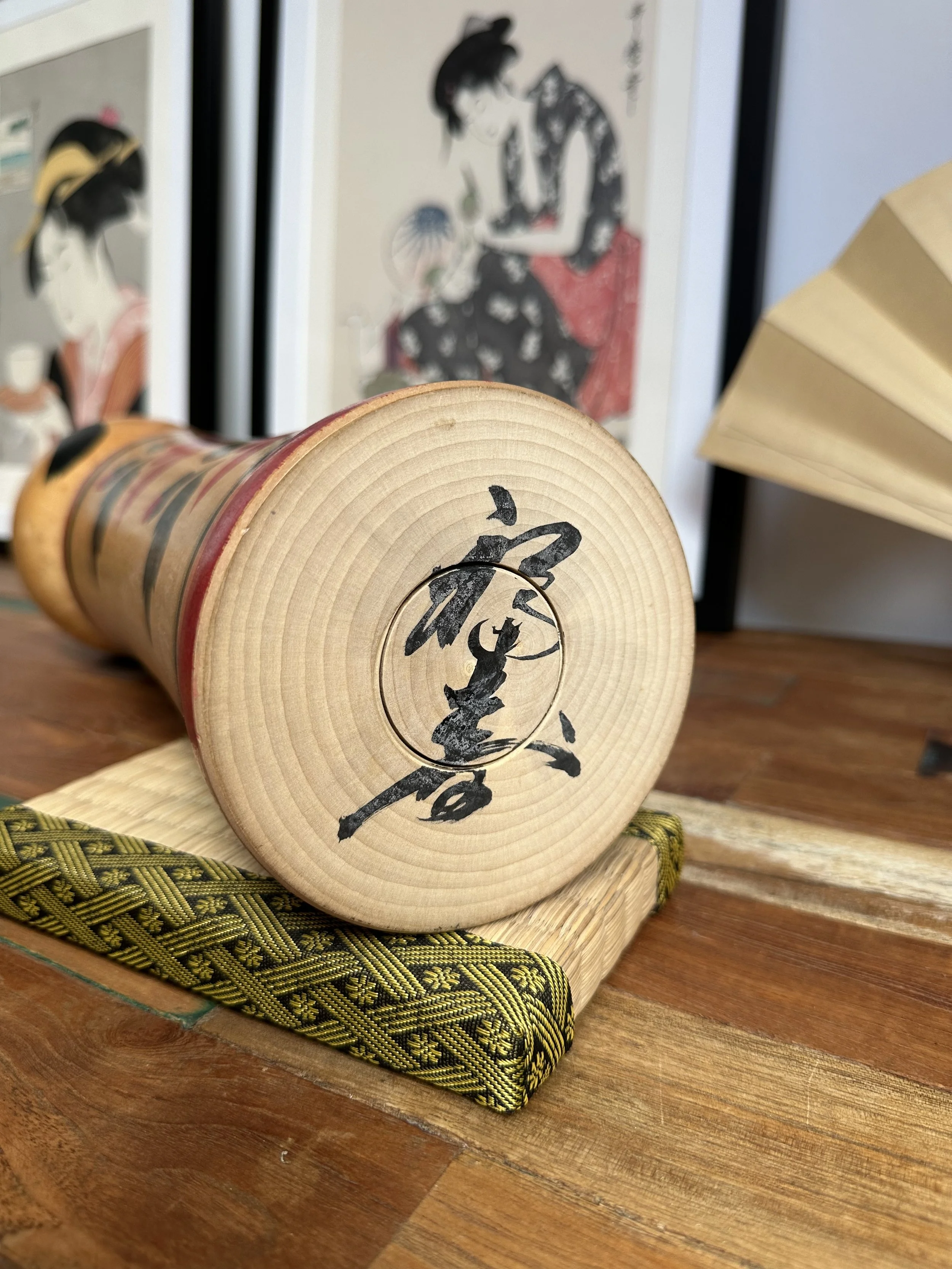
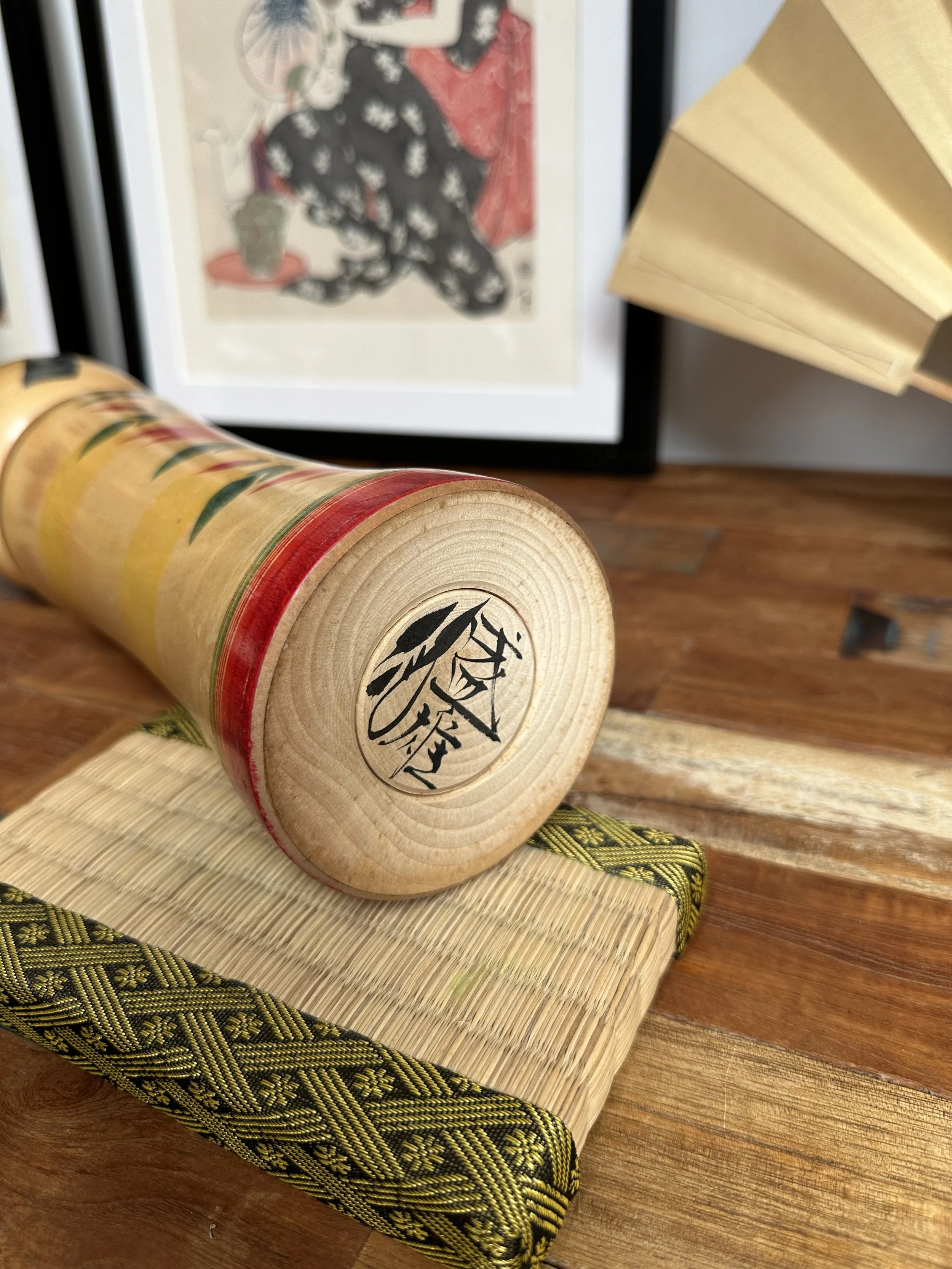
Signatures of Takakan in our archive
Photo left: Base signature 福寿, Yusa Fukuju
Photo right: Base signature 盛雄作, Takahashi Morio
Meet the kokeshi in collection
Sources
Physical examination of the seal, construction, and any award stickers on the pieces themselves
Information shared by dealers and specialists in Japan at the time of purchase
Fukuju Monogatari, collector Kunie's archive on Yusa Fukuju: Kanji-type series (Japanese)
Fukuju Monogatari, chapter 15: Fukuju joins the Yusa family (Japanese)
Fukuju Monogatari, chapter 18: Hōju and the Prime Minister's Award (Japanese)
Read more
Curious how a maker's brushwork can shift over a lifetime, or across a family workshop? Both pieces in this collection carry the same seal in two different hands. Read the full story in the journal.
Wondering where Naruko sits among the eleven kokeshi traditions, and what sets it apart from Naruko? The eleven kokeshi traditions, and how to tell them apart
Thin painted washes on wood need different care from lacquer. The kokeshi care guide explains what to avoid.
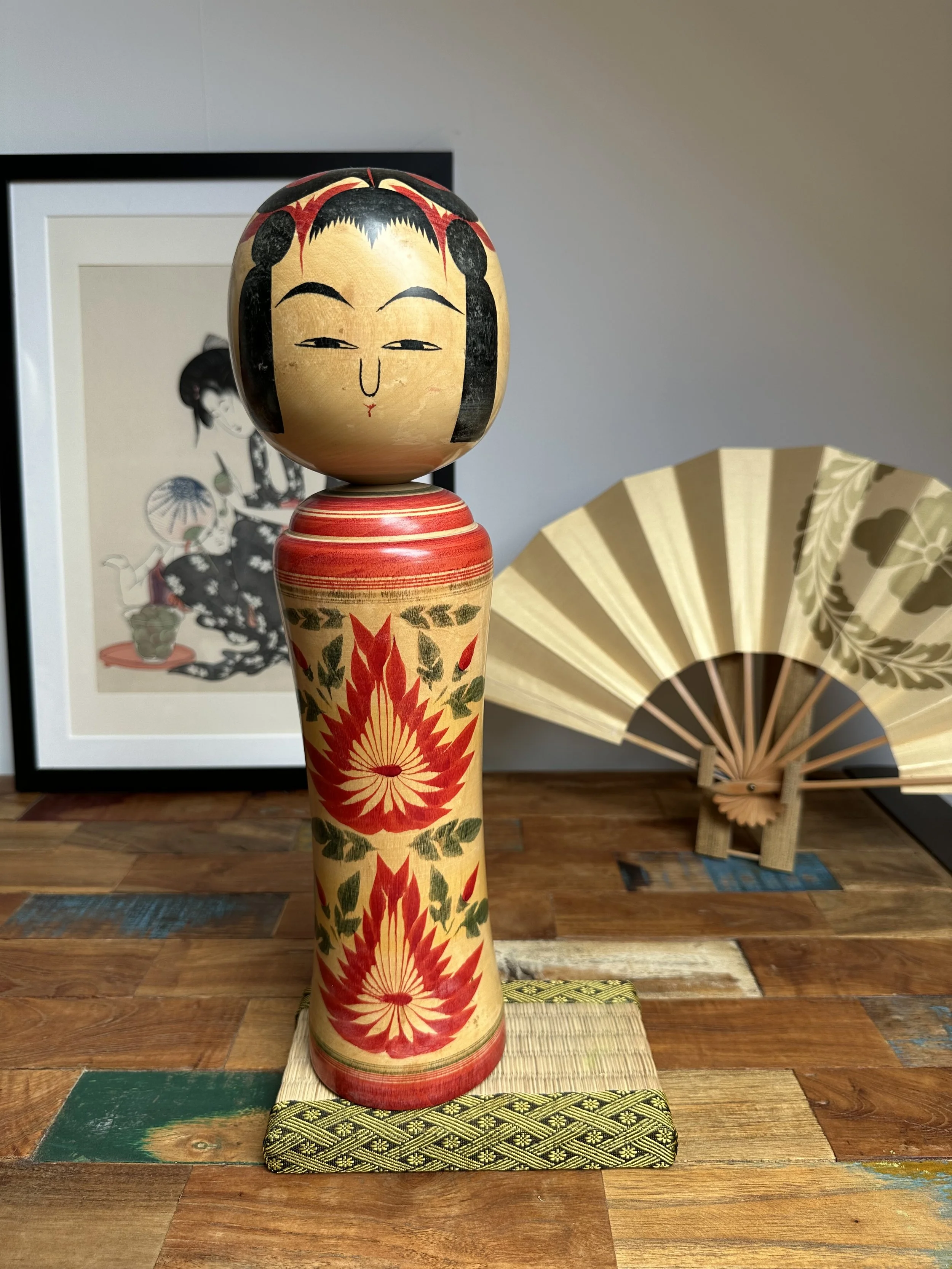
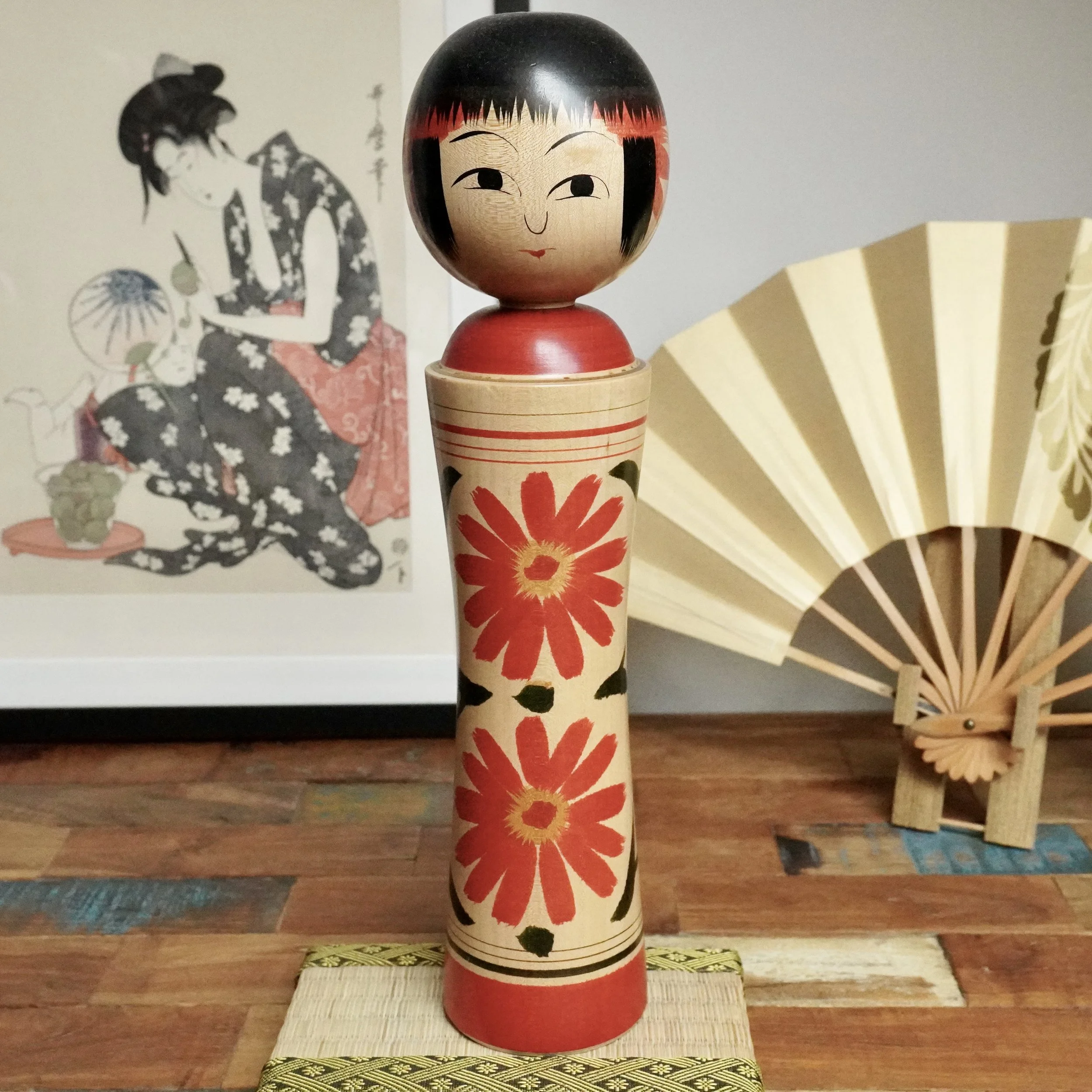
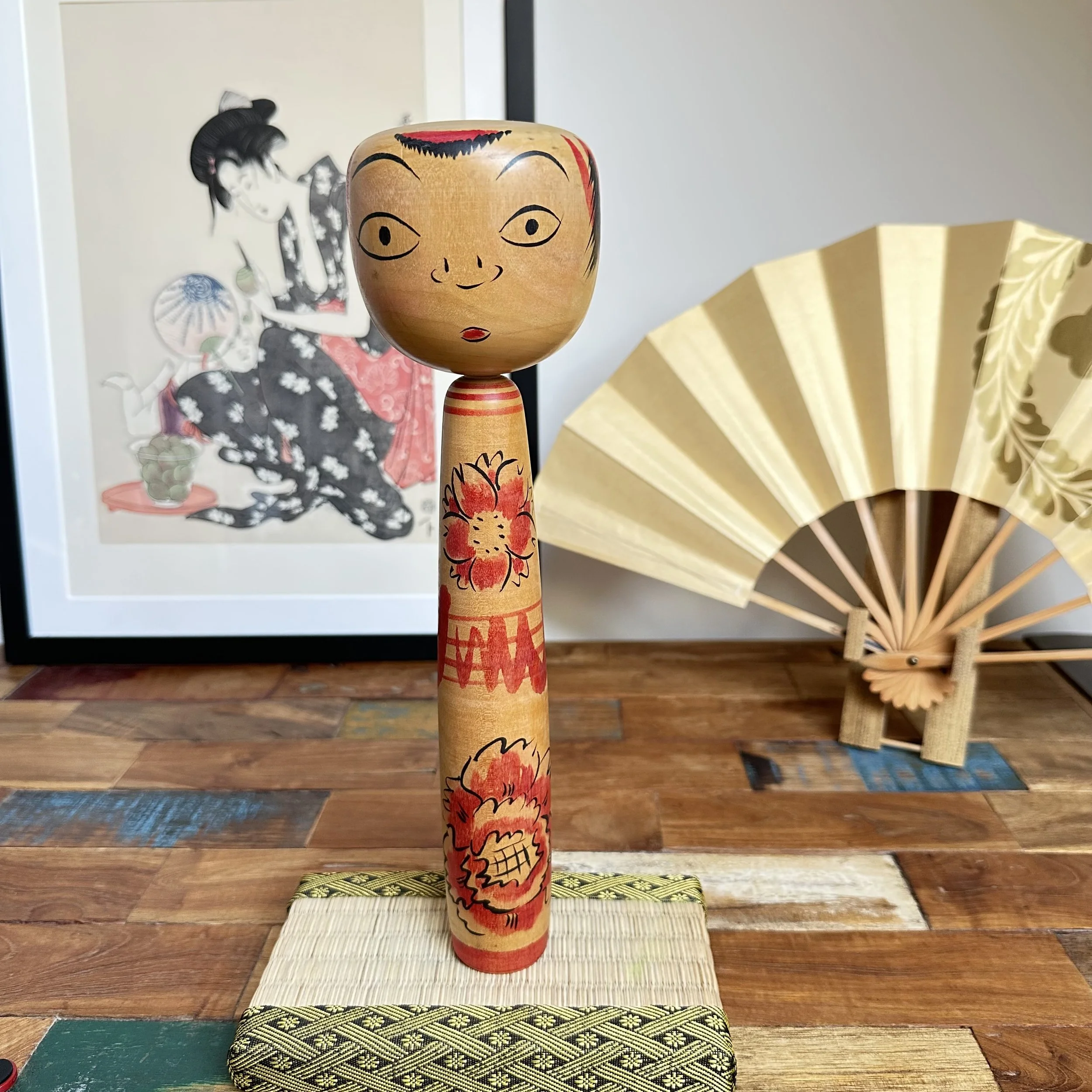
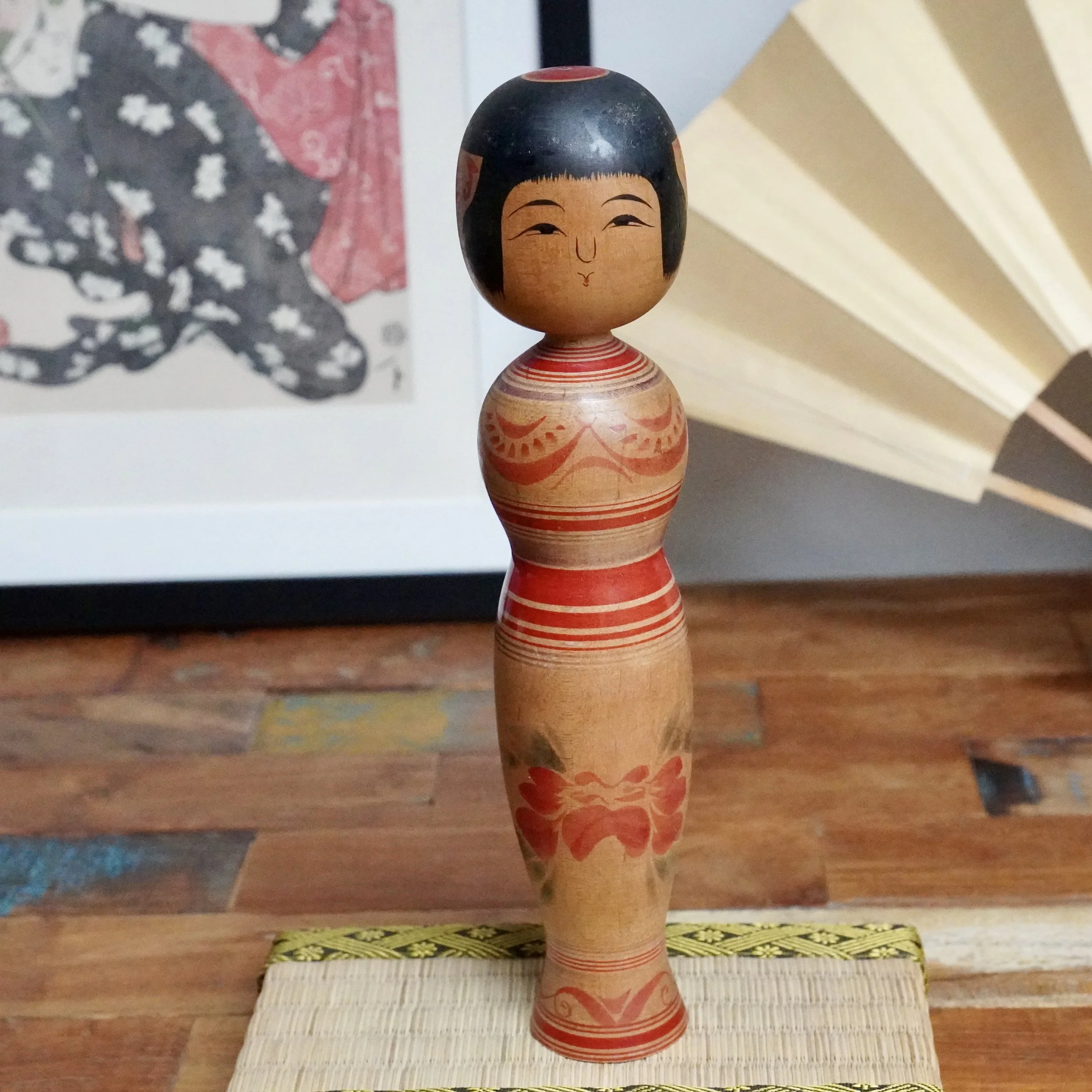

Soft, narrow eyes under thin brows, black side locks hanging straight beside the cheeks, and chrysanthemums in strong red on pale wood: from the front this kokeshi looks calm, and from above it is busy. At 39 cm it stands comfortably on a shelf or sideboard, and the head turns, so you can choose which way it looks at the room. If you would like it to have company, his brother Yusa Fukuju's Kanji-type is almost half a metre tall, is in the collection too and goes very well with it.
Takahashi Morio was the grandson of Takahashi Kanji and ran the family workshop Takakan after the war, training many of the Naruko makers who came next. The pattern is the Kanji-type, his grandfather's kokeshi, which his father Sakari rebuilt in 1952 and which the Kokeshi Wiki counts among the first successful reconstructions. This one carries his own name on the base.
→ Want to understand the difference between dentō and sōsaku kokeshi? I wrote about it, with a trip through Fukushima along the way.
→ Curious how Naruko compares to the other ten traditional kokeshi lines? Read the full guide.