
The eleven kokeshi traditions and how to tell them apart
Dentō kokeshi, the traditional Japanese wooden dolls, come from eleven recognised regional traditions across the Tōhoku region: Tsugaru, Nanbu, Kijiyama, Naruko, Tōgatta, Yajirō, Sakunami, Yamagata, Hijiori, Zaō Takayu and Tsuchiyu. Each carries its own silhouette, colour palette and painted motifs, passed down within a small number of families for generations. This differs from sōsaku kokeshi, the freer, individually signed creative tradition that emerged after the war.
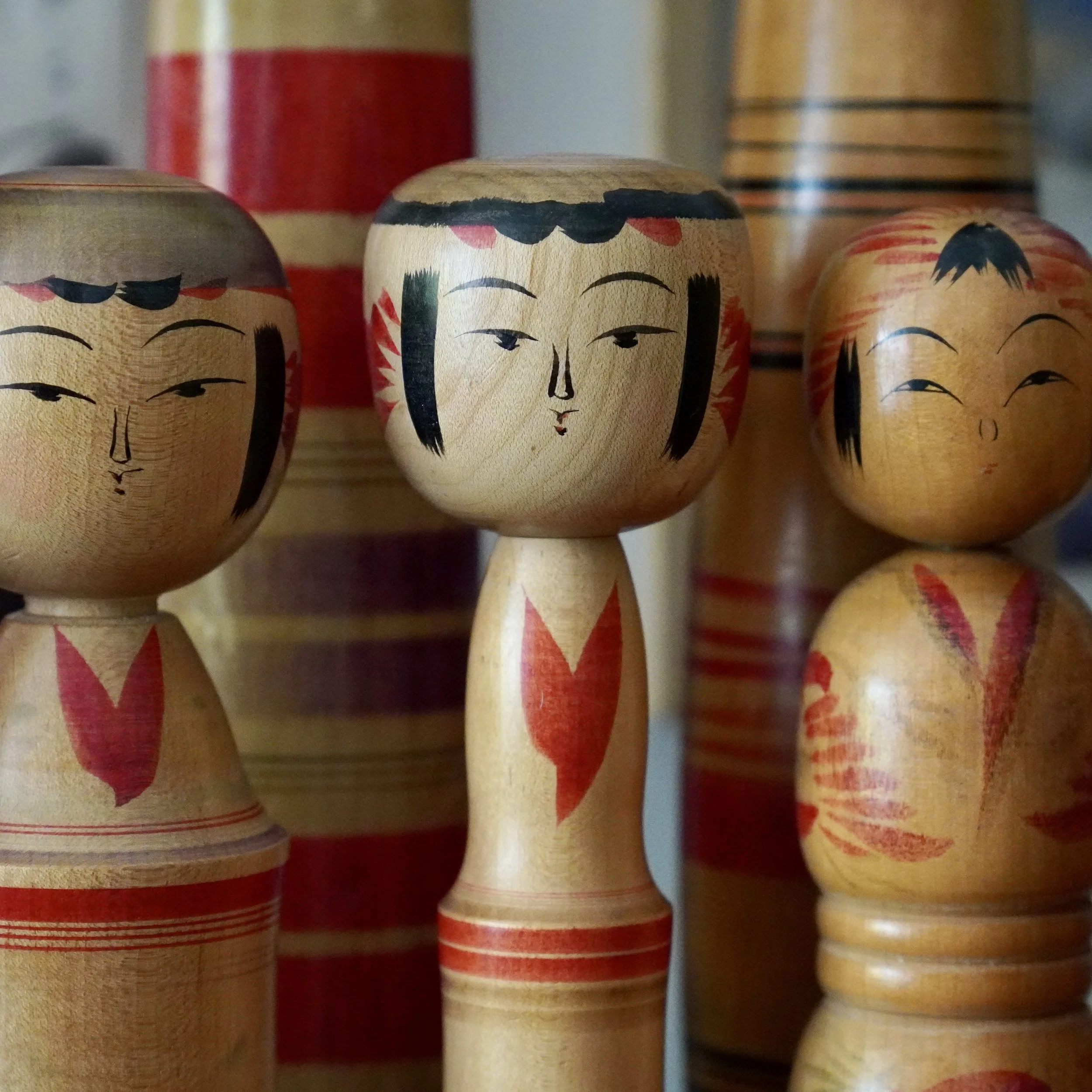
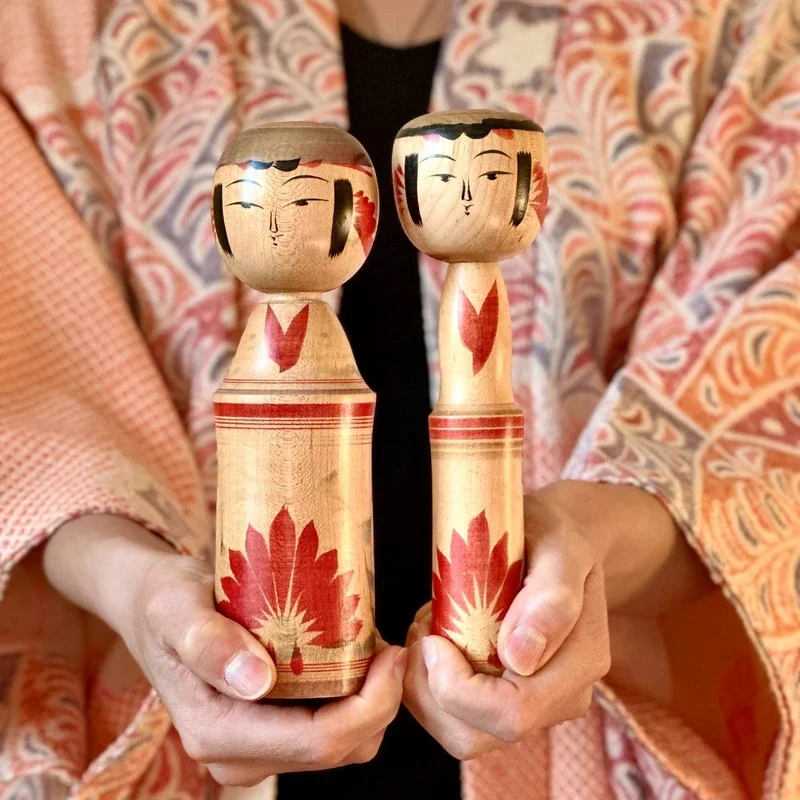
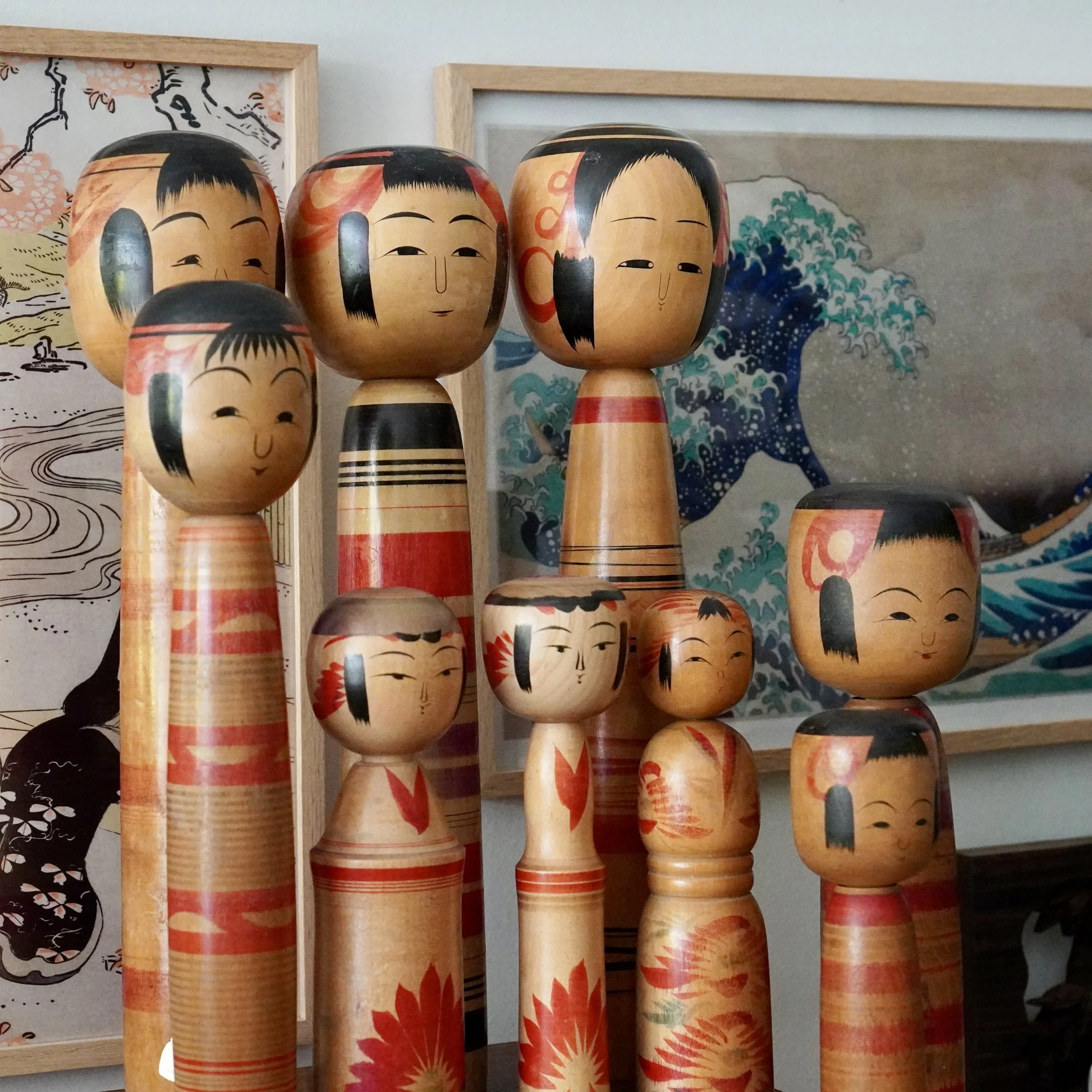
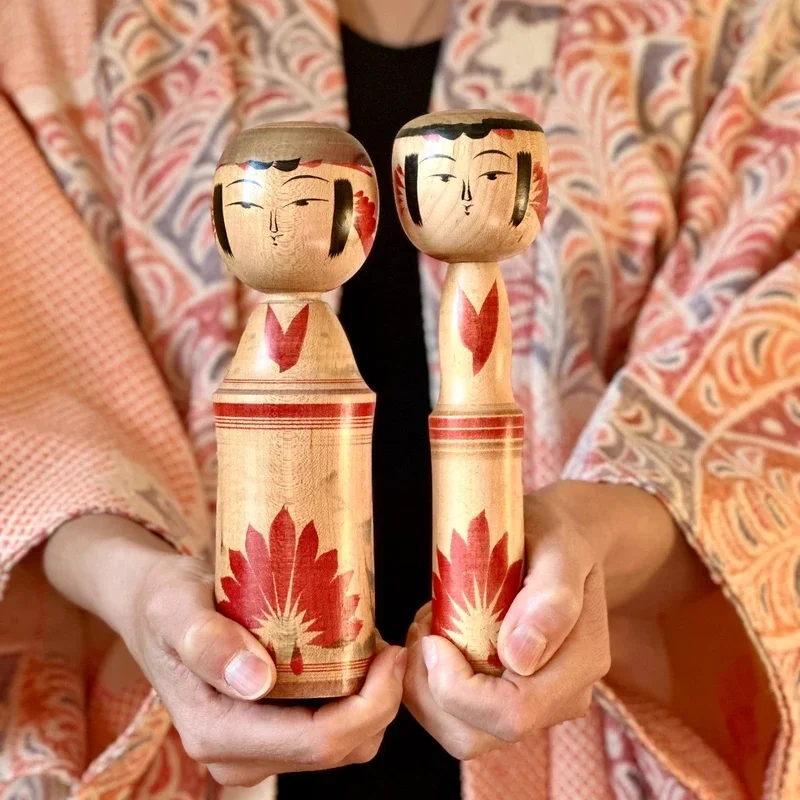
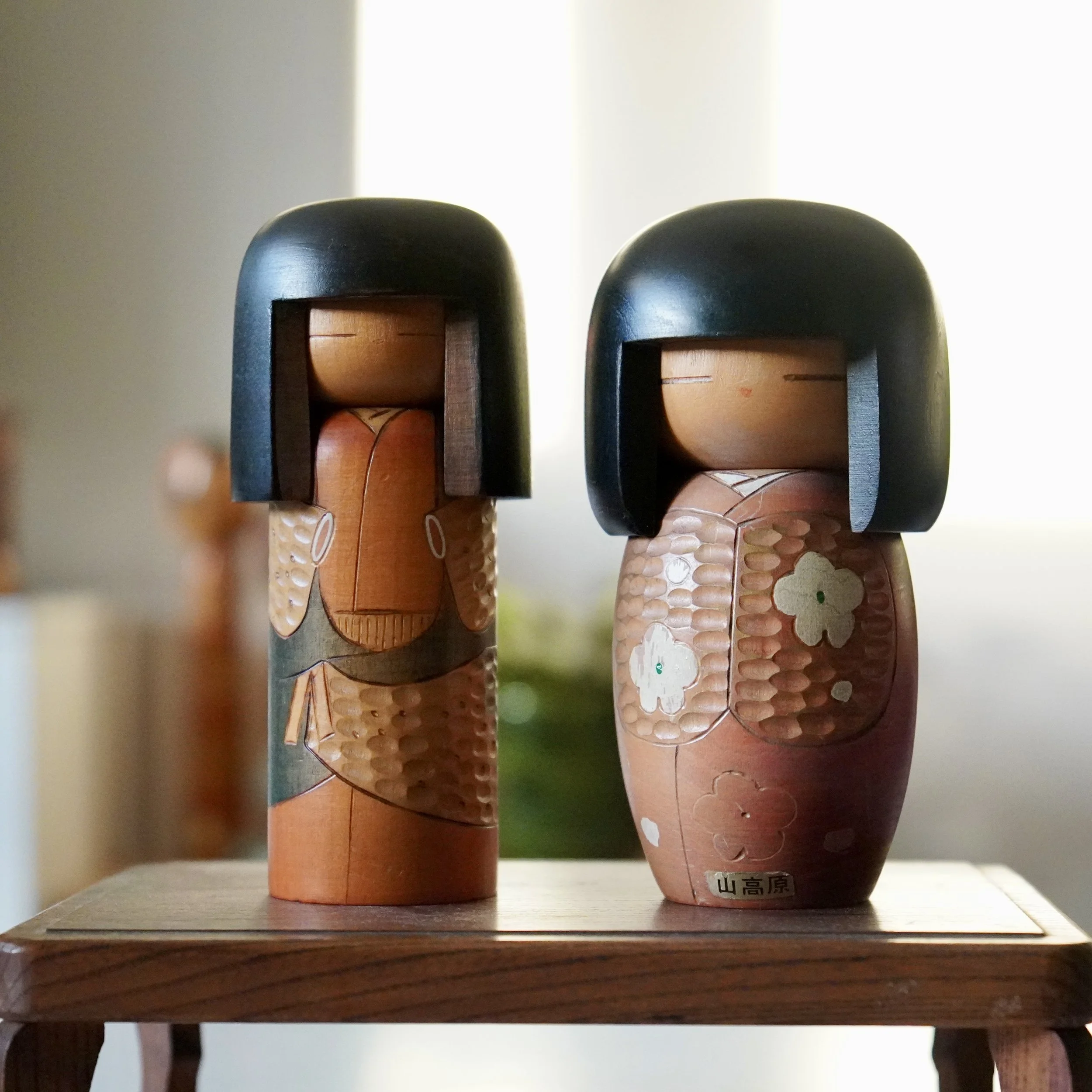
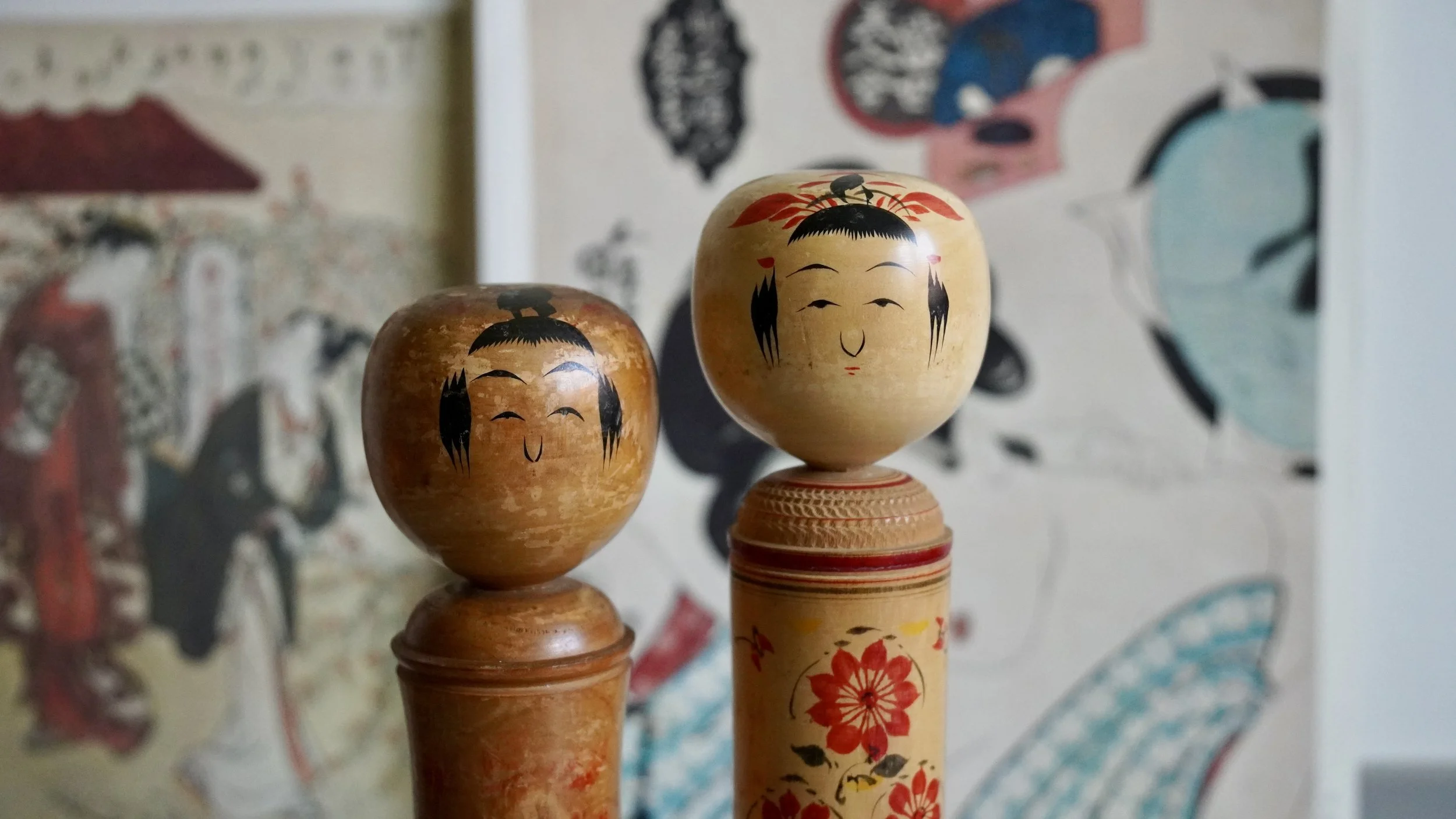
Two Miyagi traditions side by side, close enough in feeling to explain why they are sometimes confused: Yajirō's bold black hair sweeps on the left and centre, Tōgatta's red tegara sunburst catching the crown on the right.
Every kokeshi I bring home has a place it belongs to before it belongs to anyone else. Not a shop, a region. A specific valley in Tōhoku where a specific family has been turning the same shape on the same kind of lathe for longer than anyone can quite pin down.
There are eleven of these places, eleven recognised traditions, and once you have spent enough time with kokeshi you stop seeing them as wooden dolls and start seeing them the way a collector sees them: Naruko or Tsuchiyu or Yajirō, the way you would say Bordeaux or Burgundy. Same idea, different soil.
The eleven traditions:
Tsuchiyu (土湯), Fukushima (including Nakanosawa (中ノ沢) a substrain of Tsuchiyu)
Naruko (鳴子), Miyagi
Tōgatta (遠刈田), Miyagi
Yajirō (弥次郎), Miyagi
Sakunami (作並), Miyagi
Yamagata (山形), Yamagata
Hijiori (肘折), Yamagata
Zaō Takayu (蔵王高湯), Yamagata
Kijiyama (木地山), Akita
Nanbu (南部), Iwate
Tsugaru (津軽), Aomori
I wrote about this properly once already, a whole piece about my week in Fukushima, climbing Mount Bandai before sunrise, sitting with makers who have been doing this since before I was born. That piece also covers the difference between dentō and sōsaku kokeshi in more depth than I will here. This page is the reference version, the one you come back to when you are holding a kokeshi and trying to work out where it is from.
→ Curious about that week in Fukushima and the difference between dentō and sōsaku kokeshi ? Read the full story here.
Tradition 1: Tsuchiyu (土湯), Fukushima
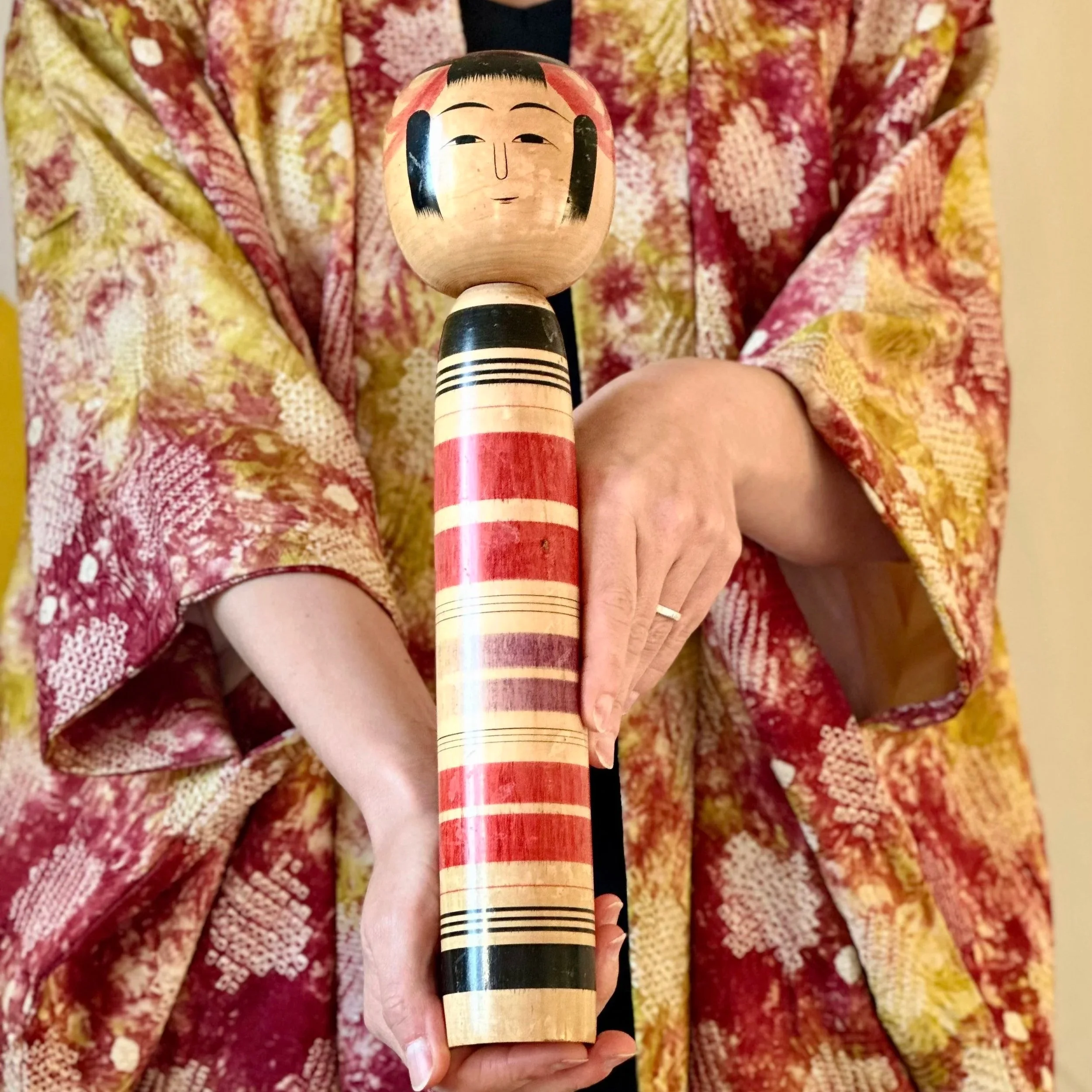
Tsuchiyu kokeshi by Abe Ichirō, 36 cm, black and purple banding, signed, Shōwa period ca. 1970s
At a glance: Small heads, oversized in proportion to the body, painted with tight horizontal banding and a face that is almost always caught mid-expression. The signature trick: the head turns and squeaks, a friction joint every Tsuchiyu maker still uses. If you have ever tilted one and heard that soft cry, that is not a flaw. That is the tradition working exactly as intended.
History: The line traces back to the 1840s, to a kijishi named Sakuma Kamegorō working at the Tsuchiyu hot spring, half an hour from Fukushima City. His son and later his grandson Asanosuke carried the craft forward, with Asanosuke adding enough of his own touch to sharpen the style into what collectors recognise today.
The head: Look closely and the details start to separate one piece from another. A janome ring sits painted on top of the head, sometimes left unpainted in the centre so it reads almost like a target. A red kase, a bow or loop shape, appears near the side tufts. The eyes vary by maker and period: some carry simple double eyelids, others the wider, startled bikkuri-me look, or a whale-shaped kujira-me. The nose comes in four recognised forms, marubana (round), nagabana (long), tarebana (droopy) and shishibana (flared, lion-like), and the mouth is either a double lip or a single lip with a touch of red tongue showing.
On the body: Most often zigzag lines and the rokuro lathe-turned rings recur, alongside peony, iris and cherry blossom used as decoration.
Charming detail: The painters use a technique called kaeshi, a reversed lathe stroke that lets pigment bleed slightly into the grain rather than sitting flat on top, part of why an authentic Tsuchiyu surface has a soft, absorbed quality rather than a printed one. Hats appear on some figures too: a split-peach momoware style, a helmet, or a wide sunshade, alongside a small nested variant.
I have written about Tsuchiyu at length, from a reconstructed near-lost style to the makers still working the lathe today. Meet Jinnohara Kazunori, who spent his life bringing the historic Kumematsu style back from the edge of disappearing.
Nakanosawa (中ノ沢), a substrain of Tsuchiyu
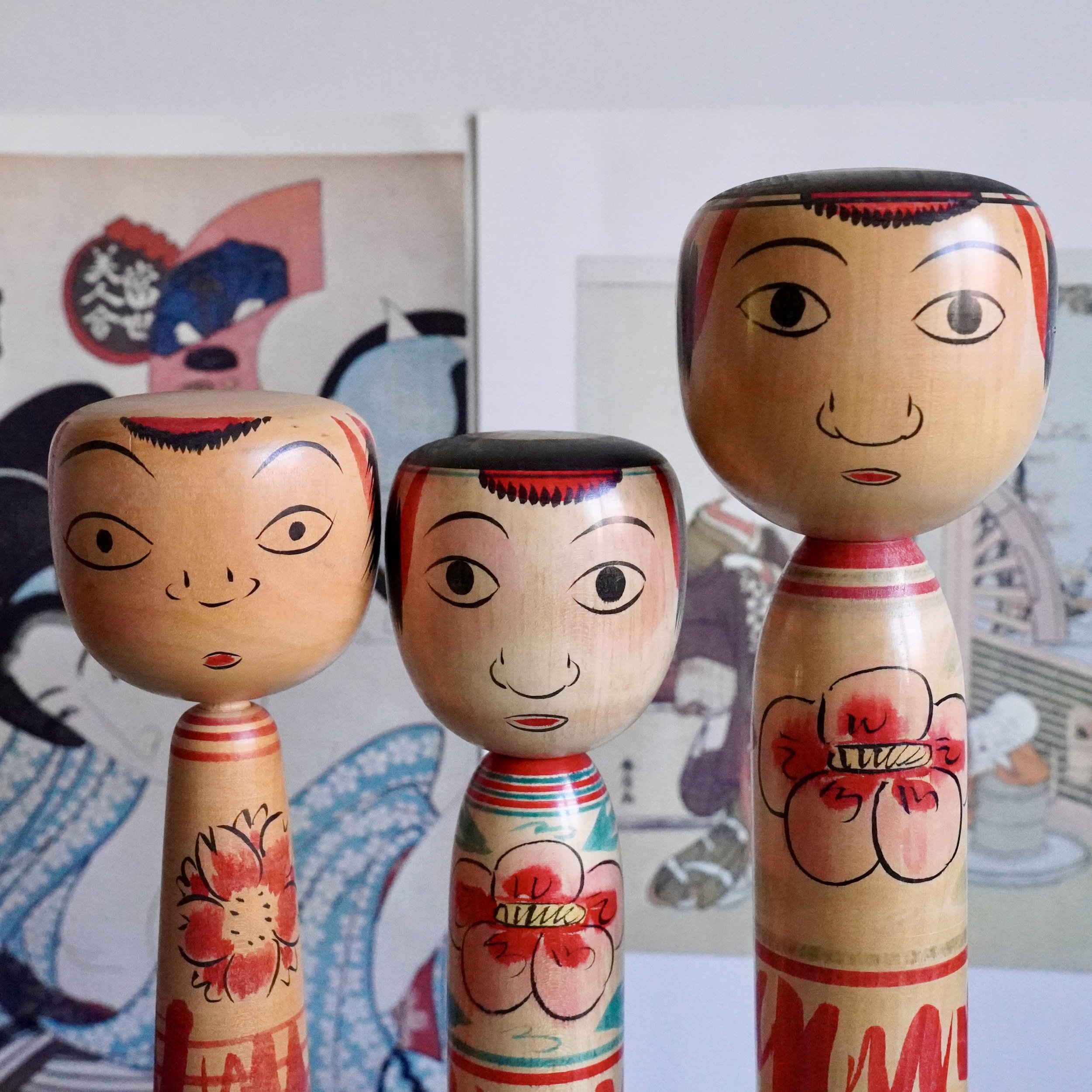
Three faces of the same Nakanosawa story: the same bikkuri-me eyes, the same janome crown, each figure telling the shaved-head Tako Bōzu design a little differently.
At a glance: Wide, startled eyes and a rounded, shaved-looking head, a substrain of Tsuchiyu born from a dancer's stage prop.
History: Nakanosawa split off from Tsuchiyu in the 1920s. A dancer named Iwamoto Zenkichi, working across the mountain pass from Tsuchiyu Onsen, based the design on a papier mâché figure he used in his own performances. The result was odd enough that people nicknamed it Tako Bōzu, octopus monk, after its shaved, rounded head. Zenkichi's son Yoshizō continued the line after his father's early death, and a group of his own apprentices later formalised it as the Taka Bōzu-kei, sometimes called the Zenkichi type.
The head: Large, round, faintly startled bikkuri-me eyes, with a soft blush high on each cheek. Concentric black rings circle the crown, often left unpainted in the very centre, the same janome device seen at Tsuchiyu but drawn bigger and more theatrical.
Charming detail: Saito Tokuju, who apprenticed directly under Iwamoto Yoshizō, spent his working life protecting this exact design rather than putting his own spin on it, and became a central figure within the Takobozu no Kai association formed to keep the style alive.
I have written about this substrain at length. Meet Saito Tokuju here.
Tradition 2: Naruko (鳴子), Miyagi
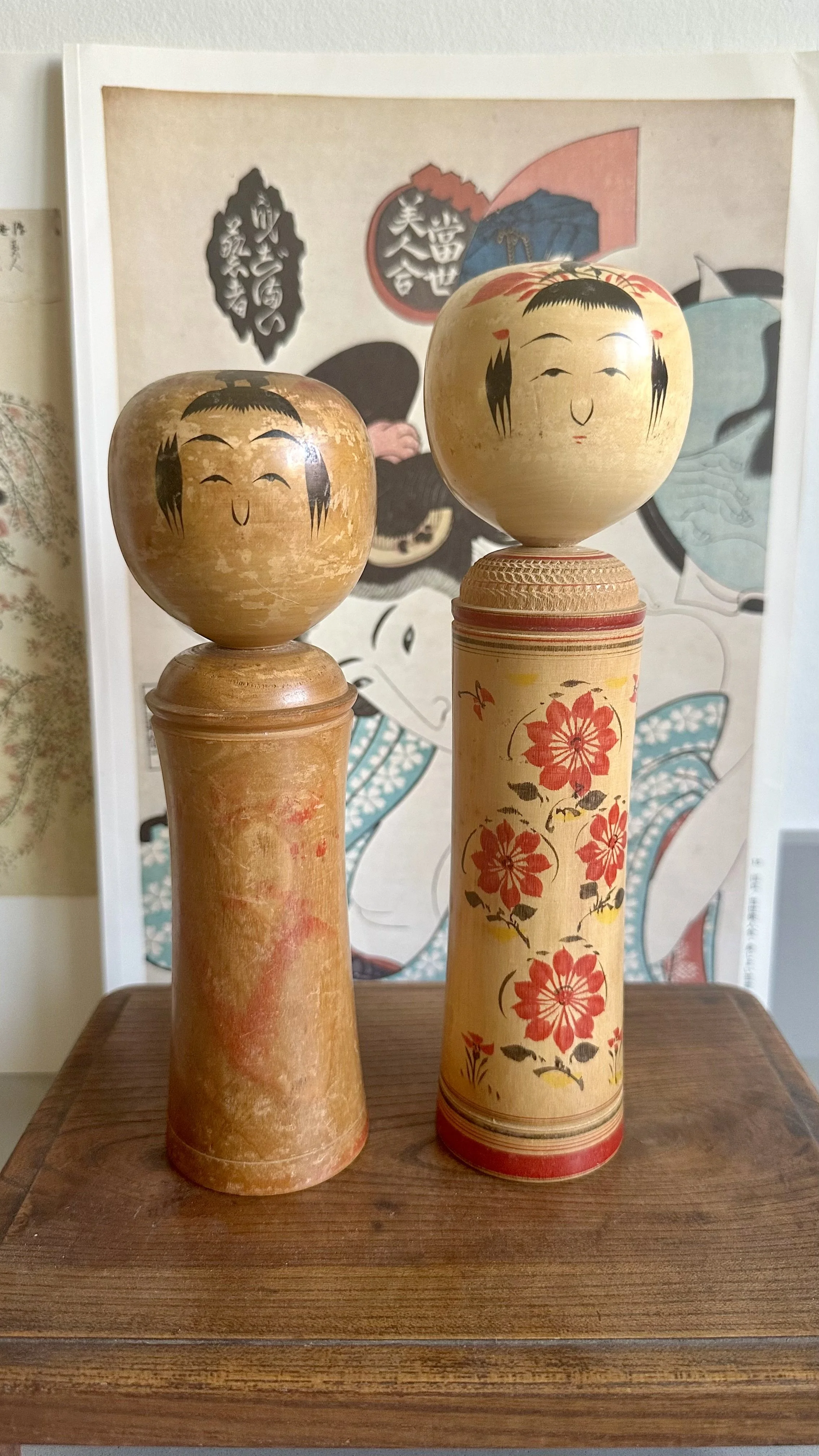
Two Naruko faces from the Sakurai workshop, the mizuhikite lines radiating slightly differently on each, proof that even within one family the hand never repeats itself exactly.
At a glance: Probably the kokeshi most people picture, a full round head with chrysanthemum motifs and a squeak the doll was designed to make.
History: Naruko Onsen is still one of the liveliest kokeshi towns in Japan, home to the Japan Kokeshi Museum, with kokeshi shops lining the main street of the town itself rather than tucked away as a niche craft. More than 120 makers still work in this line today, one of the largest living kokeshi traditions alongside Tōgatta, which means Naruko is also one of the few lines where you can still walk into a working studio and watch a piece being turned on the same kind of lathe used generations ago.
The head: Small red lines called mizuhikite radiate from the crown, sometimes combined with a chrysanthemum motif rather than sitting on their own. A squared side-tuft style known as agemaki or mizura, borrowed from an old aristocratic men's hairstyle, appears on some figures, a small echo of court fashion surviving inside a folk craft. The head is fitted to squeak softly when turned, a mechanical trait built into the joint on purpose rather than a flaw in the fit.
On the body: Chrysanthemum motifs in red and black dominate, painted directly onto the turned wood rather than added afterwards. A seated variant called Nemariko is distinct to this line, its rounder, more compact shape a clear departure from the standing cylinder most people picture. Ginzan, named for a separate hot spring resort not far from Naruko, is a recognised substrain, its style built on a Naruko foundation but carrying real traces of both Hijiori and Zaō Takayu influence, passed down through the family line that shaped it, closer to a blend of three traditions than a simple offshoot.
Charming detail: The turning-head squeak found here developed independently of the same trick at Tsuchiyu, well over a century ago, two separate lineages arriving at more or less the same idea without copying each other, a small coincidence of craft logic rather than shared invention.
I have written about what it means to hand a design down inside one family, across generations. Meet the Sakurai family, one of the oldest kokeshi lines in Naruko: Shōji, who opened the family workshop in 1950, his son Akihiro, fifth generation and still working, and Akihiro's own son Naomichi, sixth generation.
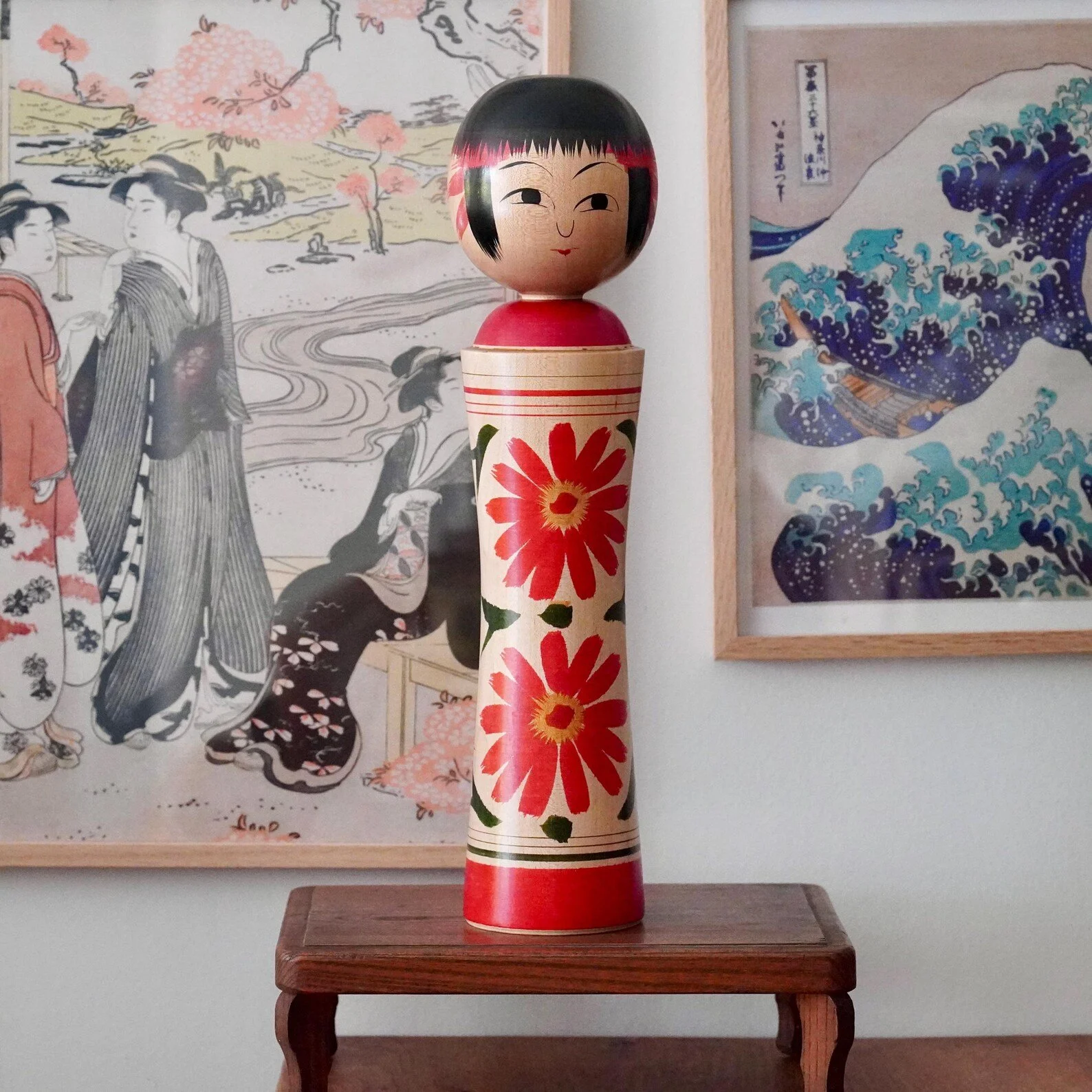
This Ginzan piece by Izu Mamoru carries the large chrysanthemum bloom associated with the style, the same kind of doll a generation of Japanese viewers first saw on television in 1983.
I also have this piece by Izu Mamoru, working in the Ginzan substrain named Oshin. Mamoru largely taught himself the lathe after his older brother, who had trained under it, died young in 1938, and only turned seriously to kokeshi himself decades later, in the late 1960s, after years spent running a restaurant alongside his workshop.
Ginzan kokeshi carry an unexpected claim to fame: when NHK's 1983 television drama Oshin showed its young heroine receiving a Ginzan kokeshi from her mother, the style became known across Japan simply as "Oshin kokeshi," a piece of quiet regional craft turned into a national image almost overnight.
Tradition 3: Tōgatta (遠刈田), Miyagi
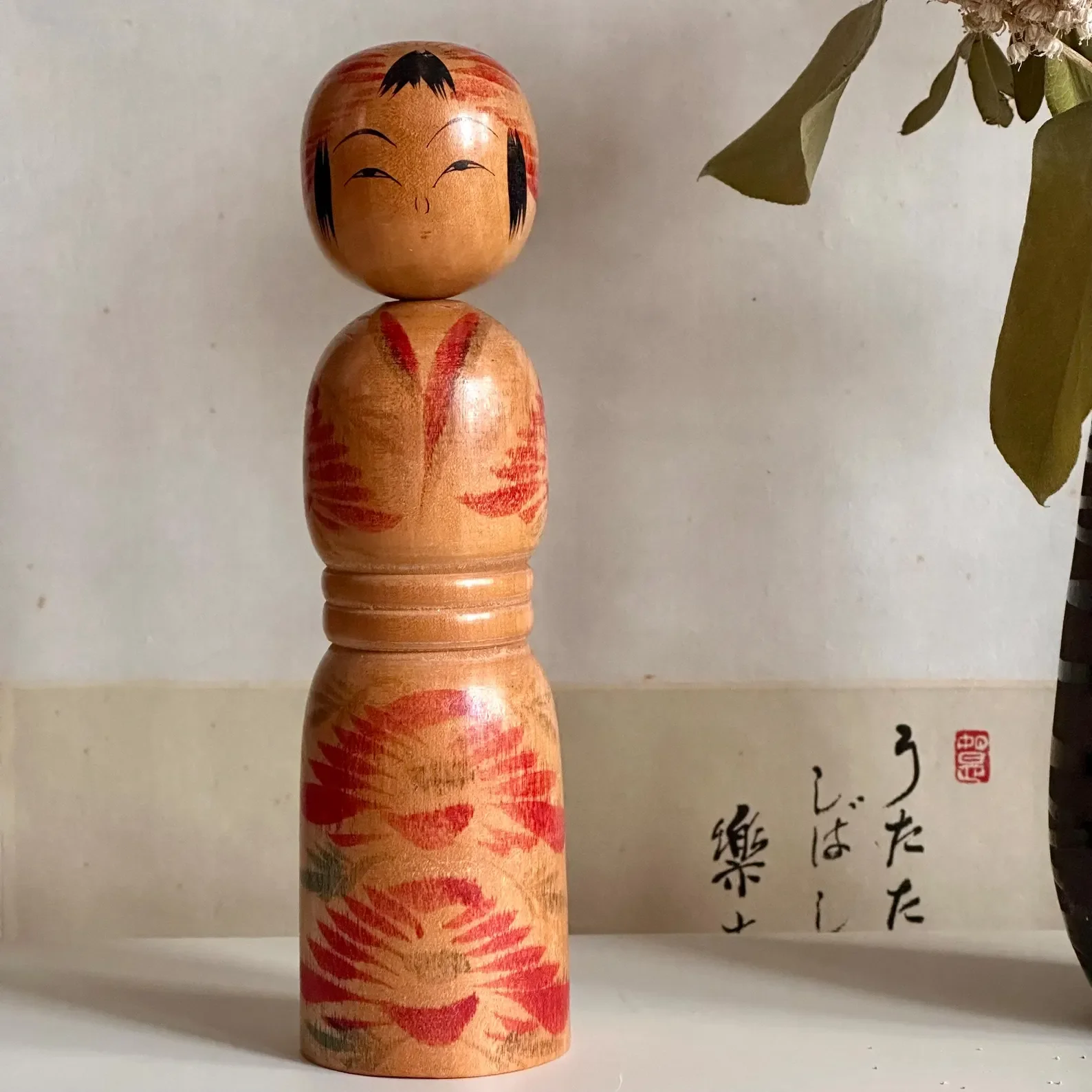
The tegara in close-up: broad red strokes fanning from a solid black centre, the detail that marks a piece as Tōgatta by Agatsuma Satoshi before you have even looked at the body.
At a glance: A red sunburst radiating from the crown, one of the two oldest kokeshi lines still made today.
History: Considered by many to be the oldest of the eleven lineages, alongside Naruko, with roots reaching back to the Aone and Tōgatta hot springs of the Zaō region in Miyagi Prefecture. The line split early into several sub-schools working from the same shared vocabulary of head shape and floral pattern, among them the Aone school, where craftsmen trained under masters who themselves had trained under masters going back generations, a chain of teaching that is part of what makes an authentic Tōgatta piece feel like it belongs to something larger than one maker's hand.
The head: The tegara, a red sunburst radiating from the crown, looks almost like a chrysanthemum flower seen from directly above, built from broad, confident strokes fanning outward from a solid black centre. Triangular eyes and a calm, settled expression are typical, and the head is press-fitted to the body rather than turning and squeaking the way Naruko and Tsuchiyu heads do.
On the body: Six traditional floral patterns are recognised: kasane-giku (layered mums), sakura-kuzushi (simplified cherry blossom), eda-ume (plum branch), kasane-botan (layered peonies), asahi-giku (sunrise mum), and mokume, which uses the visible wood grain itself as the pattern rather than paint. A visible waist, narrower than the shoulders and hips above and below it, is common across the line. Akiu is a recognised substrain within Tōgatta.
Charming detail: Some Tōgatta makers signed their work with more than just a name. Kikuchi Kōtarō, working under the adopted name Akane Kōtarō within the Aone school, sometimes added his age at the time of painting directly onto the base, in kanji, alongside his signature. A piece signed at eighty-four is not just an object, it is a dated record of one specific year in one specific hand. Comparing two pieces by the same maker, painted years apart, the brushwork itself changes: tighter and more precise in his sixties, looser and more assured by his eighties.
Note: I have three Tōgatta makers in the collection:
Agatsuma Satoshi, whose iris-motif piece carries the tegara crown and layered floral body typical of the line.
Kikuchi Kōtarō, who trained from the age of thirteen under Aone school master Obara Naoji and kept working well into his nineties, signing under the name Akane Kōtarō after being adopted into the Akane family.
And Satō Fumio, trained under Satō Bunsuke within the Tōgatta line but also the son of Satō Ushizō, whose own style is linked to the Hijiori lineage, a maker reference sources describe as caught between the two influences his whole working life. He became especially known for reconstructing his father's Ushizō-style pieces later in his career, and the piece I have, carrying a single large kotobuki character rather than a floral motif, is exactly that kind of work: a Tōgatta-trained hand working in a form pulled from the other side of his own history.
Tradition 4: Yajirō (弥次郎), Miyagi
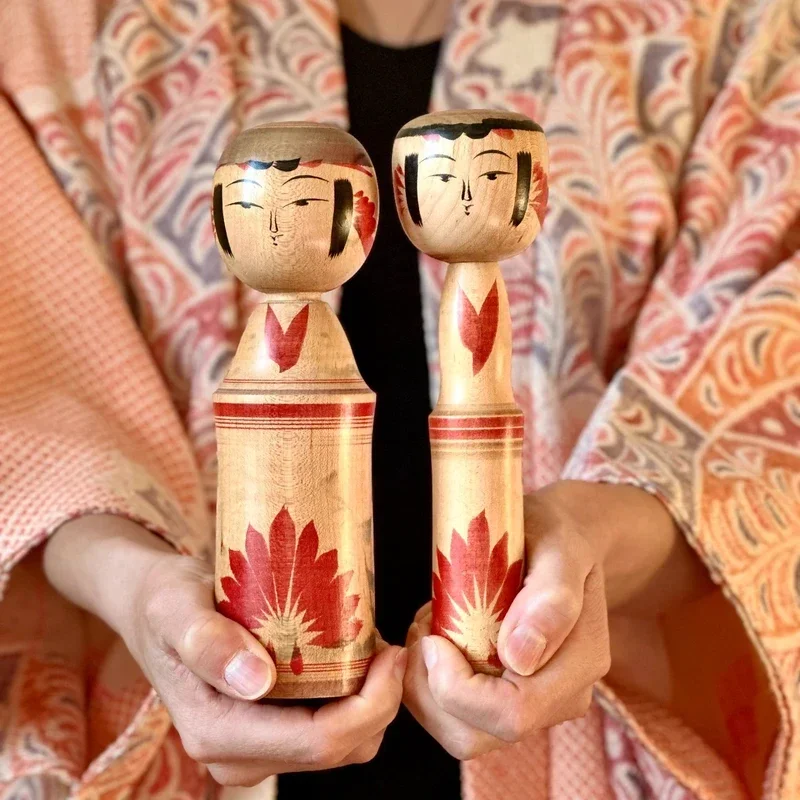
A signed pair by Inoue Harumi, the beret-like rings circling each crown and the loose, cheerful kimono lines exactly the brightness Yajirō became known for at the hot spring.
At a glance: Bright, ring-banded and cheerful, born to please hot spring visitors along the Matsukawa river.
History: Yajirō developed near the Kamasaki hot spring, on the Matsukawa river, a spring with roots dating back to 1428. Local tradition holds that the Tōgatta tradition, already well established by the time Yajirō emerged, directly influenced the makers here, making Yajirō the third line to branch off after Tōgatta and Naruko among the eleven. Visitor demand at the spring pushed makers toward brighter, more decorative work than some of the older, quieter traditions, a style shaped as much by what tourists wanted to bring home as by any single founding maker. Yajirō is really an umbrella for four related local variants, Atsushio, Onogawa, Iizaka and Iwaki, each shaped a little differently depending on exactly which spring town produced it, so two pieces both labelled Yajirō can look meaningfully different from each other.
The head: Multicoloured rings circle the crown like a beret, in black or several colours at once, sometimes finished with a cone-shaped suge-gasa hat instead of paint. Scalloped bangs and a rounded or slightly blocky head shape are typical.
On the body: Kimono lines are drawn bold and loose, the whole doll reading as cheerful rather than solemn, closer in spirit to a souvenir bought in high spirits than a formal, ceremonial object. A visibly narrowed waist or carved shoulder line often gives the body more shape than the straighter cylinders found elsewhere.
Yajirō is really an umbrella for four related local variants, Atsushio, Onogawa, Iizaka and Iwaki, each shaped a little differently depending on exactly which spring town produced it, so two pieces both labelled Yajirō can look meaningfully different from each other.
I have this signed pair by Inoue Harumi listed here in the collection. A female kokeshi maker who learned the Yajirō style from her own mother, one line of a family sensibility passed down rather than a copied template.
Tradition 5: Sakunami (作並), Miyagi
At a glance: Slim enough for a child's hand, often with a crab-shaped chrysanthemum or other flower motifs and a history recently rewritten.
History: Production is traced to Aoba Ward in what is now Sendai, in the Meiji period. For years the line was assumed to be a younger offshoot of Yamagata, founded by makers who had trained there. Genealogical research has since turned that assumption around: Sakunami is now considered the older of the two lines, the one Yamagata itself grew out of, not the other way round. The style nearly disappeared entirely at one point. It was reintroduced by Hiraga Kenzō and Kobayashi Shōji, both trained under Kobayashi Shōkichi, a rescue that means every Sakunami piece made today carries a line back through a near break in the tradition rather than an unbroken one.
The head: Disproportionately large against the slim body beneath it, a deliberate imbalance rather than an error in proportion.
On the body: The signature motif is kani-kiku, crab chrysanthemum, a stylised chrysanthemum whose petals are said to resemble a crab's claws when painted in the traditional manner. Made only in mizuki, a pale, fine-grained dogwood chosen for how cleanly it takes the lathe.
Charming detail: The narrow, tapering body was built this way on purpose so a small child could hold it easily, a practical origin for a shape collectors now value for its elegance rather than its original function.
Tradition 6: Yamagata (山形), Yamagata
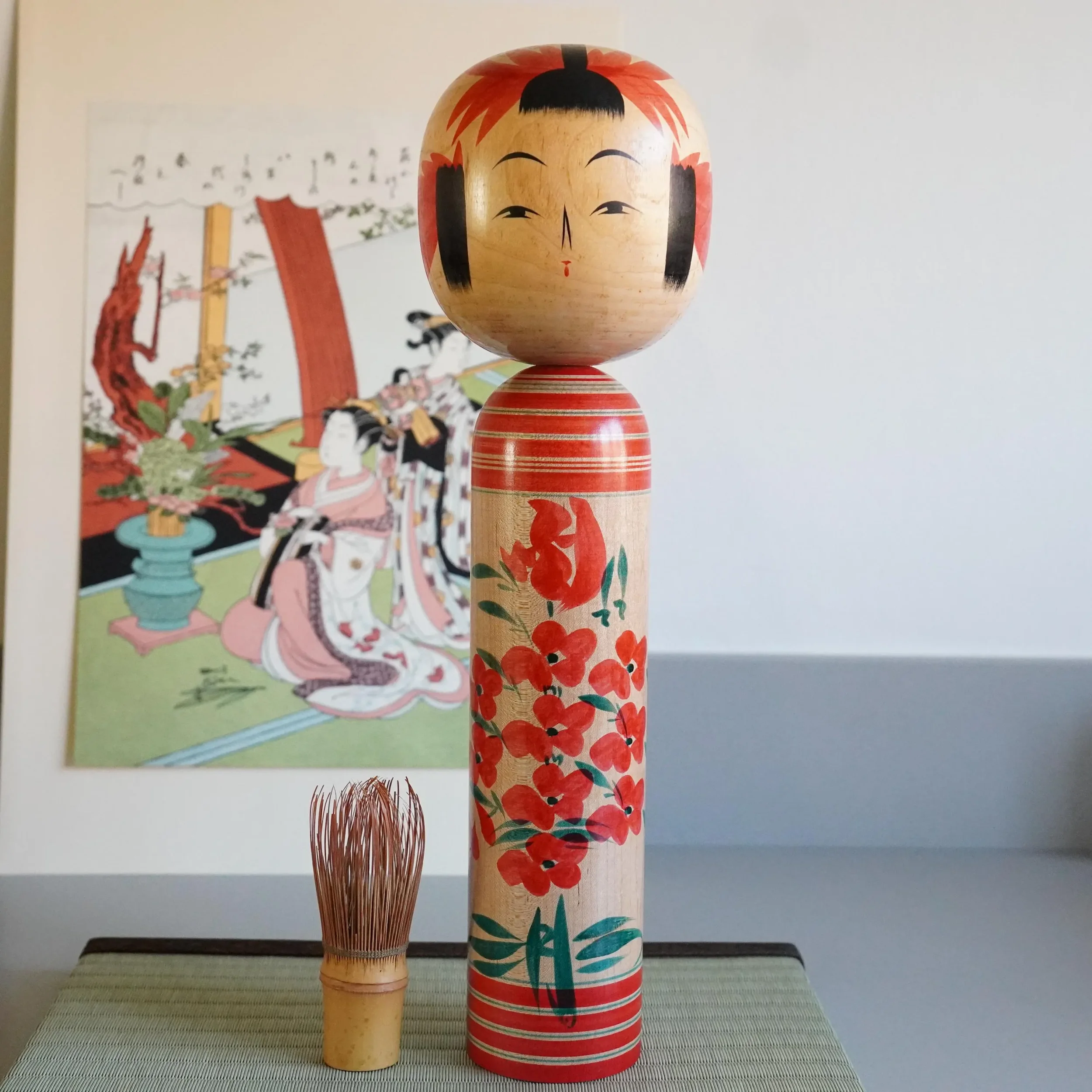
Takasaki Eiichirō's chrysanthemum work at 37cm, more presence on a shelf than the slender Sakunami bodies this line grew out of.
At a glance: Narrow-bodied and small-headed, the Sakunami offshoot that grew into its own city tradition.
History: The line is credited to Kobayashi Kuraji, who is said to have spent roughly eight years studying woodworking in Sakunami under Iwamatsu Naosuke before returning to Yamagata city to establish his own workshop. Unusually for a dentō style, it developed in the city itself rather than in a hot spring town, a line born out of an artisan's training and independence rather than tourist demand at a spa.
The head: A distinctive crab-like chrysanthemum pattern called kanibana appears on some figures, alongside a long single strand of hair crossing the crown, a detail small enough to miss unless you are looking for it.
On the body: Decorated with plum blossom, cherry blossom or chrysanthemum, and sometimes with safflower, the official flower of Yamagata Prefecture, a regional detail that ties the doll directly to the place it comes from. Narrow-bodied and small-headed compared to its Sakunami parent. Hats, when present, are considered a rarity in this line and historically associated mainly with the work of Kobayashi Seijirō and Kobayashi Kiyoshi.
I have this large Yamagata piece by Takasaki Eiichirō in the collection, its chrysanthemum motif and 37cm height a good example of how substantial this line can read on a shelf, closer in presence to Tōgatta or Zaō than the slender, child-sized bodies of its Sakunami origins.
Tradition 7: Hijiori (肘折), Yamagata
At a glance: Crescent-moon eyes and a sleepy calm, one of the rarest traditions still being made.
History: Named for Hijiori Onsen, the line is said to have been started by Kakizaki Denzō, who first trained in Naruko before returning home to found his own line, folding what he had learned there into something distinct. He was later joined by an apprentice, Inoue Tōgorō, who had separately trained in Tōgatta and brought those techniques back with him, so the Hijiori style carries visible traces of both of the older Miyagi traditions inside a Yamagata line.
The head: Crescent-moon eyes, drawn as a single curved line rather than a fuller shape, give the face a calm, almost sleepy expression unlike anywhere else on this list. Squared-off shoulders sit beneath a head that reads gentler than its Naruko or Tōgatta relatives.
On the body: Most often painted yellow with chrysanthemum motifs, a colour choice that sets it apart at a glance from the red-dominant palettes of most other lines.
Charming detail: It is one of the rarest traditions still practised today, with very few makers continuing it, which means a genuine Hijiori piece is as much a statement about scarcity as it is about style.
Tradition 8: Zaō-Takayu (蔵王高湯), Yamagata
At a glance: Thicker-bodied and pastel-toned, born from Tōgatta at the foot of a volcano.
History: Named for hot spring settlements at the foot of Mount Zaō, an 1841 metre active volcano straddling the border of Yamagata and Miyagi. The line developed directly out of Tōgatta from around the 1890s, close enough in origin that the family resemblance is unmistakable, but the makers who settled here pushed the proportions and palette in their own direction over time.
The head: Visibly related to Tōgatta in its large head and confident, stylised patterns, the tegara crown decoration carried over from its parent tradition.
On the body: The body reads thicker and more square-shouldered than a Tōgatta piece, the palette often softer and more pastel rather than the saturated reds typical of its parent line. A doll built for presence on a shelf rather than for a child's hand.
Charming detail: Atsumi is a substrain within Zaō credited to Abe Tsunematsu, who blended in Tsuchiyu and Yamagata influences distinct enough to be treated almost as its own line: thicker bodies, a tapered top, and a droopy tarebana nose rather than the round or split noses more typical of core Zaō pieces, a maker visibly borrowing across three traditions at once.
Tradition 9: Kijiyama (木地山), Akita
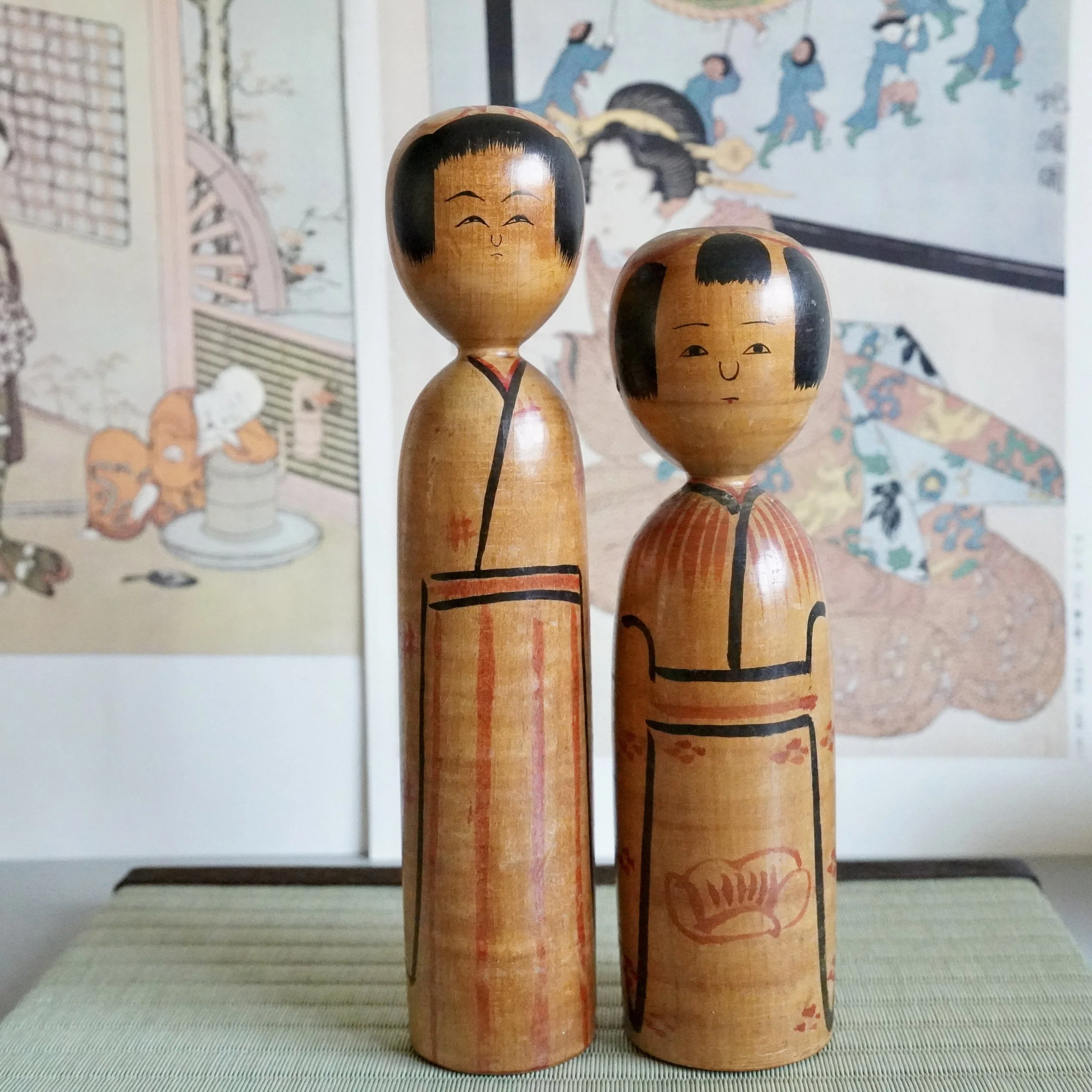
Two Kijiyama makers side by side, the same elongated, gently rounded head shape, one striped kimono against one plainer robe, restraint expressed two different ways.
At a glance: Restrained almost to bareness, letting the wood grain do most of the talking.
History: The most restrained of the eleven traditions, and deliberately so. The line traces to the Ogura family, who migrated into this part of Akita in the late 1800s, working in a region of such heavy winter snowfall that Kijiyama itself became inaccessible for months at a time, many families later resettling in the more reachable area of Kawazura, now part of Inagawa-machi. Yuzawa is a recognised substrain within Kijiyama.
The head: An elongated, gently rounded head, sometimes described as an inverted egg shape, is typical. Hair is usually a full bobbed style, shingled at the back, though older pieces sometimes carry a single tuft above the nape in a Meiji-period style, or bangs finished with a small dragonfly-shaped bow. Eyes are often shut or half closed (tsubushi-me), giving many Kijiyama faces a quiet, inward expression, and blush on the cheeks is unusual on this line, one notable exception being Satō Tatsuo, whose circular blush was his own deliberate departure, inspired by the woodblock prints of Shūzō Ikeda rather than any Kijiyama convention.
On the body: A long, simple, rustic body with minimal decoration, the natural grain of the wood often left to carry the visual weight rather than paint, though the kimono-like striped and floral patterns seen today are a relatively recent development, thought to be only around sixty years old. Chrysanthemum and iris tend to appear on the front of the body, plum blossom more often on the back, a small compositional logic worth looking for. Peonies, apple blossom and bellflower motifs are rarer. Some pieces also carry a kite motif known as managu-dako, worked into the kimono design. The body is built from one continuous piece, though older, rarer examples were made in two, joined with a small wooden peg, and a nested variant exists alongside the standard standing form.
Charming detail: Some Kijiyama makers became known less for their own designs than for bringing extinct patterns back to life. Abe Heishirō spent decades reconstructing the Taiichirō and Yonekichi styles, both long out of production, the second built entirely from months of studying a single original piece a collector sent him. It is a pattern that echoes across several dentō lines: a maker's deepest work sometimes being not invention, but faithful return.
I have this pair of Kijiyama makers in the collection:
Ogura Kyūtarō, whose signature carries the place name Akita-shi Asahiyama alongside his own, trained by his father Ogura Kyūshirō
Abe Heishirō, trained under Takahashi Hyōjirō, whose later work reviving the Taiichirō and Yonekichi patterns became the work he is remembered for.
Tradition 10: Nanbu (南部), Iwate
At a glance: Once left entirely unpainted, with a head that rattles rather than squeaks.
History: Also known by the town name Hanamaki, the line descends from an earlier, simpler form called Kina Kina. The earliest Nanbu kokeshi were plain, unfinished wood, with no painted decoration at all, made explicitly as teething toys and rattles for small children rather than as display pieces for adults, a genuinely different original purpose from every other tradition on this list.
The head: Loosely fitted rather than fixed, so the doll rattles like an infant's toy when shaken, the head simply pegged into the body rather than turning and squeaking the way Naruko and Tsuchiyu heads famously do.
On the body: Later makers gradually introduced modest painted decoration, but the tradition never fully lost its original, stripped-back character, and even decorated Nanbu pieces tend to look sparer than their counterparts from other regions.
Charming detail: A genuine Nanbu piece is, in a sense, the closest thing on this list to what a kokeshi was before it became a collector's object at all: a toy, meant to be shaken, not admired from a shelf.
Tradition 11: Tsugaru (津軽), Aomori
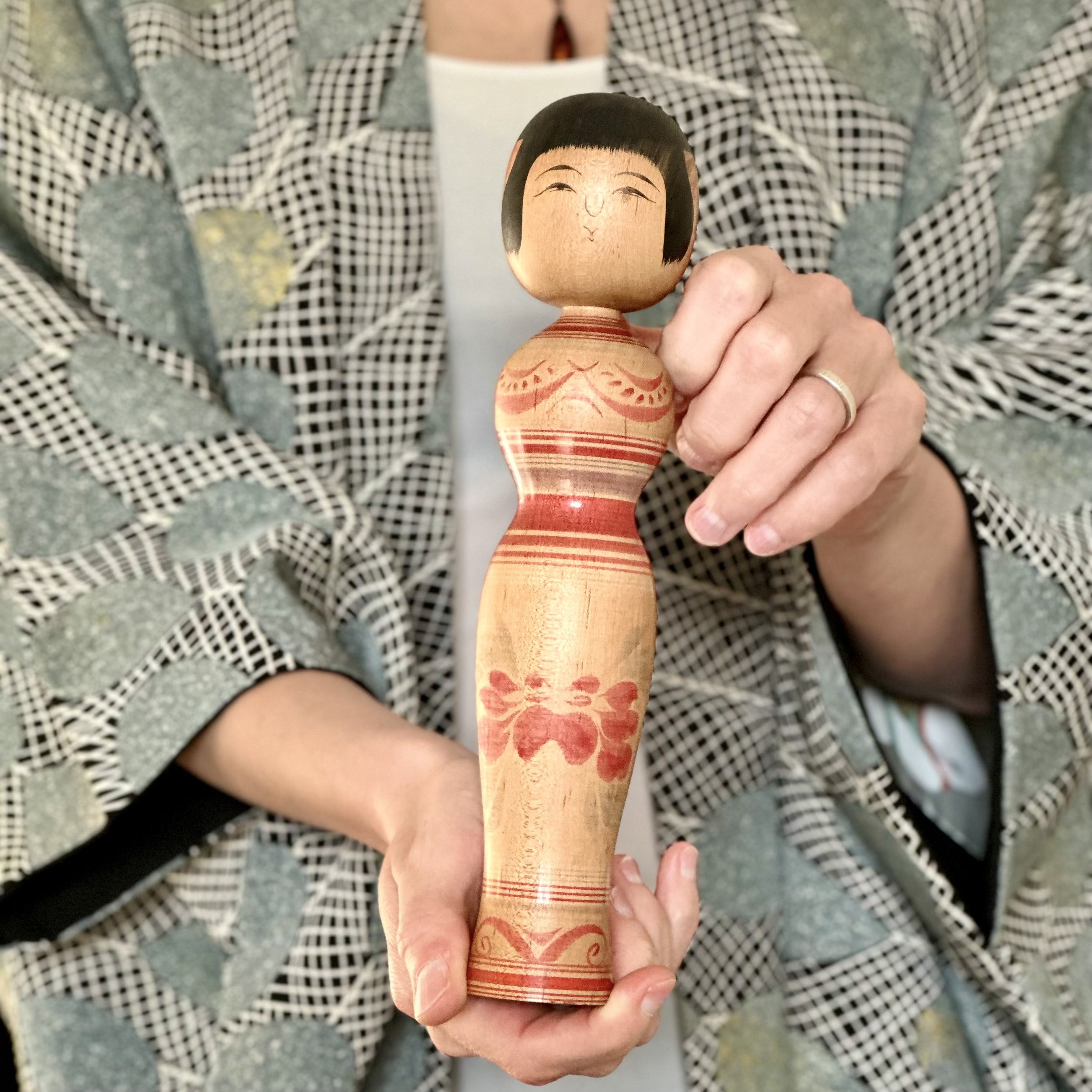
Sasamori Junichi's peony, the crest of the Tsugaru clan itself, painted with the loose, painterly hand that makes this line easiest to mistake for sōsaku.
At a glance: A waspy waist and an Ainu-inspired pattern, the youngest and freest-handed of the eleven.
History: The youngest of the eleven recognised traditions, only reaching back to the 1920s, and it shows: Tsugaru developed once adults, rather than children, became the main buyers of kokeshi as souvenirs from hot spring resorts, which freed makers from the toy-shaped constraints that had governed the older lines. Associated with Kuroishi City and the Nuruyu ("lukewarm") hot spring, with Mori Hidetarō credited as founder, working under the name Morihide. His son, Mori Shōichi, continued and refined the style. Tsugaru is also the only one of the eleven traditions still made using a genuinely difficult reverse-lathe carving technique, a demanding method every other line has largely set aside.
The head: Made from a single piece of wood, head and body together, with no separate joinery, unusual among the eleven traditions. The face is often strikingly painterly for a dentō doll, sometimes carrying the face of Daruma painted across the lower body instead of a conventional kokeshi face, a substitution unique to this line.
On the body: Decorated with a noticeably freer, more painterly hand than most other traditions: peonies, camellia, iris, cherry blossom, and sometimes Nebuta festival motifs echoing the region's famous summer lantern parade. The peony in particular carries weight here, it is the crest of the Tsugaru clan itself, not just a decorative flower. Rokuro-moyo, varied-width banding painted while the wood turns on the lathe, often appears at the top, centre or base of the body. The body has a distinctive waspy waist rather than a straight cylinder, and the most identifiable motif of all is a pattern inspired by the Ainu, the indigenous people of northern Japan, circling the upper torso and sometimes the head, in place of a Daruma face on some pieces. The style sits closest to sōsaku in feel, which is part of why it is occasionally mistaken for creative work rather than dentō.
Charming detail: A small rebellion lives in some Tsugaru signatures. Mori Hidetarō sometimes painted a pair of tiny feet at the base of his dolls beneath his signature, something no kokeshi tradition otherwise does, since kokeshi are, by definition, dolls without arms or legs. His student Satō Zenji later adopted the same touch on his own Daruma pieces, a private joke passed from teacher to student and considered mildly rebellious within a tradition built on family conformity.
I have three Tsugaru makers in the collection.
Seiju Kon, whose figures work in this tradition while carrying his own recurring subjects, Noh theatre and Heian-period noblewomen travelling in disguise, Meet Seiju Kon here. Meet his kokeshi here.
Sasamori Junichi, born 1954, working in the Nuruyu style, whose large brushed peony carries the crest of the Tsugaru clan itself onto the body of the doll.
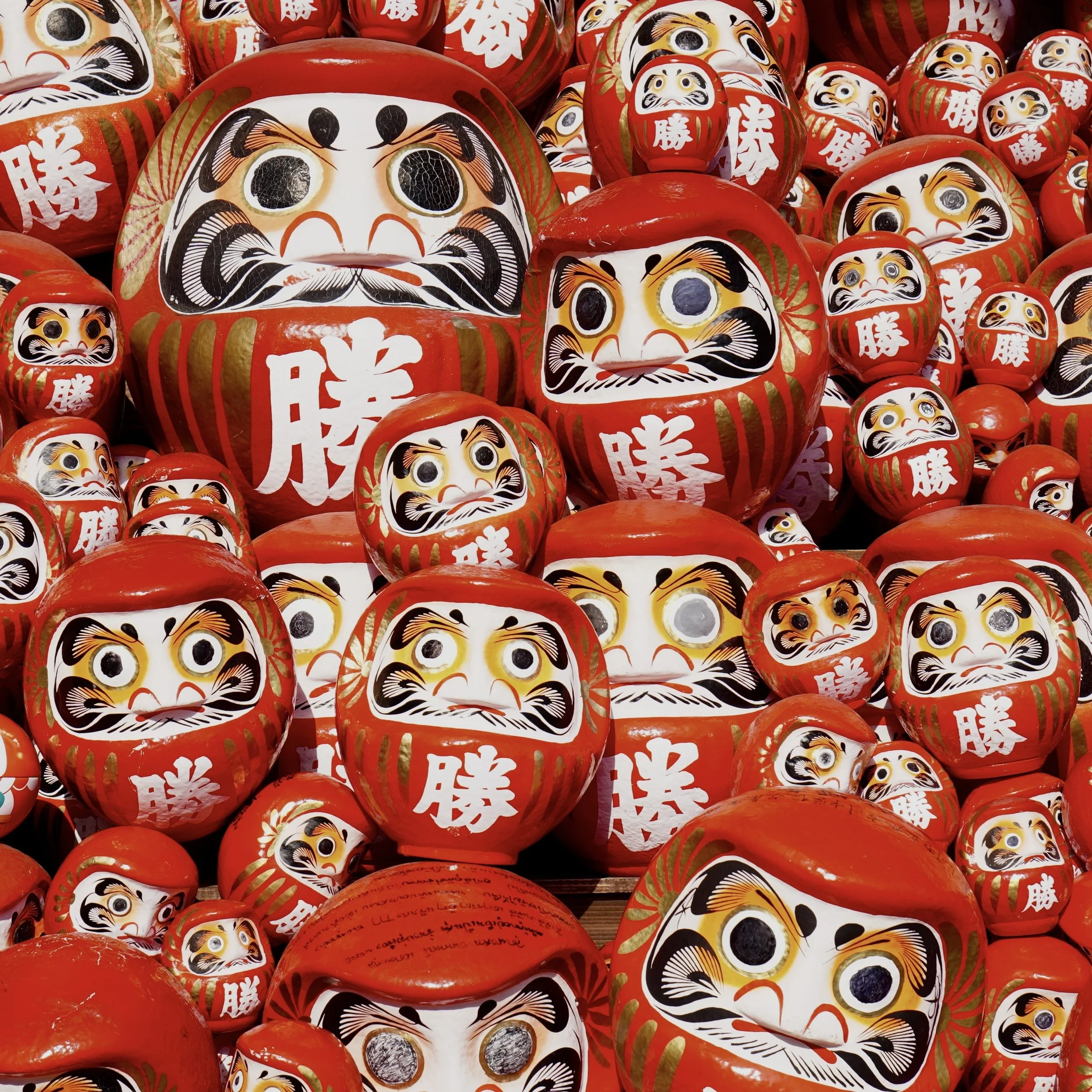
And Satō Zenji, the craftsman who trained under Nuruyu founder Mori Hidetarō and later adopted his teacher's habit of painting tiny feet beneath his signature, seen here on a daruma pair rather than a kokeshi.
What is dentō, and how is it different from sōsaku?
Everything above is dentō kokeshi, shapes and patterns handed down within a family or region, sometimes for well over a century. Sōsaku kokeshi is the newer, freer tradition that broke away from all of this after the war, individual artists signing their own original designs rather than working within an inherited house style. I go into that split in more depth, with a trip through Fukushima along the way, in this journal piece.
Read more
Journal: Curious how kokeshi makers actually work the wood itself, the grain, the burn marks, the carving? I wrote about the techniques behind it.
Care guide: Bringing a kokeshi home, dentō or sōsaku? The kokeshi care guide covers what every one of them needs.
Makers: Curious about the specific hands behind pieces like these? Meet the makers currently in the collection.
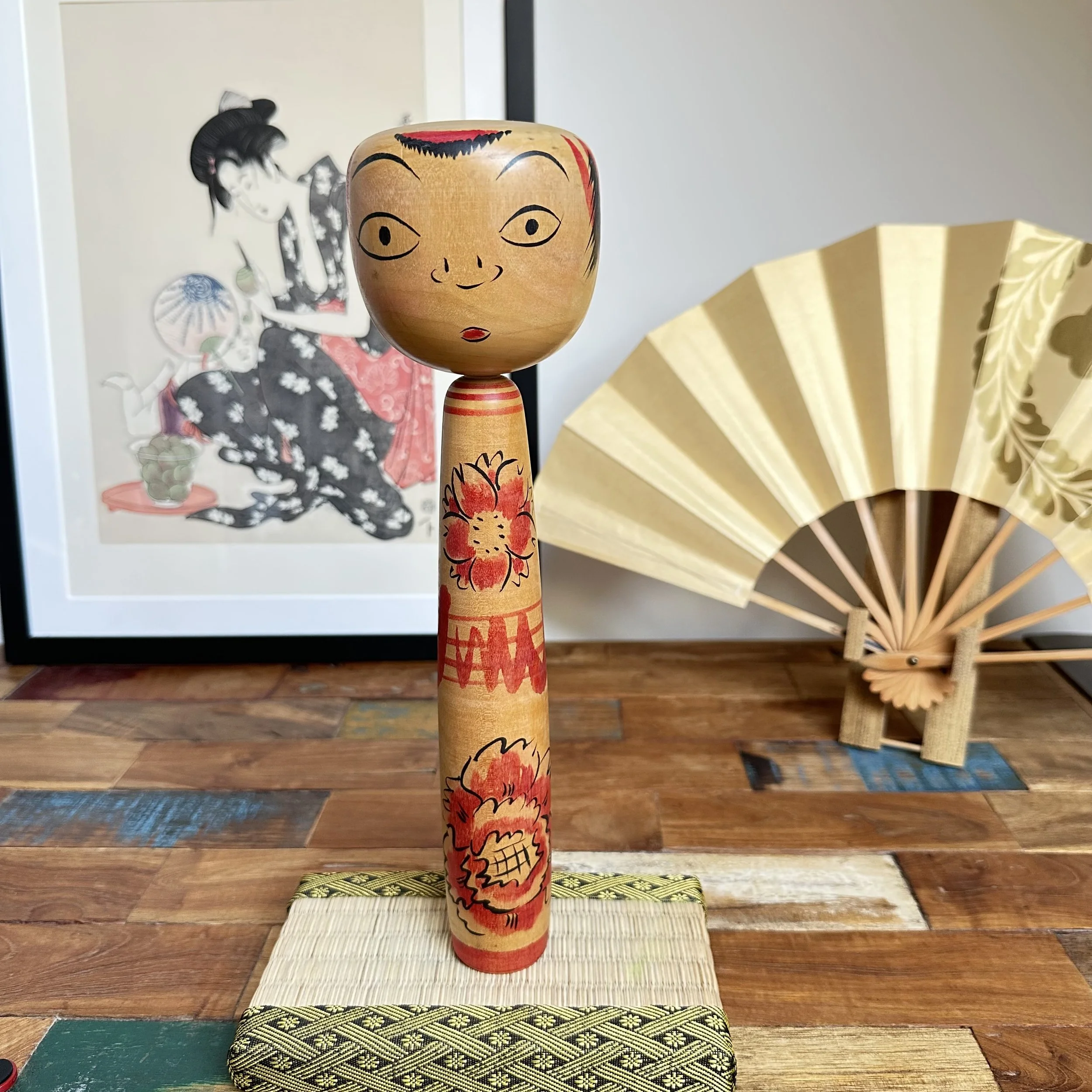
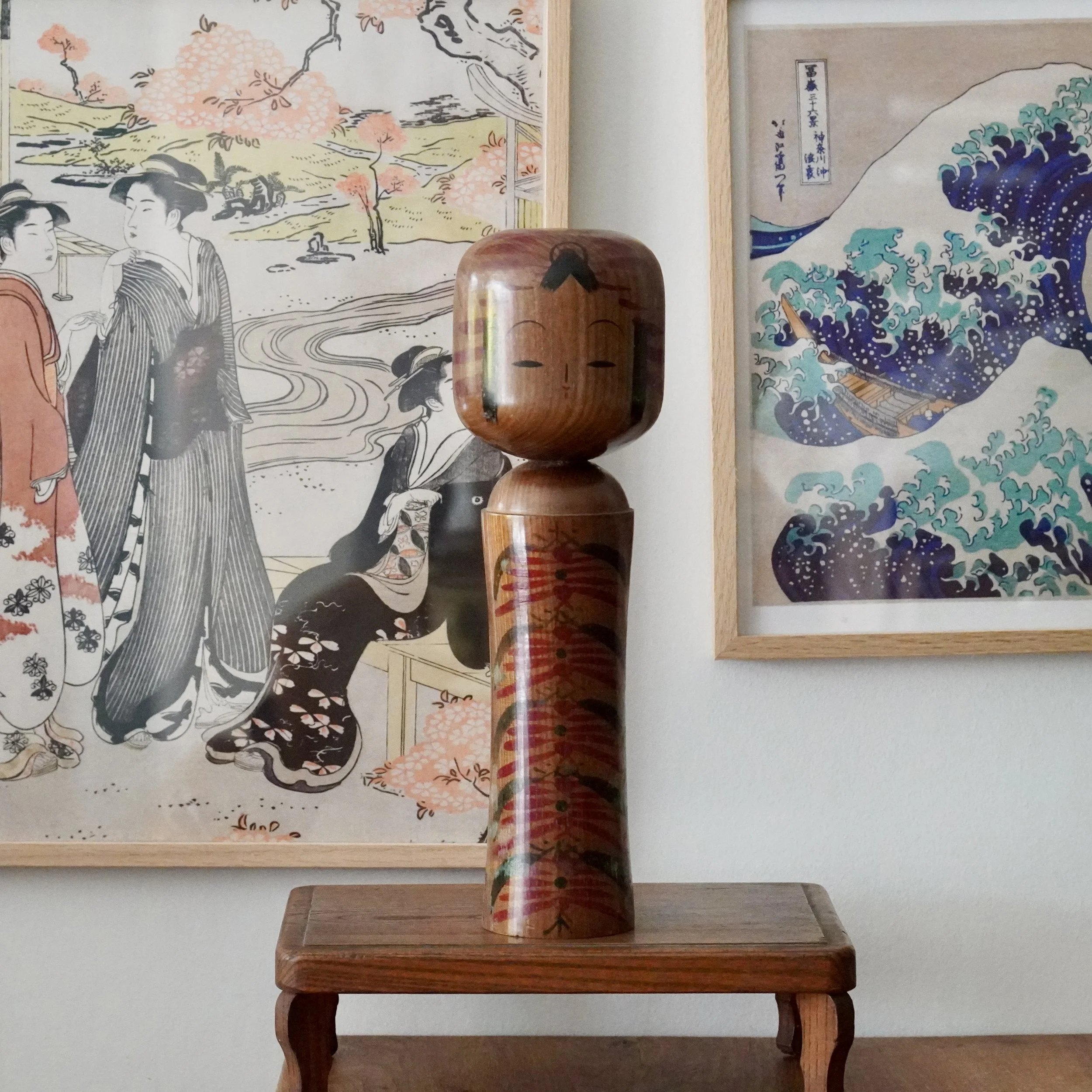
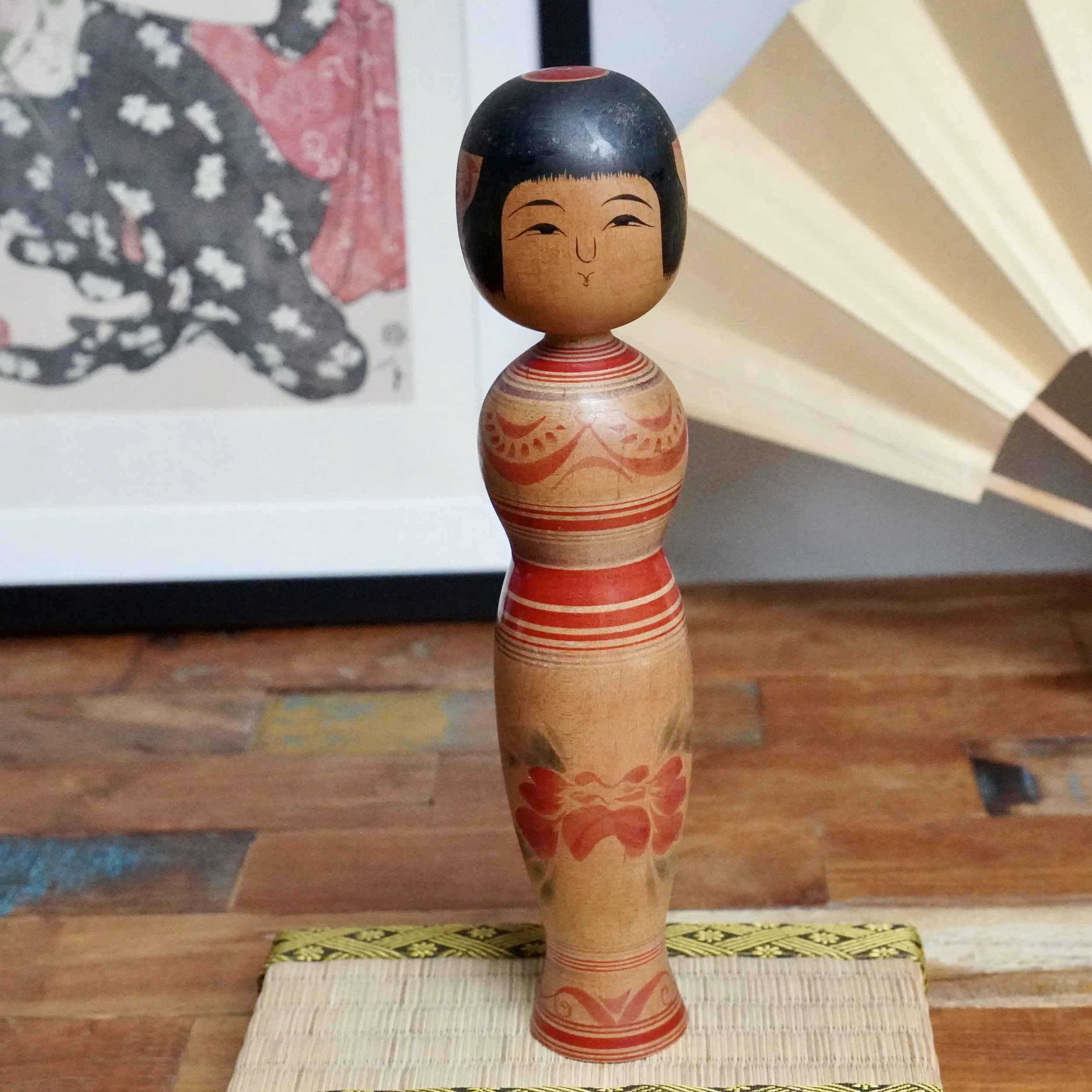
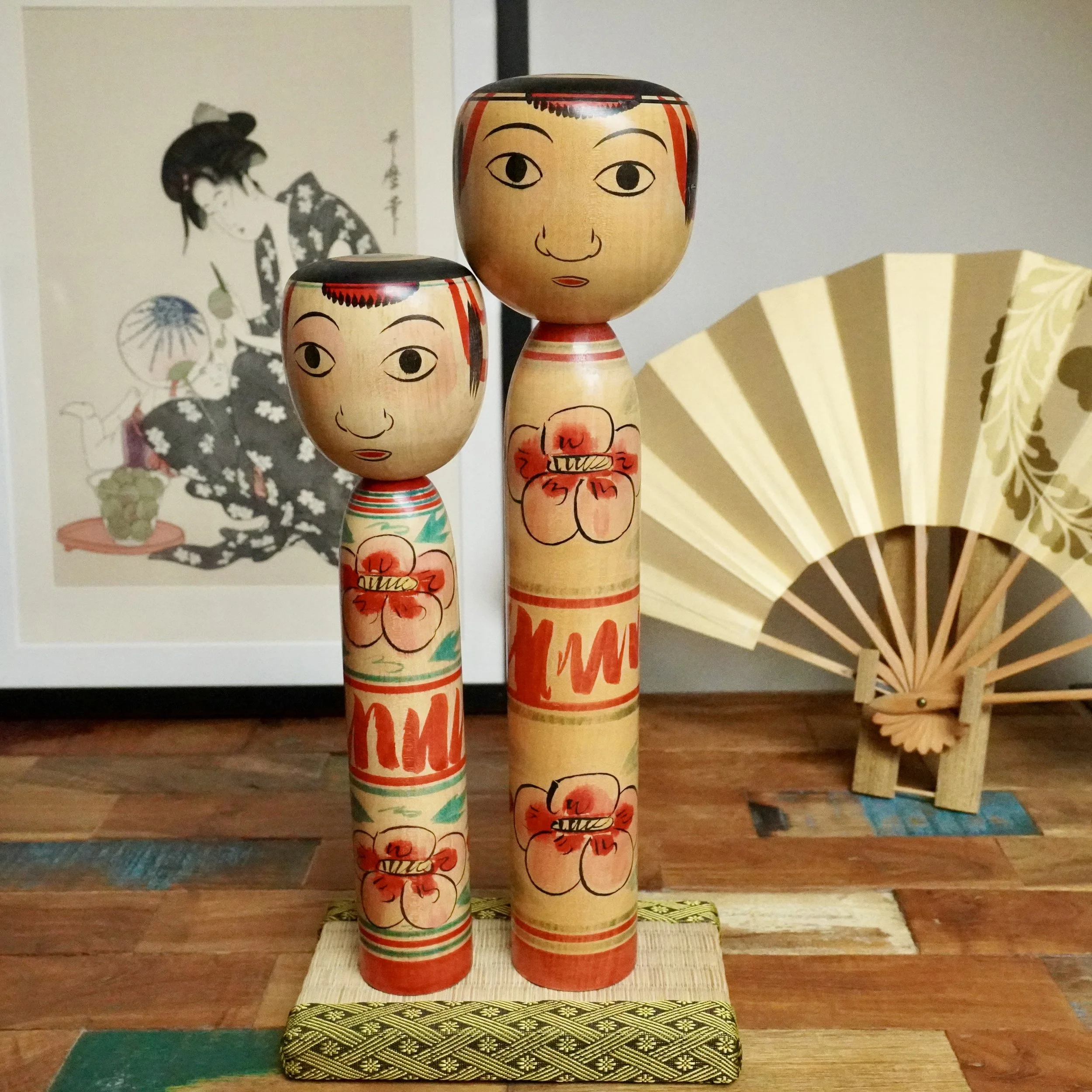
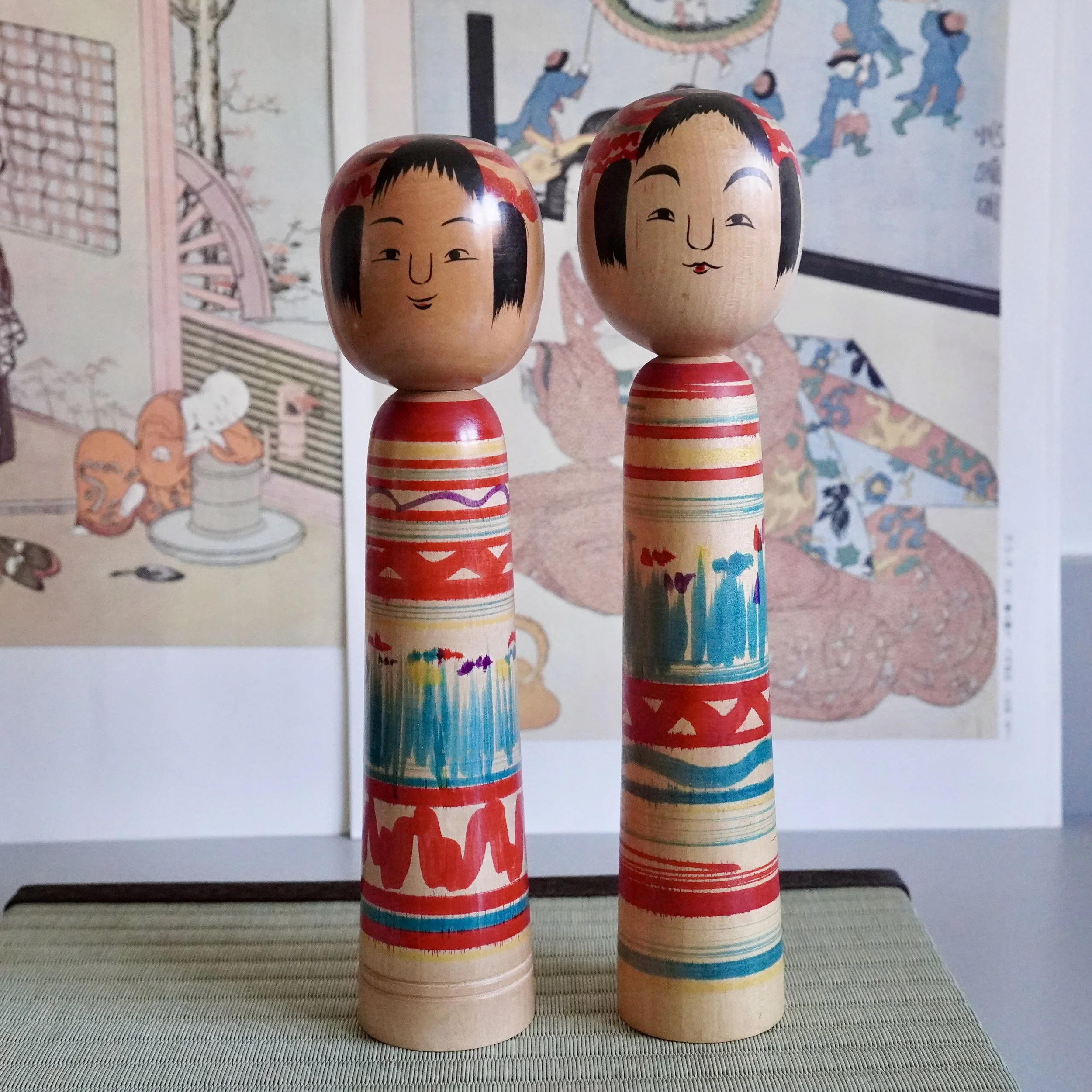
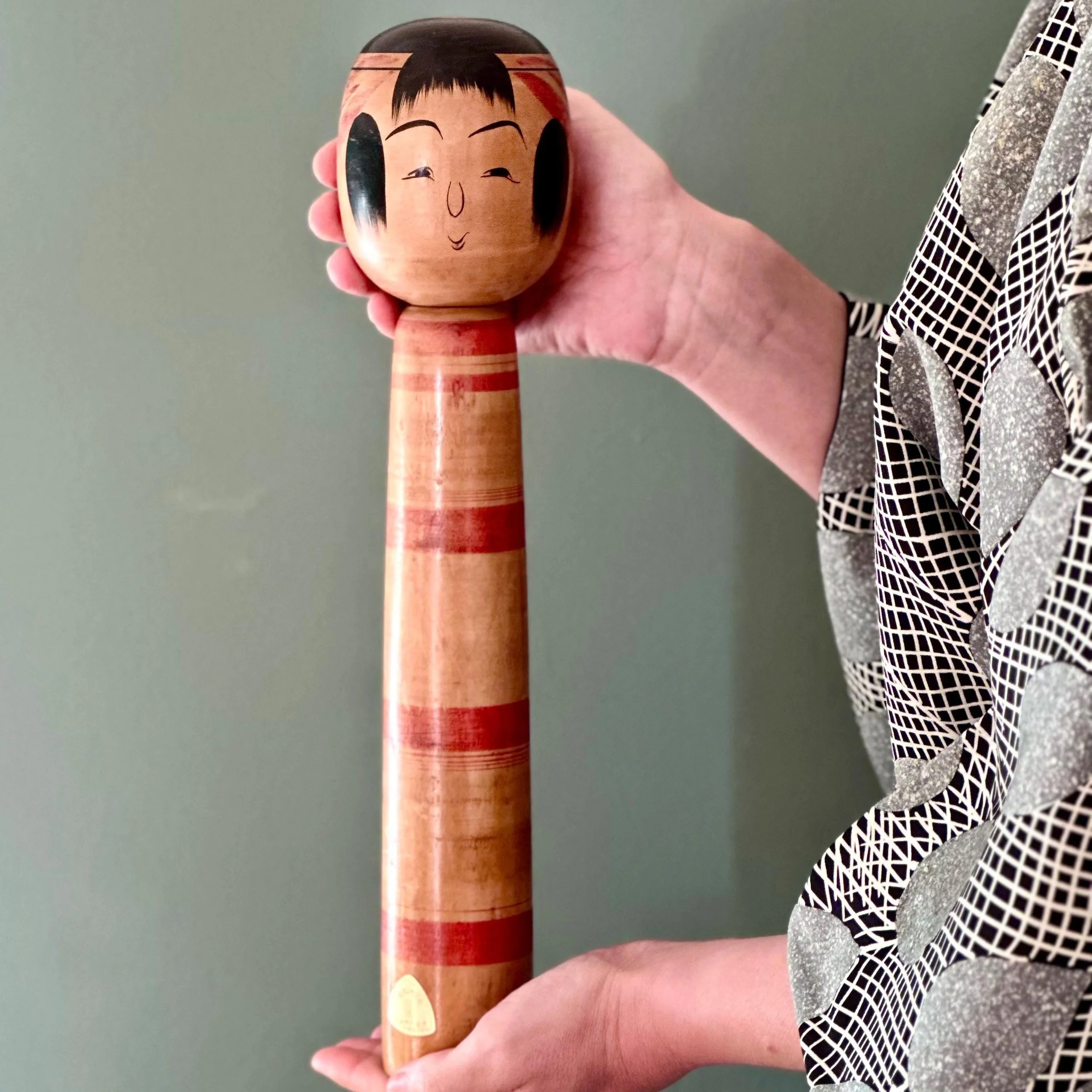
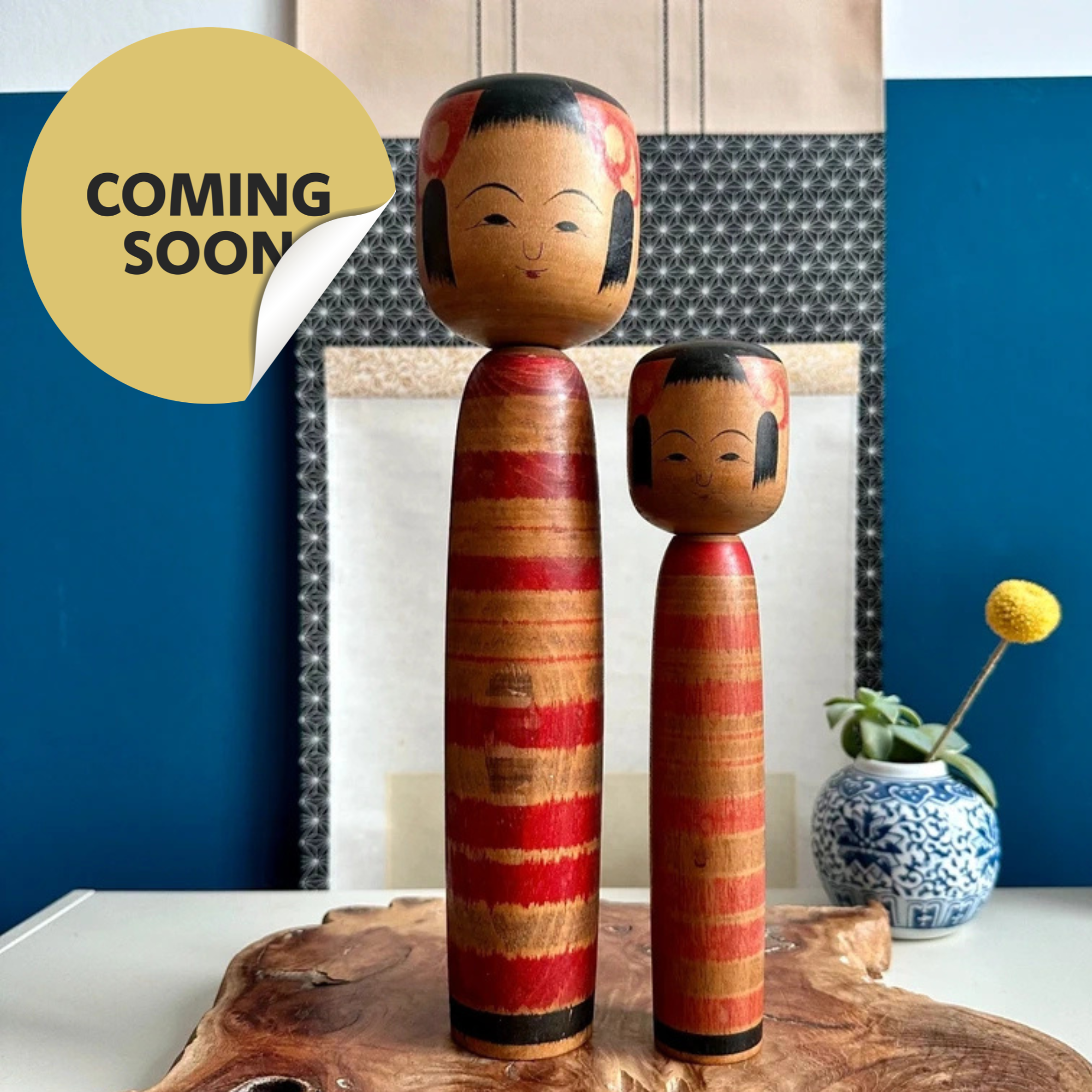
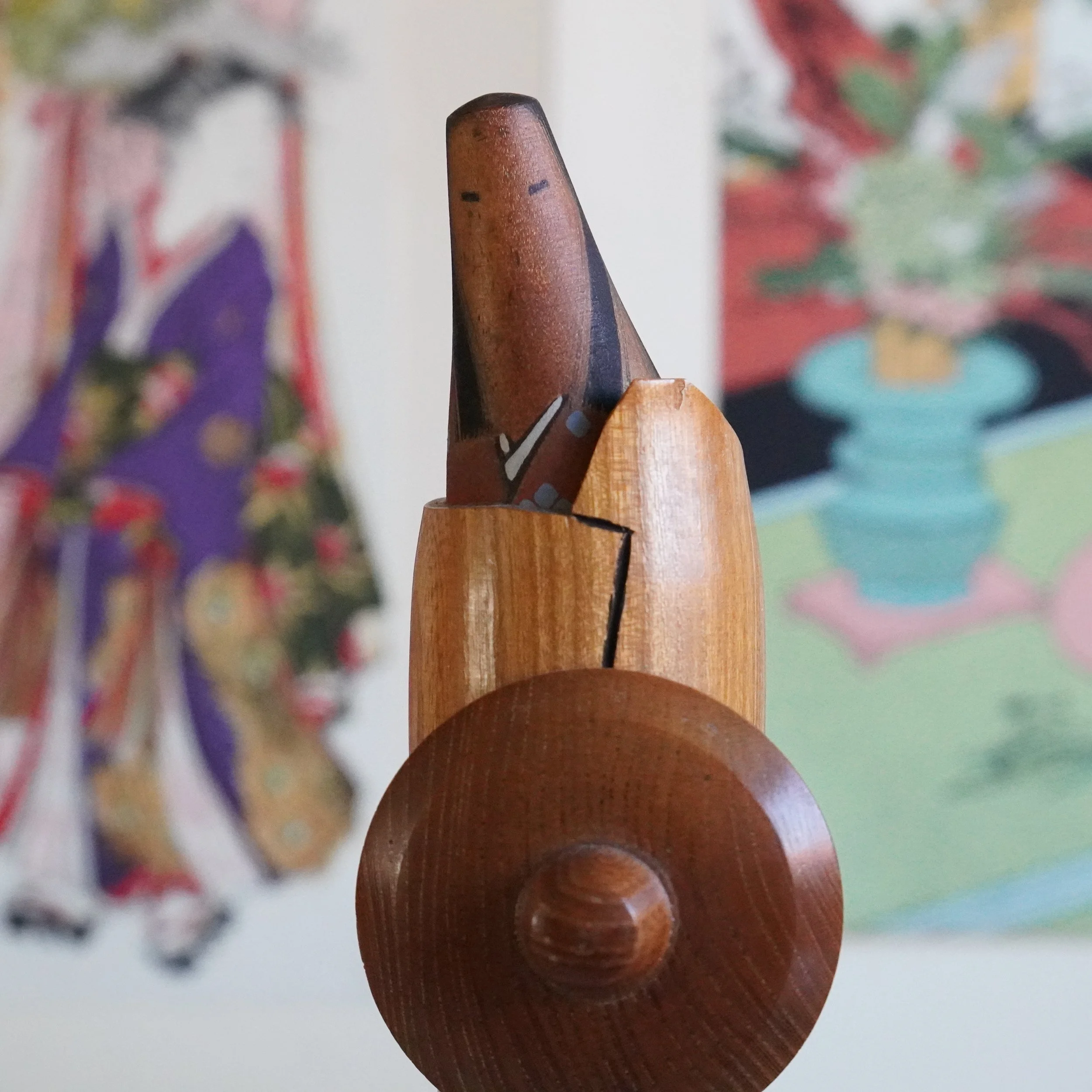
Two kokeshi stand side by side, one almost half a metre tall and both wearing traditional bands of red, black, purple and bare wood from collar to base. There are no flowers and no scenes: the stripes are the whole design, and at this height two of them fill a shelf or sideboard by themselves. Under a straight fringe both faces look out with a calm gaze.
Abe Ichirō learned the Tsuchiyu craft from his father, Abe Shinjirō, and in 1967 rebuilt one of his father's Taishō period kokeshi, a body decorated with lathe lines only. These two are decorated the same way: every band was painted while the wood turned on the lathe, so the pattern is the making itself.
The head turns and produces a soft squeak when rotated. In Japanese this is called the cry of a child, and it is one of the quiet surprises of traditional Tsuchiyu kokeshi.
→ Curious how Tsuchiyu compares to the other ten traditional kokeshi lines? Read the full guide.