
Rare Japanese finds
Some objects I bring back from Japan because they exist nowhere else.
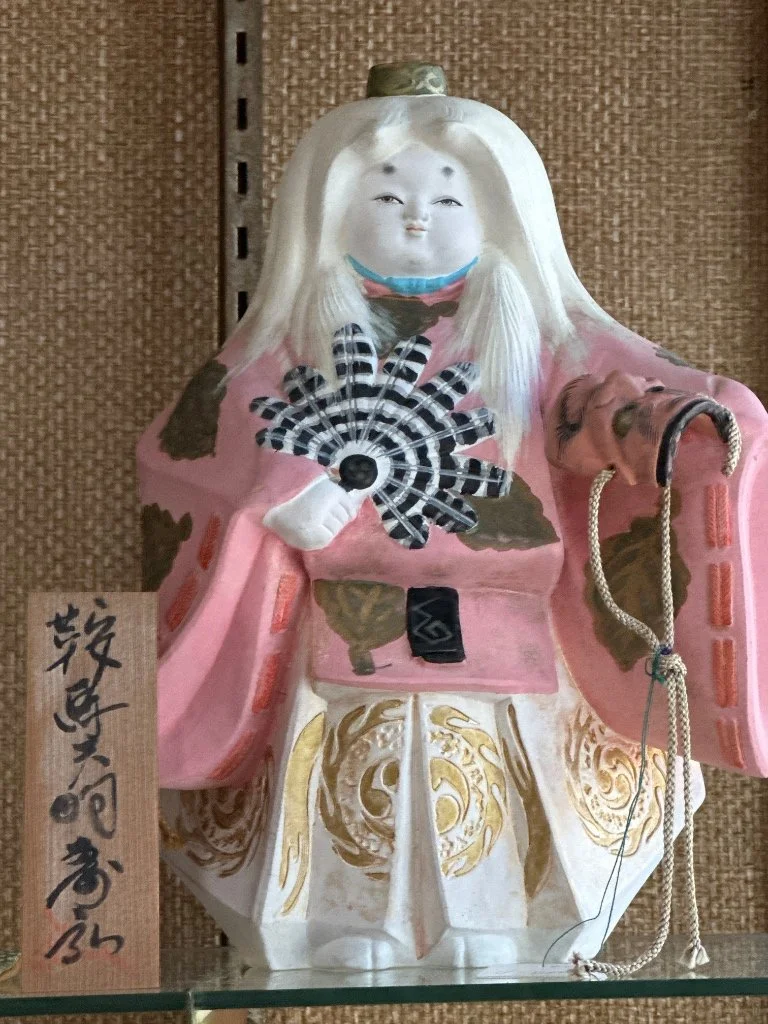
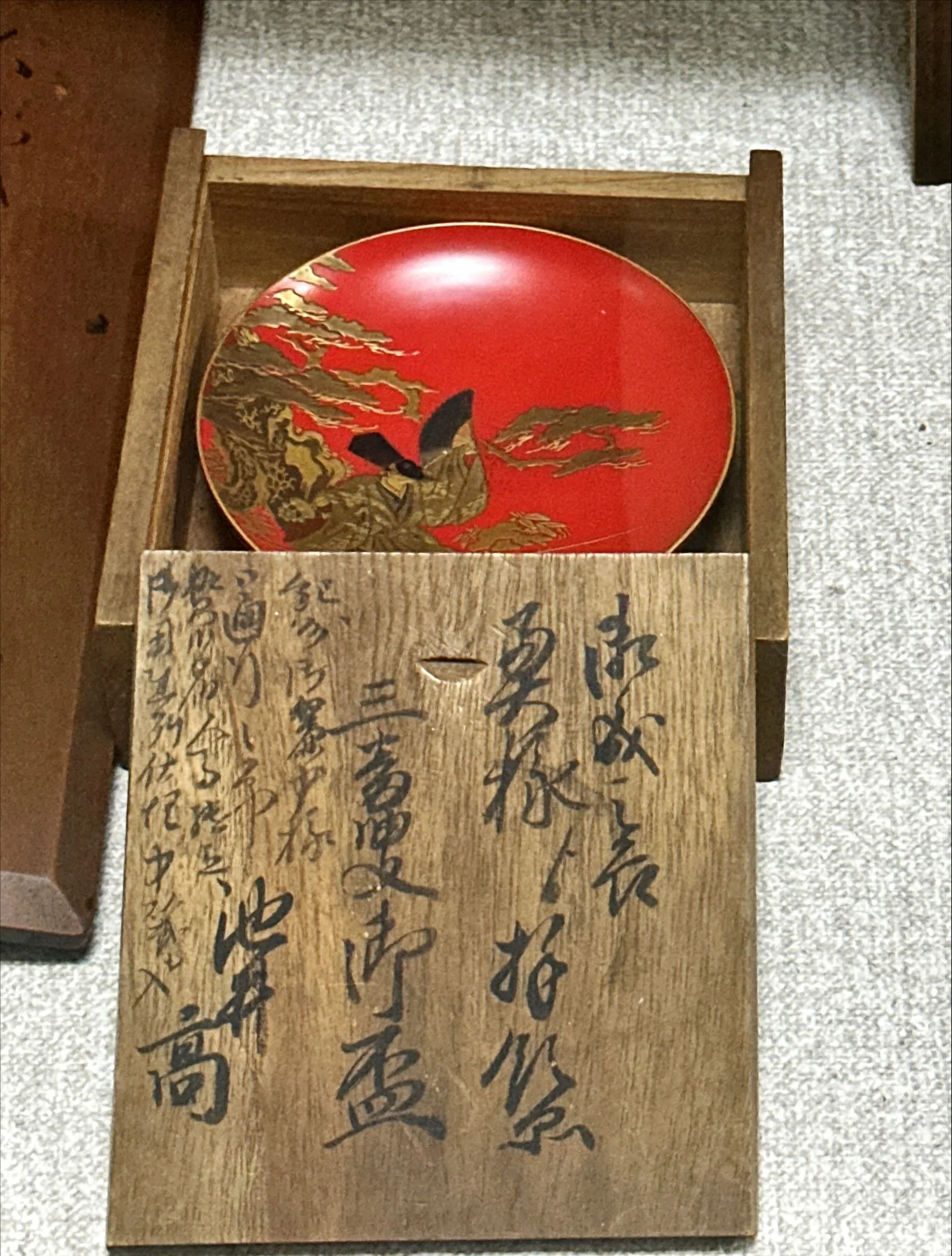
A complete sake set with the maker's documentation still inside the box. A haori worked in shibori silk that represents more hours of labour than anyone would budget for today. A kabuki doll pair on its original display stand. These are objects for people who know what they are looking at, signed works, genuine period pieces, and prices that reflect something real. I find them one at a time, in places that do not advertise. When they are gone, they do not come back.
If you collect Japanese objects seriously, or if you want something that will still matter in thirty years, this is where to look.
How do I source these collector’s pieces?
This is the part of the collection I am most careful about.
These are objects I source specifically for people who know what they are looking at, or who want something extraordinary without needing all the context in advance. Signed works with original documentation. Pieces from periods and makers that are genuinely difficult to find outside Japan. Objects where the price reflects something real, and where I will always explain exactly what that is.
Want to know how a find like this actually happens?
One afternoon in Kyoto, I found a set of ten colour lithographs from 1895 tucked in the back of an antique bookshop. Here is how that day went.
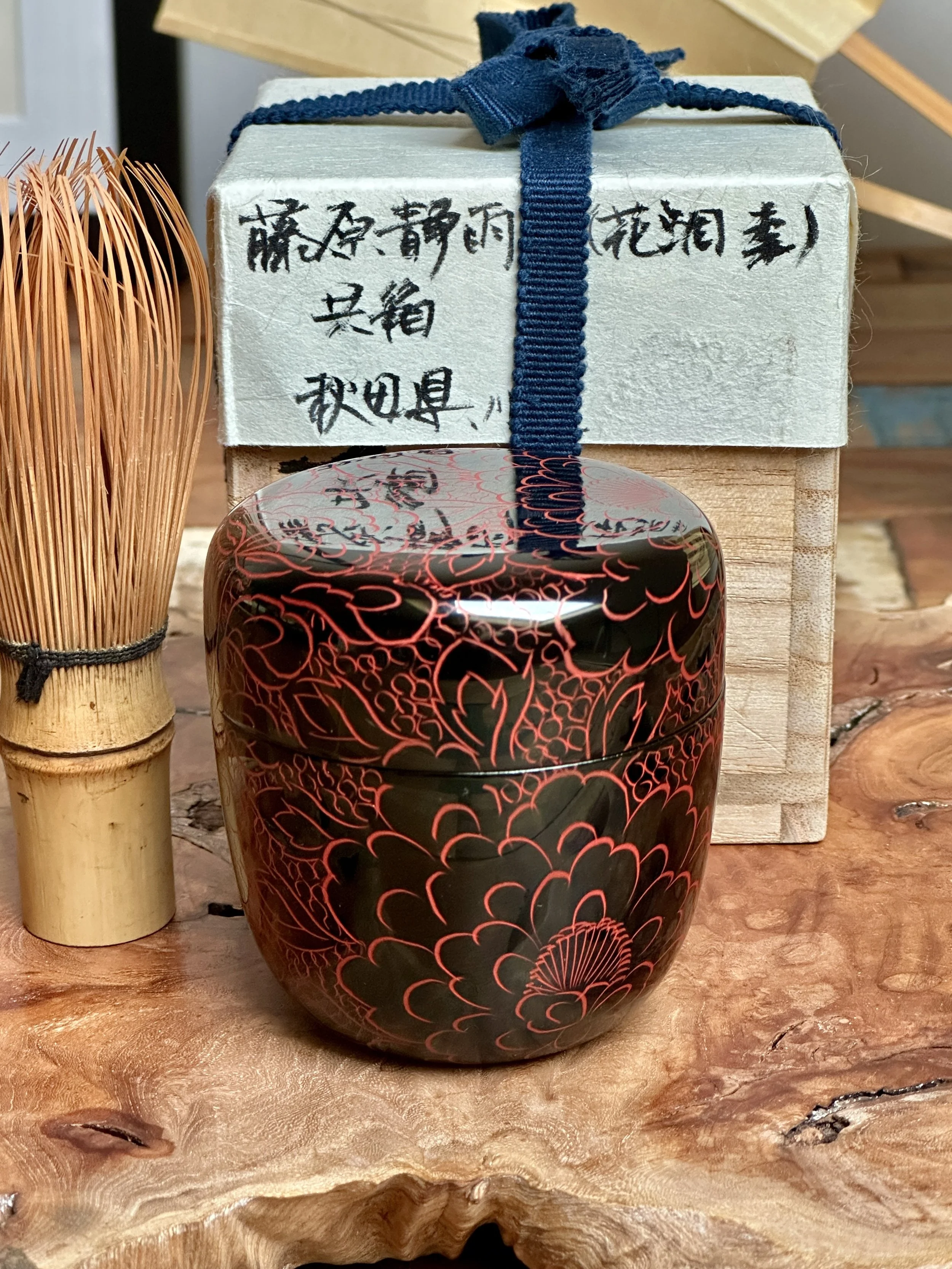
Turn it toward the light and the red changes. What looks like a deep, dark red on black shifts to a brighter red with a hint of pink, and the blossoms on the lid and body turn delicate rather than graphic. It is a small, rounded caddy with flowers drawn right across it, and with every tilt you notice a different one. It is the kind of object you pick up to look at and end up turning in your hands.
The lacquer is glossy and smooth. Run a fingertip over the flowers and in places you can feel the cuts through the lacquer, fine lines that sit in the surface rather than on top. At approx. 54 g the natsume is light in the palm, small and rounded.
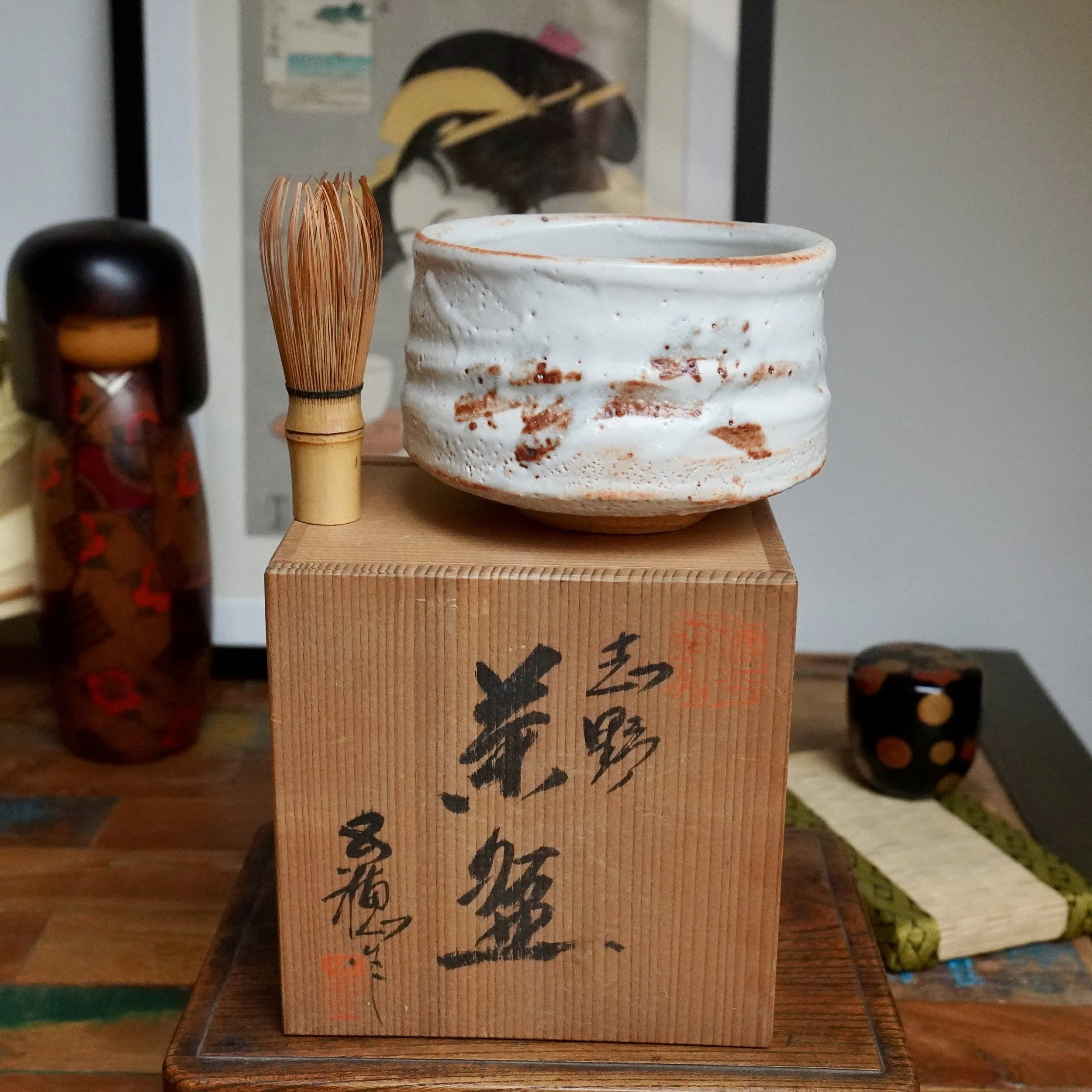
Pick this bowl up and it surprises you: for something this size, it settles low and steady in your hands, the thick walls giving it a grounded weight rather than a fragile one. The rim moves in its own irregular line, never quite a perfect circle, so no two angles look the same. White glaze breaks into rust-orange blush along one side like scorch marks, and it is easy to imagine how matcha would sit inside it, pooling green against that warm white and orange, exactly the kind of contrast tea practitioners seek out a bowl for.
What makes this one worth taking home rather than admiring from a distance is that it comes whole: the original tomobako, signed and sealed, and the silk wrapping cloth that carried it, stamped with the same seal as the box. Pieces where the box, cloth and bowl are still this clearly matched to each other carry a quiet kind of proof in themselves.
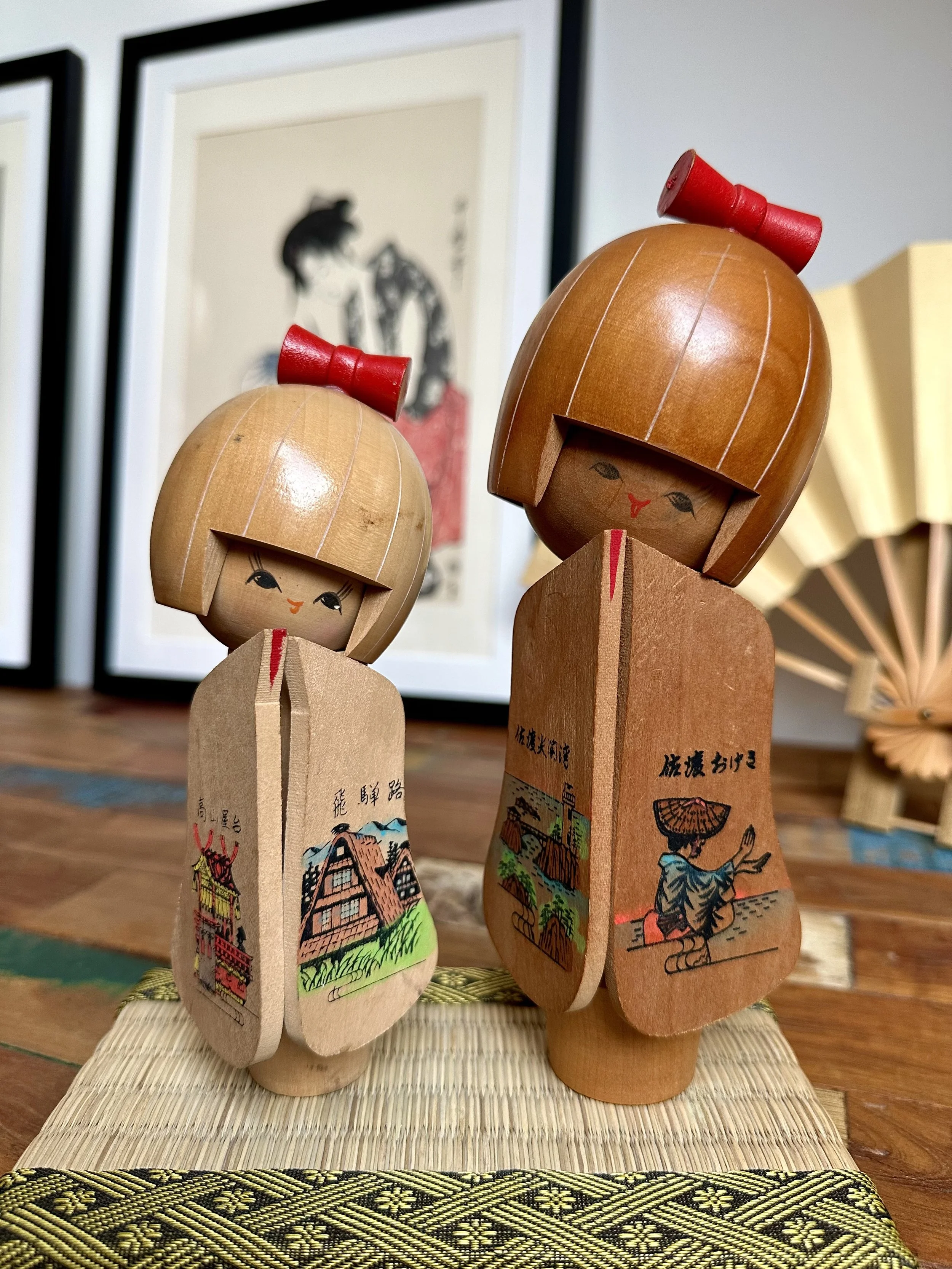
They are the same object twice: same flat panels fanning out from the waist, same simply painted face with a faint blush at the cheek, same red square seal on the base. But open them and they show two completely different corners of Japan. One carries the Okesa dancer of Sado Island and the sea cliffs of Senkaku Bay. The other shows the lacquered festival float of Takayama and the steep-roofed farmhouses of the Hida countryside. Same format, same hand, two worlds.
Sato Suigai (佐藤翠涯) was a Gunma-born kokeshi master and multiple Prime Minister Award winner who made this flat-panel omiyage kokeshi for travellers returning from destinations across Japan. These two pieces show that practice clearly: the same maker, the same form, two different regions, each panel a compression of what that place most wants to be remembered for. Together they work as a pair not because they match exactly, but because they rhyme. The last photo shows their bigger sister in our collection.
The larger lady has aged to a slightly darker wood tone than the smaller lady, the kind of natural variation that happens when two pieces live their decades separately before finding each other again.
→ Interested to read more about the woodworking on kokeshi like these? I wrote about it in my journal.
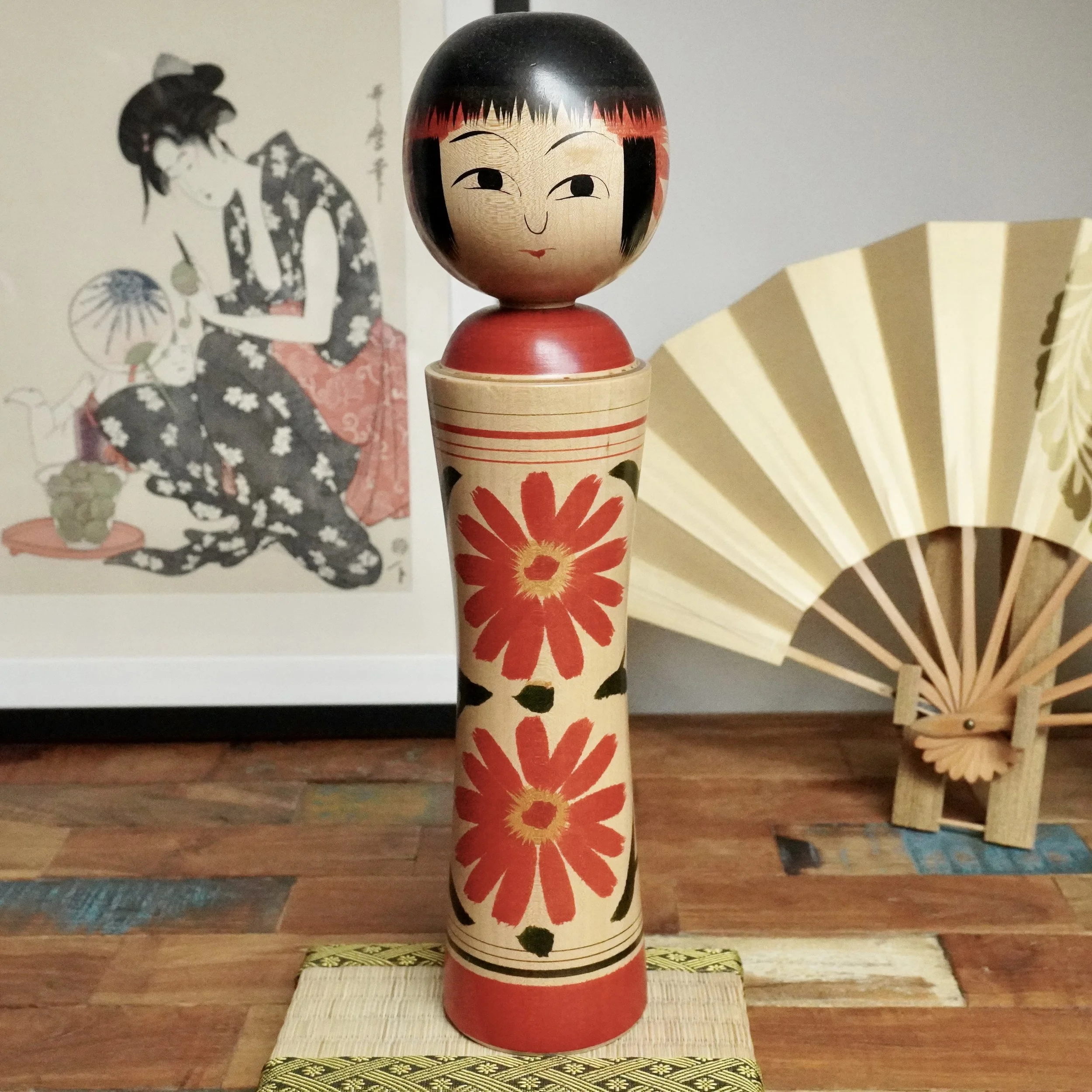
The scale alone stops you. At 36.5 centimetres, this is a kokeshi that holds a shelf on its own. The body is a clean, pale column, with two oversized red chrysanthemums running almost its full height, petals brushed outward in confident strokes around small golden centres. Red at the collar, red at the base. The face is quiet and a little knowing, framed by a precise black bob.
Izu Mamoru spent decades making Ginzan kokeshi at Ginzan Onsen, in the family workshop that is still the only place this style is made. He died in 2019. On the base of this piece he recorded the exact day it was finished, June 23, 1998, and his age at the time, 73.
Most kokeshi carry a name. This one also carries a moment.
Want to understand the difference between dentō and sōsaku kokeshi? I wrote about it, with a trip through Fukushima along the way.
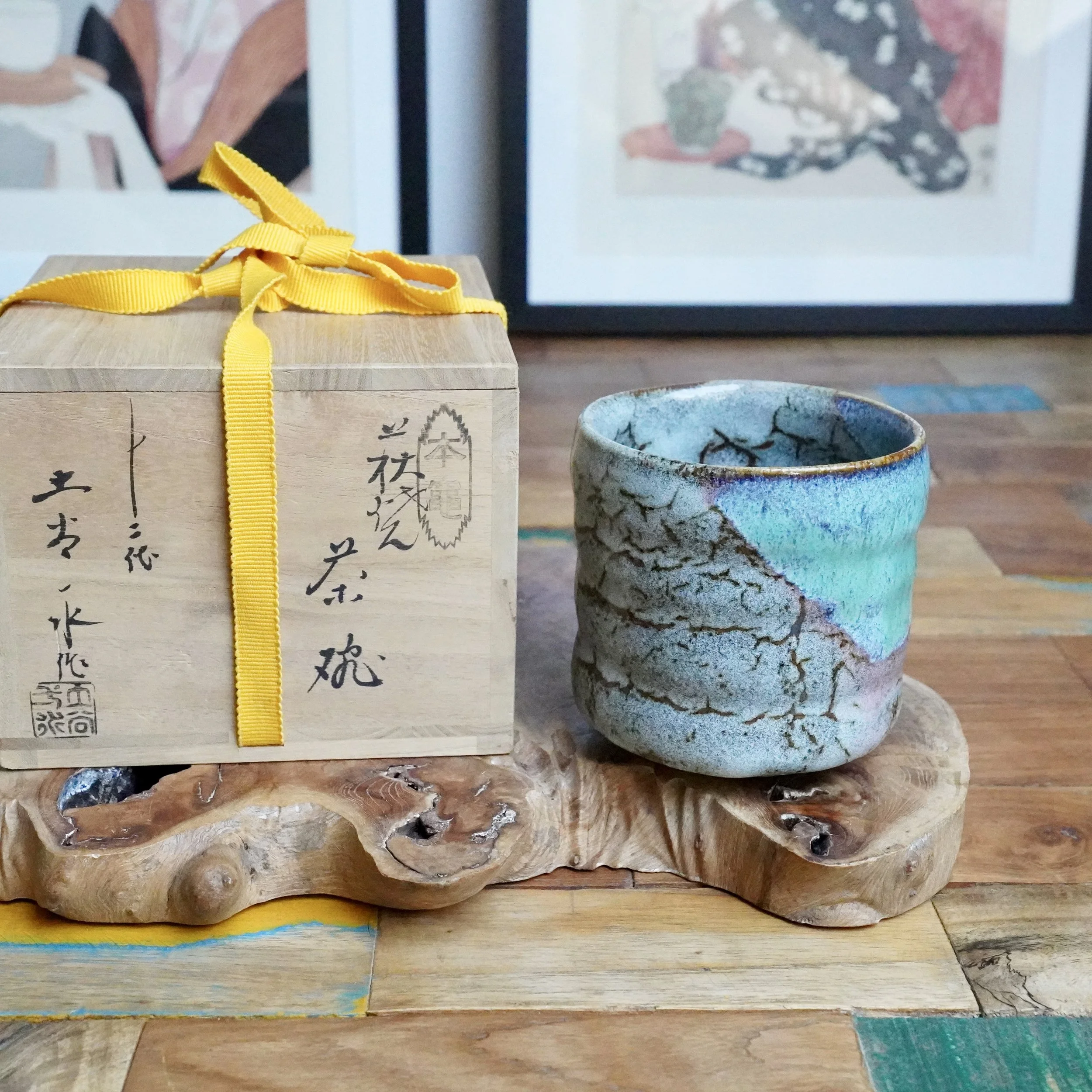
Tall and straight-walled, this tsutsu shaped chawan holds its heat the way it holds attention, a shape traditionally reached for in the colder months. It hols a substantial, satisfying weight in the hand. The glaze pools into a clear turquoise on one side, breaking into a soft, speckled grey field, with warm brown lines tracing all over the body. It is a bowl that draws the eye before it ever reaches your hands.
This chawan comes with a wooden tomobako inscribed with the name of a Hagi-yaki maker. The glaze and form of the bowl itself are not typical of Hagi-yaki, so I can't confirm this is its original box. Japan has an enormous number of studio potters, each with their own variations, so I'm not ruling it out either. The box reads: Tsuchiya Issui (土屋一翠), 12th generation, Hongama kiln (main/head kiln) and Hagi-yaki. Either way, it's a genuine wooden box and comes included. It keeps the cup safe in your home.
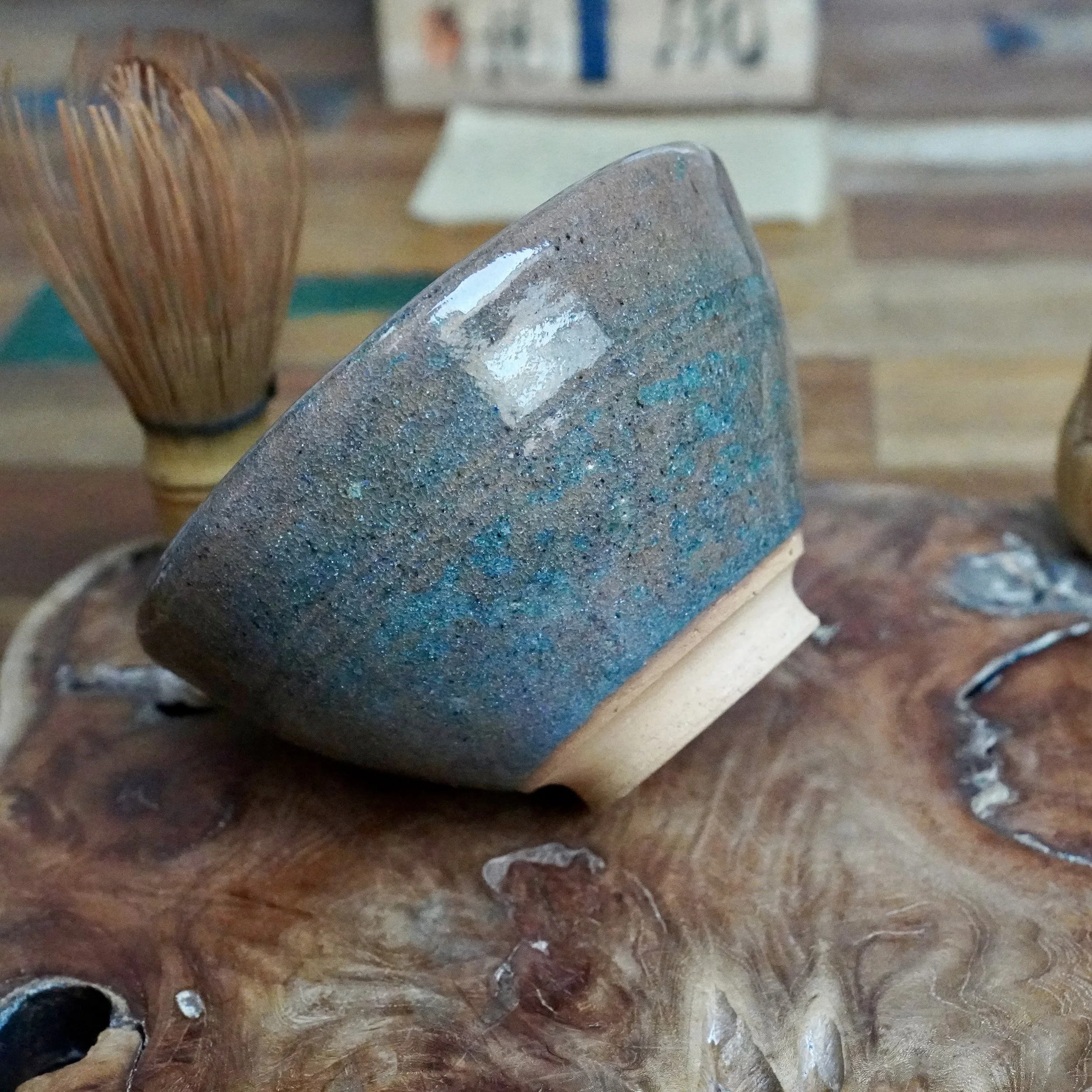
The glaze is what stops you first: smooth under the light, dense with fine blue speckling that seems to change as you turn the bowl, flaring brighter in some angles and settling quieter in others. Run a finger across the surface and it glides.
This bowl comes from a kiln you will not find in any reference book. Mizushima Jirō built it himself at the foot of Kagurao, a hill near an old castle ruin outside Tsuyama, in Okayama Prefecture, and named the ware after the mountain itself.
The ruin belonged to Kagurao Castle, a hilltop fortress whose founding date is undated but which stood active through the Muromachi period, into the late sixteenth century. In his own handwritten shiori, he describes using local clay and firing with red pine, the same wood traditionally used to fire Bizen ware in the same prefecture, chasing a glaze effect he calls a "unique melting field," one he admits he was still trying to master.
He called his own work raku-yaki, and the bowl itself, dense, high fired stoneware with a hard, unglazed foot, tells a story closer to a personal, self-taught practice than to the soft, low fired tradition the word usually points to. Owning this piece means owning one individual potter's own account of his materials and process, in his own hand, with nothing added or assumed beyond it.
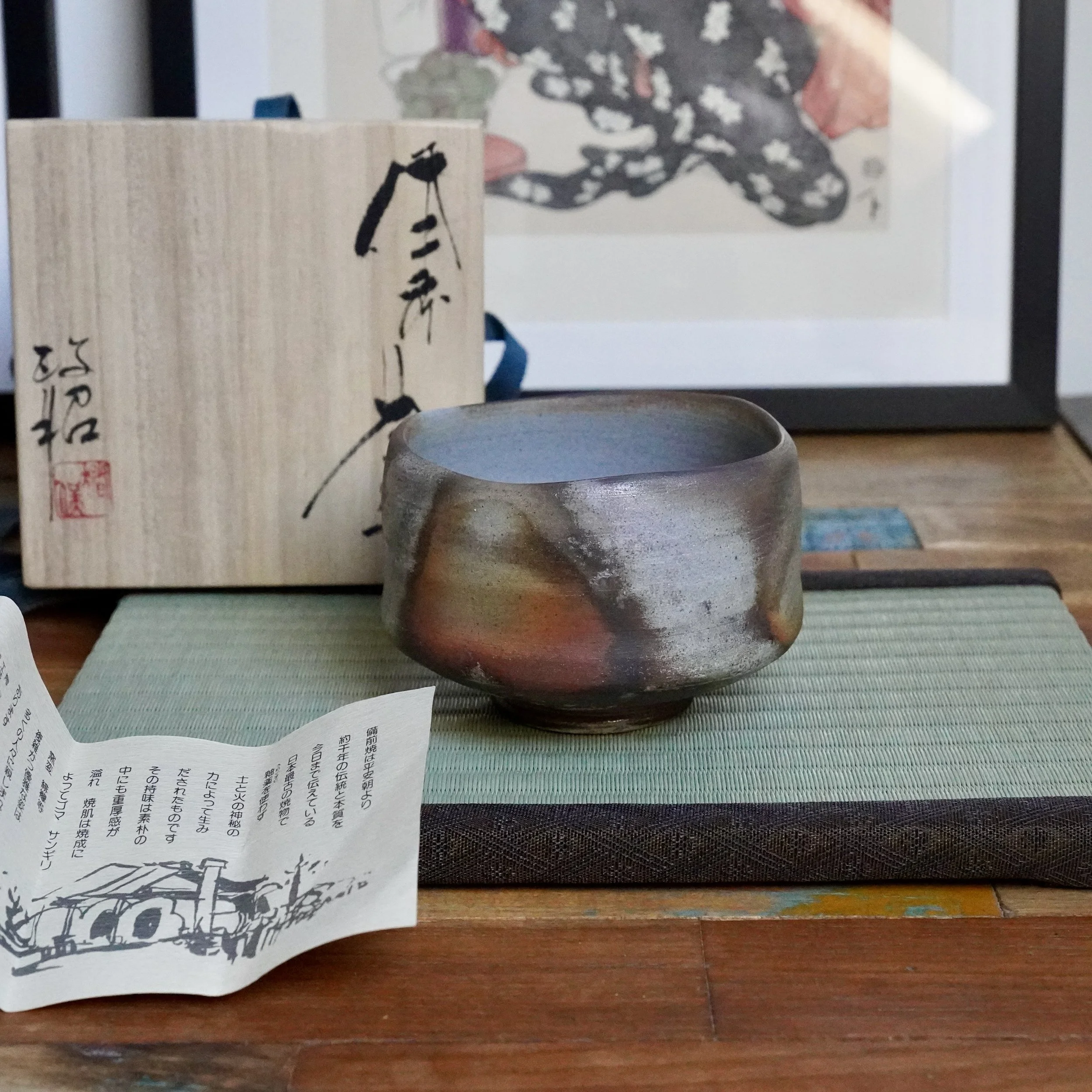
The clay tells you everything before you even touch it. One side has gone the colour of embers still holding heat, deep rust and burnt orange bleeding into ash grey where the flames never quite reached, and across the rim that grey turns almost silver, dusted like the first frost on a window. No glaze was ever applied here. Every mark, every shift in tone, is the direct signature of ten days or more inside a wood fired kiln, clay and flame negotiating the surface between them.
This bowl carries the seal of Inomata Masaaki, a Bizen potter based at the Saizōbō kiln in Okayama prefecture and one of the region's certified Dentō Kōgeishi, a formally recognised Traditional Craftsman title awarded by the prefecture. He built his own climbing kiln and became independent in 1975, after training under a respected Bizen workshop, and has spent the decades since inside a tradition that dates back over a thousand years to Japan's oldest surviving pottery kilns. A chawan carrying his signature is not a stylistic guess. It is a documented piece from a working master within one of the Six Ancient Kilns of Japan.
→ Fourteen days, one fire: what it actually takes to fire a Bizen kiln. A visit to Shibaoka Tōsendō during an active firing, standing at the kiln mouth while the family read the fire by eye and ear alone. Read the full visit in my journal.
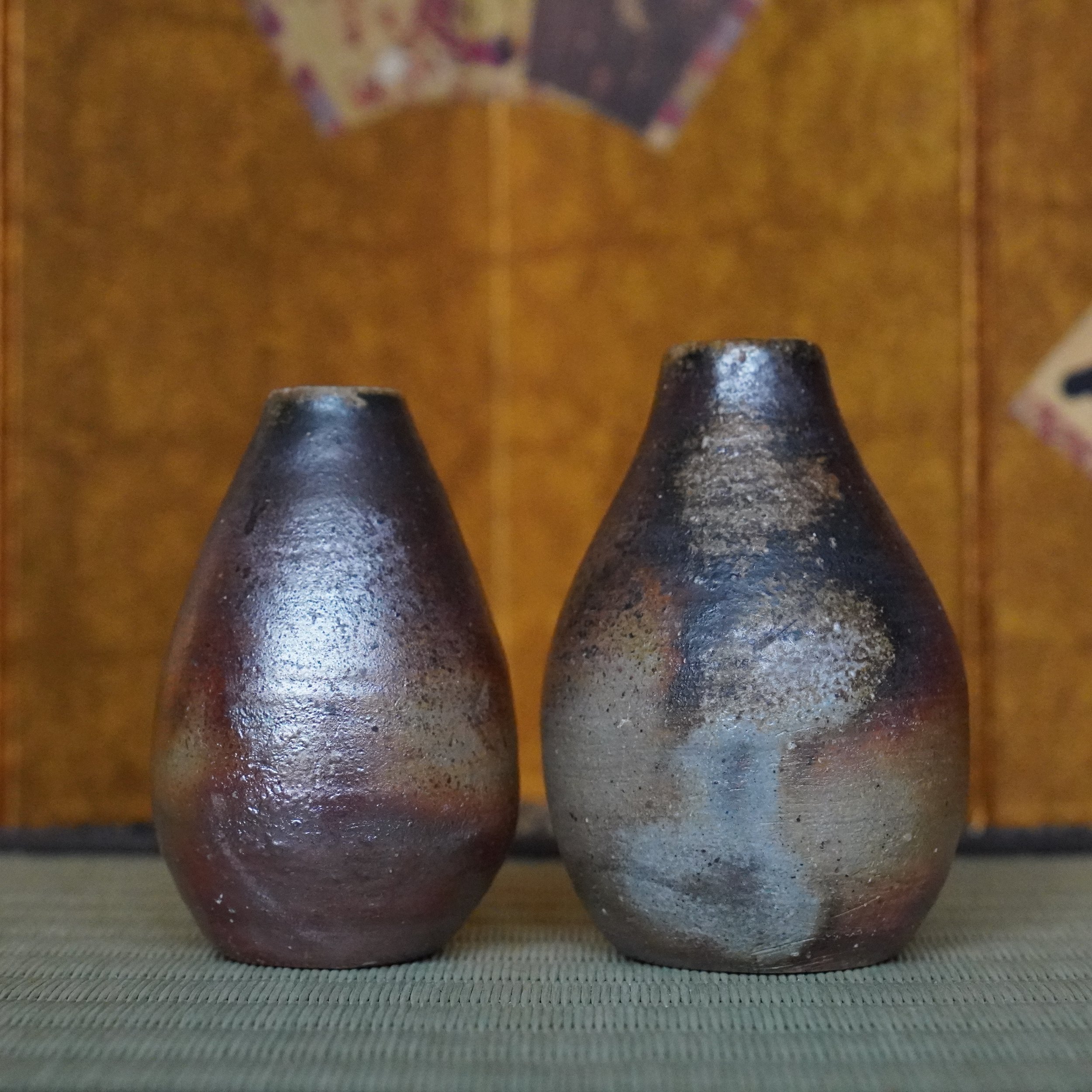
Two small teardrop vases, narrow at the neck and full through the shoulder, standing close enough together that they read as a pair without being identical. One leans toward deep aubergine with a soft silver mist rolling across the front, almost metallic where the light catches it. The other runs cooler still, a wash of silvery blue-grey shifting into warm rust low on the body. Neither would look complete alone. Together they hold a conversation, one leaning warm, the other leaning bright.
Both carry the maker's mark of Shibaoka Tōsendō, working under the kiln name Kōzan-gama in Imbe since 1912. The kiln has stayed in one family for three generations, currently the third-generation Kōzan, Shibaoka Masashi, working alongside his sons Chikara and Hisashi. A pair like this, thrown at the same time and fired side by side in the same noborigama, is a small, physical record of one firing at a kiln that has kept its own fire burning for over a century.
→ Fourteen days, one fire: what it actually takes to fire a Bizen kiln. A visit to Shibaoka Tōsendō during an active firing, standing at the kiln mouth while the family read the fire by eye and ear alone. Read the full visit in my journal.
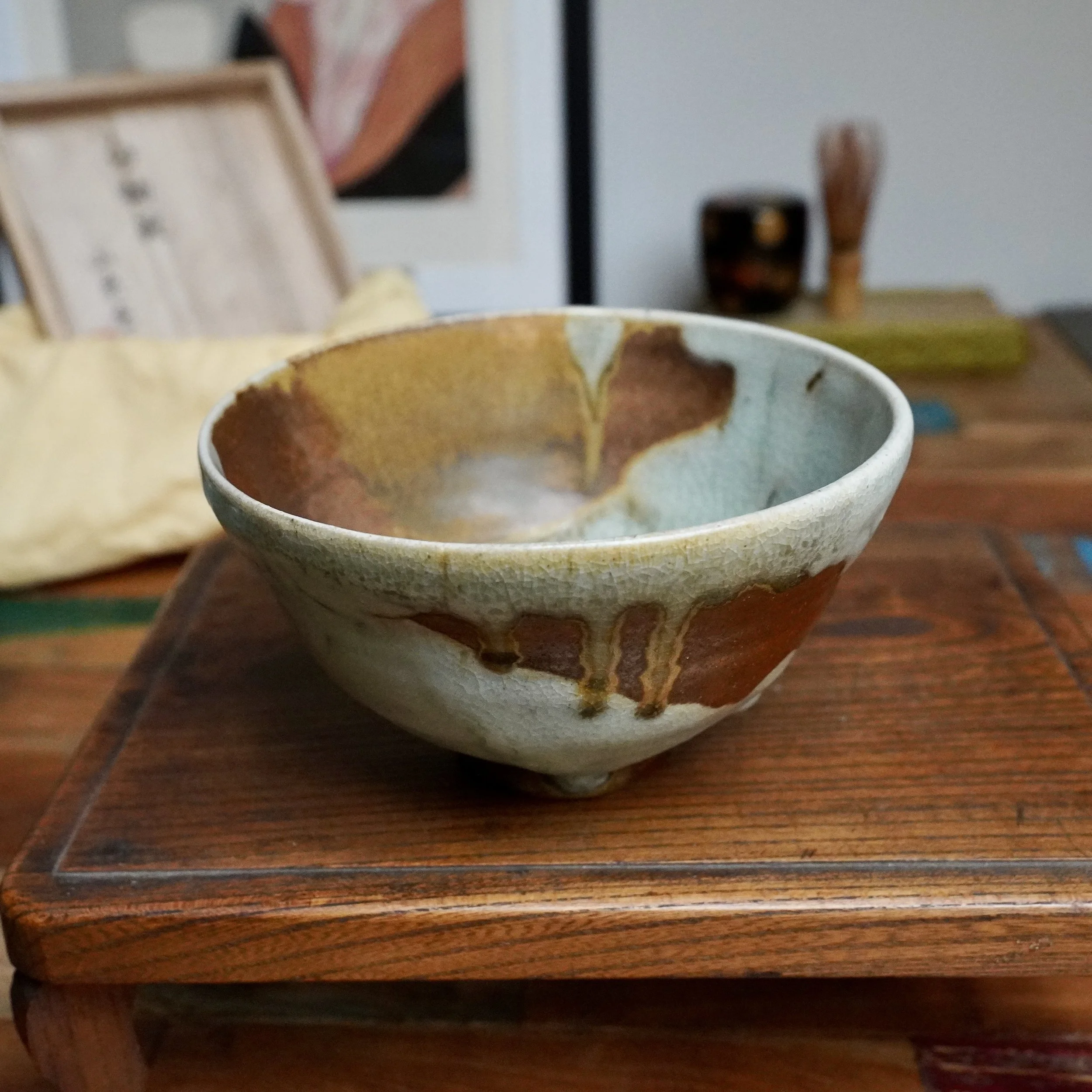
The glaze on this one shifts from a pale, crackled blue-grey into a deep, warm rust-brown that spills down one whole side like something poured rather than painted. Streaks of ochre yellow brown run through the transition, and the unglazed foot beneath it all is a rich, earthy red-brown, left bare so the clay can speak for itself.
This chawan comes with its original tomobako, signed and sealed 山桑庵 (Sansōan), a studio potter’s workshop name. It has the kind of glaze variation that rewards turning it slowly in the hand before you drink from it.
→ Curious to know why the size and weight of your chawan makes a difference when drinking tea from it? Read more in my journal.
→ Want to see this bowl meeting the early morning sunlight? Here it is on my Instagram.
Notice: This chawan has found a new home. If you are looking for something similar, please let me know. As I list in small batches, so there may be more in stock than you currently see.
And if I do not have it yet, I source in Japan a few times a year and am always happy to keep an eye out for you specifically.
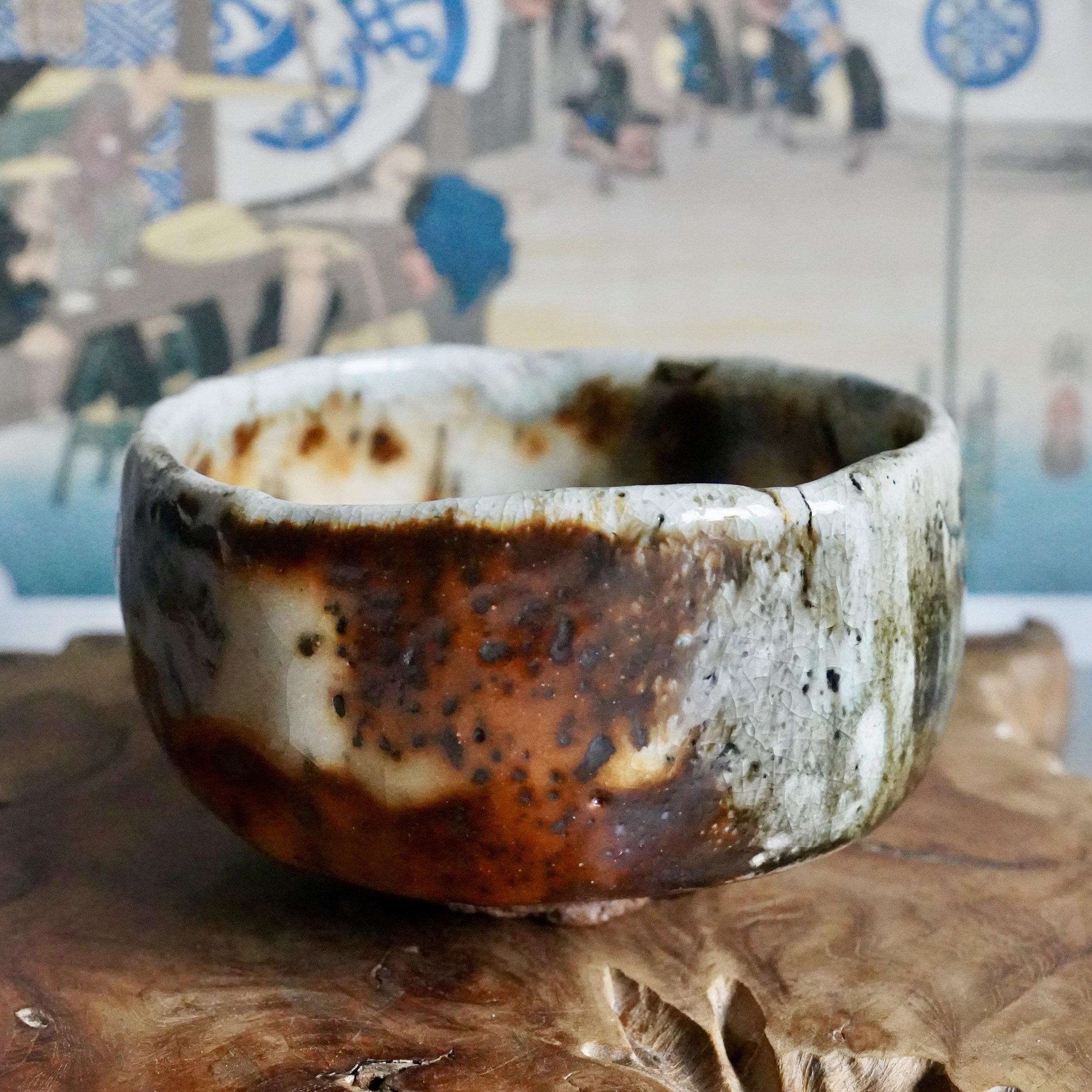
There is a moment, turning this bowl slowly for the first time, where you stop trusting your own eyes. From one side, the glaze looks almost calm, a pale, crackled white. Look closer and that white is covered edge to edge in a fine web of cracks, catching the light like a cracked windshield. Turn it a few degrees and that same surface has turned to rust, deep orange bleeding into near black at the rim. Then you tip it, and the inside pools into a deep, mossy green touched with gold, a colour neither side of the outside ever hints at. Somewhere along the thick, generous rim sits a small patch that has turned an unexplained grey-blue, rougher under the thumb than the glaze around it. This is not a bowl that settled on one thing.
This chawan was made at the Kakuzan-gama in Ayabe, a kiln built in 1959 at the headquarters of the Ōmoto religious organisation, and it is signed by Deguchi Eiji, who married into the family that founded Ōmoto and served as its Sōchō, its director, from 1958 to 1962. He was not a professional potter by trade. He was someone close to the centre of a movement that treated making things by hand as part of its own philosophy, working in an ash-glaze tradition brought to the kiln by its founder, the Bizen master Kaneshige Sozan. This bowl is what that looked like when it left his hands. A signed, boxed chawan from a maker with this kind of documented history rarely surfaces outside Japan.
→ Curious about the glaze on this matcha bowl? One glaze, three lives: a wood-fired chawan from a kiln built by a religion is in my journal.
Notice: This chawan has found a new home. If you are looking for something similar, please let me know. As I list in small batches, so there may be more in stock than you currently see.
And if I do not have it yet, I source in Japan a few times a year and am always happy to keep an eye out for you specifically.
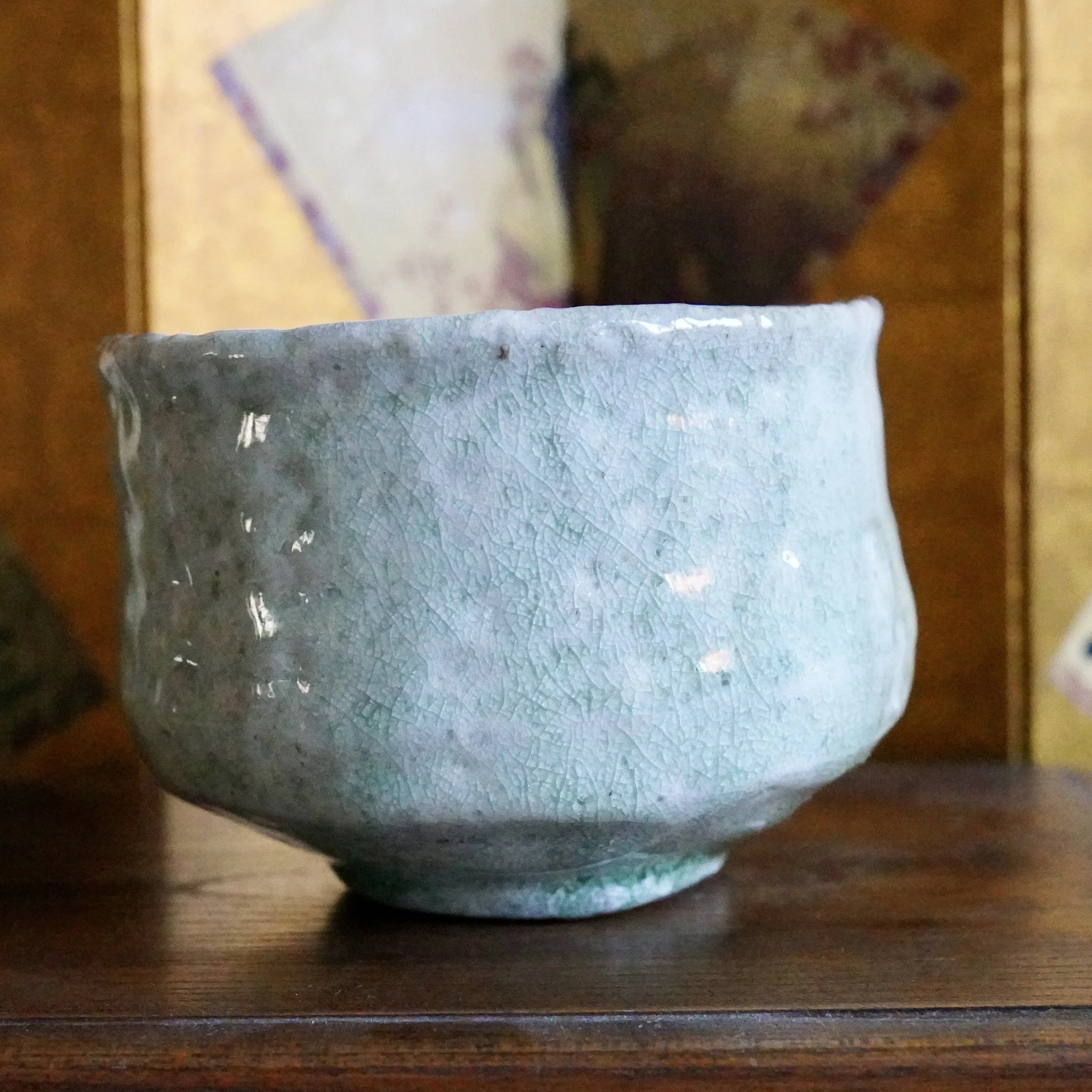
Turn this chawan and the surface answers differently every time. A rough, ash-textured grey-green skin gives way, near the rim, to a pool of deep crackled jade, the kind of colour you notice from across a room before you notice anything else about the piece. The clay shows through at three small unglazed spots on the interior where kiln supports once held it during firing, tiny, honest proof of exactly how this bowl was made.
This chawan made by Ishihara Shōji, a Fukuoka Prefecture ceramic artist born in 1943, who trained as a sculptor before turning to ceramics and building his own kiln in 1981. Ash-glazed, unglazed stoneware work like this belongs to his early period, before the distinctive coloured Oborodeisai style that made him widely known from 1989 onward. A documented early piece by an artist now represented by galleries in New York and across Japan.
→ Curious to know why the size and weight of your chawan makes a difference when drinking tea from it? Read more in my journal.
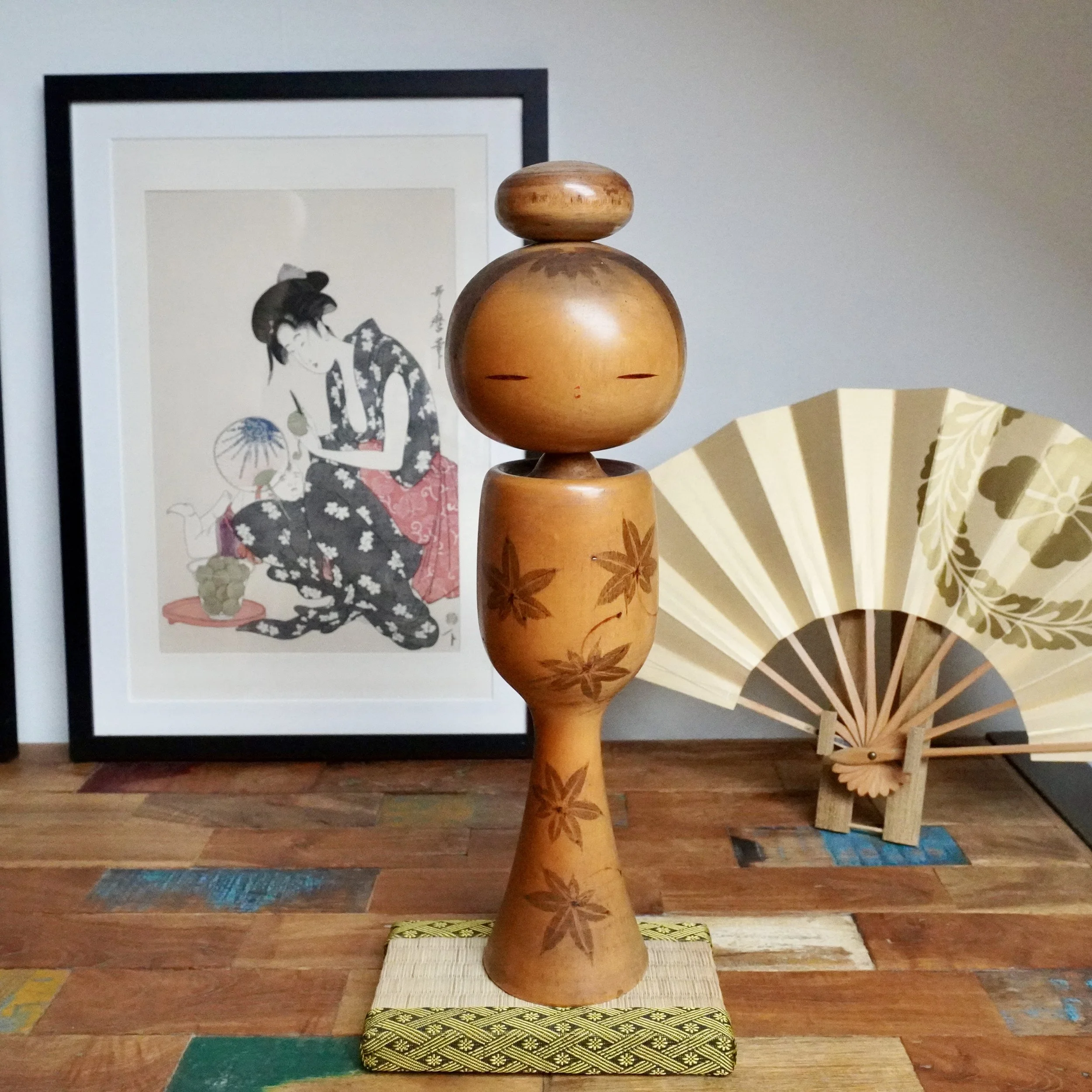
This kokeshi stands taller than almost anything else in the collection: 41 centimetres of smooth, weighted wood, its rounded head resting above a body that tapers in and out again like a figure caught mid movement. Dark maple leaves drift across the surface in loose, hand painted clusters, their veins burned into the wood before the colour was added. At nearly a kilo in the hand, this is not a piece you display and forget. It asks to be picked up.
This is the work of Kano Chiyomatsu, a sōsaku kokeshi artist from Gunma prefecture whose career spans more than seventy years and includes two occasions, in 1981 and 1982, when his work was presented to the then Crown Prince and Crown Princess Michiko. His pieces have been included in Gunma's own middle school art textbooks and he has been recognised as a Prefectural Traditional Craftsperson. This particular piece carries his signature and seal.
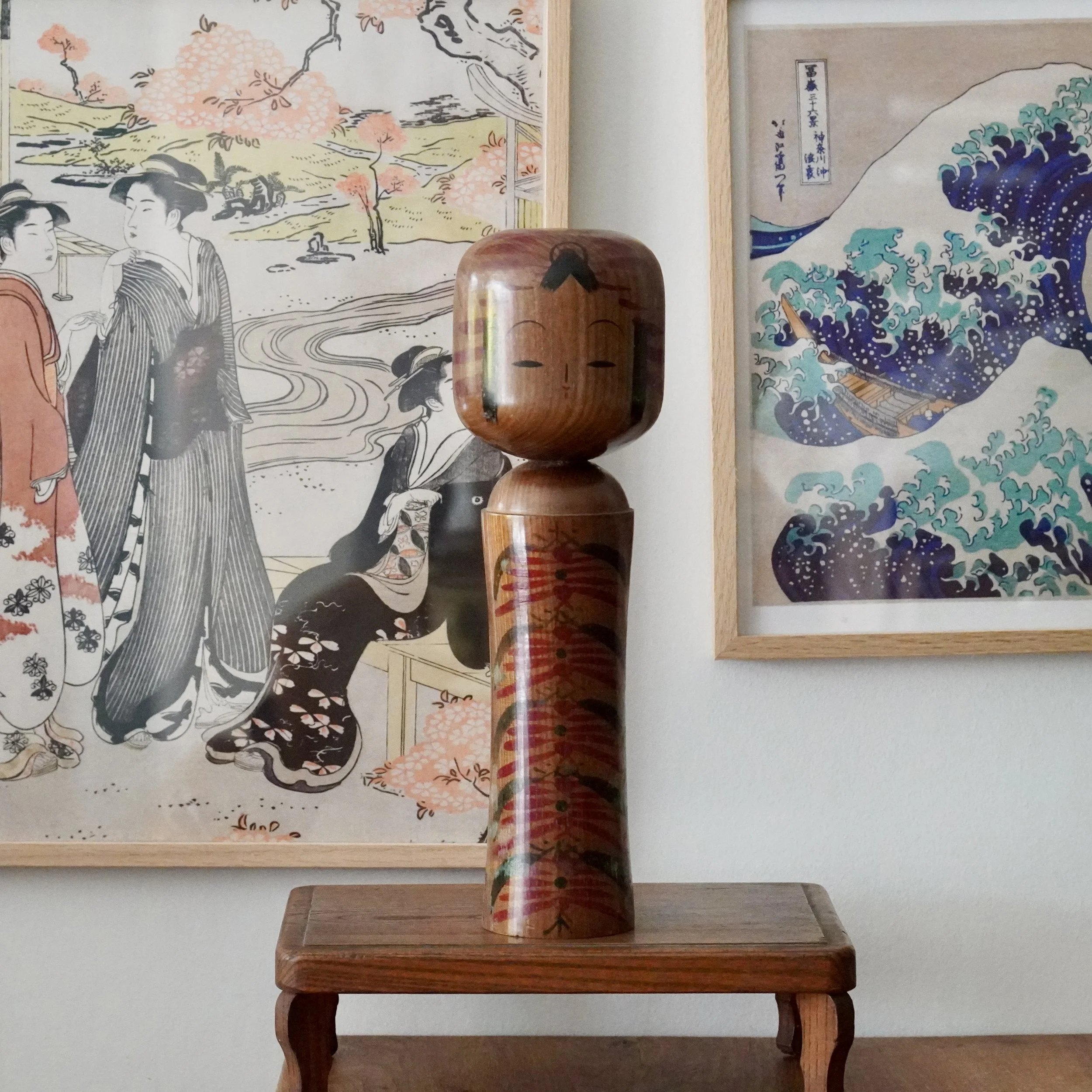
The grain does most of the work before the paint even starts. This kokeshi is turned from dark keyaki, Japanese zelkova, and the wood has aged into something close to bronze: warm, dense, with a reddish-brown depth that shifts as the light moves across it. Over that, sweeping black brushwork and horizontal red-maroon banding run the full length of the body. The result is more calligraphy than decoration. It stops you because it looks like nothing else on a shelf.
Kawamura Shōji (川村昭治) was part of the Kawamura family of Yamagata kokeshi makers, a lineage documented across multiple generations in the dentō tradition of Tōhoku. This piece shows his more abstract side: the traditional training is visible in the precise lathe work and the weight of the form, but the decoration is entirely his own, abstract, direct, and confident.
Kawamura’s work sits on the boundary between dentō and shingata. His foundation is traditional Yamagata-kei kokeshi making, but his output ranges from pieces that stay close to that convention to others that drift toward the freer, more individual expression associated with shingata and sōsaku work.
→ Interested to read more about the woodworking on kokeshi like these? I wrote about it in my journal.
→ Wondering where Yamagata fits among the eleven kokeshi traditions? Here's the full picture.
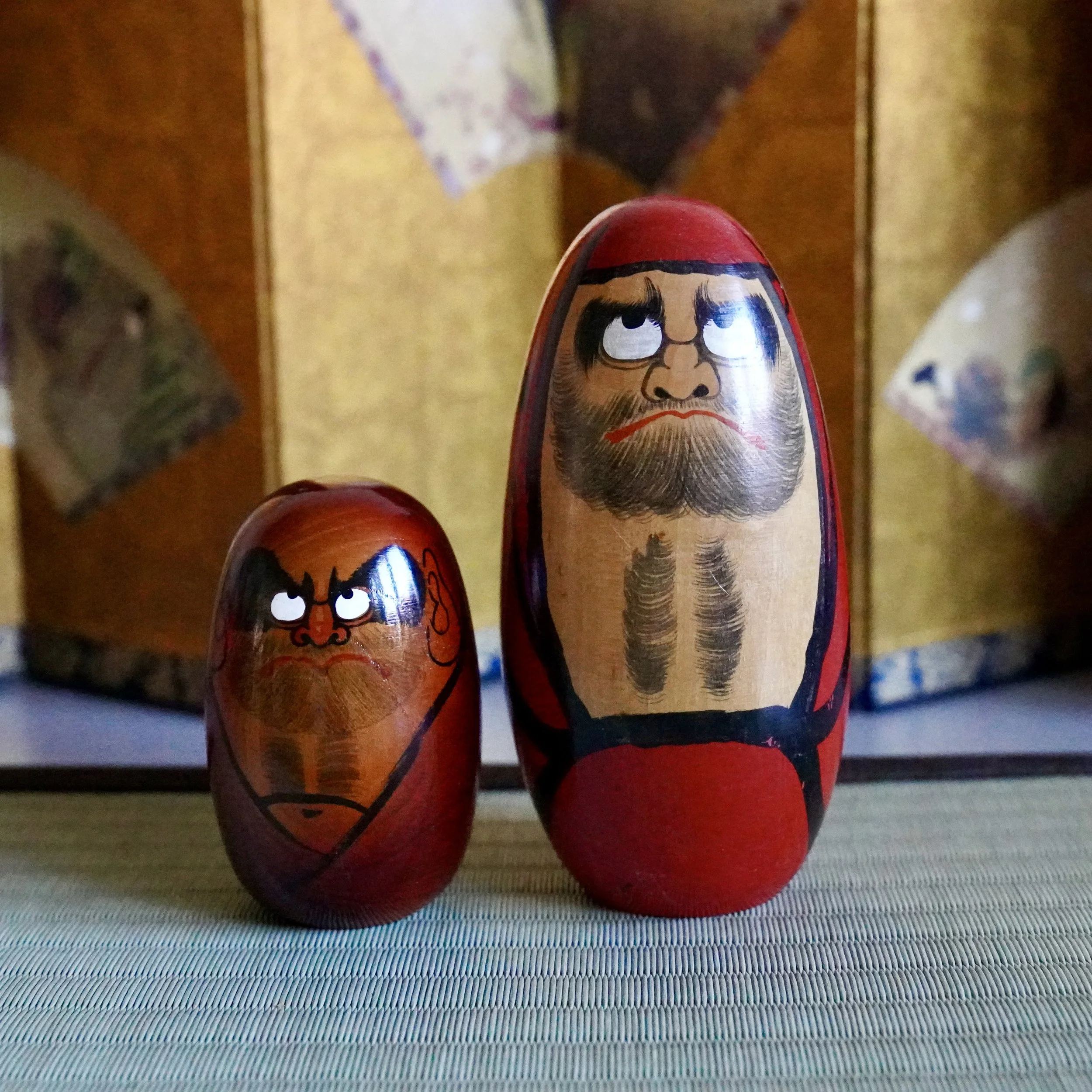
They look down with the kind of stillness that takes a moment to place, heavy lidded eyes under thick brushed eyebrows on the larger figure, the same sharp piercing eyes on the smaller one. A full beard is painted strand by strand rather than filled in flat, while vermilion lacquer sweeps around him in one unbroken line, giving way to a dark, almost black hood at the crown. Beside him, the smaller daruma that carries an deep warm lacquer worn into a darker tone where beside the decades of handling he still holds his shine.
Both take the armless, legless form associated with Bodhidharma, the monk said to have meditated so long in stillness that his limbs withered away, leaving only the seated shape carried in his memory ever since.
Both made by different well-known woodworkers. The larger daruma has a black seal pressed at its base, belonging to Shido Shozan, a Yamagata carver known chiefly for his sōsaku kokeshi rather than daruma like this one. The smaller daruma is made by Seifu Gono. A mingei craftsman known for turning keyaki, the slow growing Japanese zelkova prized for its depth of grain, into figures exactly like this one. Keyaki is not an easy wood to source, it takes centuries to mature, and Gono treated every piece as something meant to outlast him.
Curious where this expression comes from in the flesh? I found a thousand versions of it on one hillside in Osaka. Read about it in my journal.
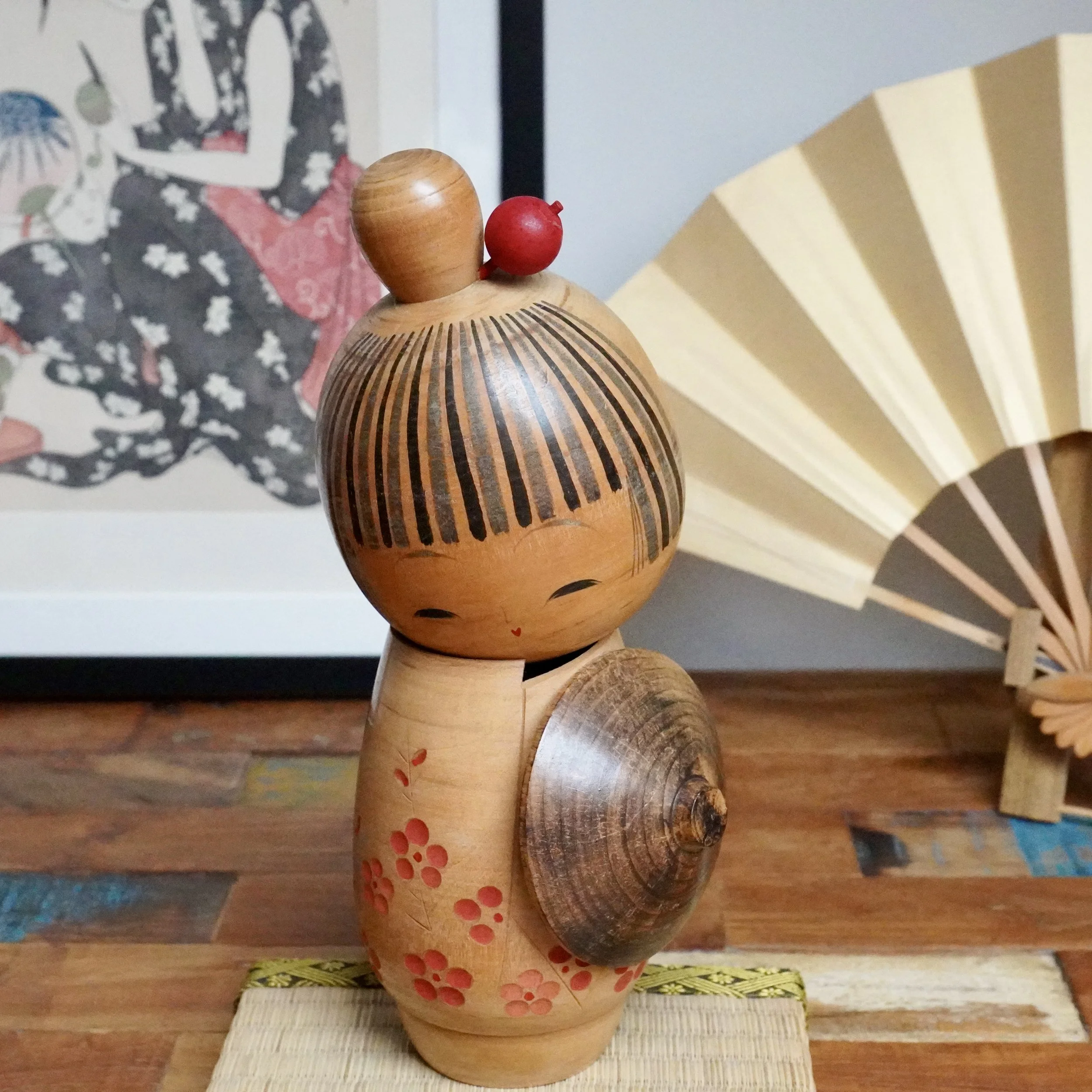
She stands taller than most kokeshi you will come across, and heavier too, with real weight settling into your palm the moment you pick her up. The head is covered edge to edge in fine combed striping, dark lines cut close together into a rounded cap, with a single red wooden bead perched at the crown like a stray plum bud. Sprays of red plum blossom trail down the body, each one carved first and filled with pigment after, and held against her side is a separately turned wooden kasa, a wide travel hat, raised the way a Heian noblewoman would once have lifted hers to shield her face on the road. Nothing about the proportions is timid: this is a maker working at full scale and full confidence.
The base carries the brush signature of Suigai, a painter who found his real language in wood. He spent a lifetime letting plants speak for people, plum blossom especially, always returning to it the way you return to a word that still means something. That instinct is what earned him Japan's Prime Minister's Award, but it is also simply what makes this particular figure feel considered rather than decorative. You are not buying a doll. You are buying the version of plum blossom one specific person kept coming back to, and decided, of everything he could have painted, this was worth painting again.
→ Interested to read more about the woodworking on kokeshi like these? I wrote about it in my journal.
→ Curious about the theme behind this pose? I wrote about oshinobi dōchū, the Heian tradition of travelling in disguise, in my journal.
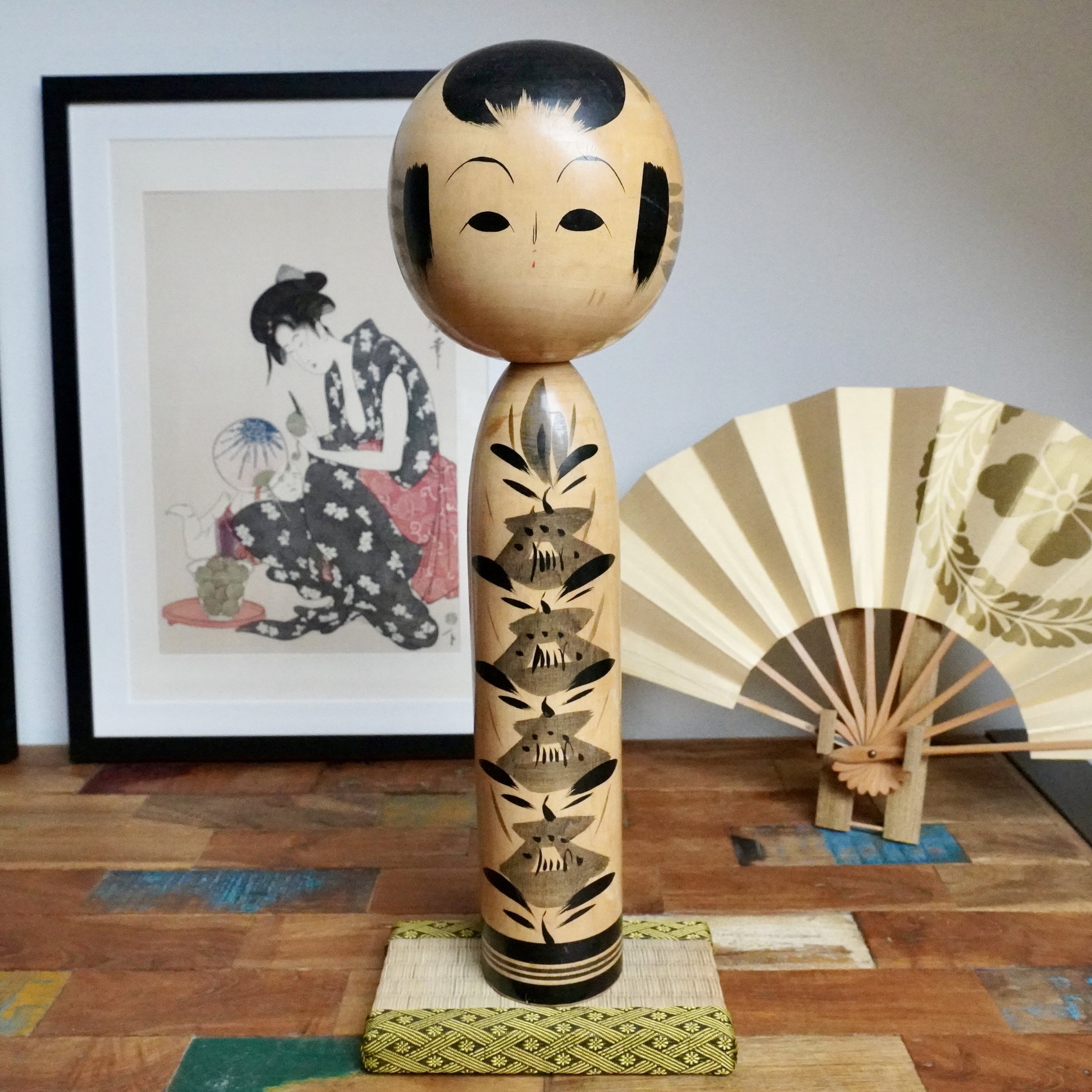
He looks caught mid turn. One section of his dark hair is brushed back in short, dry streaks, as if just ruffled, while the rest sits in a neat round cap above a calm, half lowered gaze. Down the long cylinder of his body, four flowers stack in grey and black, each bloom slightly different from the one above it, hanging leaves drifting between them. There is a stillness to him that a mass produced kokeshi rarely has, the kind that comes from a hand working without a template.
At 46.5 centimetres, this is not a doll you tuck onto a shelf and forget, it commands a room the way only a handful of vintage kokeshi can. The name on the base, Tetsuen, belongs to a small, tightly knit Shiraishi workshop where a style was considered worth keeping alive even after its maker was gone. Female kokeshi maker Chiyoko Hamatsu picked up the brush in her brother in law's memory and kept his flowers blooming for another four decades. Owning a piece like this means owning both the scale and the story, a kokeshi large enough to anchor a room and old enough to carry a small piece of a family's determination not to let something disappear.
Want to understand the difference between dentō and sōsaku kokeshi? I wrote about it, with a trip through Fukushima along the way.
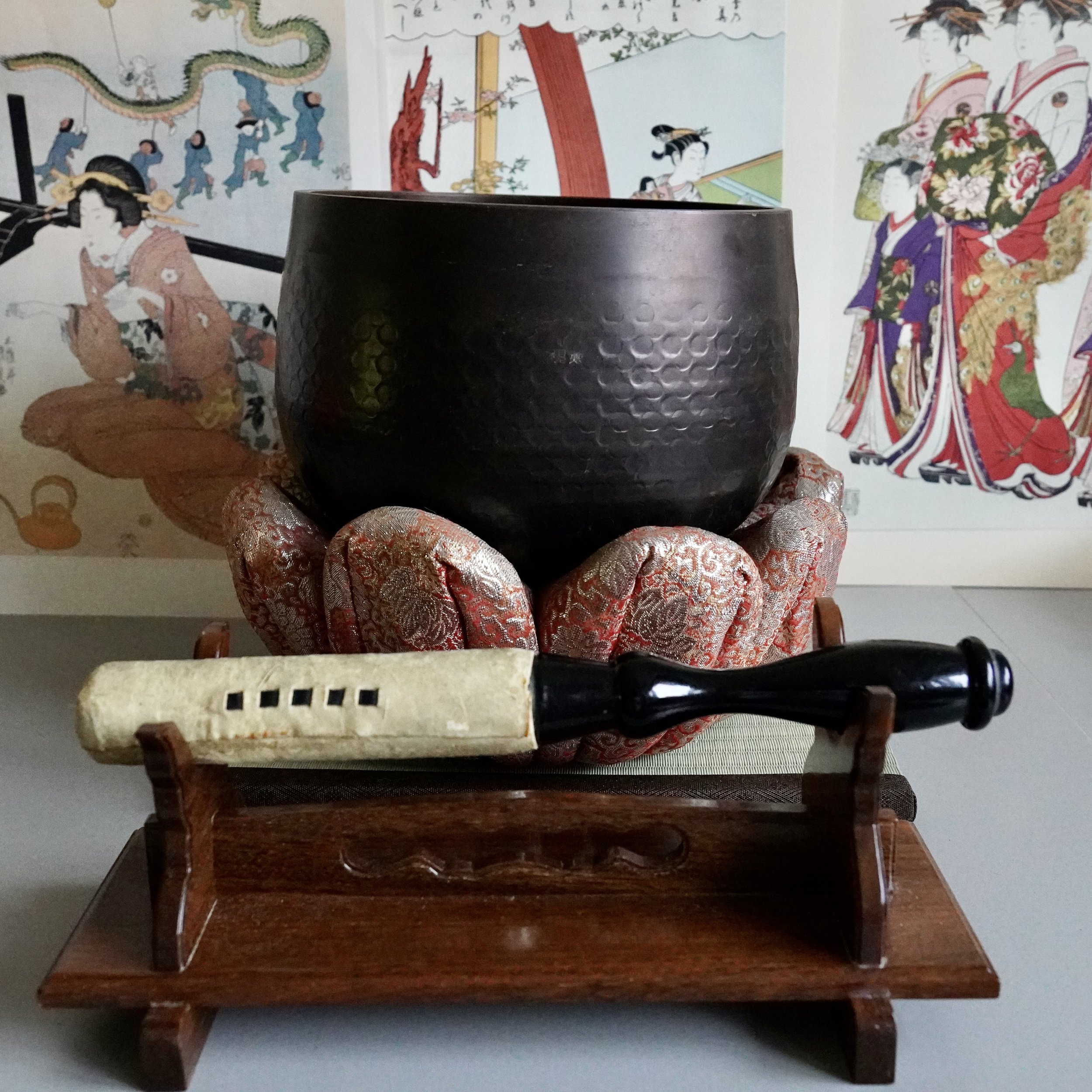
Most orin you come across fit in one hand. This one does not. It takes up real space, dark bronze gone almost black in the low points and warm brown where the light lands, its whole surface alive with tiny hammered ripples that never quite repeat themselves. Rest your palm against it and the cold of the metal surprises you every time, heavier than a bowl this size has any right to be. You do not so much notice this piece as feel the room shift around it.
Strike it, and it does not simply ring, it opens. The tone spreads outward and keeps going, long past the point where a smaller bell would have already gone quiet, the kind of deep, unhurried resonance that once called a temple hall to attention rather than a single room to prayer. Turn it over and a stamped mark reads 堤製, signed by Tsutsumi, a name history has otherwise let go of. What remains is the sound itself, and the sense that whoever made this understood exactly what they wanted it to do to a room.
Read more about the objects for your Japanese meditation corner, and why each one matters in my journal.
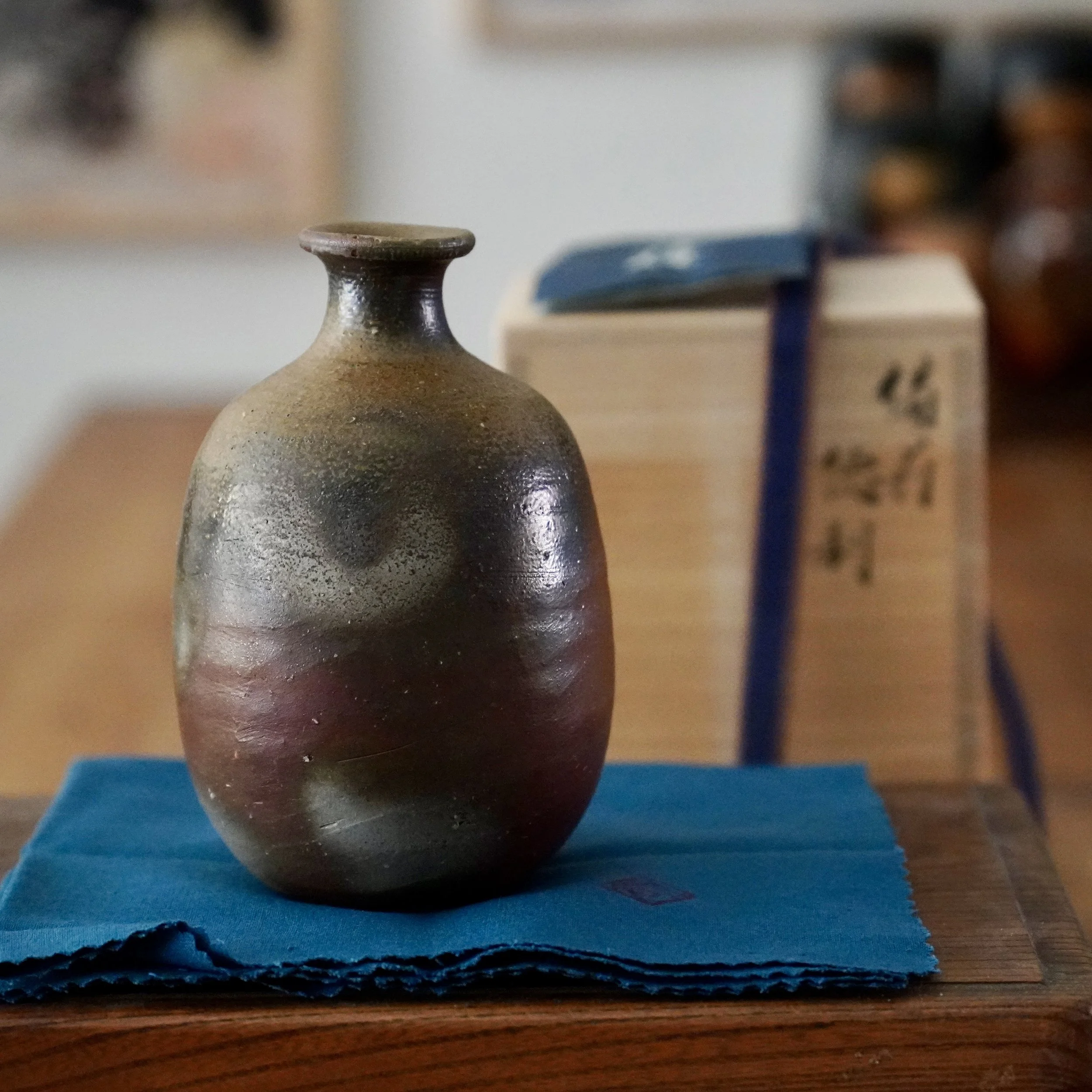
There is a quiet violence to how this tokkuri came out of the kiln. No glaze was ever applied, everything you see, the deep olive shoulder, the passages of smoky grey, the flush of aubergine low on the body, happened because ash and flame found this exact spot in the kiln and nowhere else. The form is rounded and a little heavy in the middle, the neck flares just enough to pour cleanly, and it sits with the kind of quiet confidence that unglazed stoneware only earns after firing for days.
This comes from Isezaki Sō, born into one of the defining pottery families of Bizen and a full member of the Nihon Kōgeikai, the Japan Craft Association, since 2004. He trained under Yamashita Jōji from 1987 and has spent the decades since collecting awards at the Nihon Dentō Kōgei-ten and the regional Chūgoku exhibitions that matter most within the tradition. Owning this is owning a piece from someone who has spent a working lifetime answering to that lineage, not performing it.
No glaze, no paint, just fire. I wrote about how Bizen gets its color, in my journal.
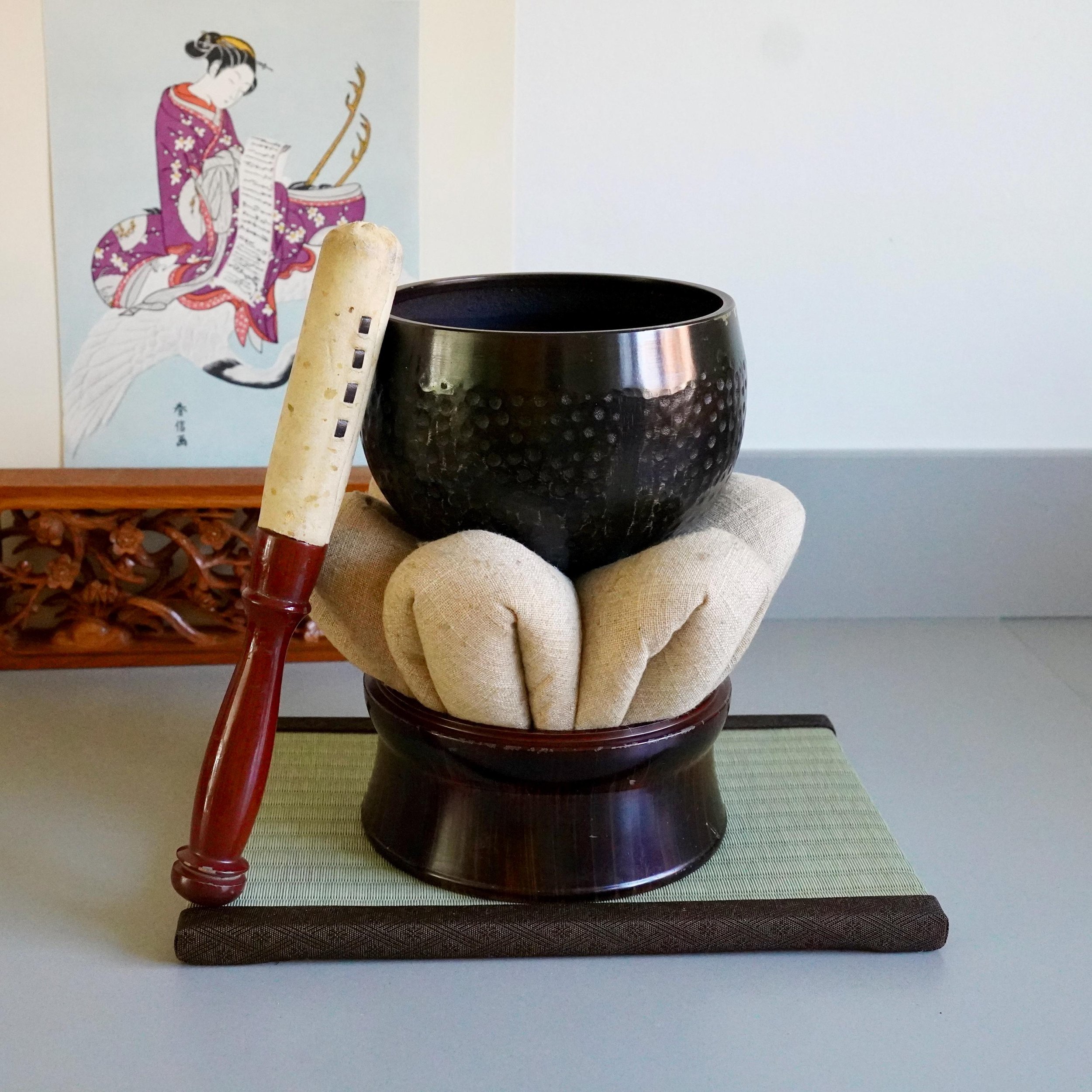
This rare temple singing bowl from the Showa era is a heavy, resonant treasure, sourced directly from Kyoto. Cast in solid bronze, its surface features a hand-hammered tsuchime finish that catches the light, shifting from deep graphite to warm amber as you move around it. It is a substantial piece with a grounded presence even before it is struck.
Place it in a meditation room or on a yoga studio altar and it will hold its own. It has the weight and presence of a genuine temple object, which is exactly what it is. If you work with somatic healing, breathwork, or mindfulness practice, the depth of the tone carries well even in a larger space. The set is entirely original and complete, standing 24 cm tall. It includes the bronze bowl, a dark red-brown lacquered wood stand, and a mallet with a matching red handle.
Read more about the objects for your Japanese meditation corner, and why each one matters in my journal.
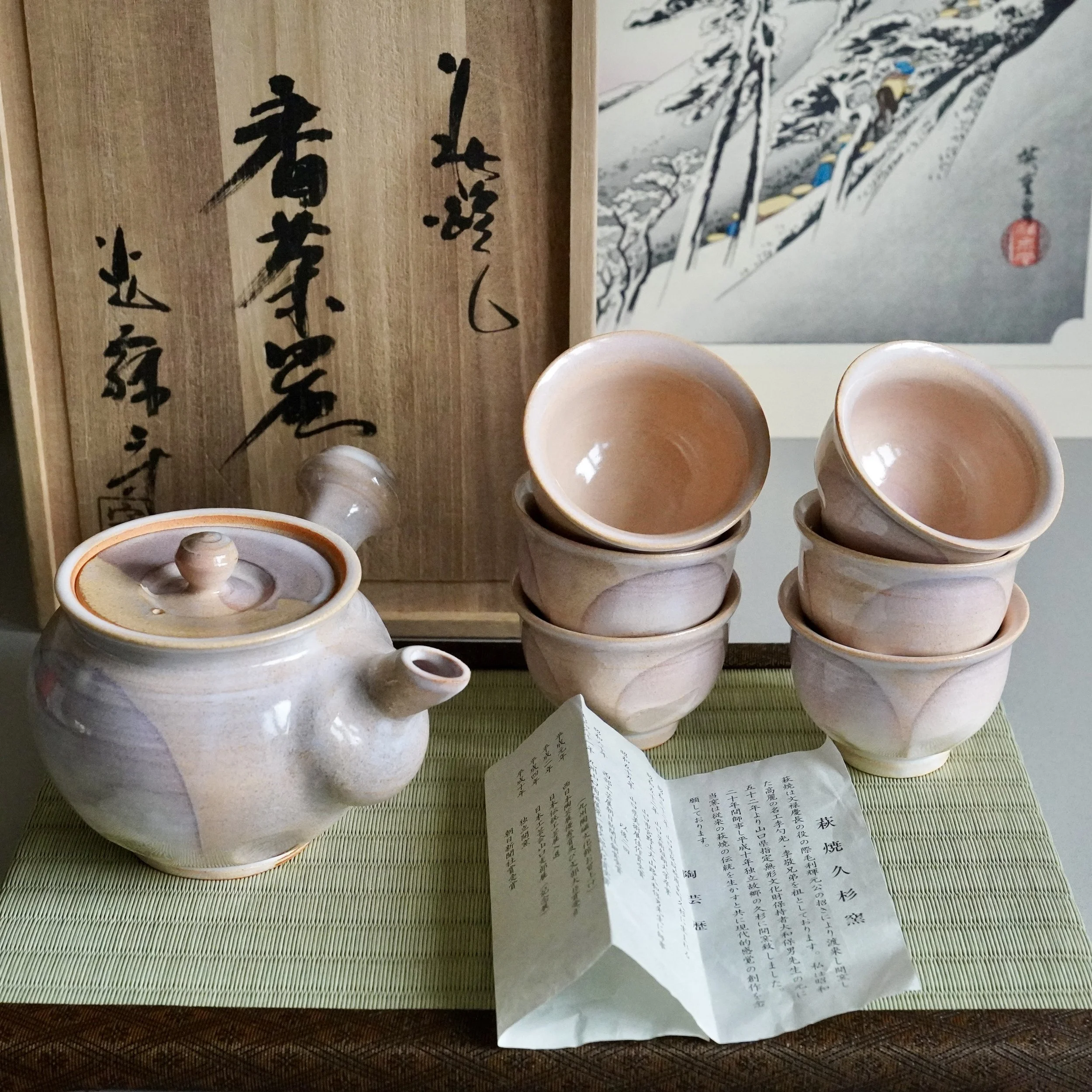
Six yunomi and a kyusu, all thrown and fired together in the soft, porous clay that makes Hagi-yaki so distinct, in a glaze that shifts between pearl white and a soft, bruised lavender depending on the light. The cups curve gently inward, sized to sit naturally in both hands. The kyusu is low and full, compact but generous, built for loose leaf tea, with a side handle and a ceramic strainer fitted right into the spout. Nothing about the set feels overworked, and the seven pieces read unmistakably as one gesture.
Most vintage Hagi-yaki arrives with a kiln stamp and nothing else, no way to trace who shaped it or when. This set comes with more: an original tomobako signed and sealed by Kondō Mamoru himself, and his own shiori documenting the piece. Paper trails like that rarely survive on tea ware that has changed hands as often as this has. It turns six cups and a teapot into something you can actually place, not just admire.
Read more about the beauty of Hagi-Yaki that will grow with you in my journal.
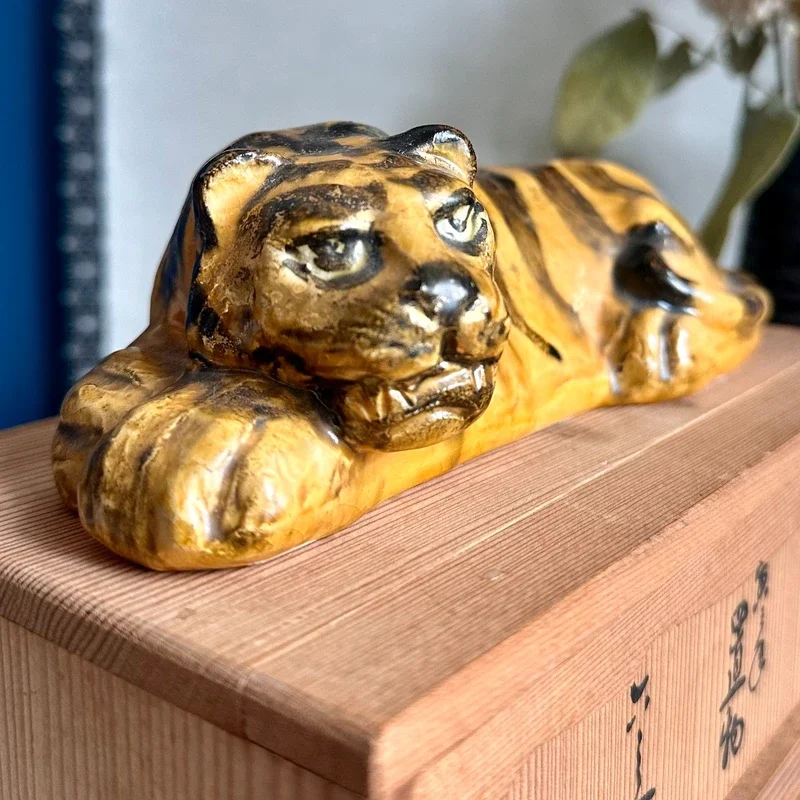
The tiger lies with its head turned toward you, one paw forward, the weight of the body settled. The glaze is warm amber with dark brown stripes, and the face is painted with enough specificity that you know exactly what kind of animal this is without needing to be told. It is not decorative in the way of a souvenir. It is a studied likeness. Something about the expression, slightly open-mouthed, the eyes directed outward, makes it feel more alert than resting.
Kiyomizu Rokubei VI (六代清水六兵衞, 1901 to 1980) came from a kiln lineage that had been making animal okimono as part of its output since the 18th century. Zodiac animals made at the Rokubei studio were considered collector pieces, sold at high-end establishments throughout Japan. This tiger is signed with the 六兵 personal name seal pressed into the base, and comes in its original tomobako inscribed 寅置物, tiger okimono. A piece likely made for a Year of the Tiger, most probably 1950 or 1962.
Read more about this tiger made for its own year and the kinsai gold Kyoto tradition in my journal.

Notice: This daruma has found a new home. If you are looking for something similar, scroll down.
There is a stillness to this face that stops you before you know why. The lacquer catches the light in a single warm sweep across the rounded body, and out of that glow two eyes stare back with an intensity that has nothing playful about it. Thick black brows, a carved red nose, a beard rendered in fine combed strokes rather than paint alone. This is not the round red good luck charm most people picture when they hear the word daruma. This one is older in spirit, more watchful, carved with the weight of someone who meant it.
This piece was made by Seifu Gono, a mingei craftsman known for turning keyaki, the slow growing Japanese zelkova prized for its depth of grain, into figures exactly like this one. The figure represents Bodhidharma, the monk who founded Zen Buddhism, and in Japan a daruma like this one is kept as a symbol of perseverance and quiet resolve rather than an empty decoration, its stern gaze said to watch over the room and turn away misfortune. Keyaki is not an easy wood to source, it takes centuries to mature, and Gono treated every piece as something meant to outlast him. What you are looking at carries his hand throughout, from the fine combed beard strokes to the deep, glass smooth lacquer.
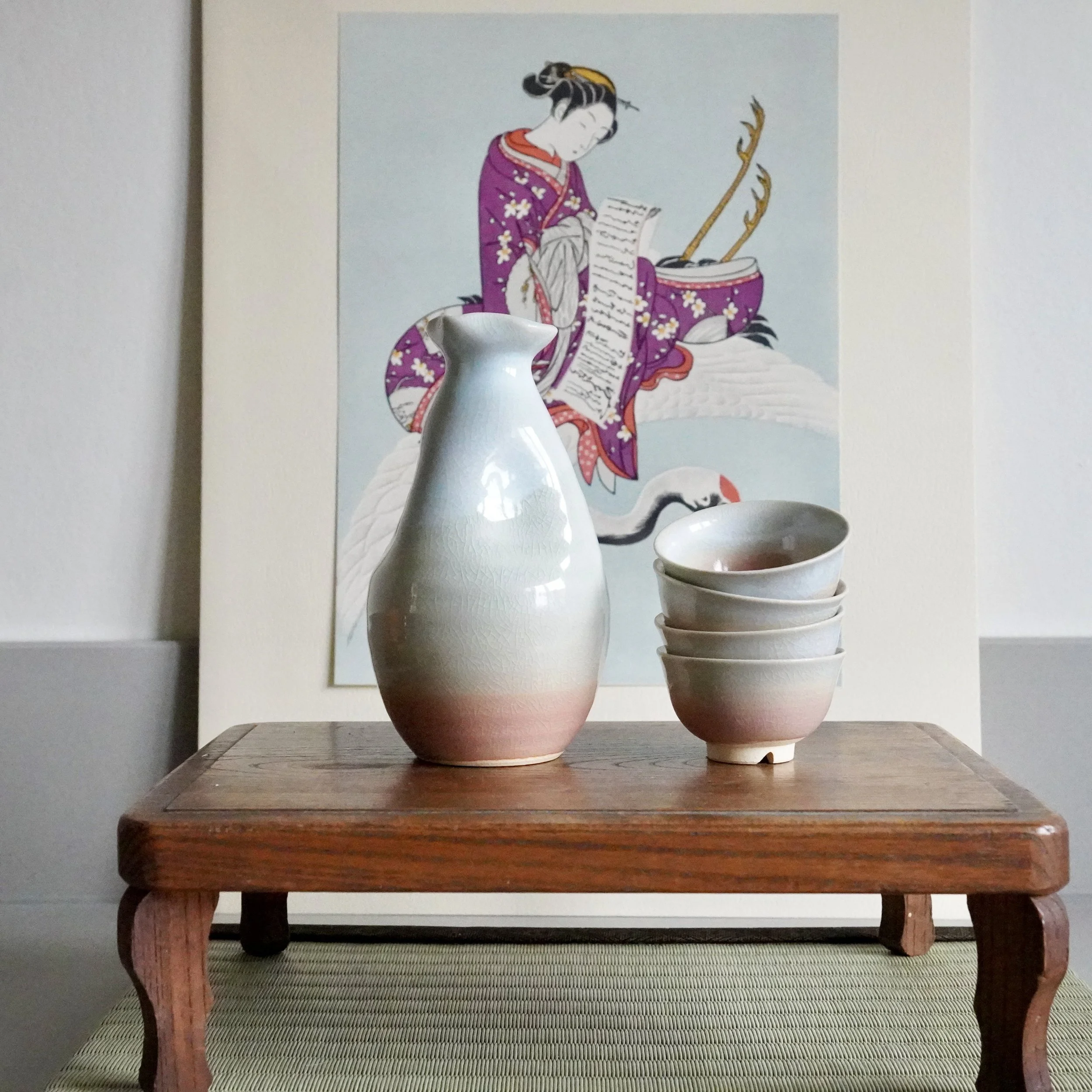
The gradient is the first thing that stands out A soft blush at the base, the colour of a winter sunset, rising into a cool pale blue-grey at the rim, as though the glaze caught its breath halfway through. One tokkuri and four ochoko, every piece moving through the same shift of colour, every piece a slightly different temperature when you hold it.
Hagi-yaki stands just behind Raku in the old hierarchy of Japanese ceramics, and its reputation rests on one quality: the clay is porous. Over years of use, sake works its way slowly into the surface and the colours shift. The Japanese call this shichibake, the seven transformations. For sake ware, this is not wear; it is the point. This set bears a kiln stamp pressed into the unglazed foot of each piece.
Pour sake into this set once and you have started something. Hagi clay is porous, so every cup you drink from leaves a trace: a slow, quiet shift in colour that the Japanese have a name for. Nobody can rush it, and no two sets change in quite the same way. I wrote about what actually happens inside the clay, why the crazing matters, and how to help the change along instead of fighting it. Read the full story.
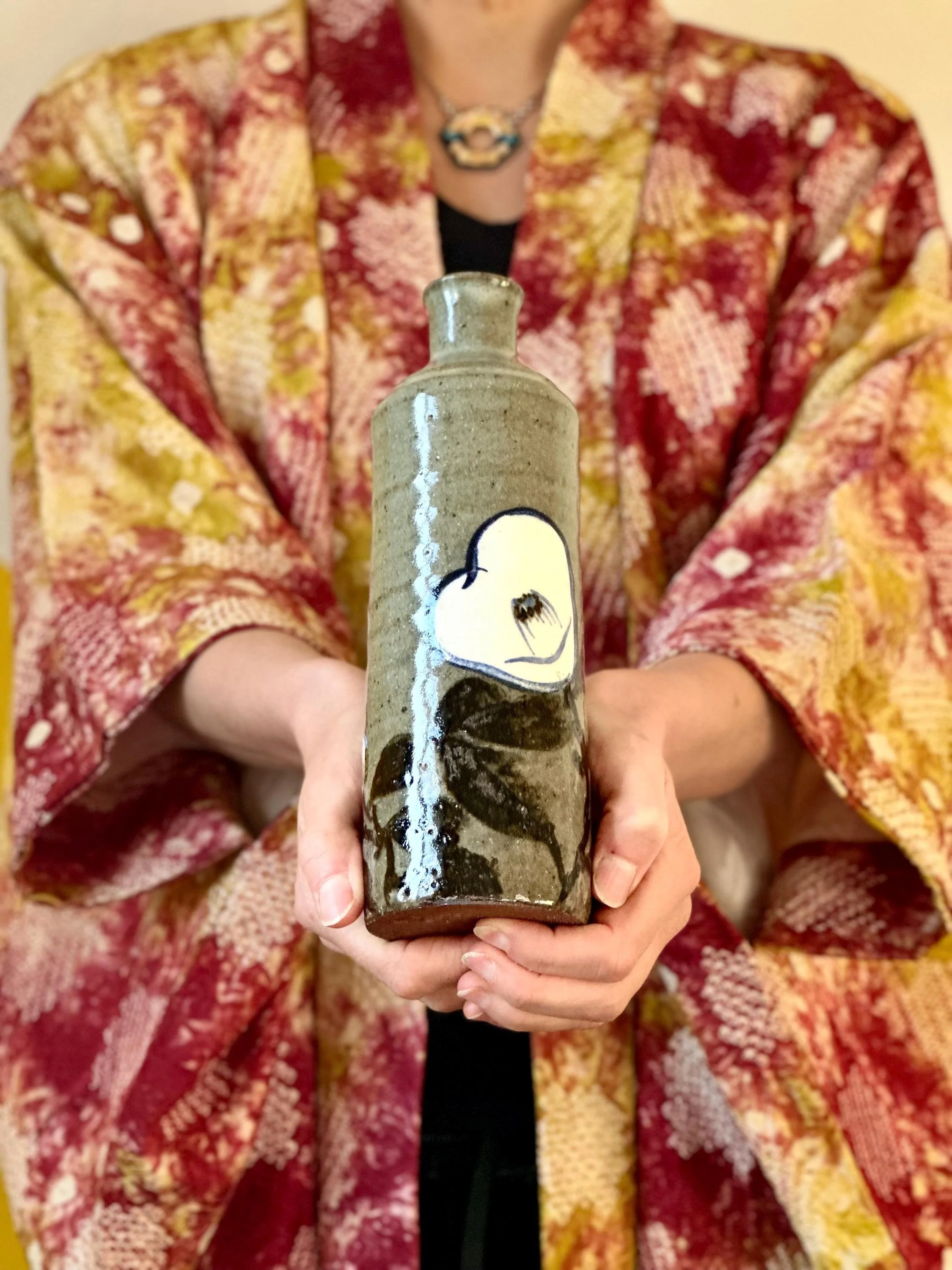
A grey-green cylinder with a white camellia near the base of the body. The white camellia flower sits brightly against dark brushwork. A branch with leaves painted in loose gestural strokes that look effortless and are not.
Above it, the glaze shifts and pools in variations of green, grey and near-black. The narrow neck rises straight from the shoulder. The whole piece has the quality of something made by someone who no longer needed to think about what they were doing.
The vase is covered in a sophisticated grey-green glaze that shows a fine, well-developed kanyuu crackle pattern. Adding a sense of depth and history to the stoneware. The way the crackle interacts with the speckled underglaze creates a subtle, organic texture that is highly valued in Japanese ceramics.
Kiyomizu Rokubei VI (六代清水六兵衞, 1901 to 1980) was the sixth generation of one of the most significant kiln lineages in the history of Kyo-yaki, a family with nearly 250 years of history in the Gojōzaka district of Kyoto. His work is in the collection of the Metropolitan Museum of Art in New York.
This piece comes with its original signed tomobako inscribed 白椿, shirotsubaki, white camellia, and the original printed shiori documentation tracing the Kiyomizu Rokubei lineage across every generation.
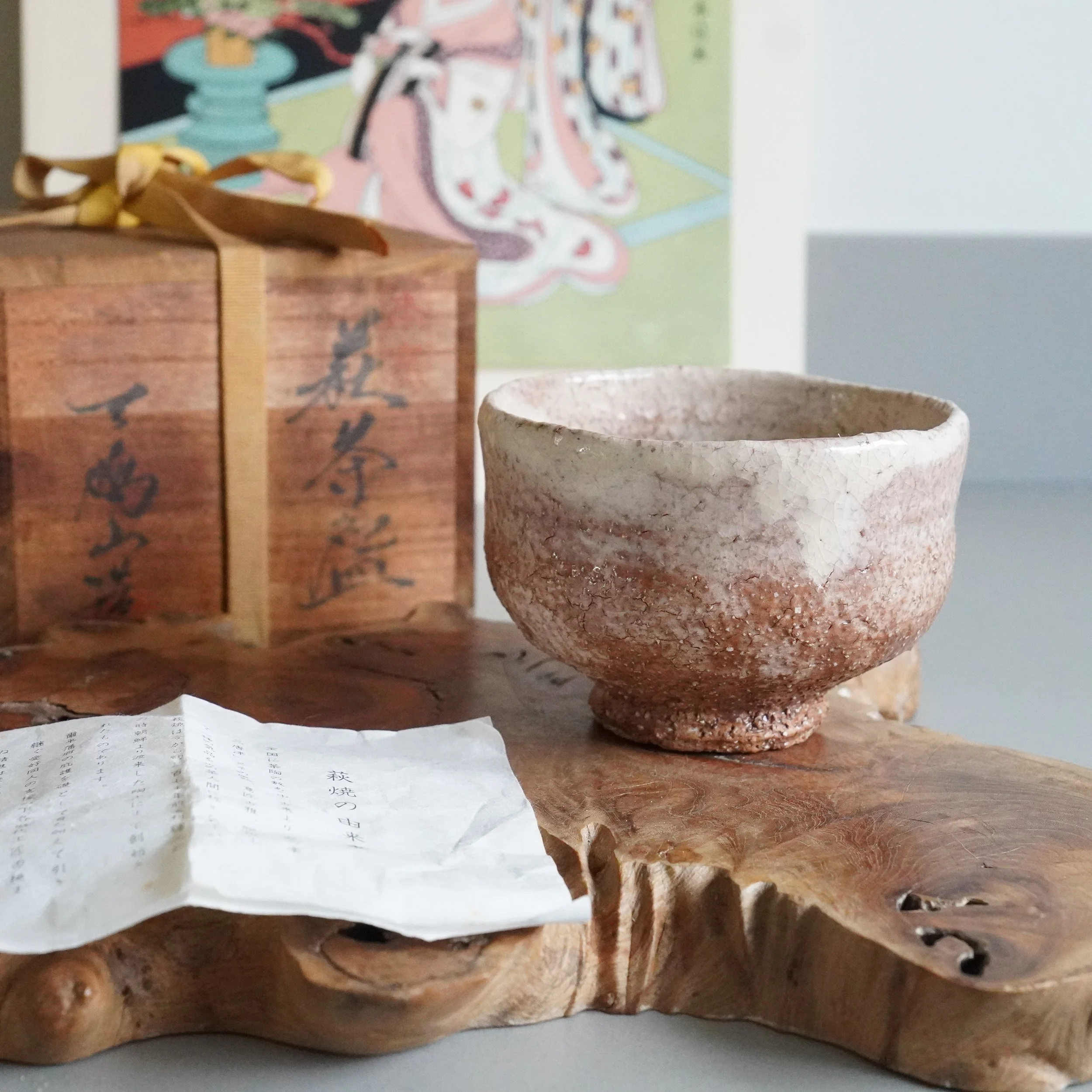
The clay here is warm and gritty in a way that reads almost geological. The glaze deepens to amber-brown at the base and fades toward a pale sandy beige at the rim, and the transition between the two is not a line but a gradual dissolve. The form is slightly irregular, soft-shouldered, made without any ambition to be symmetrical.
This bowl comes from the founding generation of one of Hagi's most recognised kilns. The tomobako carries the hanko of Hirose Nanshū (南州), the man who established the Tsubaki-gama Tenpōzan in Hagi. The telephone notation on the shiori dates the documentation to before direct-dial lines existed in the city. Somewhere in the 1960s or earlier.
The shiori itself was signed by his son Hirose Tanga, who took over the kiln and continued his father's practice. That combination (the father's box and seal, the son's documentation) is a quiet record of how Japanese family kilns pass from one generation to the next. Hagi-yaki has held the second rank in the traditional tea master's hierarchy for centuries, behind only Raku. A bowl from the founding generation of a kiln in that tradition is not a common thing to find.
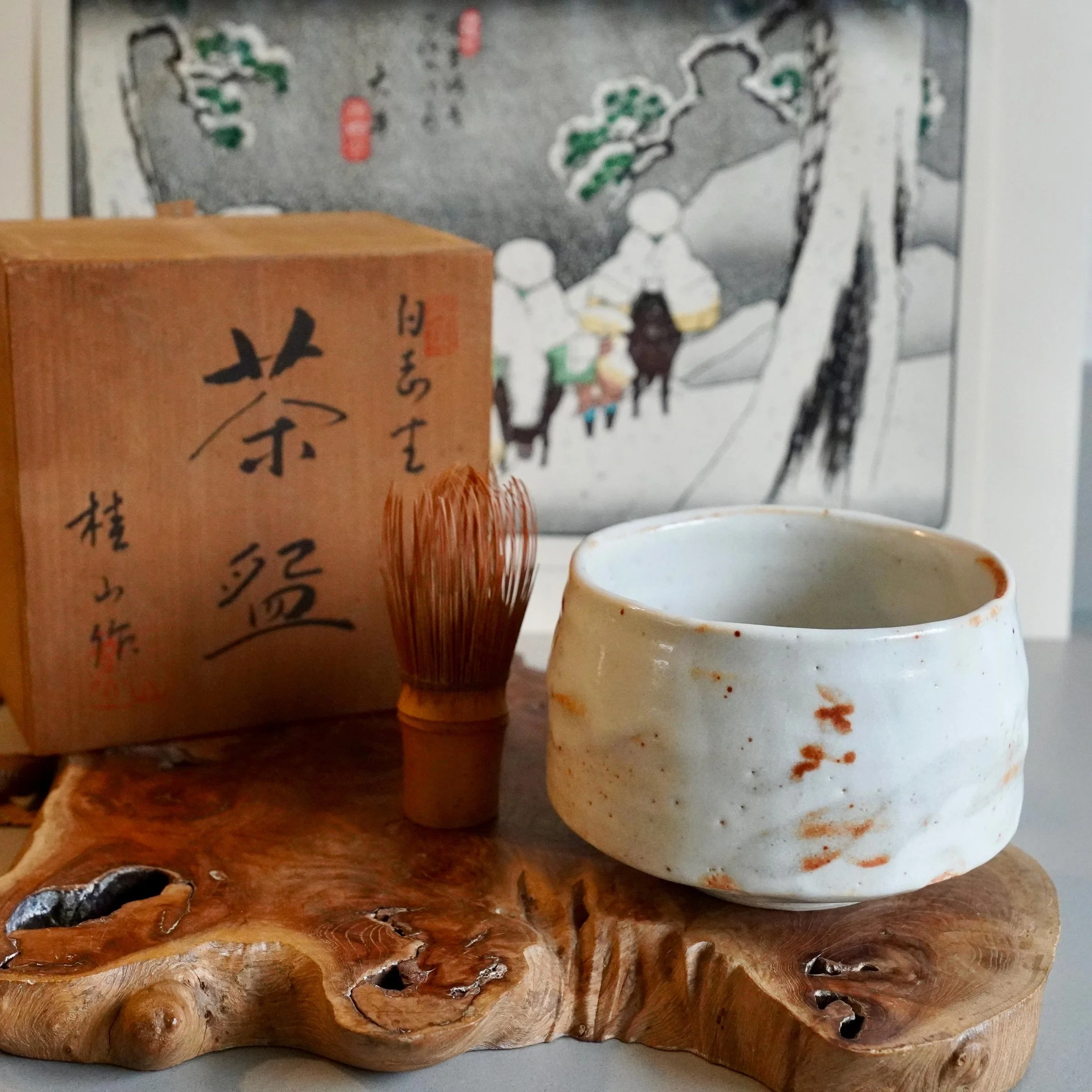
This bowl has a way of looking complete from any angle. The form is low and wide, the rim gently uneven in the way of something made by hand rather than adjusted toward perfection.
The glaze is a full, dense shining white over most of the body, with orange pushing through directly where the clay asserts itself. It stops you before you know why.
This chawan comes from an earlier generation of Taizan-gama, one of the kilns that has worked in the Tsubaki district of Hagi within a tradition tea masters have placed second only to Raku for four centuries.
The tomobako is inscribed 白萩 茶碗 and the bowl carries the full rectangular 泰山 seal, the older mark of the kiln used before the oven was incorporated as a company.
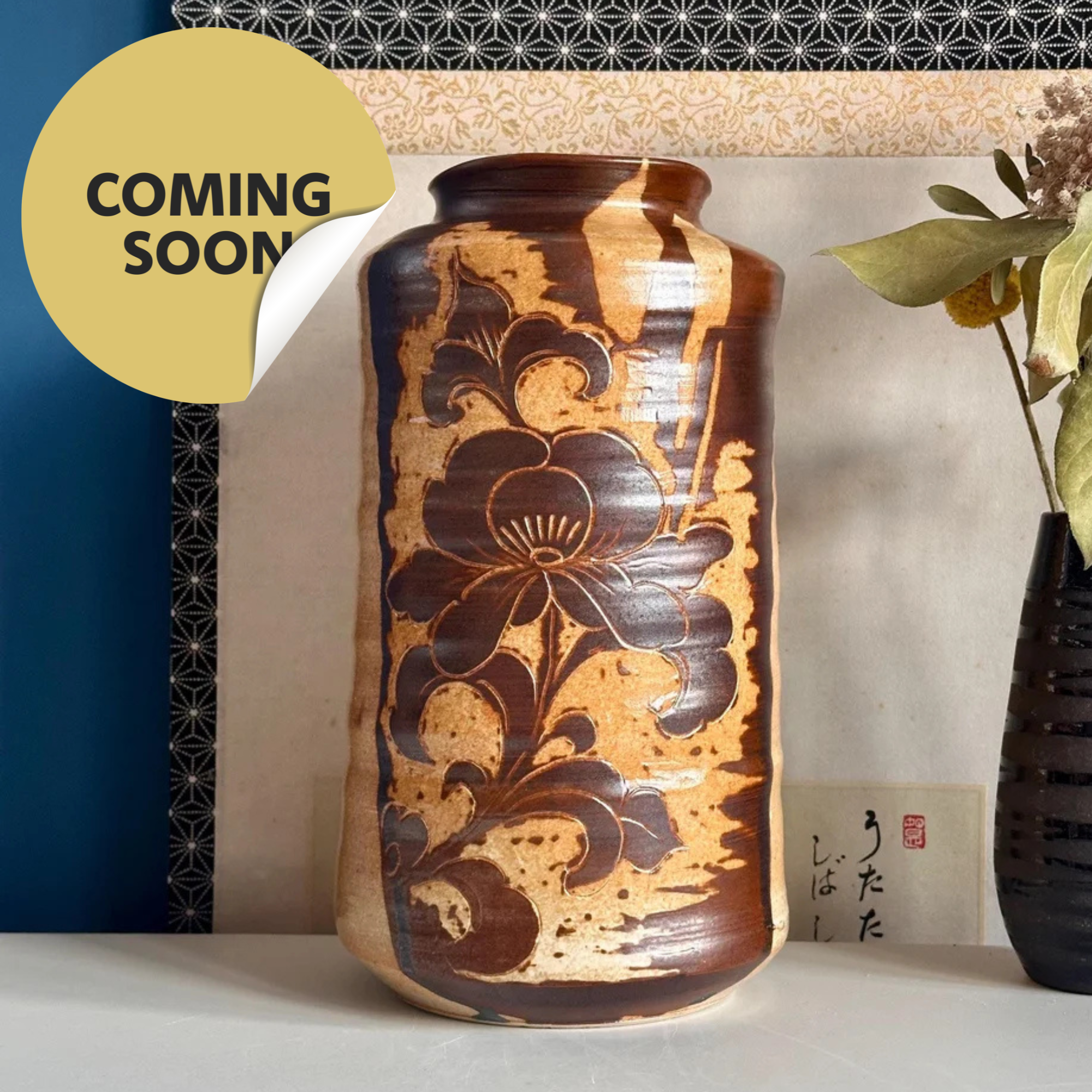
I work through my finds in small batches as each piece takes time to research, photograph and write properly. But some items are too good to sit invisible in the backlog, and if you have been looking for a significant piece of Shōwa-period award winning studio pottery, I want you to know this one exists.
This is a stoneware kabin (flower vase) by Sakai Yoshito (酒井芳人), second-generation master of the Goshōen-gama kiln in Tobe Town, Ehime Prefecture. He signed his work under the name Yoshimi (芳美), which is the name on the base and on the tomobako. The vase is approximately 30 cm tall and weighs 1.723 kg: a substantial object. Dark iron glaze covers roughly half the surface; where it has been cut through, a large peony composition emerges in the ochre clay beneath.
The piece dates from ca. 1975, the year Yoshito received the Japan Foundation President's Prize at the Japan Ceramics Exhibition. Later in his career he received the Minister of Education's Prize at the Nitten, Japan's foremost fine arts exhibition, and was designated Tobe Town Intangible Cultural Property. The original tomobako and exhibition documentation are included.
The full listing, photographs and price will follow. Want to know the moment it goes live? Scroll down.
👇
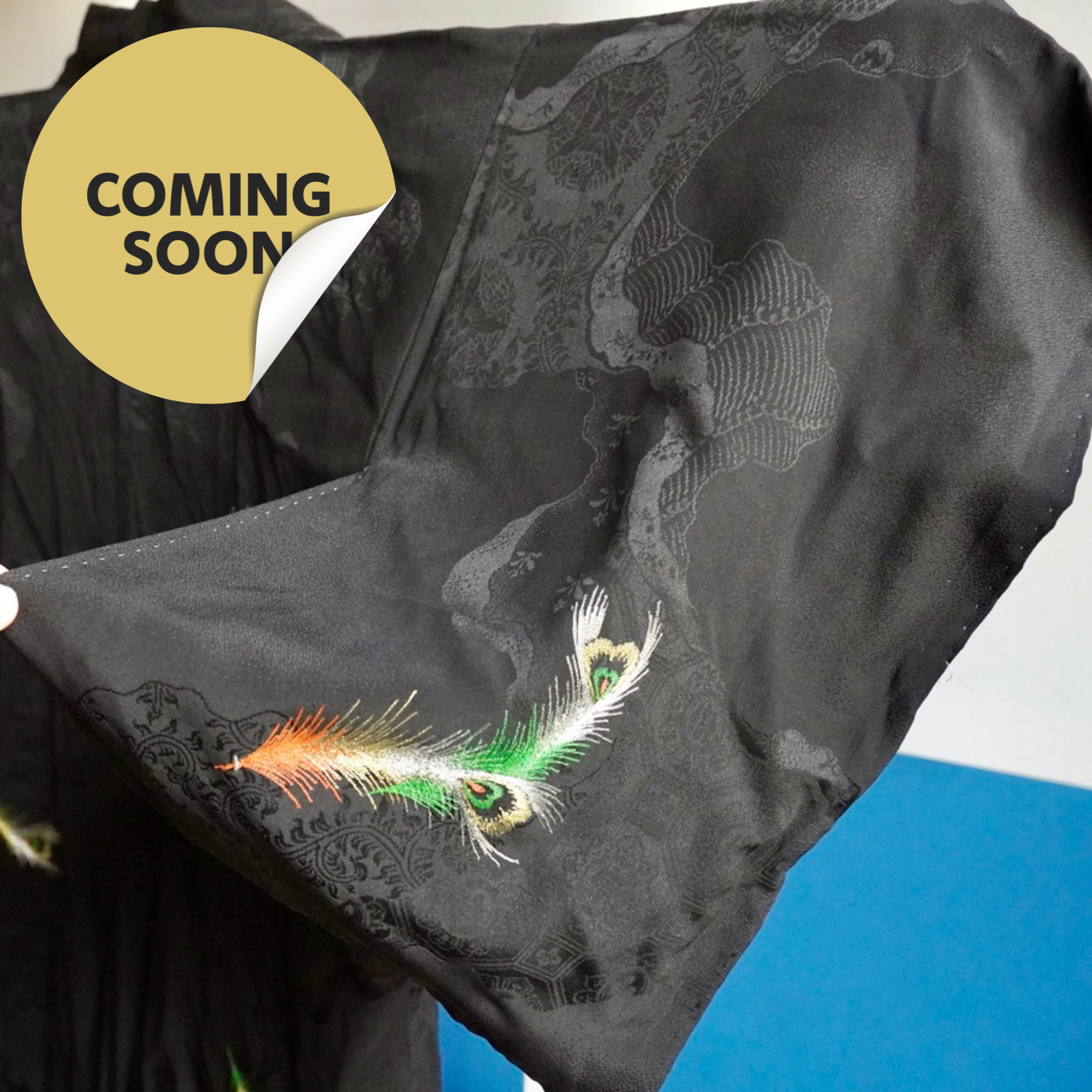
I work through my finds in small batches as each piece takes time to research, photograph and write properly. But some items are too good to sit invisible in the backlog, and if you have been looking for a vintage black silk formal haori, I want you to know this one exists.
This is a formal Shōwa-era kuro haori in black rinzu silk with a tone-on-tone hexagonal kikko pattern woven into the fabric, visible only when the light moves across the surface. Scattered across the body and sleeves are hand-embroidered peacock feathers in copper, green, and white, each with the iridescent eye worked in multiple thread tones. A single embroidered kamon sits at the center back seam. The basting stitches are still in place. This haori has never been worn.
The full listing, photographs and price will follow. Want to know the moment it goes live? Scroll down.
👇
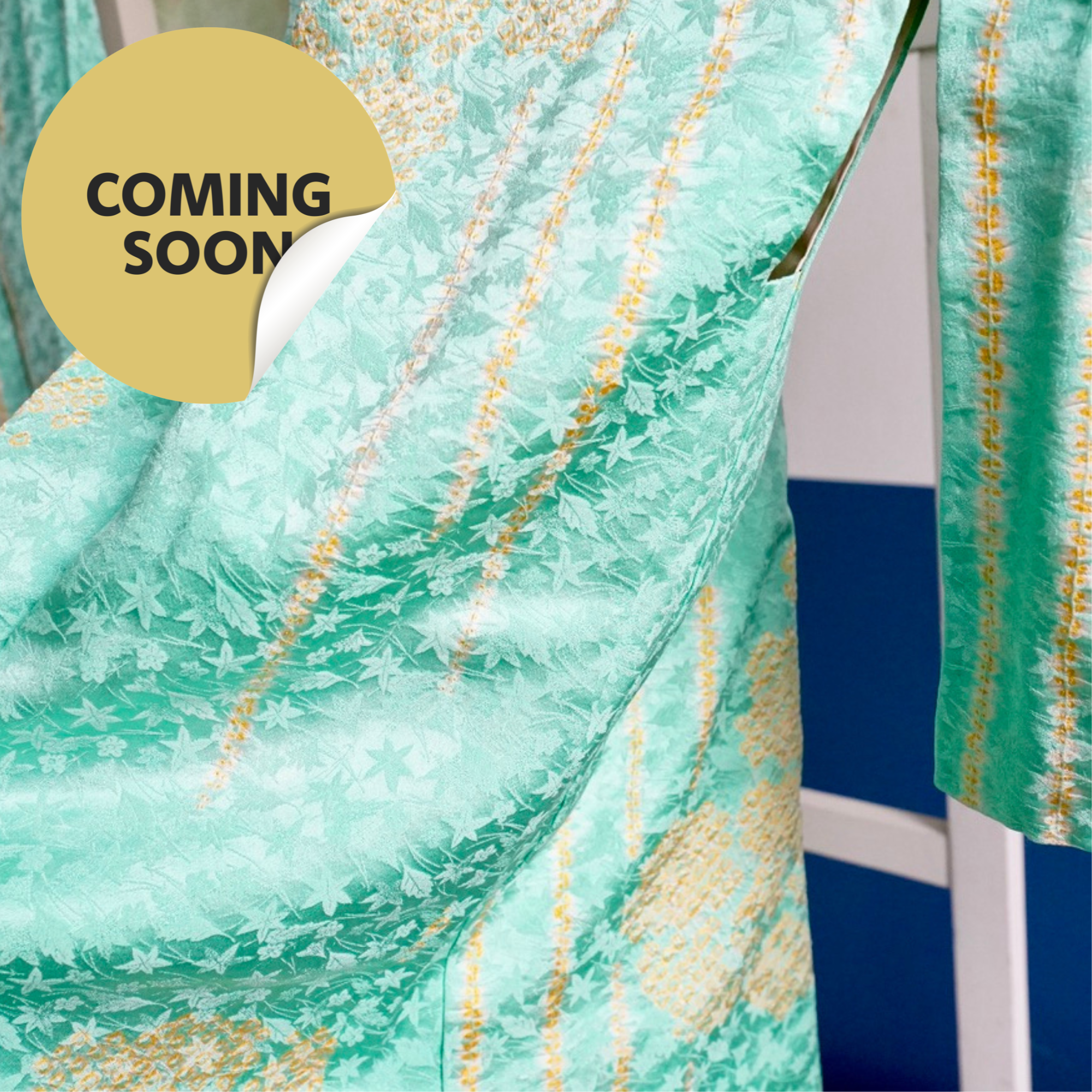
I work through my finds in small batches as each piece takes time to research, photograph and write properly. But some items are too good to sit invisible in the backlog, and if you have been looking for a vintage shibori silk haori kimono jacket with maple leafs, I want you to know this one exists.
This is a Shōwa-era haori in mint celadon green silk with a woven maple leaf pattern running through the fabric itself, visible as shadow and light rather than color. Large clusters of gold kanoko shibori sit against the green ground in rounded shapes, with vertical lines of the same gold running between them. The lining is cream silk with a subtle woven pattern. The original white himo ties are still attached and looped as stored. The condition is exceptional.
The full listing, photographs and price will follow. Want to know the moment it goes live? Scroll down.
👇
Our collection of rare and unique finds
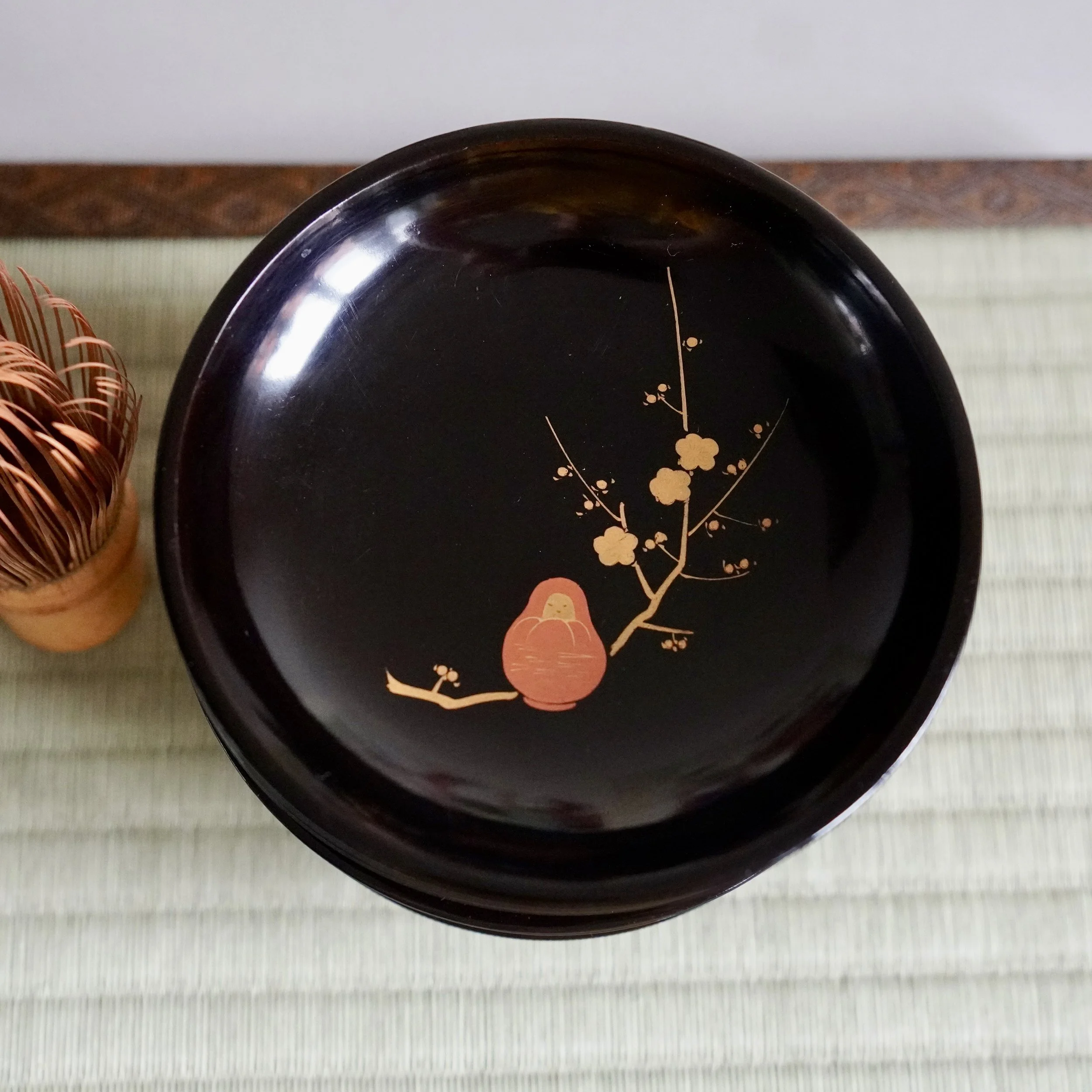
Tough surface, sensitive surroundings
Once cured, urushi lacquer resists water and everyday wear remarkably well. What it cannot handle is direct sunlight or dry air. A few simple habits keep the colour and the gold decoration intact for decades more.
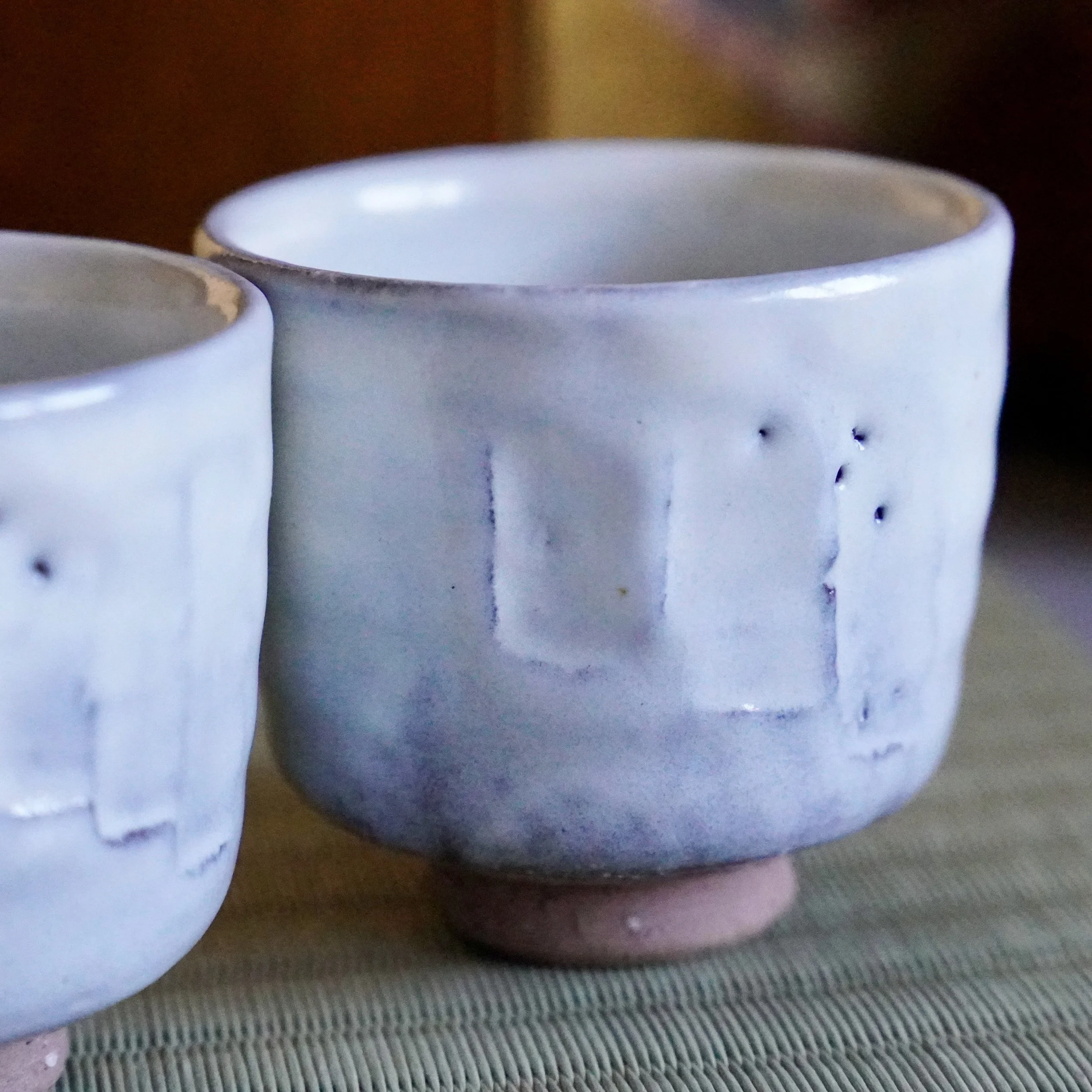
Tiny pinholes scattered across a thick glaze, a texture called su-ana, tell you more about Shino and Hagi ceramics than most people realise. Here's what causes it, and why potters never smoothed it away.
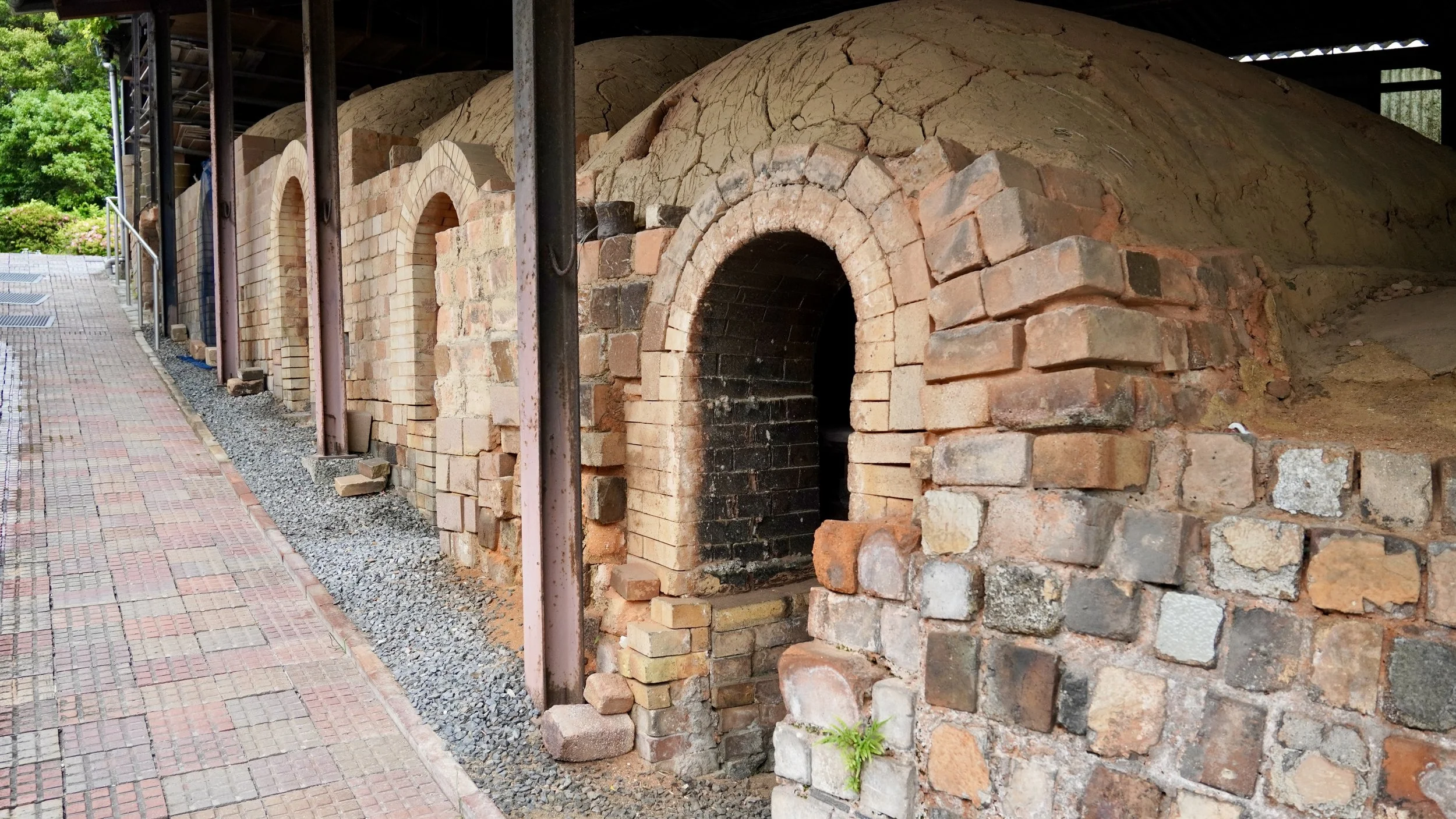
Senryūzan (泉流山) is a Hagi-yaki kiln in Yamaguchi Prefecture founded in 1826, tracing its roots back further still to the late Edo-period Obata-yaki tradition. The kiln was led for decades by Yoshiga Taibi, a recognised Person of Cultural Merit, and is now run by his son Yoshiga Hatao. Senryūzan still fires in a wood-burning noborigama, one of the few climbing kilns in Hagi still worked this way.
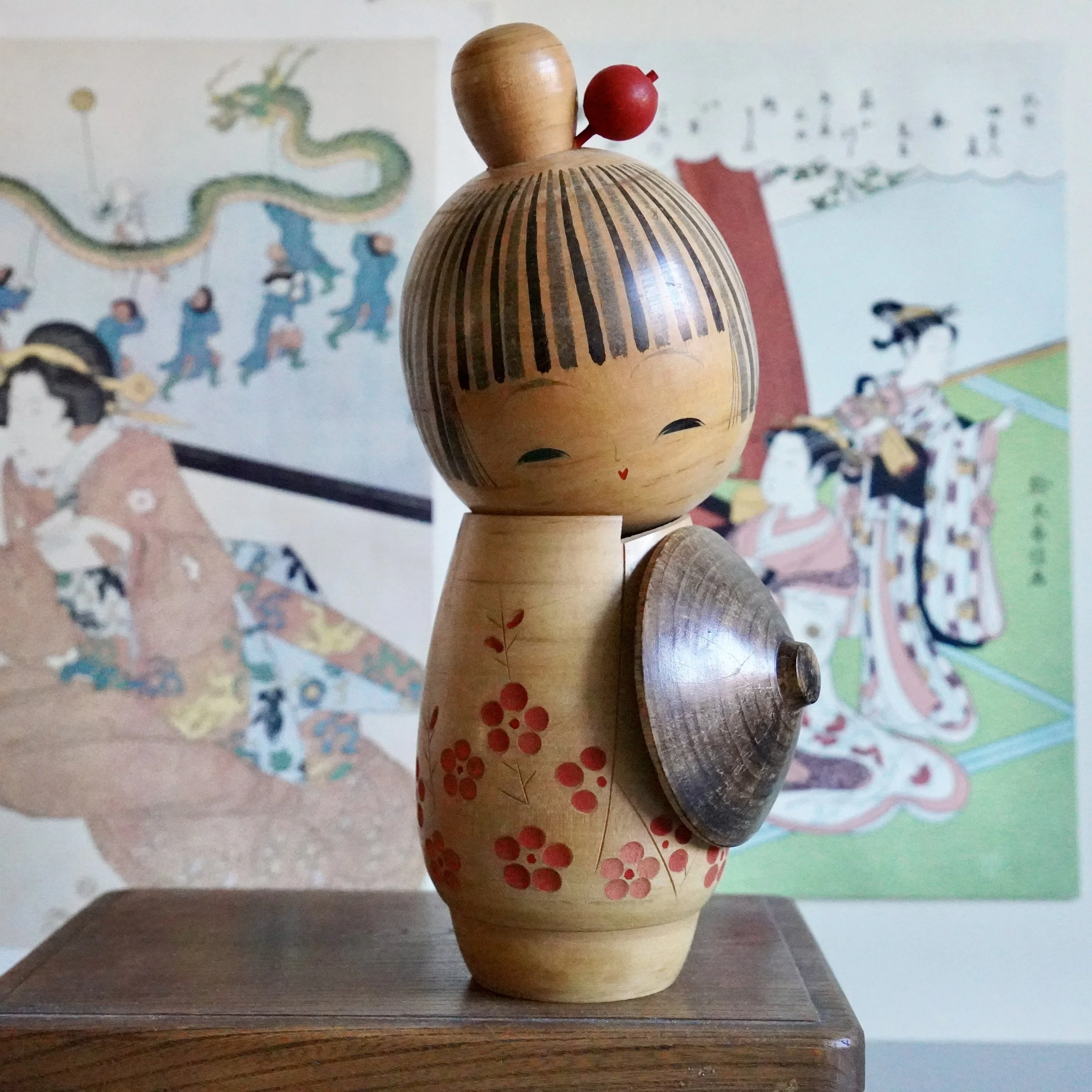
Oshinobi dōchū, travelling incognito, shows a Heian noblewoman shielding her face with a kasa hat while journeying in disguise. Two pieces in the collection, by Sato Suigai and Seiju Kon, show how differently that same story can be built in wood.
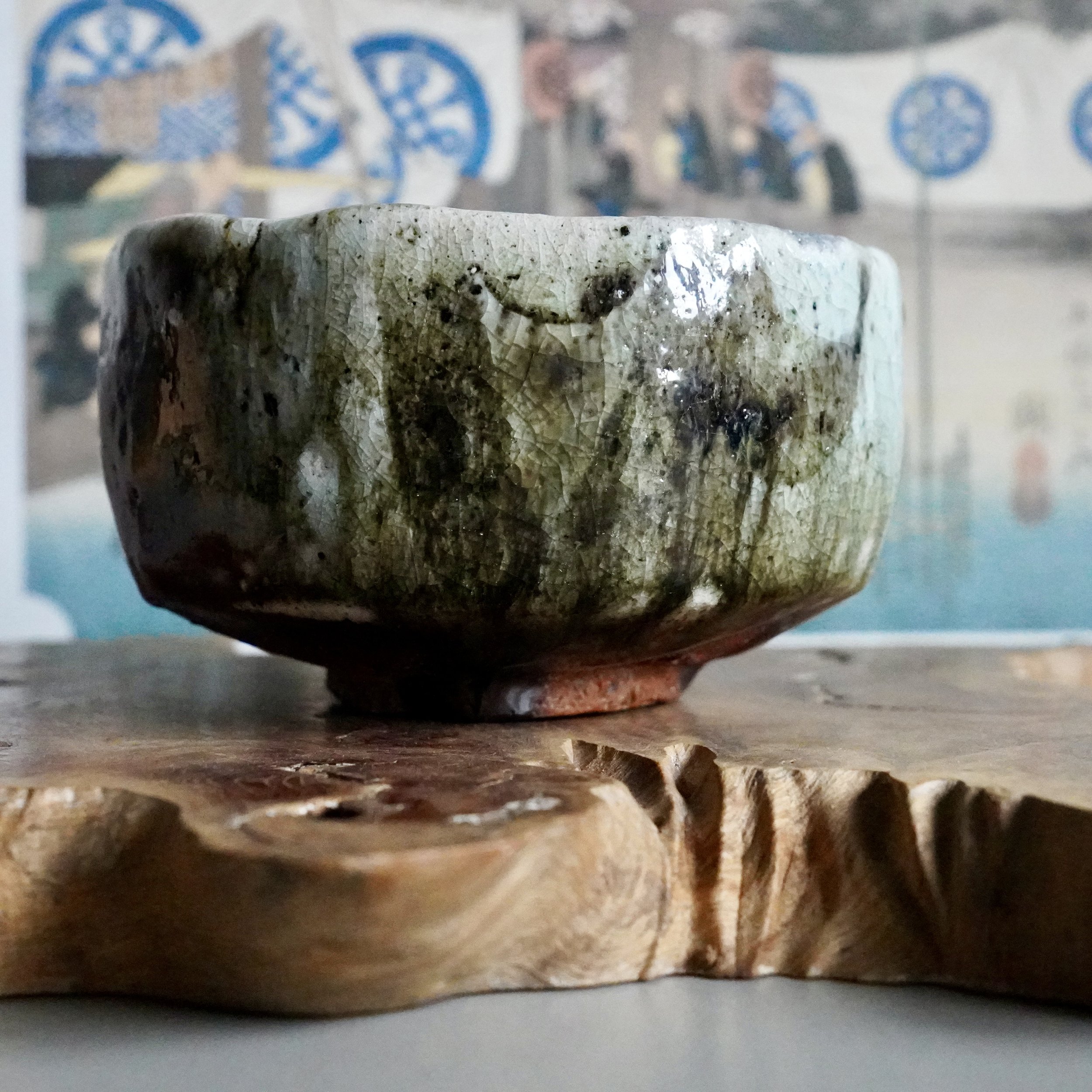
This chawan was fired at the Kakuzan-gama, a kiln built in 1959 inside the Kyoto headquarters of Ōmoto, a Japanese religious movement, by Kaneshige Sozan, a member of Bizen's most celebrated pottery family. It is signed by Deguchi Eiji, who served as Ōmoto's Sōchō (director) from 1958 to 1962. A single white glaze on this bowl developed rust, near-black and crystalline blue effects during firing, the result of flame position, ash deposit and heat variation inside a wood kiln, not of painting or decoration.
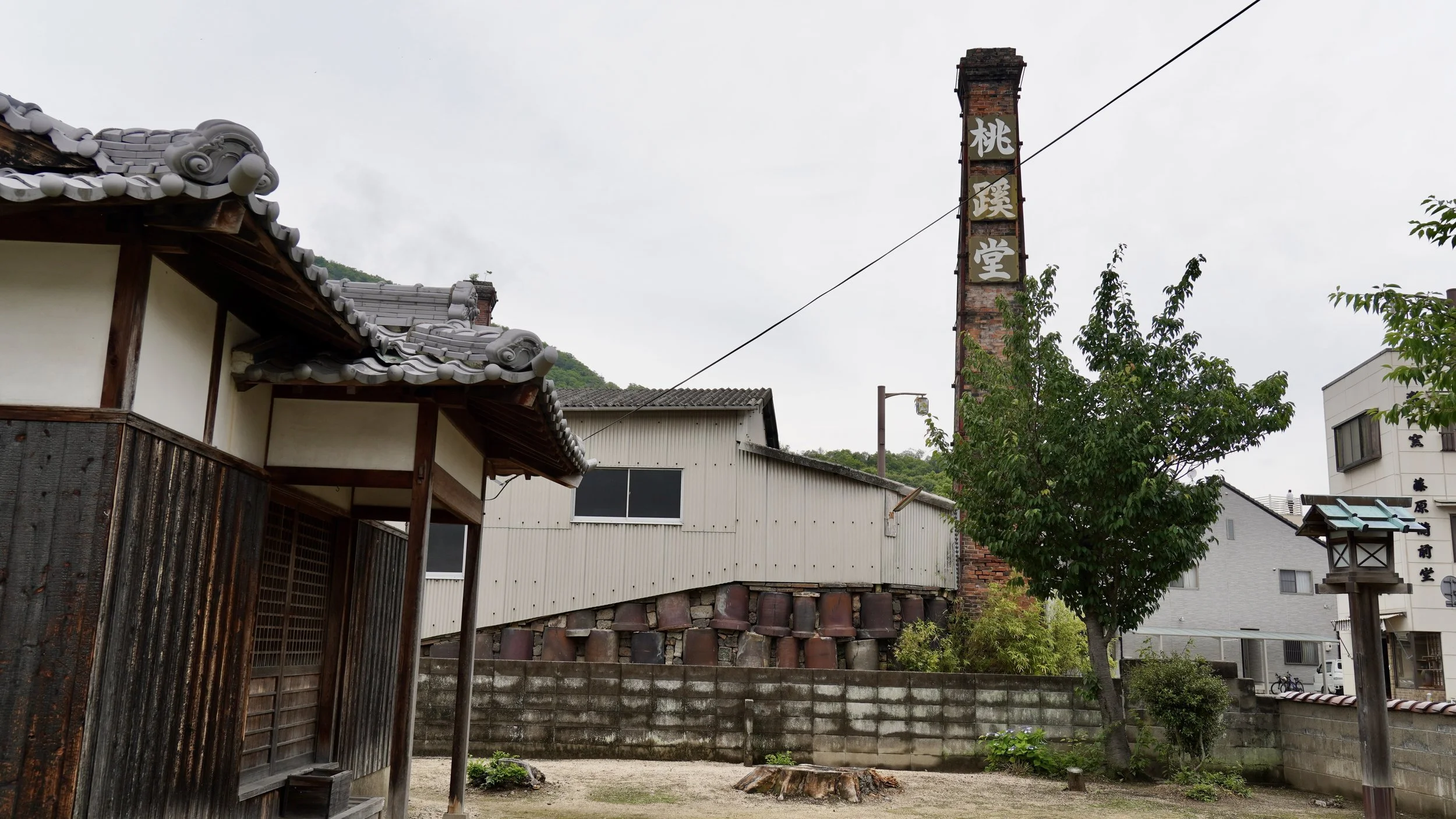
Bizen-yaki is never glazed and never painted. Everything visible on a finished piece was decided during the firing itself, by potters who spend two weeks feeding a kiln by hand, reading the fire instead of a dial. On a return visit to Shibaoka Tōsendō, the Kōzan-gama kiln in Imbe, here is what that actually looks like from the inside.
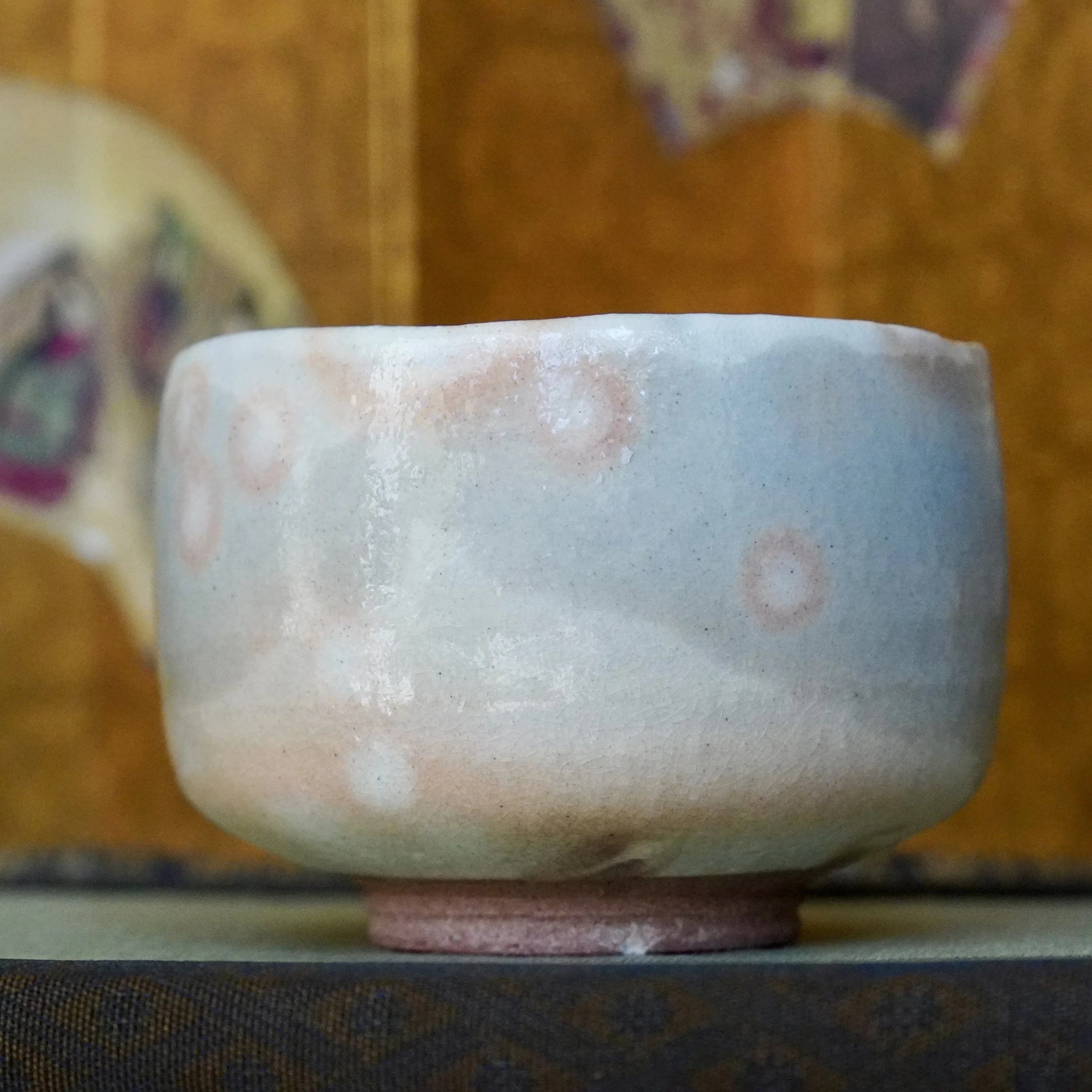
I filled a Hagi chawan with water and watched what happened. Within a minute, the glaze showed exactly how it will change with years of tea, and four other pieces revealed just how differently that process can unfold, starting long before the kiln, in the clay itself.
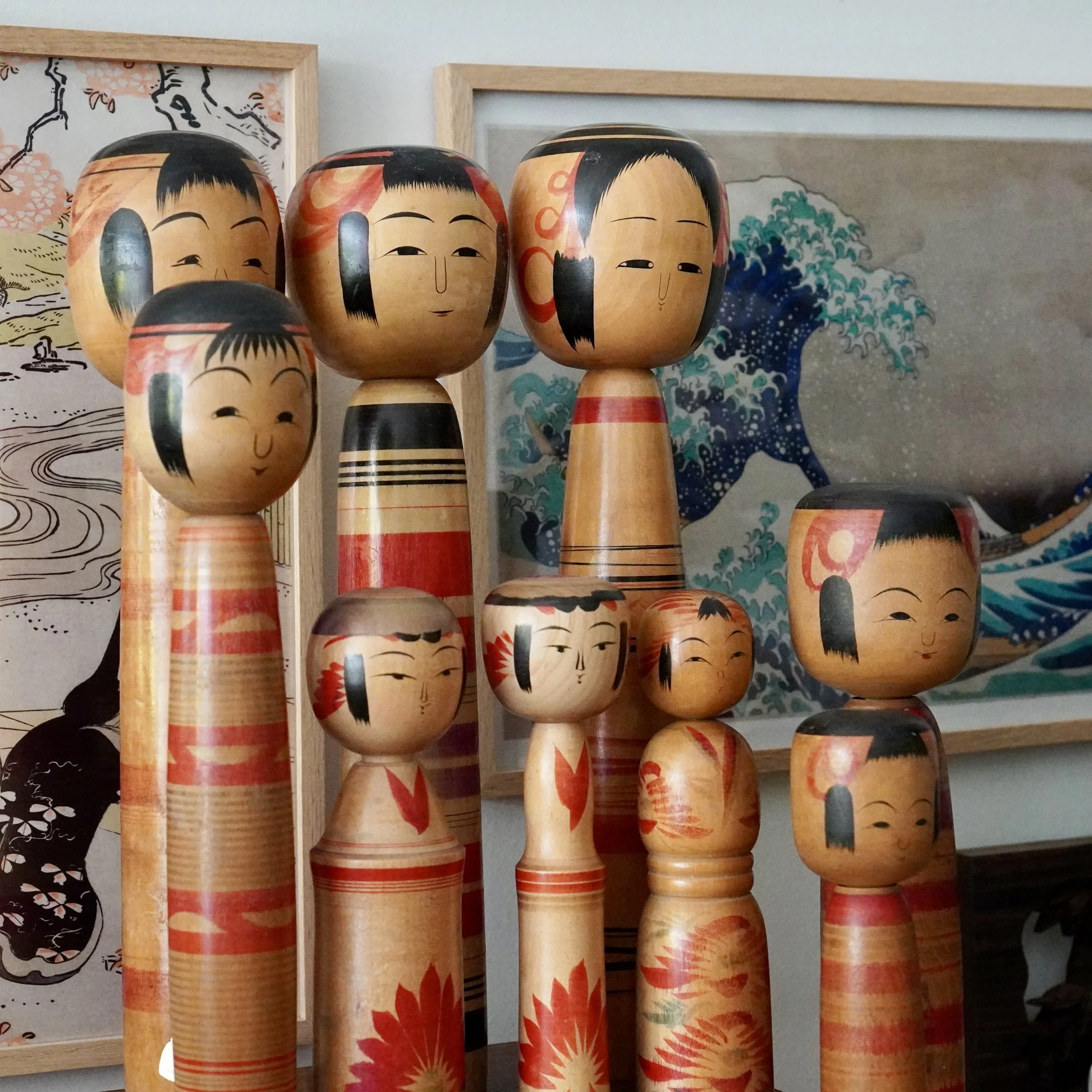
Every kokeshi carries the place it comes from before it carries anything else. A guide to the eleven regional traditions of Tōhoku, and how to recognise each one on sight.
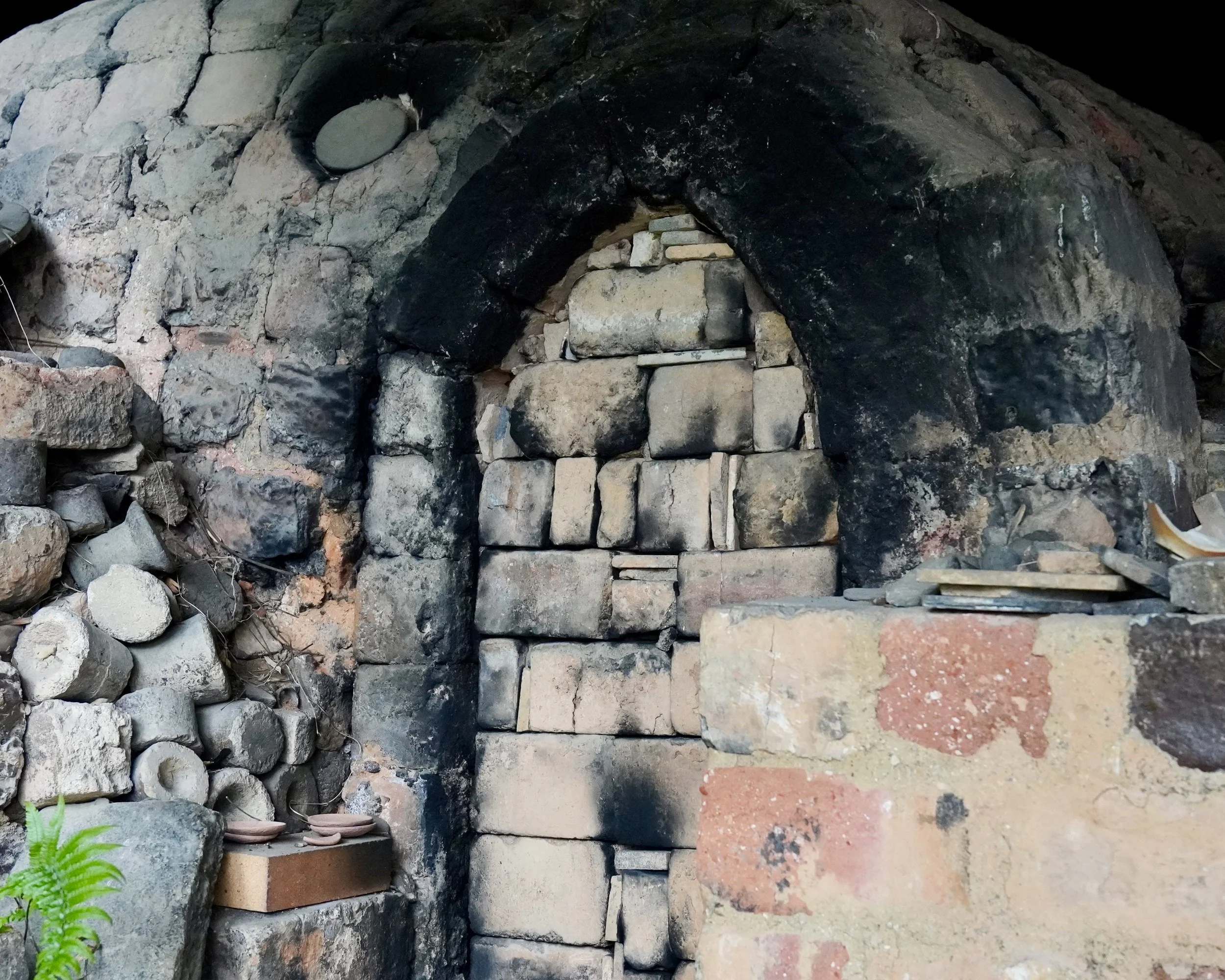
Three generations under one roof, a blue glaze that surprised me, and a cat I bought on the way out. One of my favorite mornings in Hagi, at the Okada kiln.
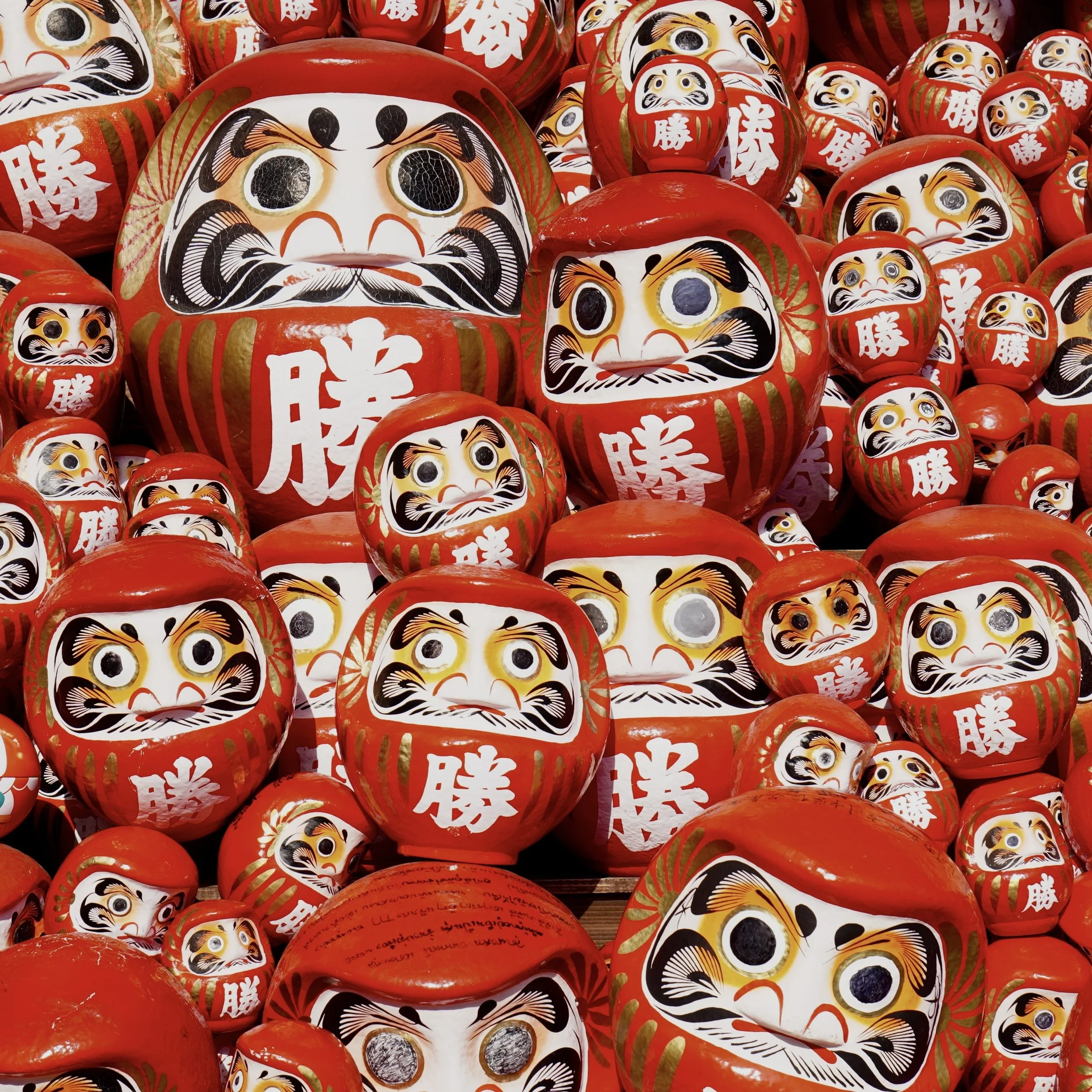
Perched in the forested hills of Minoh, Katsuo-ji is known throughout Japan as the Daruma Temple, thousands of red daruma cascading down its steps, each one carrying someone's wish. A visit that changed how I see the wooden daruma in our own collection.
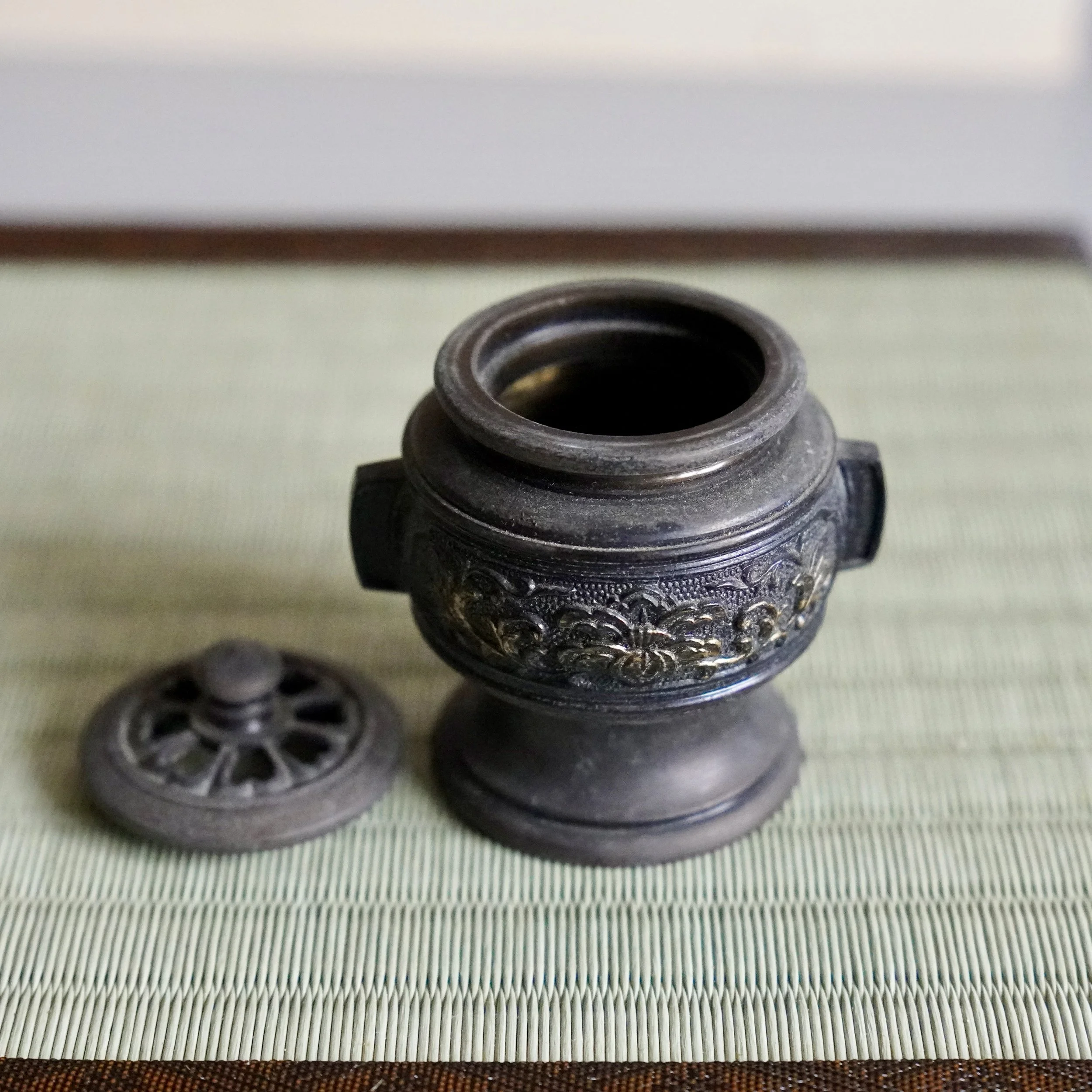
Every temple I visit in Japan has the same quality of quiet, and it starts with three things: scent, sound, and a presence that holds the space. Here is how to bring that same intention home, starting with a single kōro and the concept of ma.
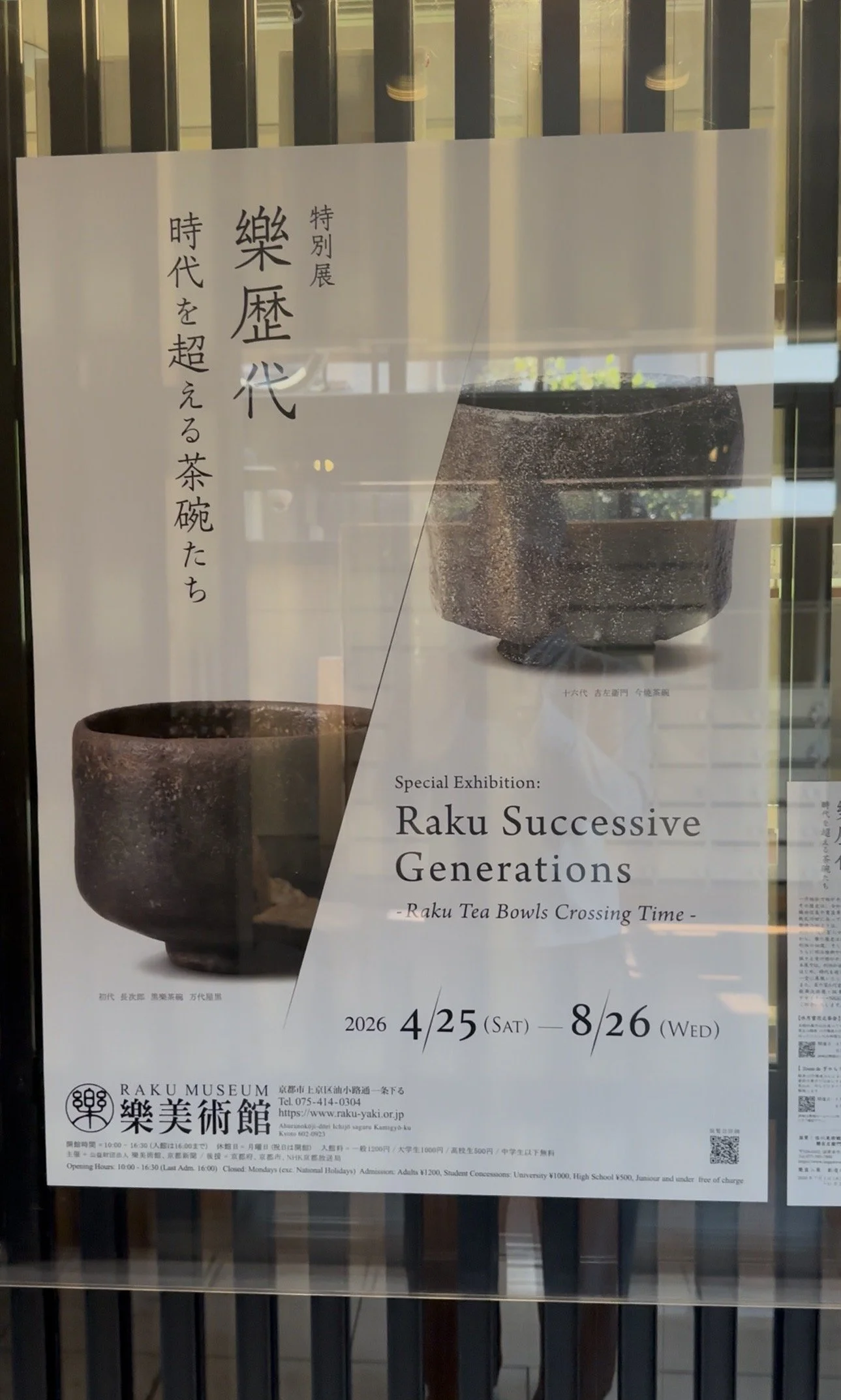
Inside the Raku Museum in Kyoto during the Raku Successive Generations exhibition. Chawan from Chōjirō to the 16th Kichizaemon, a quiet garden, and one idea about tradition that stayed with me.
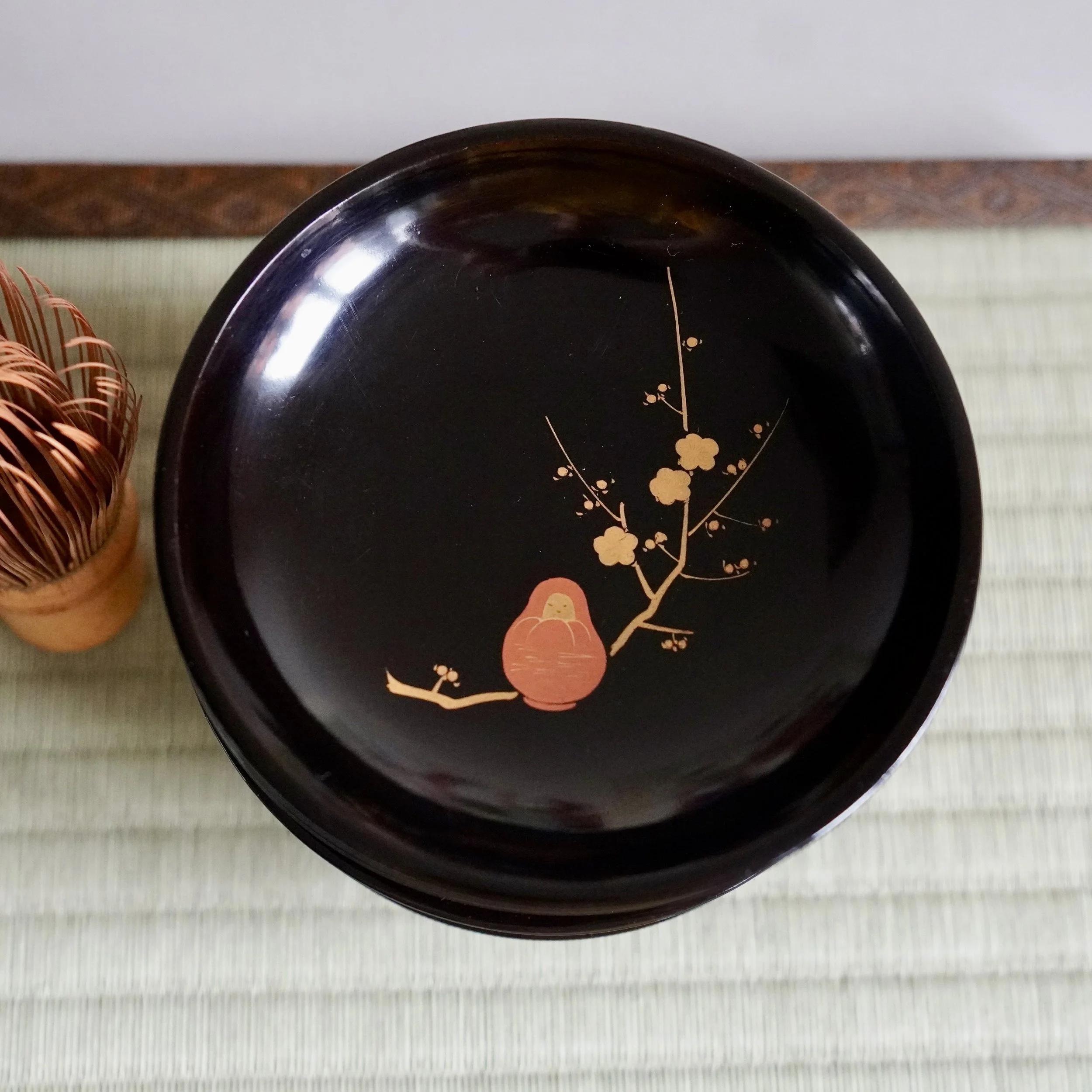
Urushi looks fragile and behaves like the opposite, until it meets a sunny windowsill or a winter radiator. Here is what actually damages lacquerware, what does not, and the handful of habits that keep a piece looking the way it did the day it was finished.
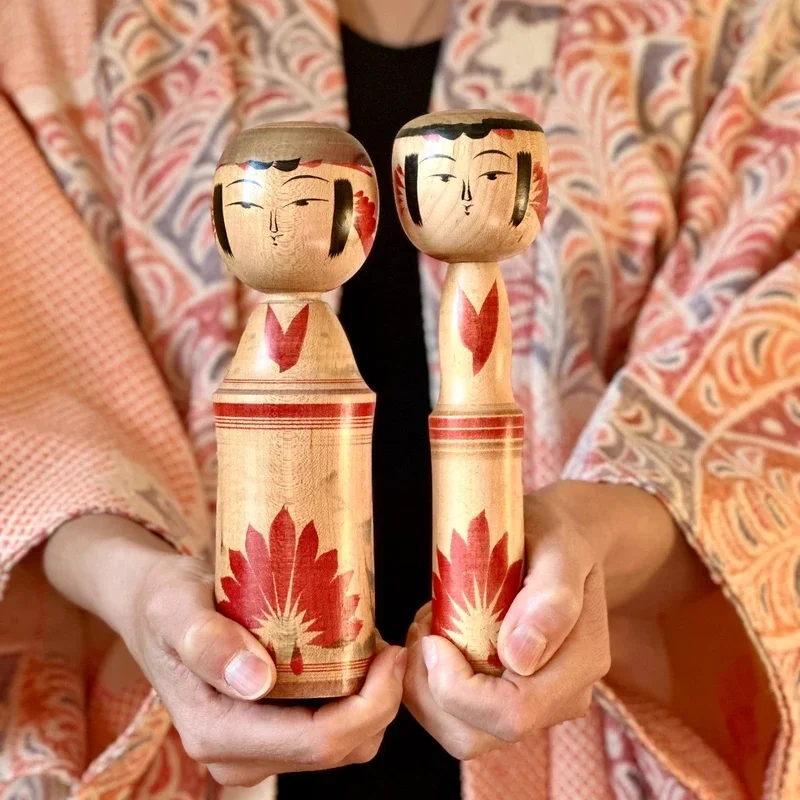
A kokeshi asks for very little once it has found the right spot. Grouped in threes on a shelf, alone on a windowsill out of direct sun, or standing next to something entirely unrelated, like a stack of books or a single dried branch. Here is what I have learned about placing them so they actually get looked at, instead of disappearing into a room.
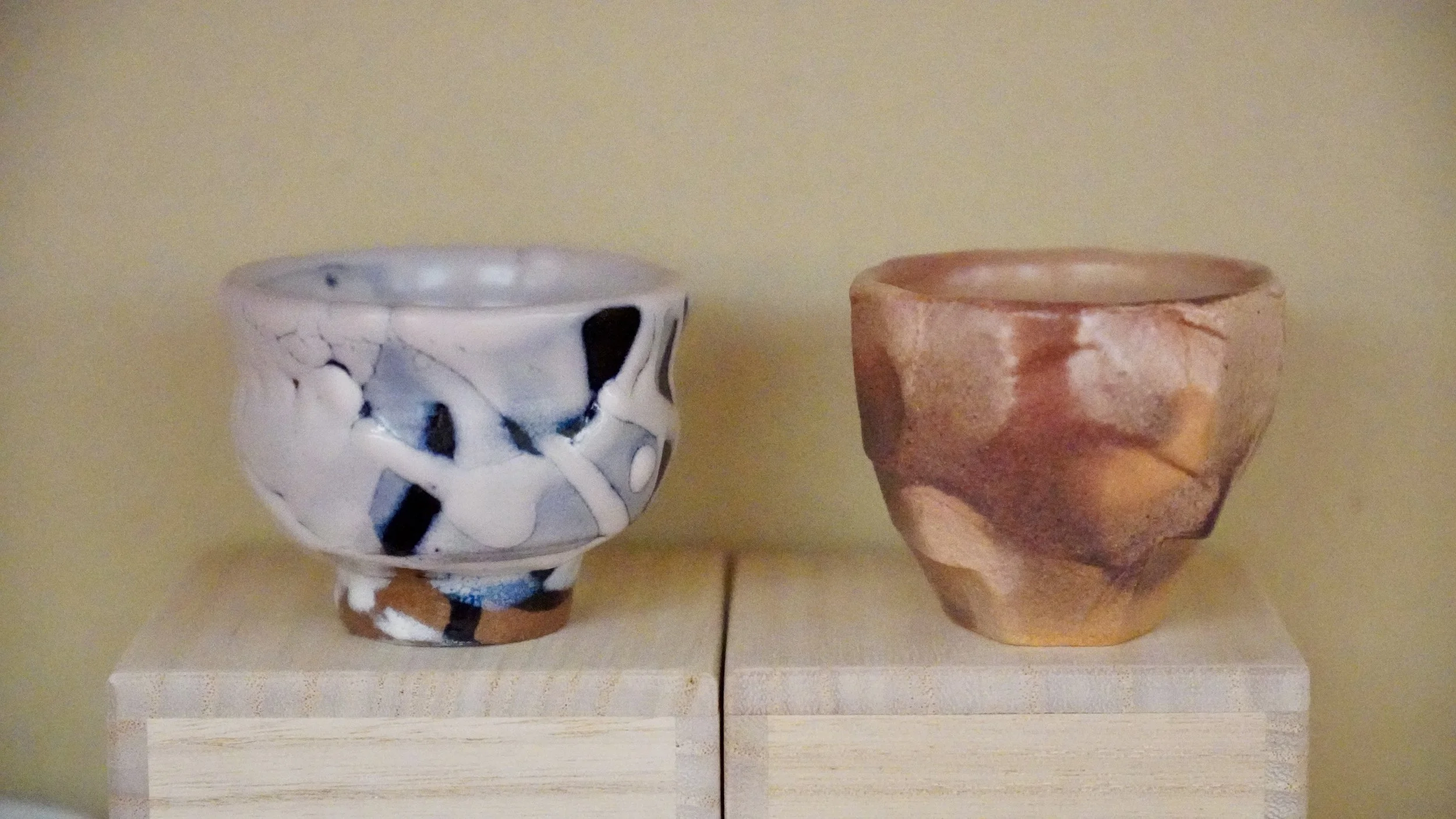
Every ceramic piece I bring home has already been through decades of hands before mine. A chawan changes colour with tea over the years, a vase collects mineral marks if you let it, and neither of those things is damage. Here is what actually matters when you look after one.
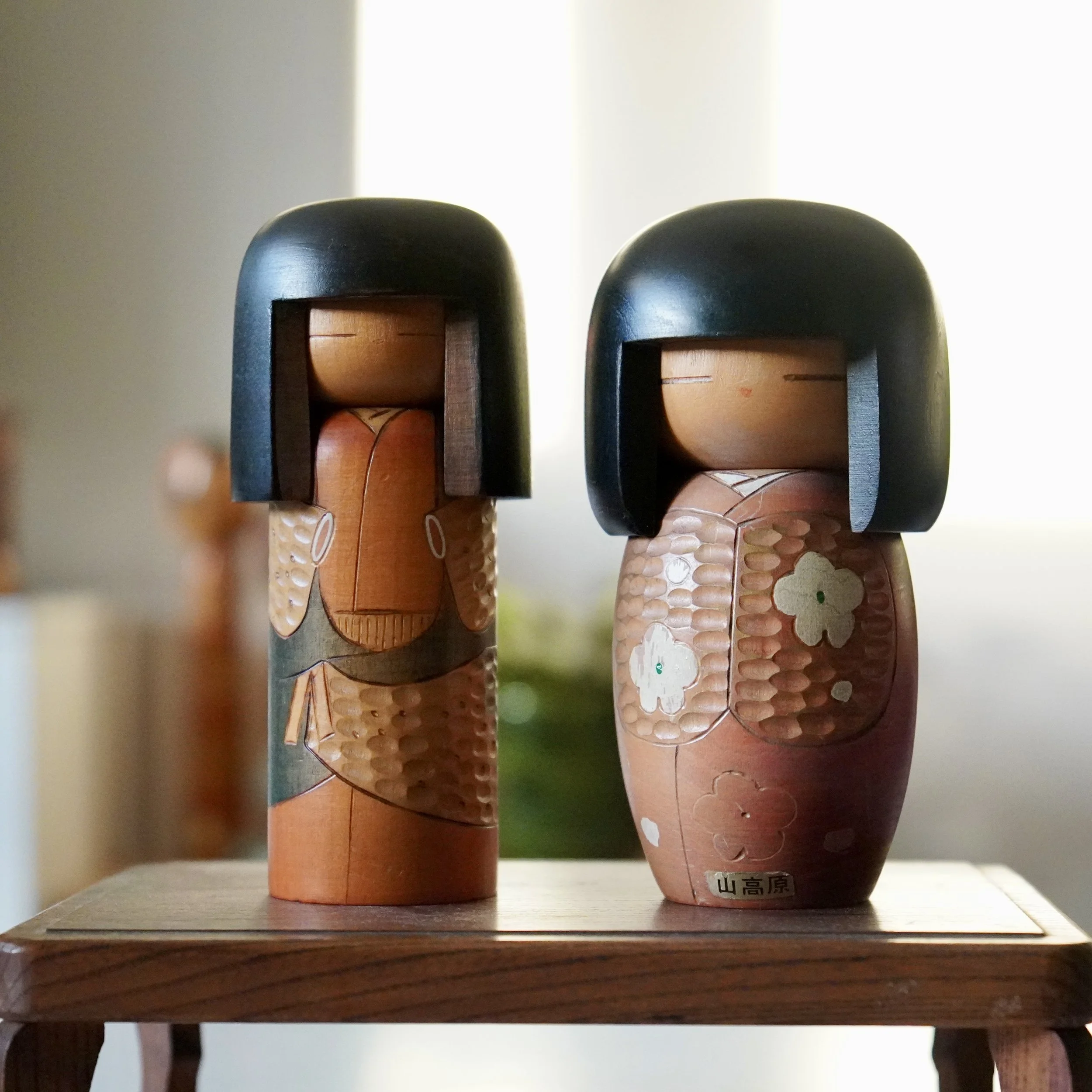
A week in the heartland of kokeshi: Fukushima. From climbing Mount Bandai before sunrise to studying the unique facial expressions in the work of masters like Ichiro and Sato Fumio. Discover how the landscape and deep-rooted woodcarving traditions shape these authentic vintage treasures.
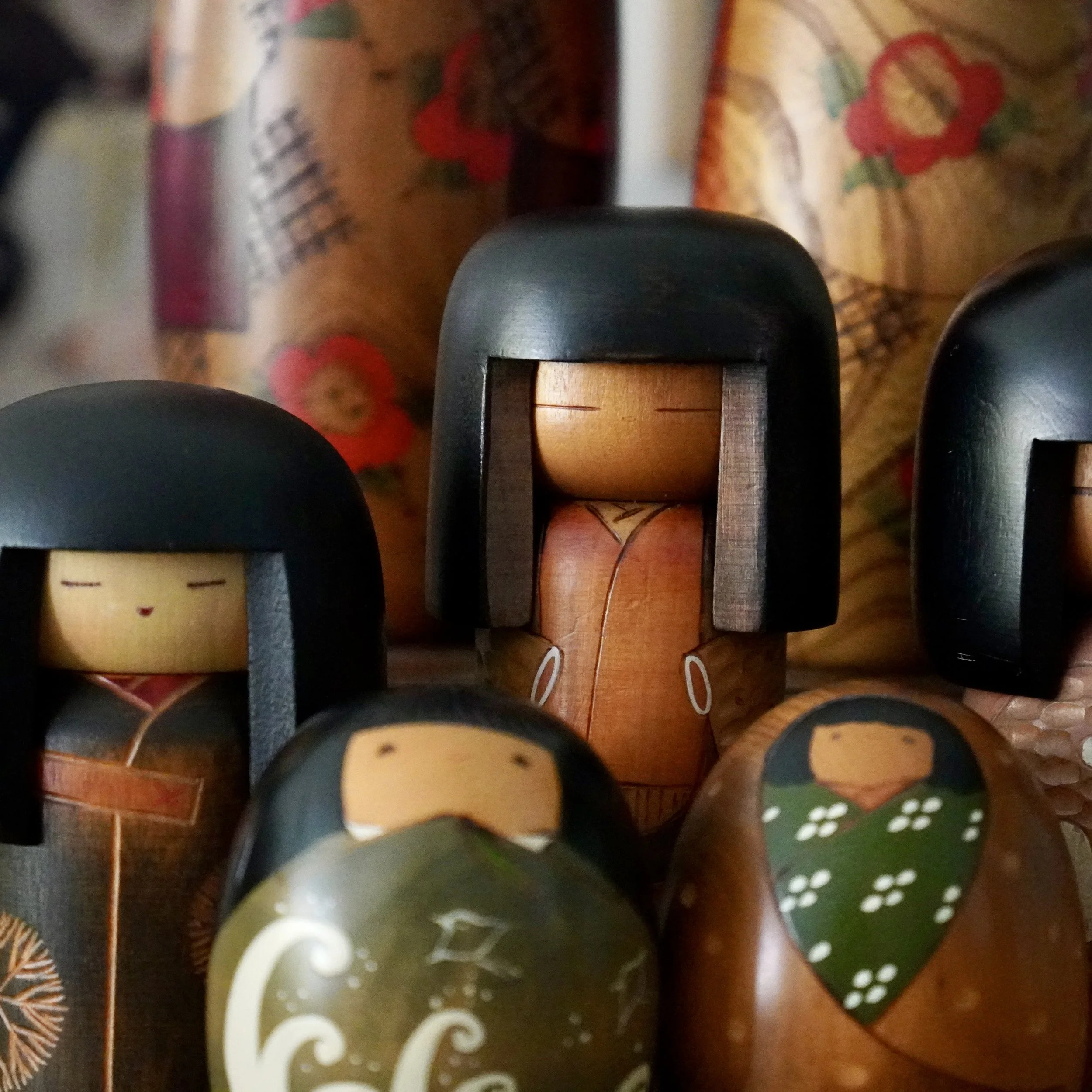
What draws you to a kokeshi is rarely the name on the base. It is the grain showing through the dark wood, the mark the tool left, and the two lines that somehow become a face. A close look at how makers like Usaburo and Sansaku Sekiguchi work with and against the wood itself.
Pages from my journal
Questions before you buy?
Since my items are one-of-a-kind piece, I want to ensure it reaches you perfectly.
Questions about the history or condition?
Need a custom shipping quote or shipping outside the EU?
Prefer to see more detailed photos or a video?
Reach out to me directly. I'm here to help you find the perfect piece for your home.
✉️ hello@kaikoandco.com
💬 Instagram DM: @bykaikoandco
Black so deep it looks like still water, and scattered across it, crests in gold and in red, none of them quite where you expect. The gold ones are soft and matte, while the red ones carry tiny flecks of gold that wake up when you turn the lid toward the light. It sits in the palm like a smooth pebble and is hard to put down. It is the kind of small object that makes a shelf, a desk or a tea tray look considered.
It was made by Hariya Yūsai, a makie artist from Ishikawa who is recognised in Japan as a Traditional Craftsman, and he signed and sealed the wooden box himself. That box is why it feels complete: the natsume, the box that names its maker and its style, and the yellow cloth that came with it have stayed together. If you make matcha, this is a proper tea caddy with a real maker behind it. If you don't, it is still something you will want to keep in sight.