
Meet the maker: Sekiguchi Sansaku
Sekiguchi Sansaku (1925-2018) was a leading figure in Gunma's post-war sōsaku kokeshi movement, designated a Contemporary Master Craftsman by the Japanese government in 1978. A survivor of wartime service in Manchuria and postwar internment in Siberia, he devoted his career to a craft he hoped could carry a quiet wish for peace forward to new generations.
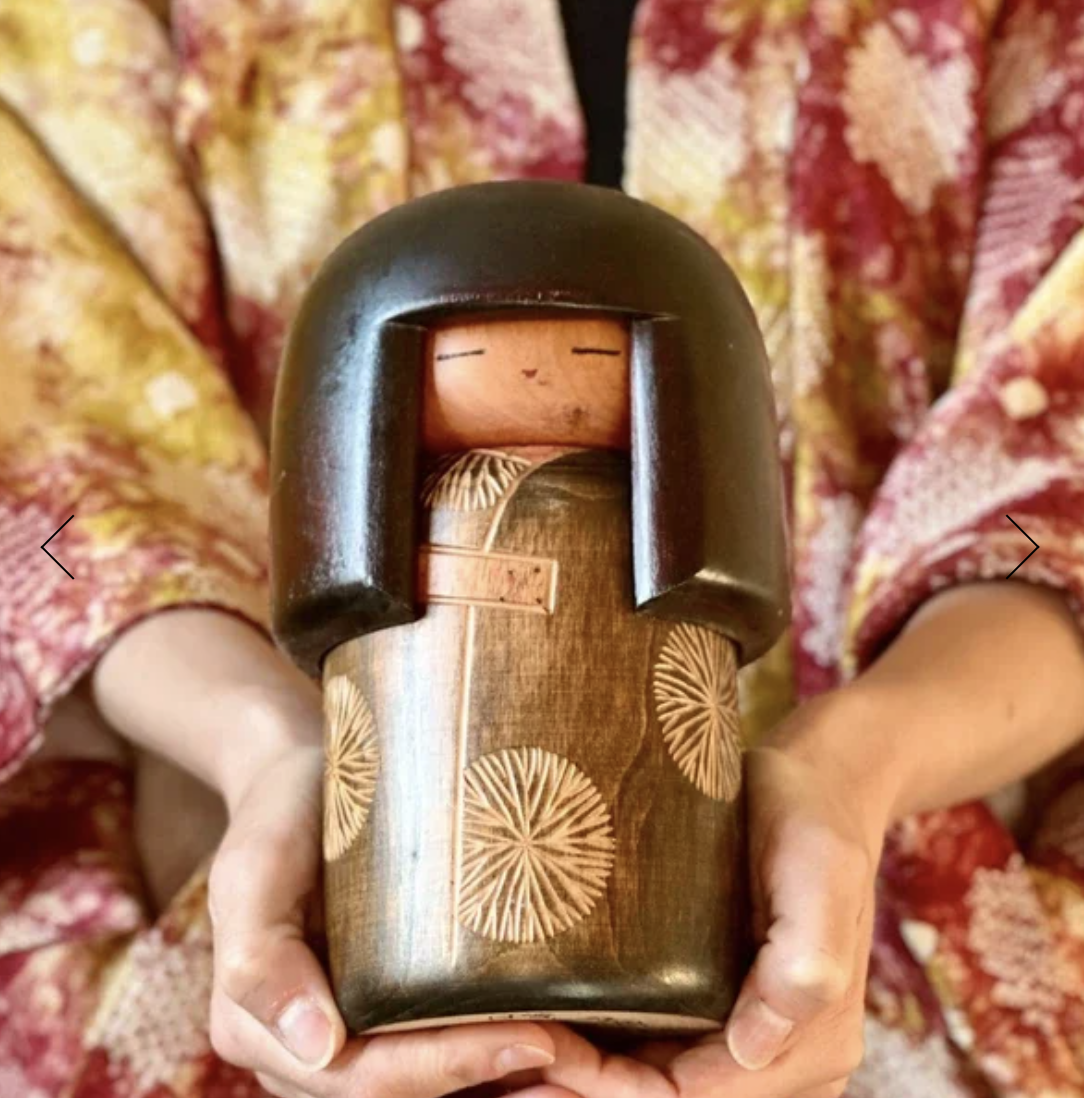
A larger Dōjo, Sekiguchi Sansaku's own titled name for this young girl figure from 1979 showing his signature carved kimono technique and minimal painted face on a taller, dark lacquered figure.
Who was Sekiguchi Sansaku
Sekiguchi Sansaku was born in 1925 in Shibukawa, Gunma prefecture. He originally trained toward Japanese painting, winning several honours at the prefectural art exhibition between 1951 and 1957, before turning fully to sōsaku kokeshi from 1958 onward.
His early life included wartime service in Manchuria, followed by internment in Siberia after the war's end. In a 2005 newspaper interview he spoke about wanting the joy of making kokeshi passed on to children so that the sorrow of war might never be repeated again, a wish that runs quietly through the rest of his career.
He won the Prime Minister's Award at the national kokeshi contest in 1969, and in 1978 was designated a Contemporary Master Craftsman (現代の名工) by the Japanese government, a national honour recognising outstanding skill, awarded to a select number of artisans across all trades each year since 1967. He continued working for decades afterward, producing pieces across a wide range of sizes and subjects, from small dōjo (young girl) figures to large bujin (warrior) forms.
His dōjo design recurs across his career in multiple sizes: pieces we have handled ourselves span from a 13.5cm example dated 1991 to a 21cm example dated 1979, both carrying the same carved chrysanthemum motif twelve years apart.
He was a direct contemporary of Kano Chiyomatsu, another leading name in Gunma's post-war sōsaku kokeshi movement. Both men worked from within the same prefecture during the same formative decades, both won the Prime Minister's Award, and both were members of the Nippon Kokeshi Artistic Handicraft Association, appearing together in that association's 1983 directory and in the 1998 Shibukawa City exhibition catalogue. Their work is often presented together by collectors and archives as part of the same modernist Gunma generation, as they shared time, place, and professional circles.
What makes Sekiguchi Sansaku’s work distinctive
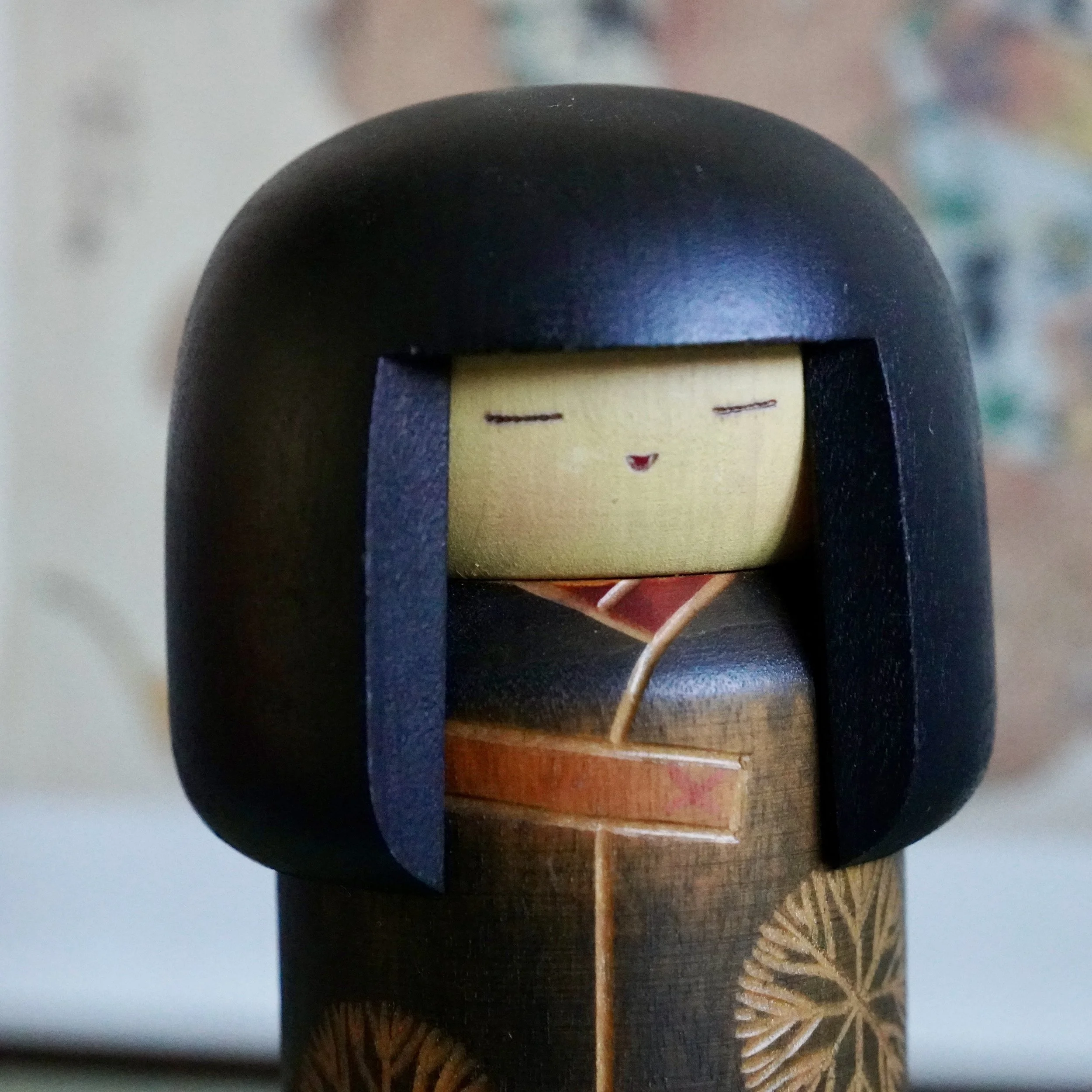
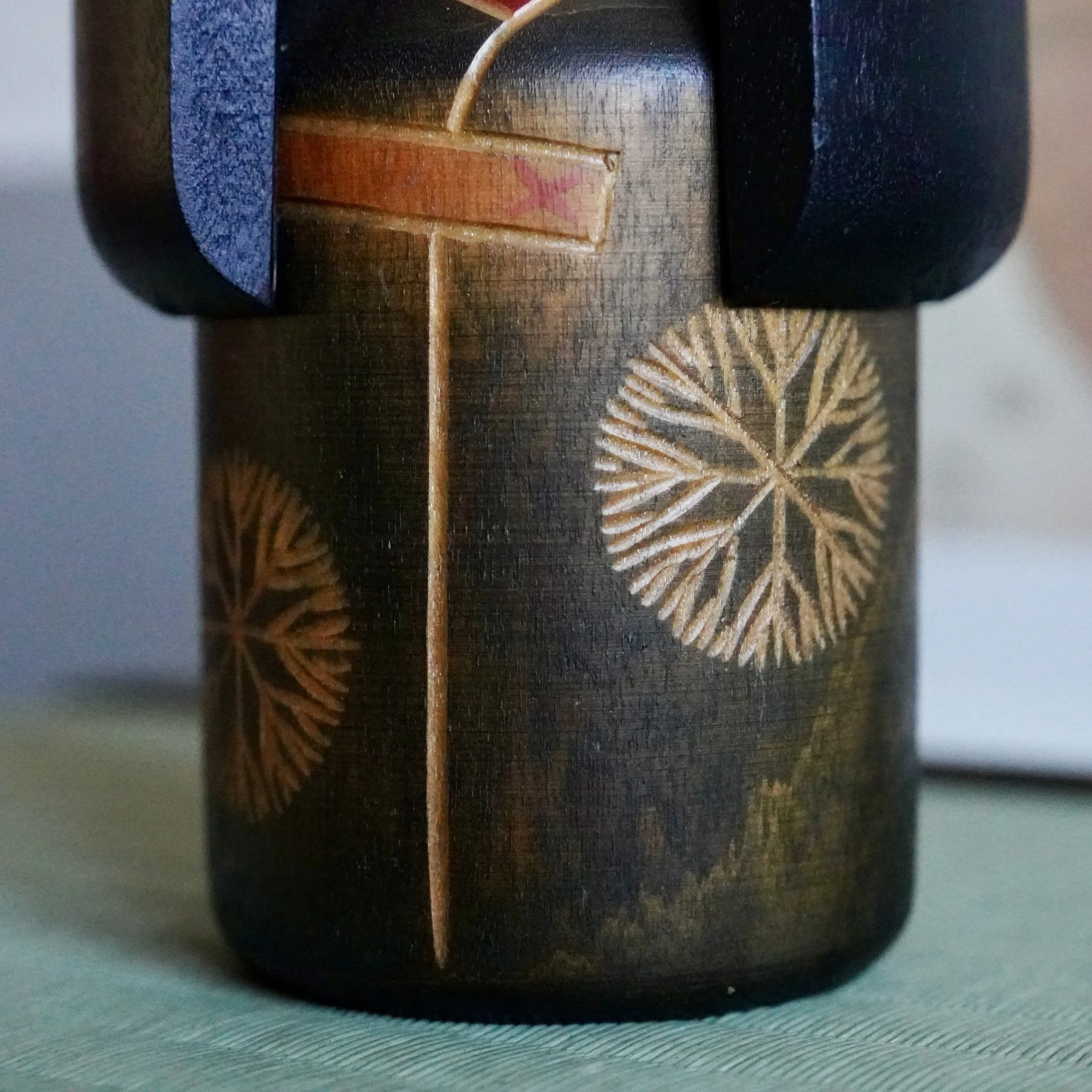
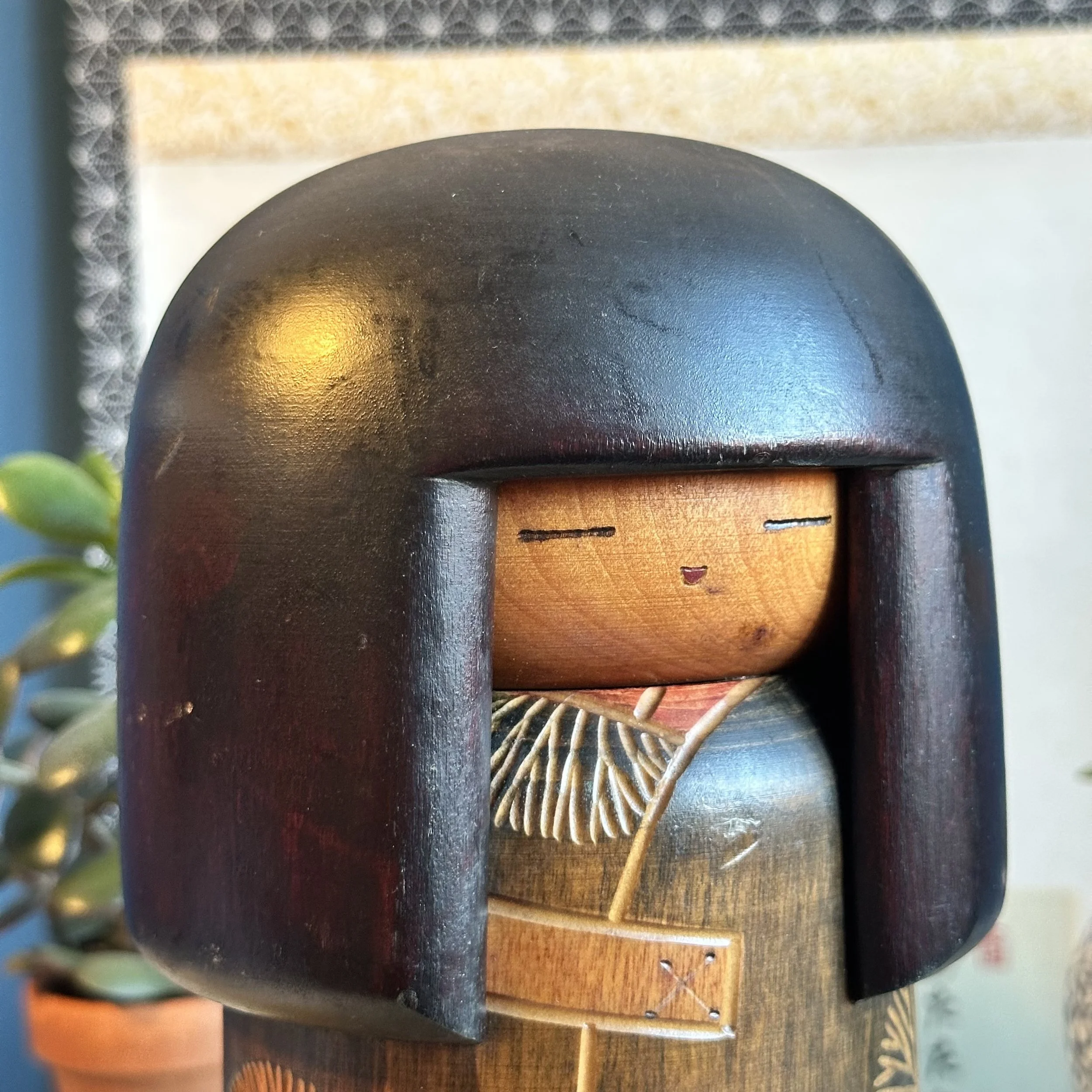
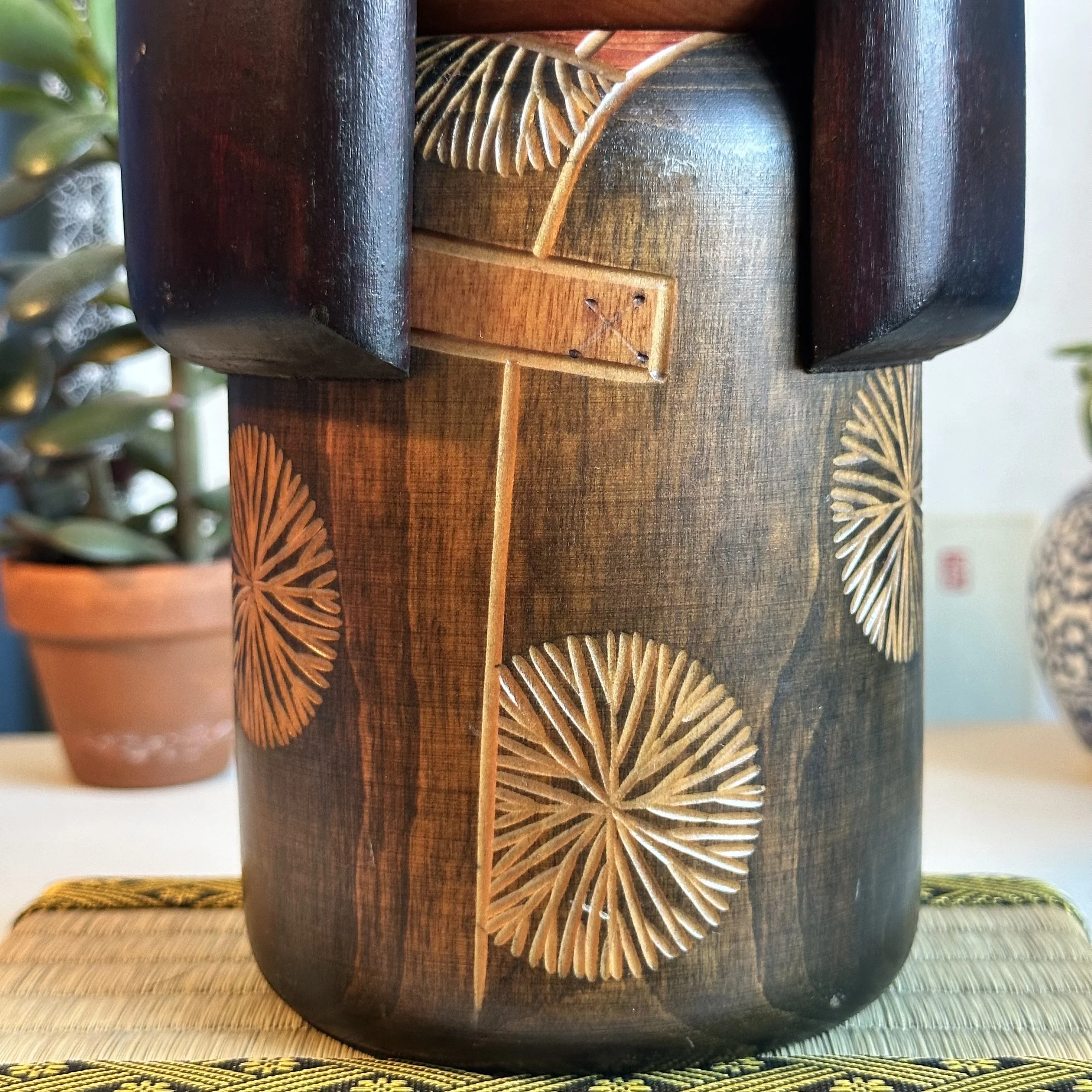
He carves his decoration into the wood rather than painting it on top, a technique distinct from the painted or pyrography work of many other Gunma makers. The design catches the light differently depending on the angle you view it from.
Faces are kept minimal, typically two lines and a single point, painted freehand, so no two pieces are ever quite identical.
His subjects range widely, from young girls (dōjo) to warrior figures (bujin), often in dark, restrained lacquered tones with fine incised kimono detail.
The same chrysanthemum. See the above pictures of two pieces dating twelve years apart. Two pieces we have handled ourselves, dated 1979 and 1991, carry the same carved chrysanthemum motif on the kimono, a sign of just how consistent and recognisable his design language stayed across decades of work.
Fun facts
A rare national honour. In 1978 Sekiguchi Sansaku was designated a Contemporary Master Craftsman by the Japanese government, one of a select group recognised nationally each year since 1967, across all skilled trades, not just kokeshi making.
A wish for peace, carried in wood. In a 2005 newspaper interview, he spoke about hoping the joy of making kokeshi could be passed on to children, so that the sorrow he lived through in the war would never return.
Signatures of Sekiguchi Sansaku in our archive
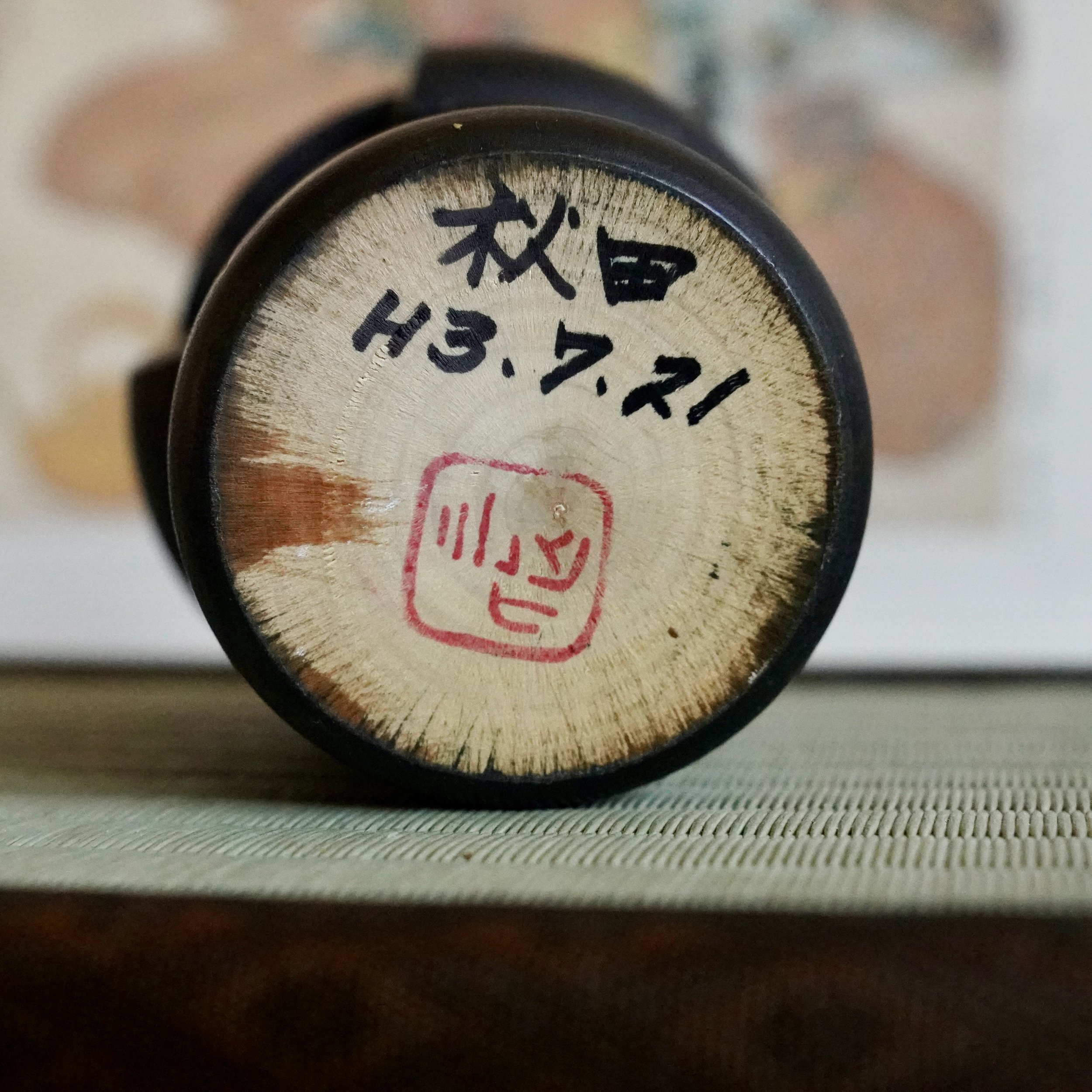
Signed on the base, typically with a red seal reading 三作 (Sansaku)Sansaku)
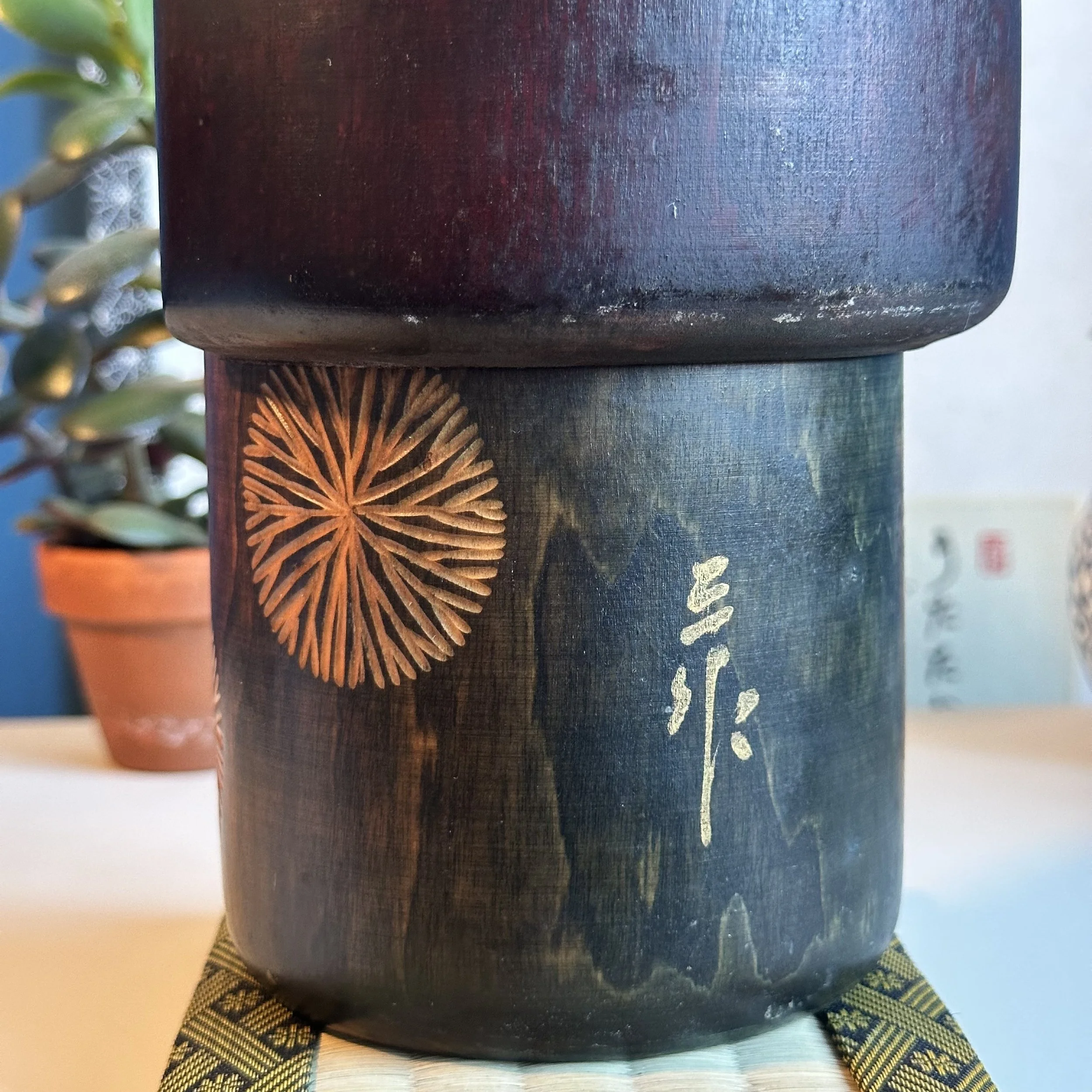
His bigger pieces are often also signed directly on the piece itself in brushwork, in addition to the base seal.
Meet the Sekiguchi Sansaku kokeshi in collection
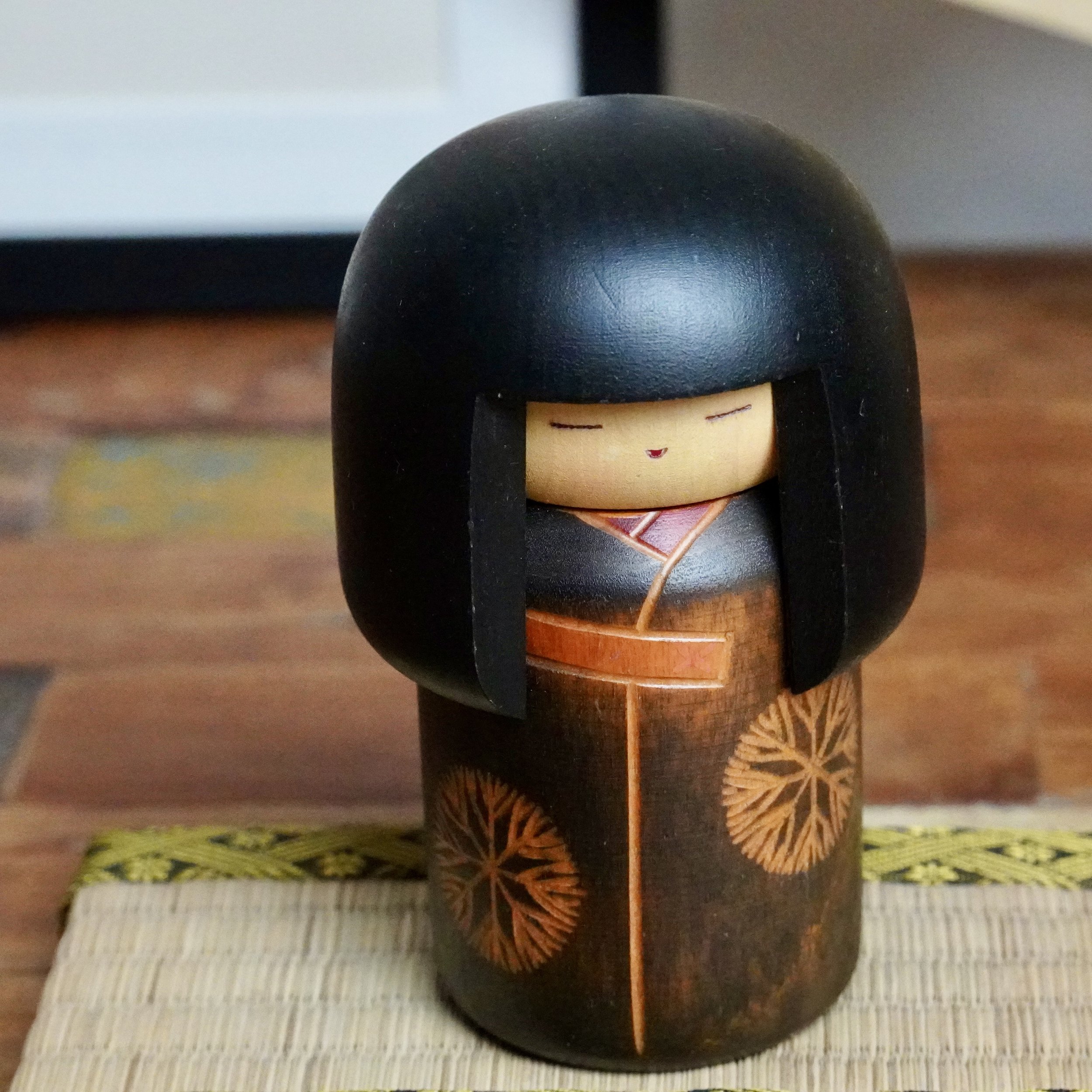
Small enough to sit in one palm, this kokeshi has a quiet, downcast composure that larger pieces often lose. Her dark lacquered hair falls in a smooth, sculpted line across a pale, softly painted face, eyes closed in a calm, almost sleepy expression. The kimono is deep and dark, incised rather than simply painted, with a fine red under layer just visible at the collar.
This is the work of Sekiguchi Sansaku, one of the defining names in Gunma's post-war sōsaku kokeshi movement and a recipient of the Prime Minister's Award. His young girl, or dōjo, design recurs across his career in many sizes, and this piece carries his own seal on the base along with a handwritten inscription dating it to the 21st of July 1991.
→ What draws you to a kokeshi is rarely the name on the base. Read more about how makers like Sekiguchi carve rather than paint their signature detail in my journal.
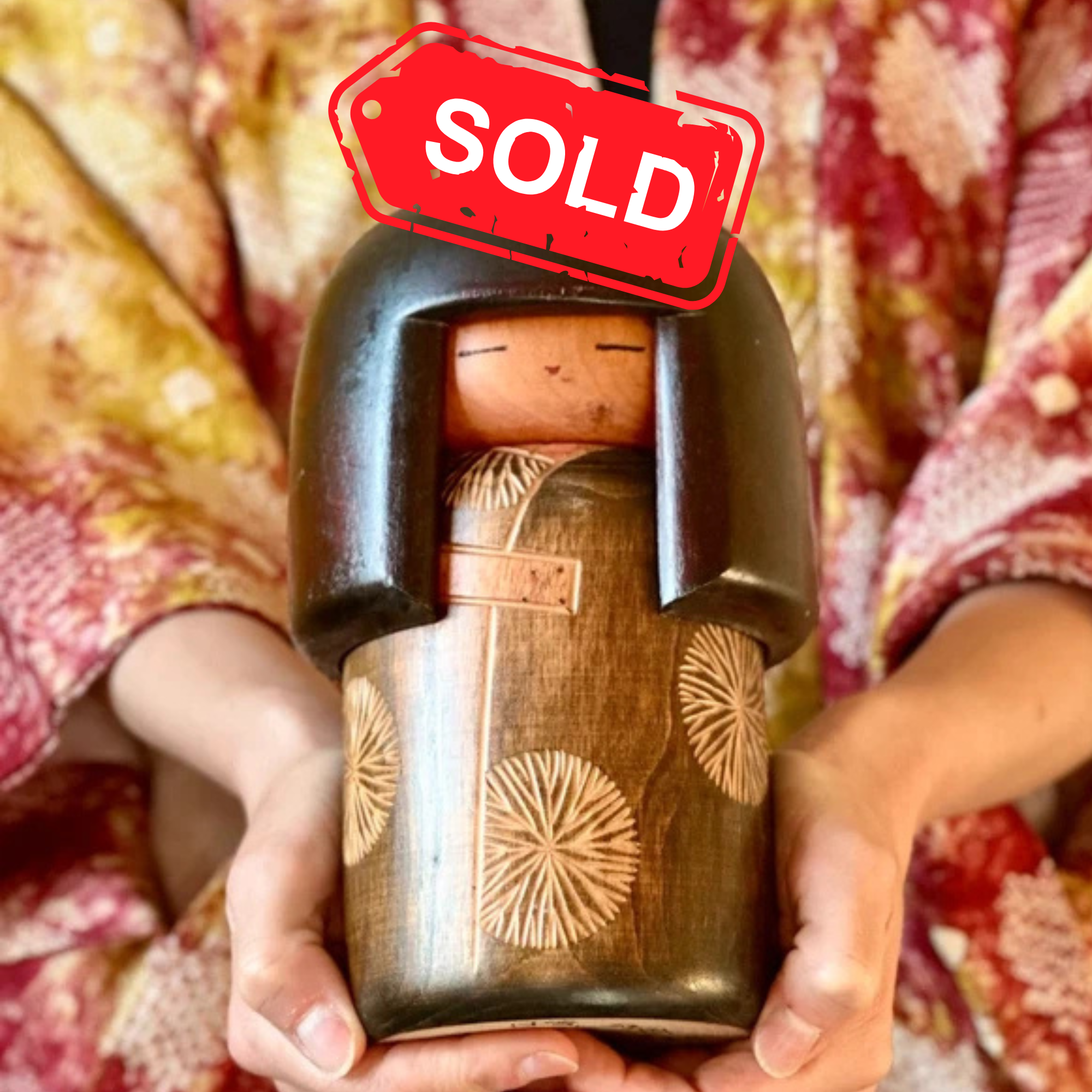
Notice: This kokeshi has found a new home. If you are looking for something similar, scroll down.
Item details
A creative kokeshi by Sekiguchi Sansaku (関口三作, 1925 to 2018), titled Dojo (童女, young girl), Shōwa period, Japan, ca. 1979. The figure stands 21 cm tall in dark lacquered wood, with a carved chrysanthemum kimono, a calm half-hidden face beneath swept dark hair, and a carved obi at the waist. Weight 1176 grams.
Sekiguchi Sansaku was the only kokeshi artist formally recognised by the Japanese government as Master of Creative Kokeshi, with work held in museum collections internationally. The base carries his signature 三作 (Sansaku) alongside a dedication in brushwork recording that this piece was gifted in January 1979 by the employees of the credit department of the Matsumoto branch, most likely a bank. A gift with a specific occasion and named givers is uncommon, and gives this kokeshi a documented social history alongside its artistic one.
Vintage condition, light surface wear consistent with age. Shōwa period, creative kokeshi tradition.
Sources
Physical examination of the seal, construction, and any award stickers on the pieces themselves
Information shared by dealers and specialists in Japan at the time of purchase
Nihon Kokeshi Kōgeikai (Japan Kokeshi Craft Association), official artisan profile: kokeshi.net/kougeikai/sansaku
Nippon Kokeshi Artistic Handicraft Association (1983). Creative KOKESHI Artistic Handicraft Directory. Edited by Kazuo Izumi, supervised by Daizo Nishide.
Shibukawa City Board of Education, Lifelong Learning Division (1998). Creative Kokeshi Doll Exhibition in Shibukawa City: 20th & 5th catalogue, 1994-1998. Edited by Ishihara.
Akahata (Japanese newspaper), 6 July 2005, feature interview: "9条こけし / 'Messenger of Peace' / 'Contemporary Master Craftsman' Sekiguchi Sansaku": jcp.or.jp/akahata/aik4/2005-07-06/2005070601_04_2.html
Gunma Prefecture official website, on the origins of Gunma kokeshi: pref.gunma.jp/site/kougei/131134.html
Read more
Curious how a maker's brushwork can shift over a lifetime, or across a family workshop? Both pieces in this collection carry the same seal in two different hands. Read the full story in the journal.
What draws you to a kokeshi is rarely the name on the base. Read more about how makers like Sekiguchi carve rather than paint their signature detail in my journal.
Wondering how to care for aged, wax-finished kokeshi wood like this? Here's what actually matters. Read the kokeshi care guide.
Browse all items
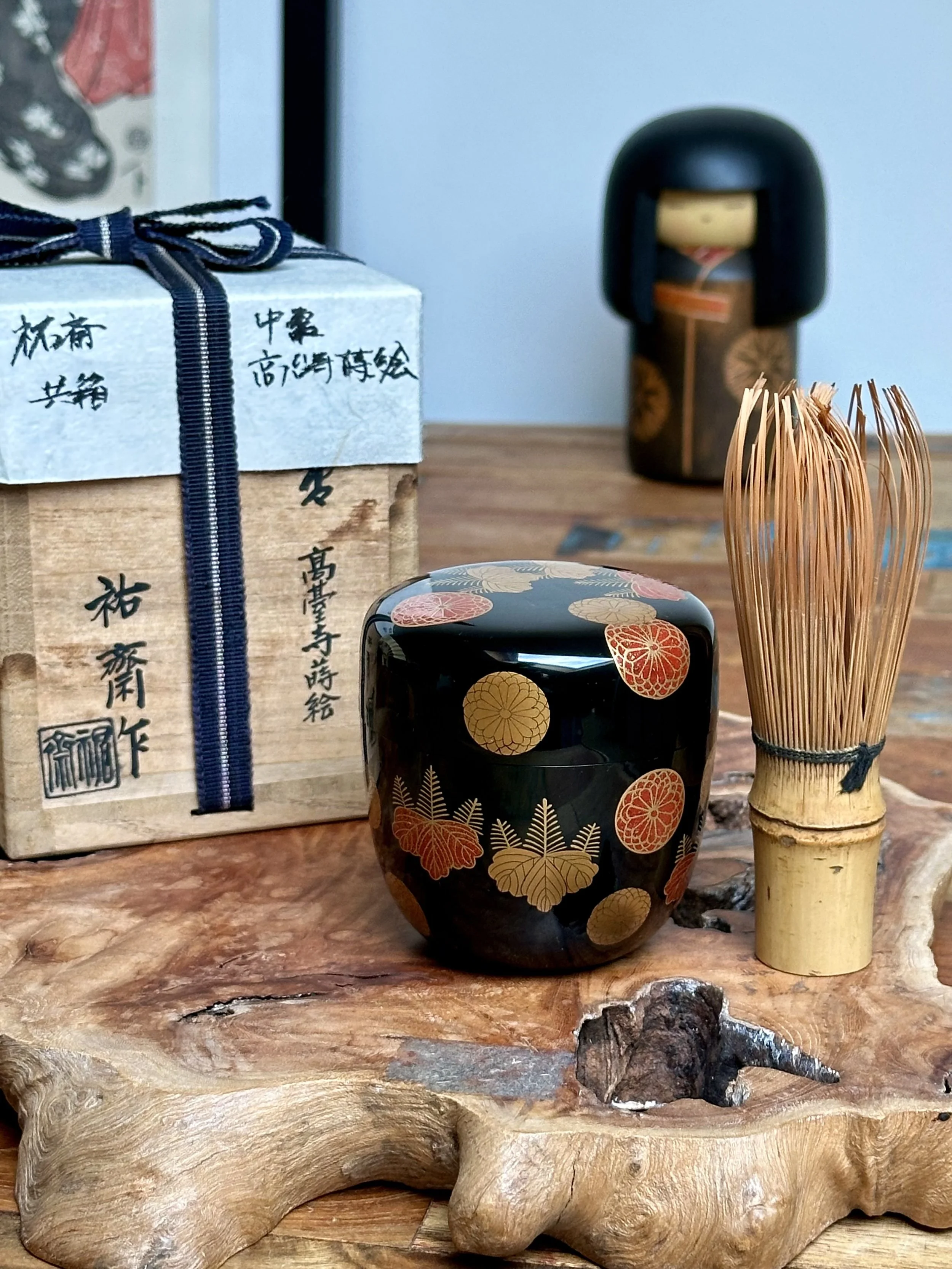
Black so deep it looks like still water, and scattered across it, crests in gold and in red, none of them quite where you expect. The gold ones are soft and matte, while the red ones carry tiny flecks of gold that wake up when you turn the lid toward the light. It sits in the palm like a smooth pebble and is hard to put down. It is the kind of small object that makes a shelf, a desk or a tea tray look considered.
It was made by Hariya Yūsai, a makie artist from Ishikawa who is recognised in Japan as a Traditional Craftsman, and he signed and sealed the wooden box himself. That box is why it feels complete: the natsume, the box that names its maker and its style, and the yellow cloth that came with it have stayed together. If you make matcha, this is a proper tea caddy with a real maker behind it. If you don't, it is still something you will want to keep in sight.
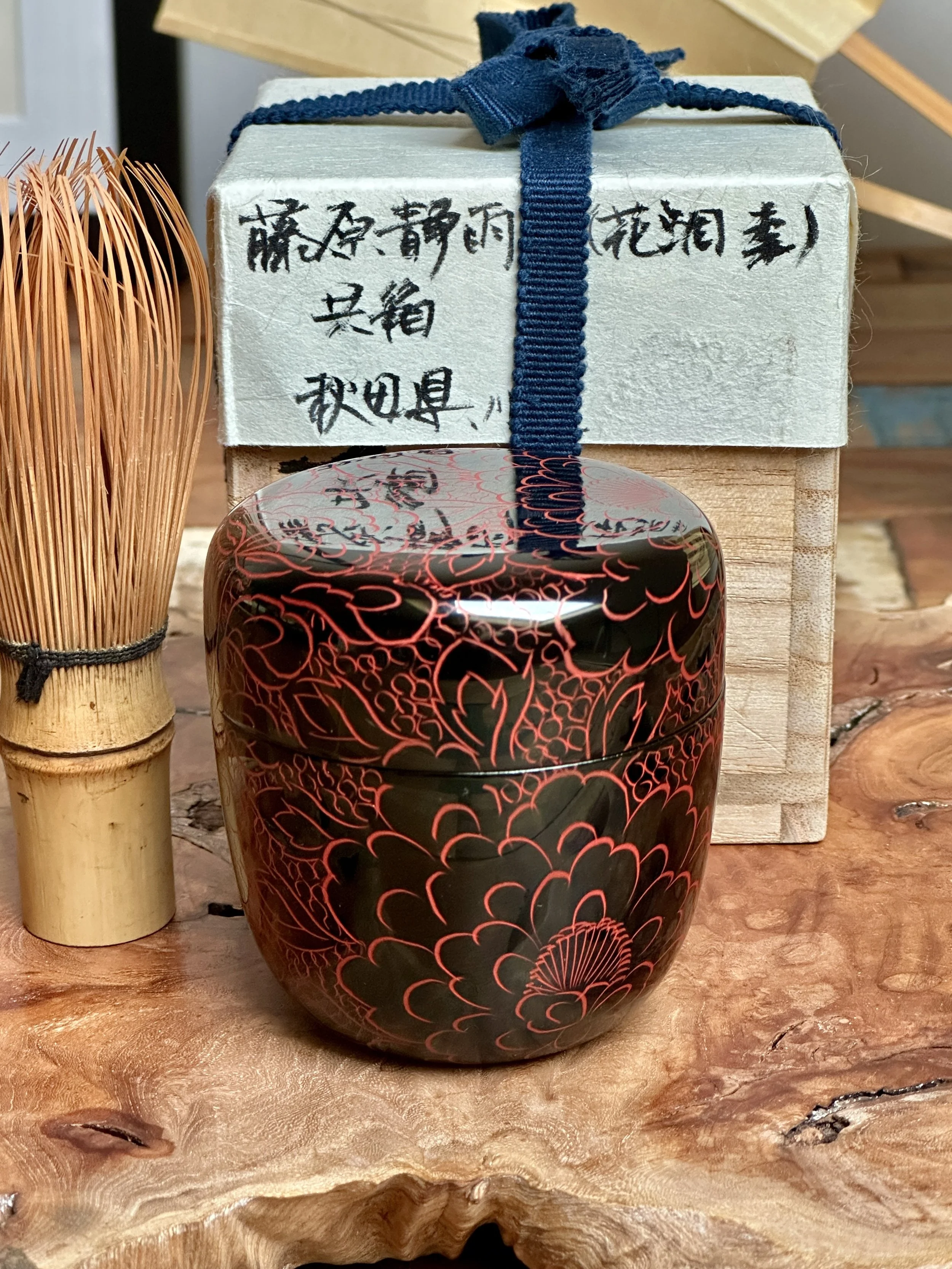
Turn it toward the light and the red changes. What looks like a deep, dark red on black shifts to a brighter red with a hint of pink, and the blossoms on the lid and body turn delicate rather than graphic. It is a small, rounded caddy with flowers drawn right across it, and with every tilt you notice a different one. It is the kind of object you pick up to look at and end up turning in your hands.
The lacquer is glossy and smooth. Run a fingertip over the flowers and in places you can feel the cuts through the lacquer, fine lines that sit in the surface rather than on top. At approx. 54 g the natsume is light in the palm, small and rounded.
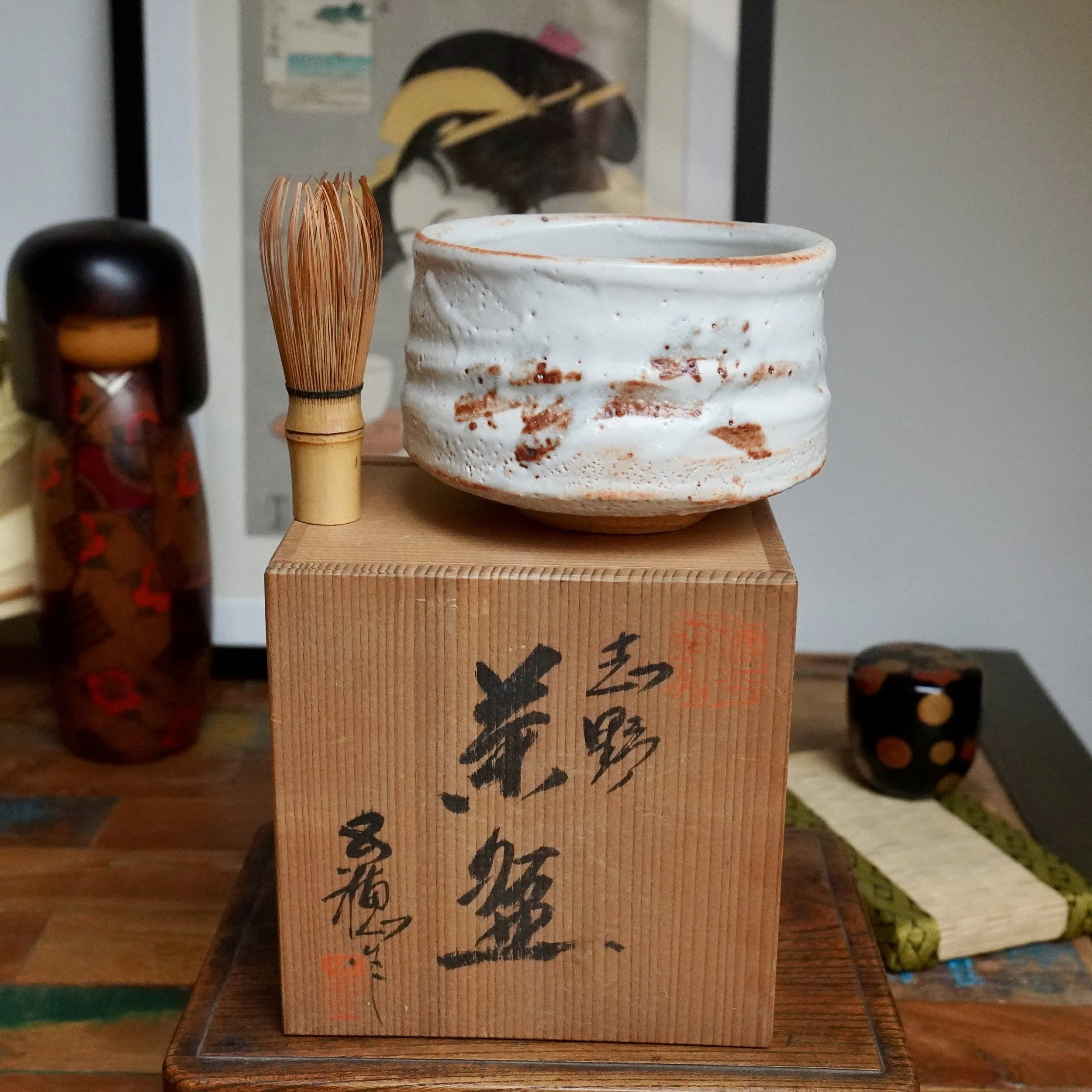
Pick this bowl up and it surprises you: for something this size, it settles low and steady in your hands, the thick walls giving it a grounded weight rather than a fragile one. The rim moves in its own irregular line, never quite a perfect circle, so no two angles look the same. White glaze breaks into rust-orange blush along one side like scorch marks, and it is easy to imagine how matcha would sit inside it, pooling green against that warm white and orange, exactly the kind of contrast tea practitioners seek out a bowl for.
What makes this one worth taking home rather than admiring from a distance is that it comes whole: the original tomobako, signed and sealed, and the silk wrapping cloth that carried it, stamped with the same seal as the box. Pieces where the box, cloth and bowl are still this clearly matched to each other carry a quiet kind of proof in themselves.
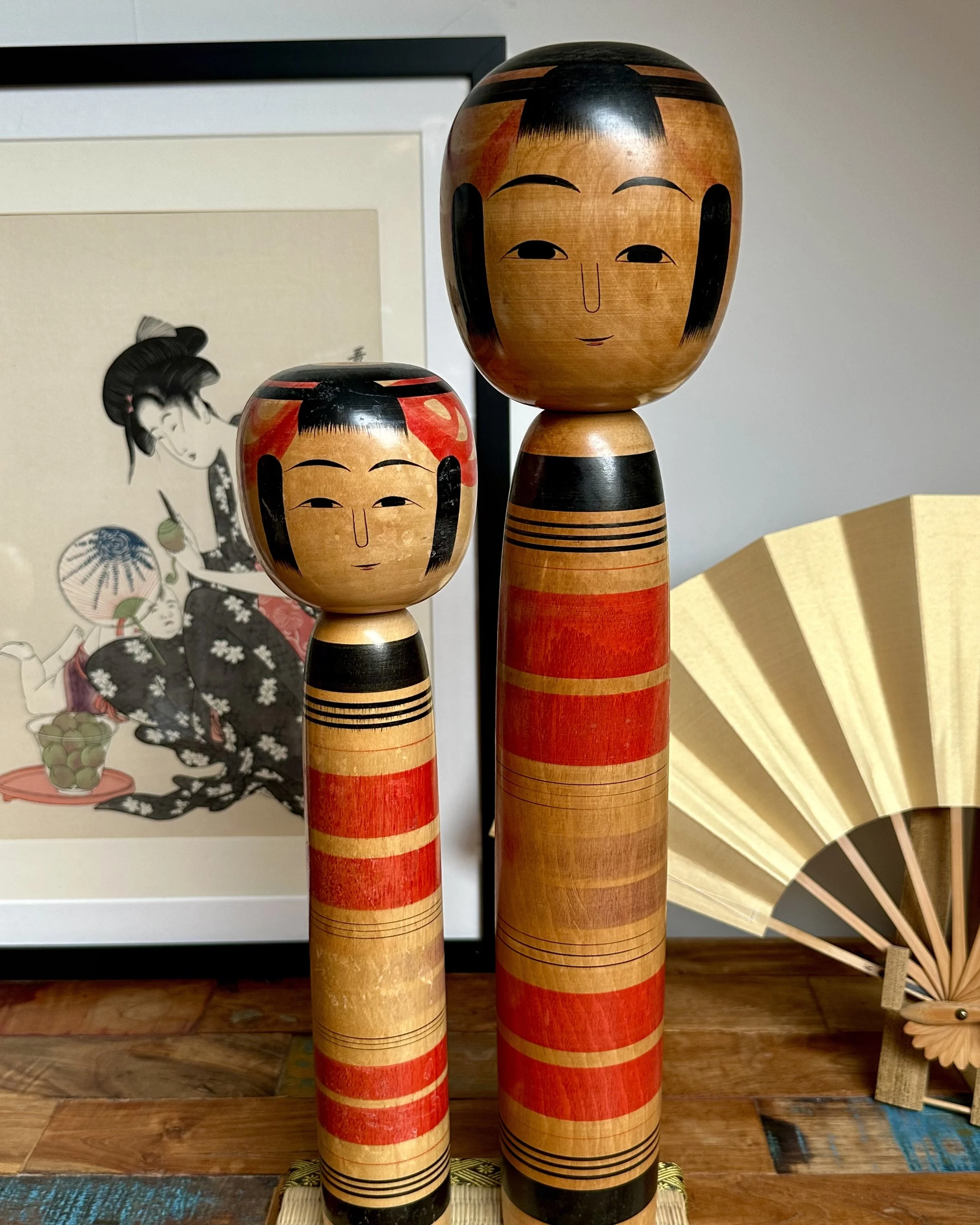
Two kokeshi stand side by side, one almost half a metre tall and both wearing traditional bands of red, black, purple and bare wood from collar to base. There are no flowers and no scenes: the stripes are the whole design, and at this height two of them fill a shelf or sideboard by themselves. Under a straight fringe both faces look out with a calm gaze.
Abe Ichirō learned the Tsuchiyu craft from his father, Abe Shinjirō, and in 1967 rebuilt one of his father's Taishō period kokeshi, a body decorated with lathe lines only. These two are decorated the same way: every band was painted while the wood turned on the lathe, so the pattern is the making itself.
The head turns and produces a soft squeak when rotated. In Japanese this is called the cry of a child, and it is one of the quiet surprises of traditional Tsuchiyu kokeshi.
→ Curious how Tsuchiyu compares to the other ten traditional kokeshi lines? Read the full guide.
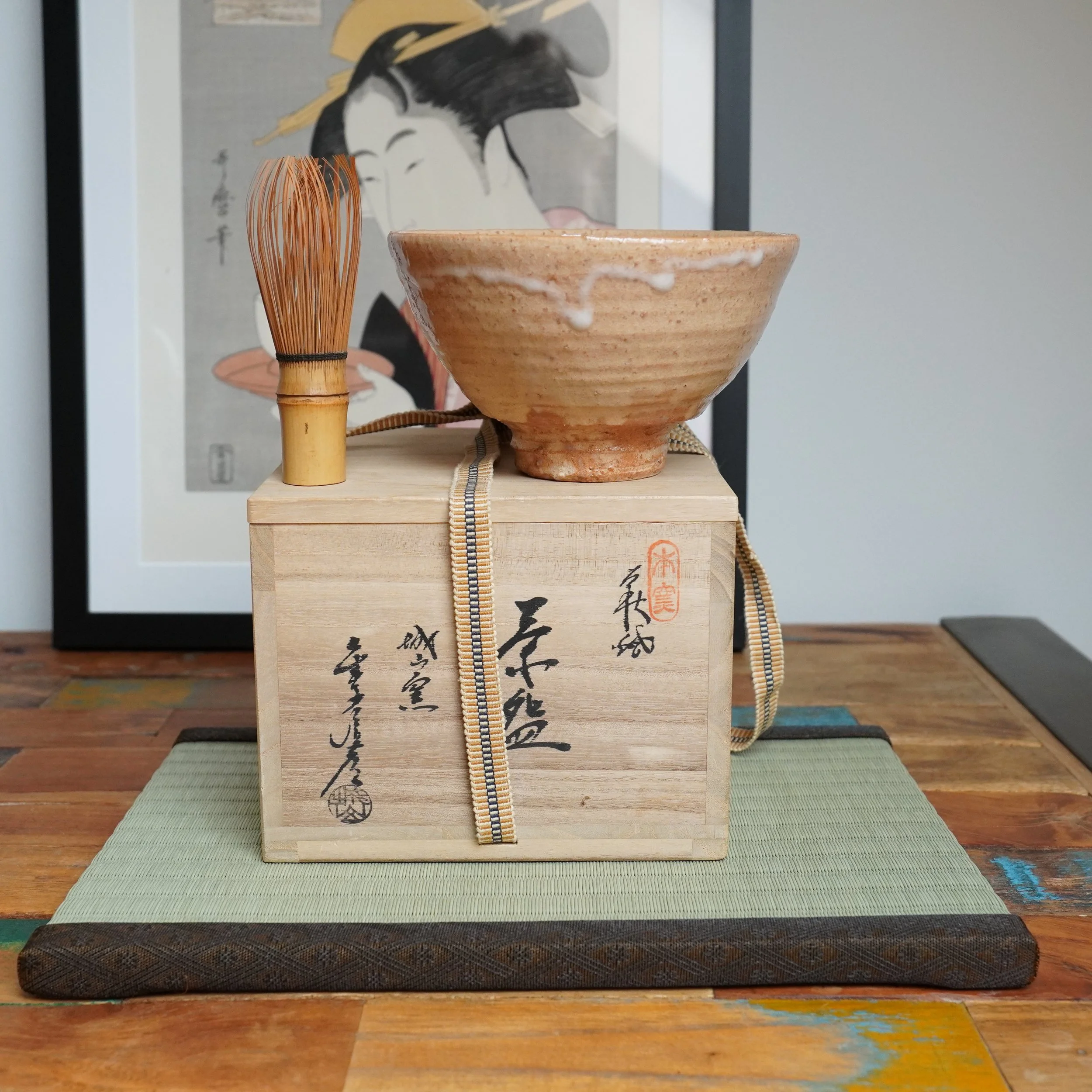
One ribbon of milky white glaze runs across the shoulder of this bowl and ends in a single fat drop, as if someone tipped a jug of cream and stopped mid-pour. Beneath it the body is salmon pink shading to apricot, freckled with dark iron and ringed with the ripples of the wheel. It sits wide and open on a tall foot, a shape that looks generous even from across the room. Beside it stands the box it was made to live in, still tied with its original cord.
Kaneko Nobuhiko (金子信彦) learned Hagi-yaki without a teacher, going from kiln to kiln and asking to be shown. At eighteen, in 1969, he joined the Jōzan kiln beside Hagi Castle and has made his career there. In 2007 the Minister of Education's prize at the Japan Ceramics Exhibition went to a sculpture of his a full metre wide, and this bowl comes from the same hand at the scale of two cupped hands. Whoever keeps it chooses a tea bowl with a named hand behind it over an anonymous one.
A Hagi-yaki glaze is never fully sealed. It develops a fine network of cracks called kan'nyū as it cools in the kiln, and through those cracks water, and later tea, slowly enters the clay beneath. Watch what happens in real time in my journal.
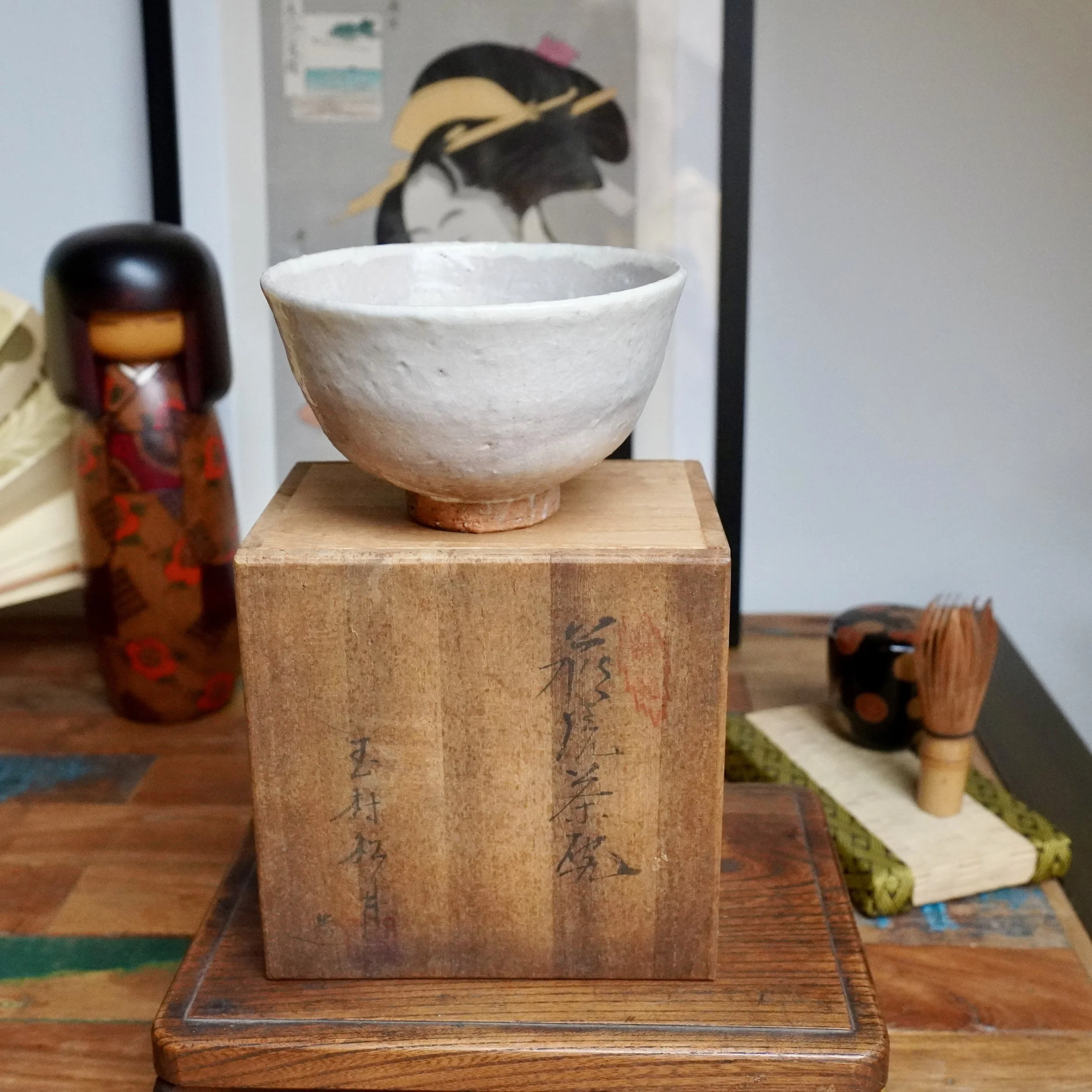
This chawan is lighter than it looks, which is the first thing you notice picking it up. The rim stays fairly calm, an even white, but your eye drops toward the base and that is where the crackle really lives, dense and a little chaotic compared to the rim above it, tea stains settled into every line of it. Someone used this bowl, and used it often enough that its history is written right into the glaze. Outside there is less drama. The white just fades out unevenly on its way down, and somewhere before the foot it gives up entirely, leaving bare reddish clay that is rough enough to feel the difference with your thumb.
This piece carries the signature of Tamamura Shōgetsu, whose kiln in Hagi has stood since 1952. Hagi ware ages the way almost no other tea ceramic does, the glaze slowly taking on colour and character through use, something tea drinkers have a specific word for. The box has its own small story too: an inscription inside notes the bowl was given as a gift in May 1972, back when there was only one Shōgetsu working the kiln, since the name did not pass to a second generation until 1988.
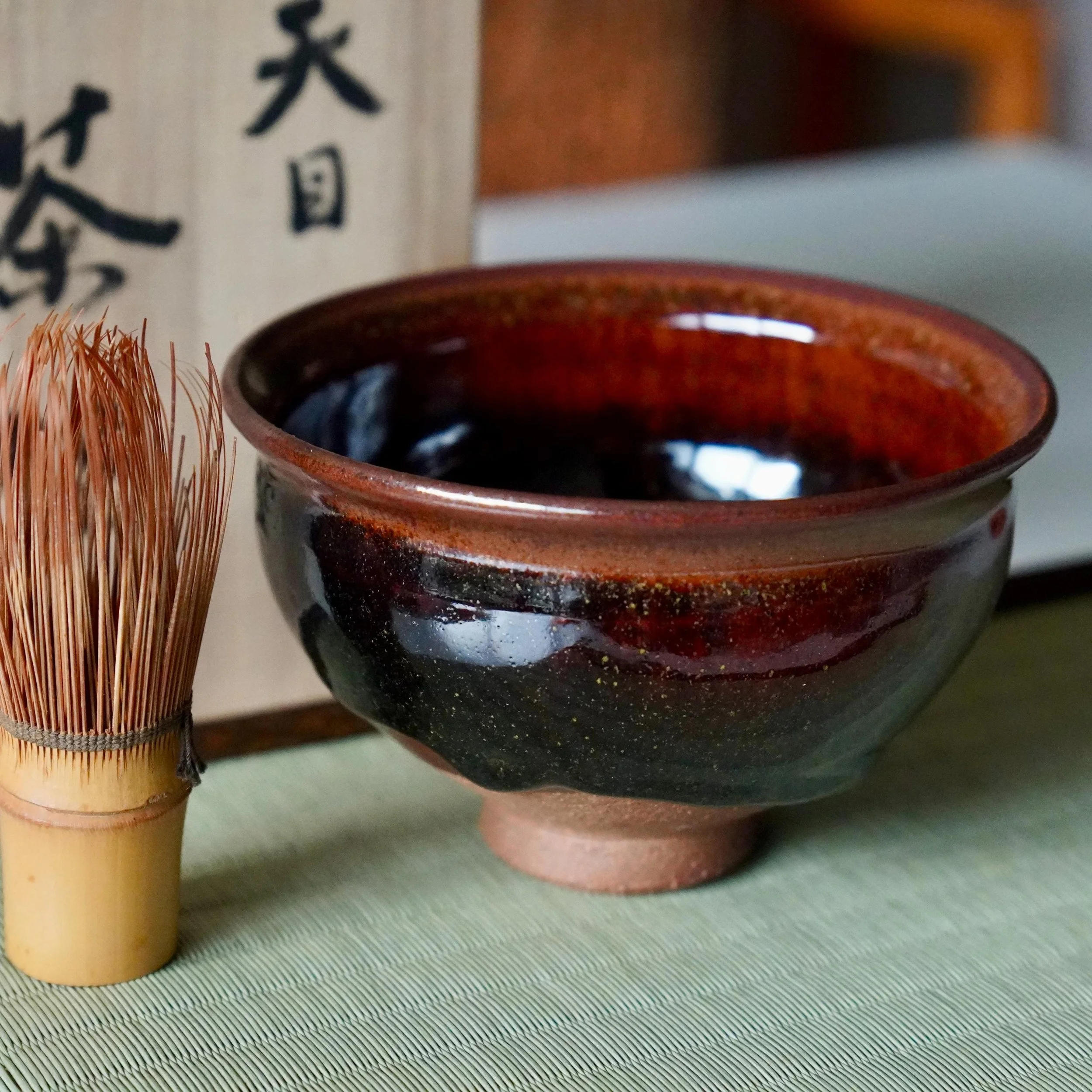
Deep, dark glaze pools thick around the base of this bowl, catching amber and rust where the light hits it at an angle. The drip is heavy and slightly uneven, the kind of effect that only comes from letting the glaze run right to the edge of what the kiln can hold before it sticks. In the hand it has real presence, a weight that settles rather than balances.
This matcha bowl has a thick application of glaze. In the world of Tenmoku, getting that heavy, "frozen-in-motion" drip without it sticking to the kiln floor is a sign of a true expert who knows exactly when to cut the heat.
The deep, chocolate-brown tones of the glaze provide a rich, lustrous backdrop that contrasts beautifully with the vibrant green of freshly whisked matcha. It comes with its original wooden tomobako box, carefully signed by the maker, adding provenance and ceremony to the piece.
Curious what to look for beyond the glaze? I wrote about why a chawan's weight and shape matter more than people expect. Read it here in my journal.
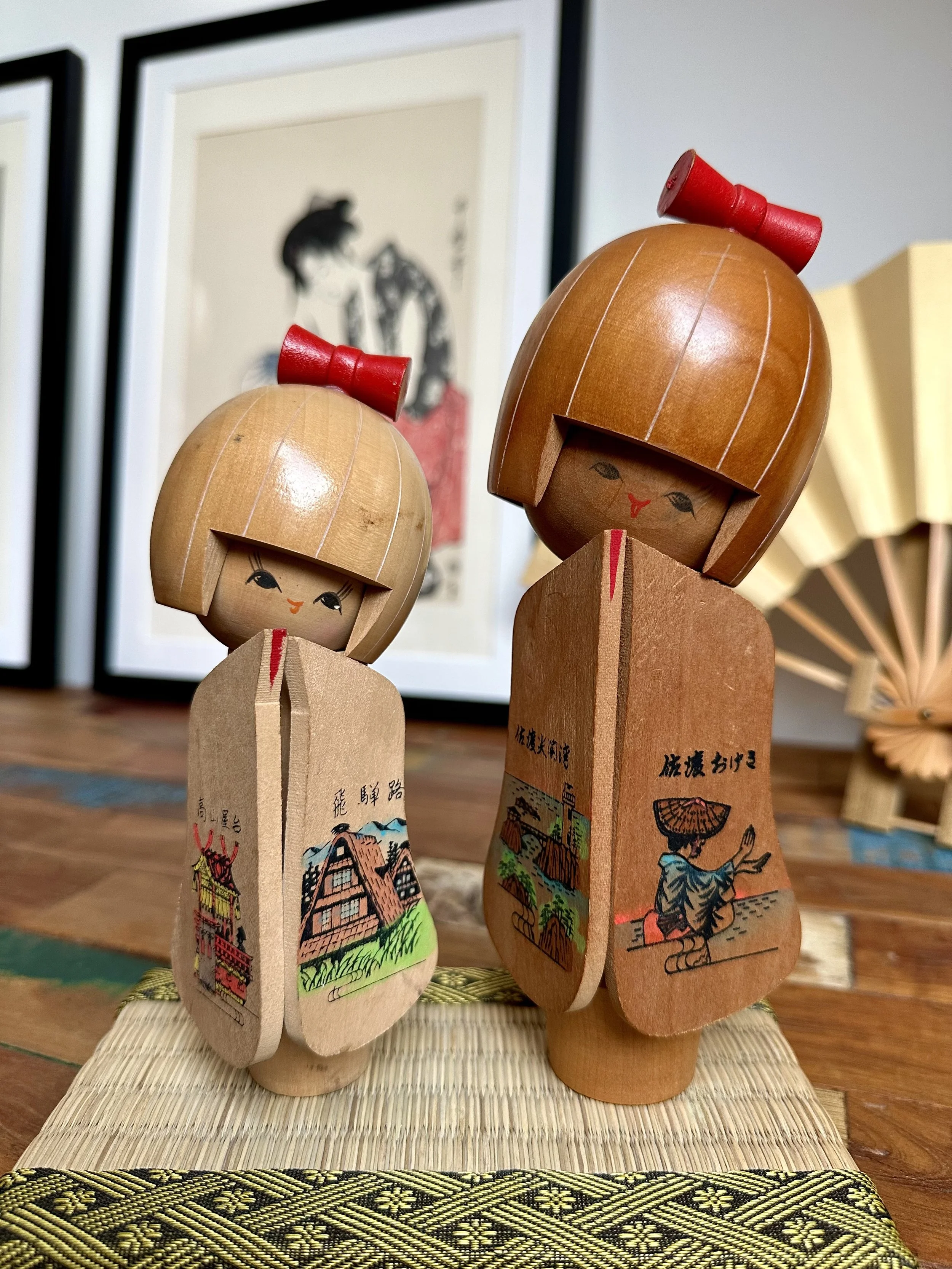
They are the same object twice: same flat panels fanning out from the waist, same simply painted face with a faint blush at the cheek, same red square seal on the base. But open them and they show two completely different corners of Japan. One carries the Okesa dancer of Sado Island and the sea cliffs of Senkaku Bay. The other shows the lacquered festival float of Takayama and the steep-roofed farmhouses of the Hida countryside. Same format, same hand, two worlds.
Sato Suigai (佐藤翠涯) was a Gunma-born kokeshi master and multiple Prime Minister Award winner who made this flat-panel omiyage kokeshi for travellers returning from destinations across Japan. These two pieces show that practice clearly: the same maker, the same form, two different regions, each panel a compression of what that place most wants to be remembered for. Together they work as a pair not because they match exactly, but because they rhyme. The last photo shows their bigger sister in our collection.
The larger lady has aged to a slightly darker wood tone than the smaller lady, the kind of natural variation that happens when two pieces live their decades separately before finding each other again.
→ Interested to read more about the woodworking on kokeshi like these? I wrote about it in my journal.
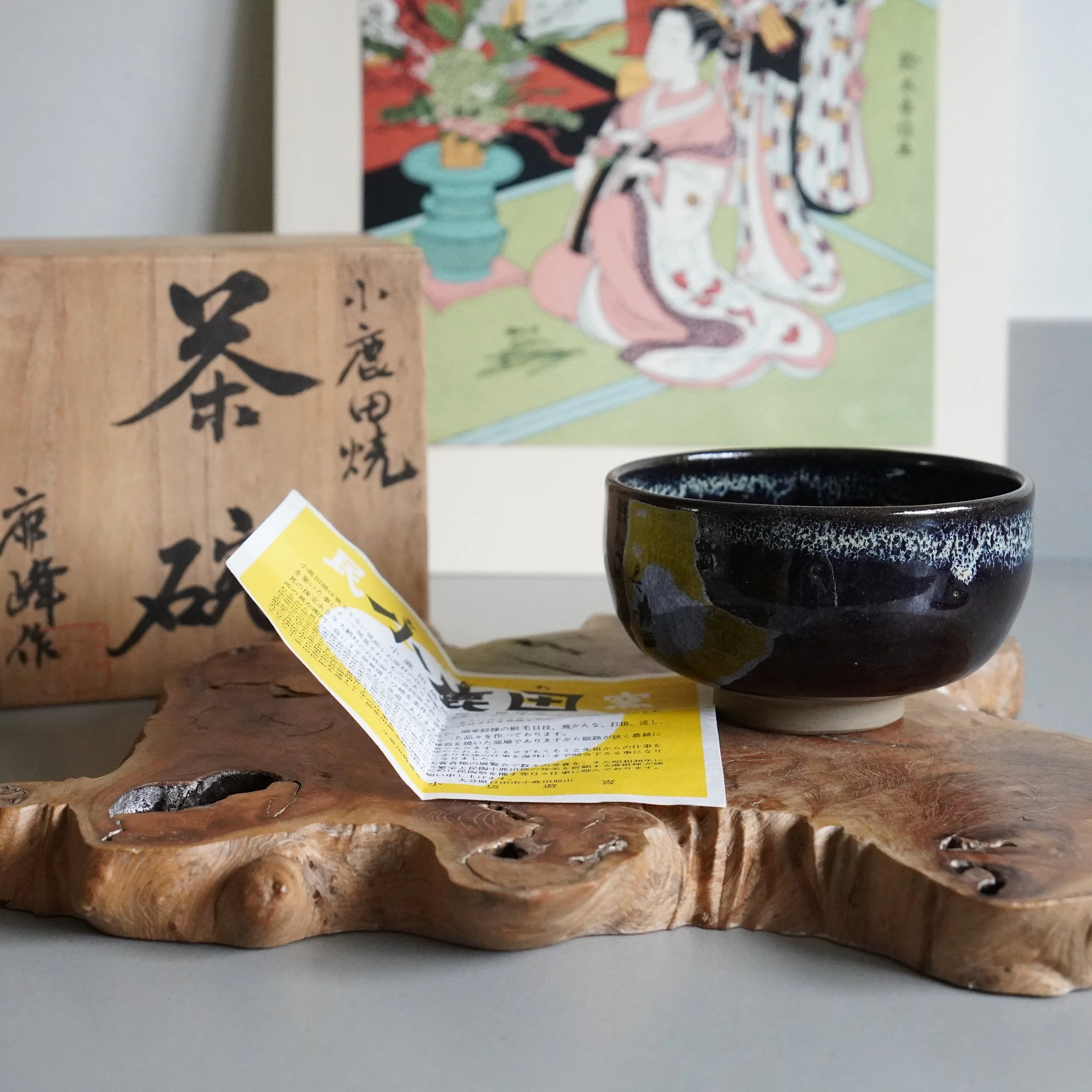
Held up to the light, this bowl is not black at all. The glaze is a deep brown that reads almost black at first glance, and over it runs a blue that settles in patches inside and out, pooling thickly before it stops at a clean line of bare clay around the foot. On the table it is dark and quiet; in your hands, turned toward a window, it becomes warm and layered.
It was made at the Kobukuro kiln in Onta, one of nine family workshops in a small mountain village in Ōita Prefecture that has made folk pottery in much the same way for about three centuries. Onta potters traditionally leave their work unsigned, and they mostly make plates, jars and rice bowls for everyday use rather than bowls for tea.
It is dated to Shōwa 47 (1972) and signed by its maker, Rokuhō (鹿峰), on its foot and on its original wooden box.
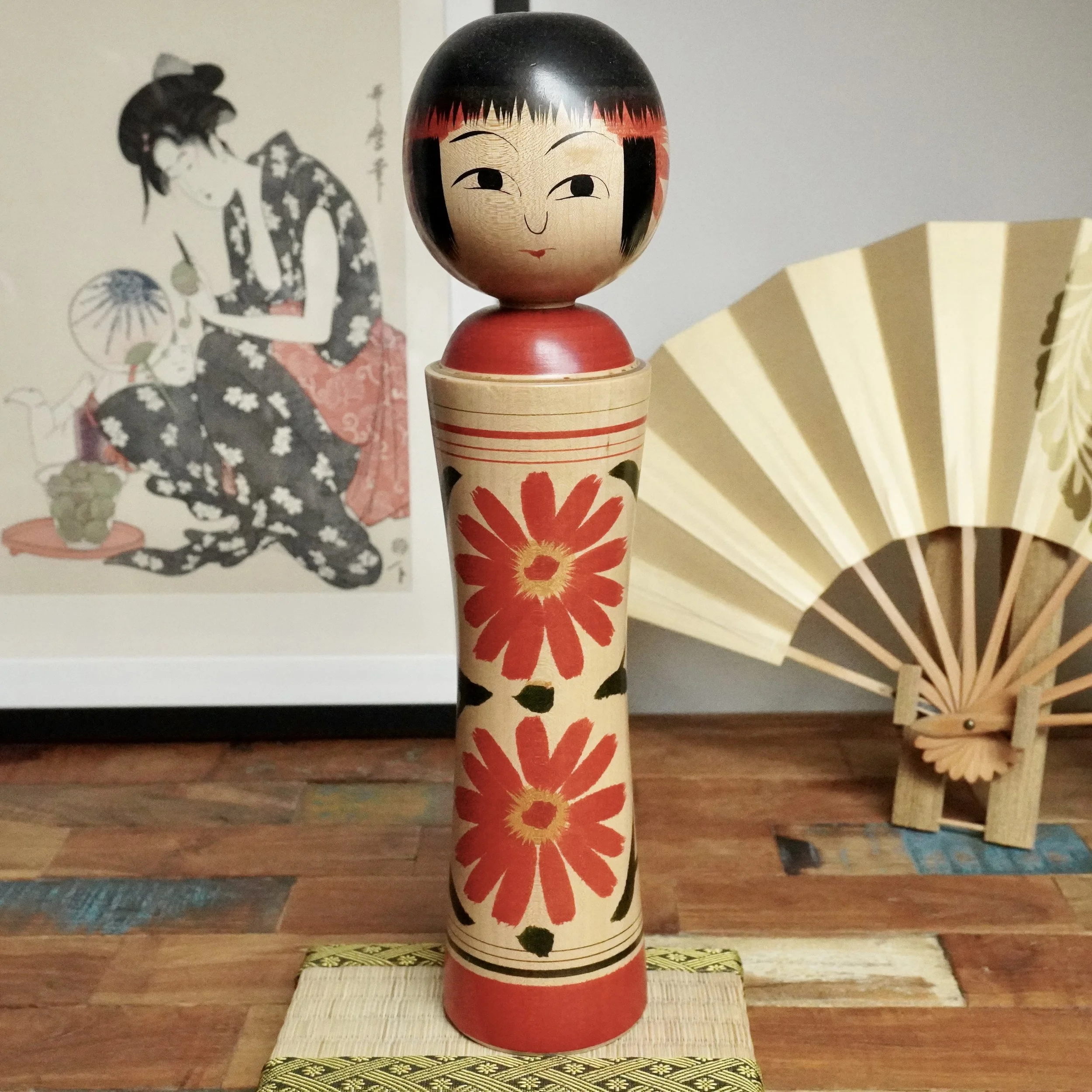
The scale alone stops you. At 36.5 centimetres, this is a kokeshi that holds a shelf on its own. The body is a clean, pale column, with two oversized red chrysanthemums running almost its full height, petals brushed outward in confident strokes around small golden centres. Red at the collar, red at the base. The face is quiet and a little knowing, framed by a precise black bob.
Izu Mamoru spent decades making Ginzan kokeshi at Ginzan Onsen, in the family workshop that is still the only place this style is made. He died in 2019. On the base of this piece he recorded the exact day it was finished, June 23, 1998, and his age at the time, 73.
Most kokeshi carry a name. This one also carries a moment.
Want to understand the difference between dentō and sōsaku kokeshi? I wrote about it, with a trip through Fukushima along the way.
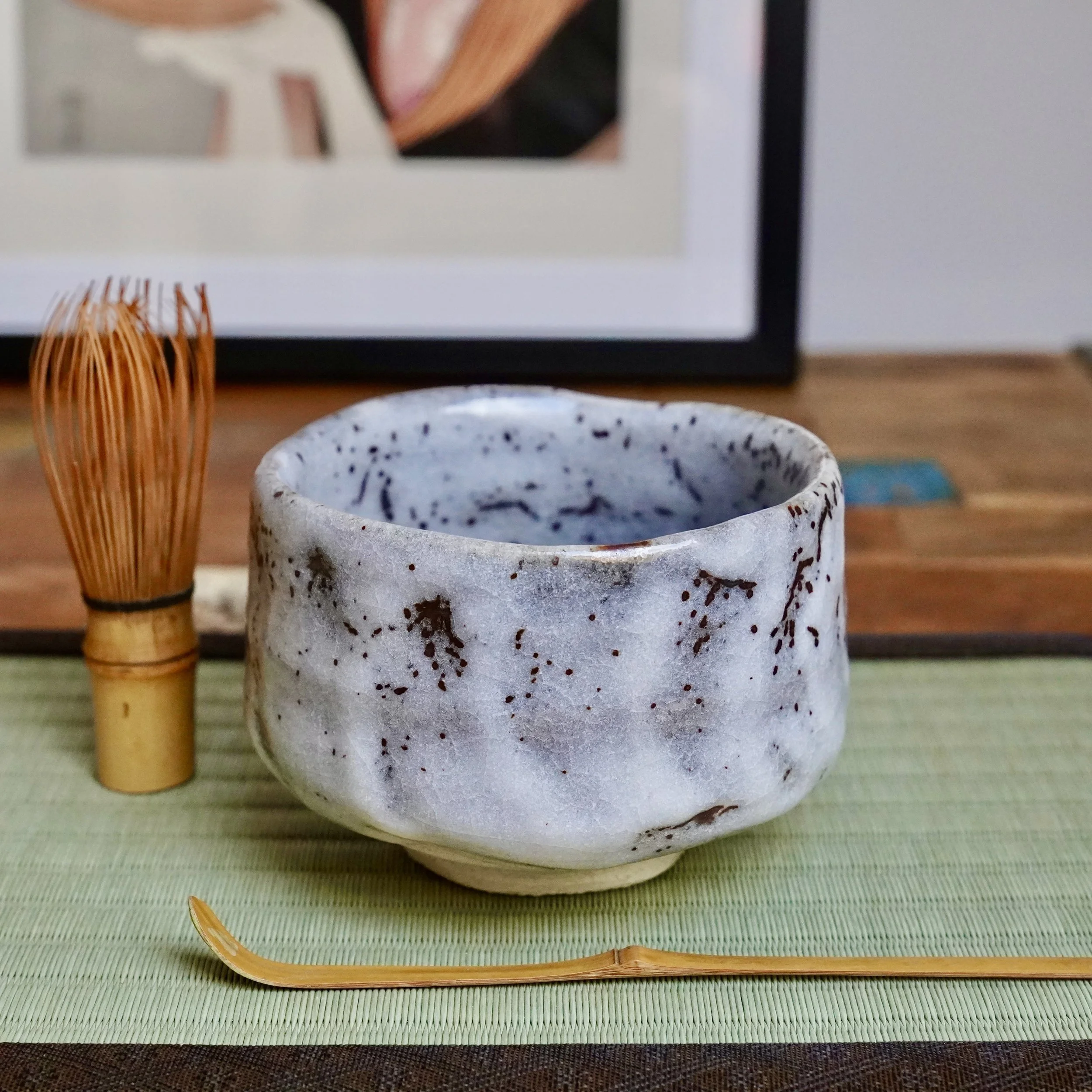
It is the snow white and the specks sprinkled all over along with the shaped outer wall that catches the eye. The walls of this bowl have been pressed inward all the way around, leaving a ring of shallow hollows that sit exactly where your fingers want to go. Rust brown flecks and drips gather in those hollows and trail down from the rim through a thick, white glaze, so the decoration follows the movement of the hand that shaped it. It is a sturdy, generous bowl, made to be held rather than admired from a distance.
It was made by Katō Shōzan at the Enshō-gama kiln in Oroshi, a pottery district of Toki in the Mino region of Gifu, the region where Shino ware was born in the late sixteenth century. The kiln's own printed leaflet speaks of carrying forward the techniques handed down from the founders of Mino pottery. This is an oni-Shino chawan, iron beneath feldspar glaze, signed by hand with 正山 scratched into the clay of the base: a working tea bowl from a working kiln, ready to be used every day.
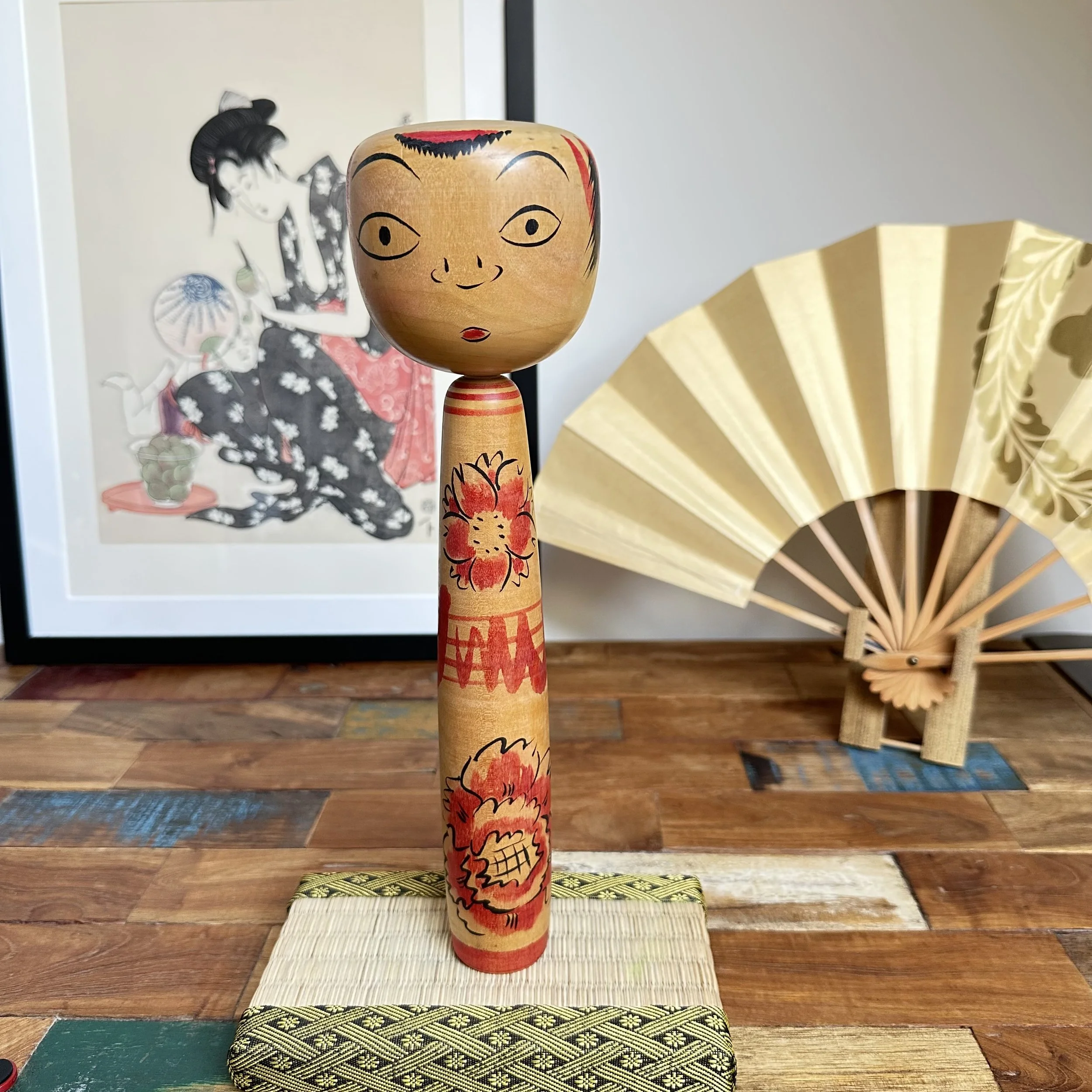
There is something almost comical about the size of her face and head against her narrow, tapering body beneath it, and that imbalance is exactly the point. Her face tilts forward slightly as if caught mid-thought, one eyebrow set a touch higher than the other, giving it a expression that shifts depending on the angle you catch it from. At just over 30cm, she commands more presence than its slim frame suggests.
This piece was made by Seya Jūji, who trained directly under Iwamoto Yoshizō, the maker who defined the Nakanosawa Takobozu style. Yoshizō gave Jūji a simple instruction early on: paint cherry blossom, not peony, so your work can always be told apart from mine. That small act of teaching is still visible on the body of this doll today, decades later. Jūji went on to become the maker Tokyo dealers turned to when they needed the earliest Takobozu designs faithfully reconstructed, work that helped keep the whole tradition alive through the 1970s.
→ Want to understand the difference between dentō and sōsaku kokeshi? I wrote about it, with a trip through Fukushima along the way.
→ Curious how Tsuchiyu compares to the other ten traditional kokeshi lines? Read the full guide.
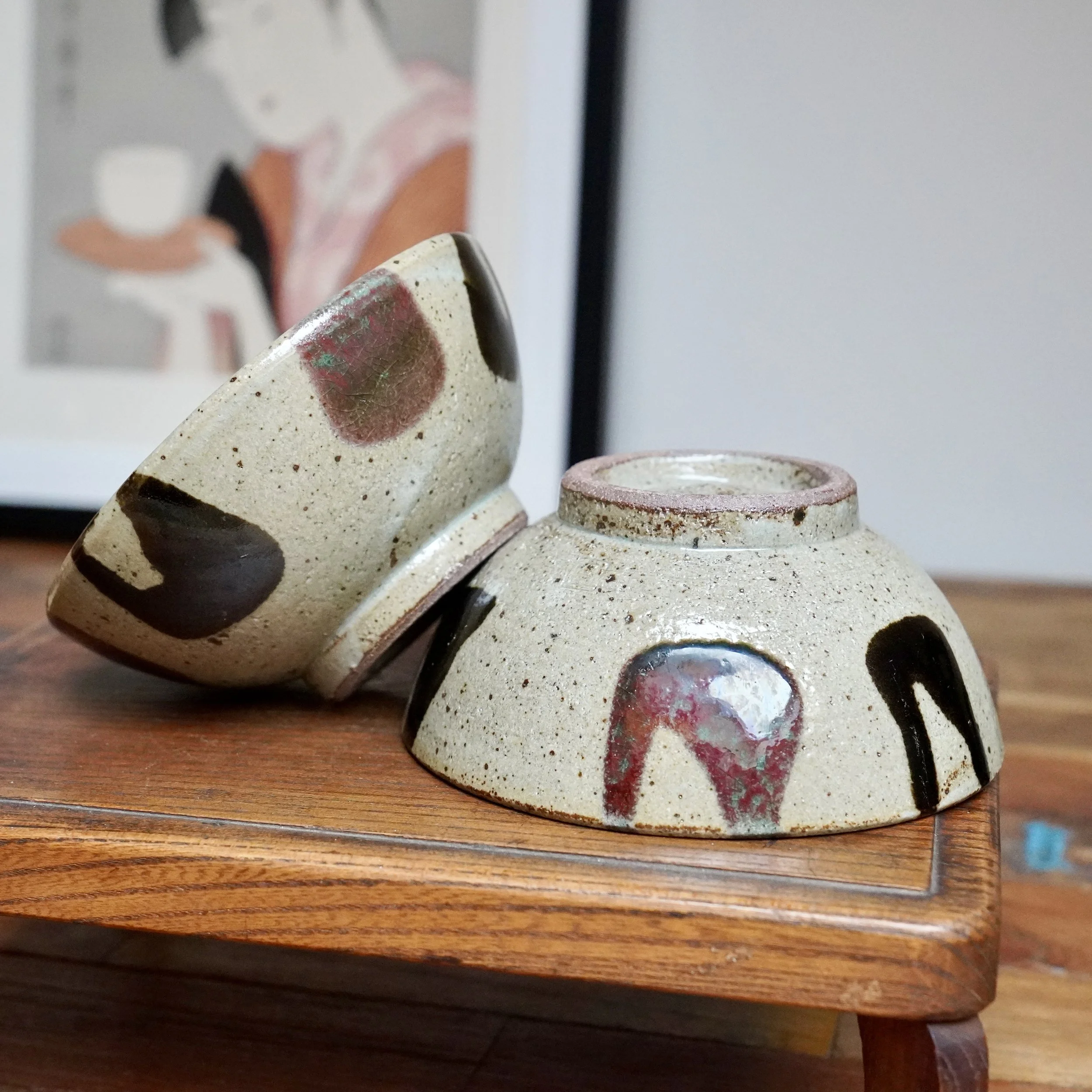
A milky white glaze drips from the rim of both bowls, as if each one had been dipped upside down and left to run before the fire. Beneath it, thick strokes of near black glaze stop and pool like brush marks, and patches of wine red seem to glow from inside the glaze itself. The clay underneath is pale grey, freckled with iron, so everything painted on it sits like ink on paper.
Wide and shallow, the two bowls side by side are clearly siblings rather than twins: no two strokes fall in quite the same place.
They come from the Maruta Nobumasa kiln in Takeo, the last working kiln in Kuromuta, a mountain village that once counted around forty. The kiln's founder, who set up on his own in 1961, chose to make ware for daily use rather than for exhibition, and these bowls still feel like they want to be picked up. They arrive with their original tomobako, hand inscribed and carrying the kiln's red seal.
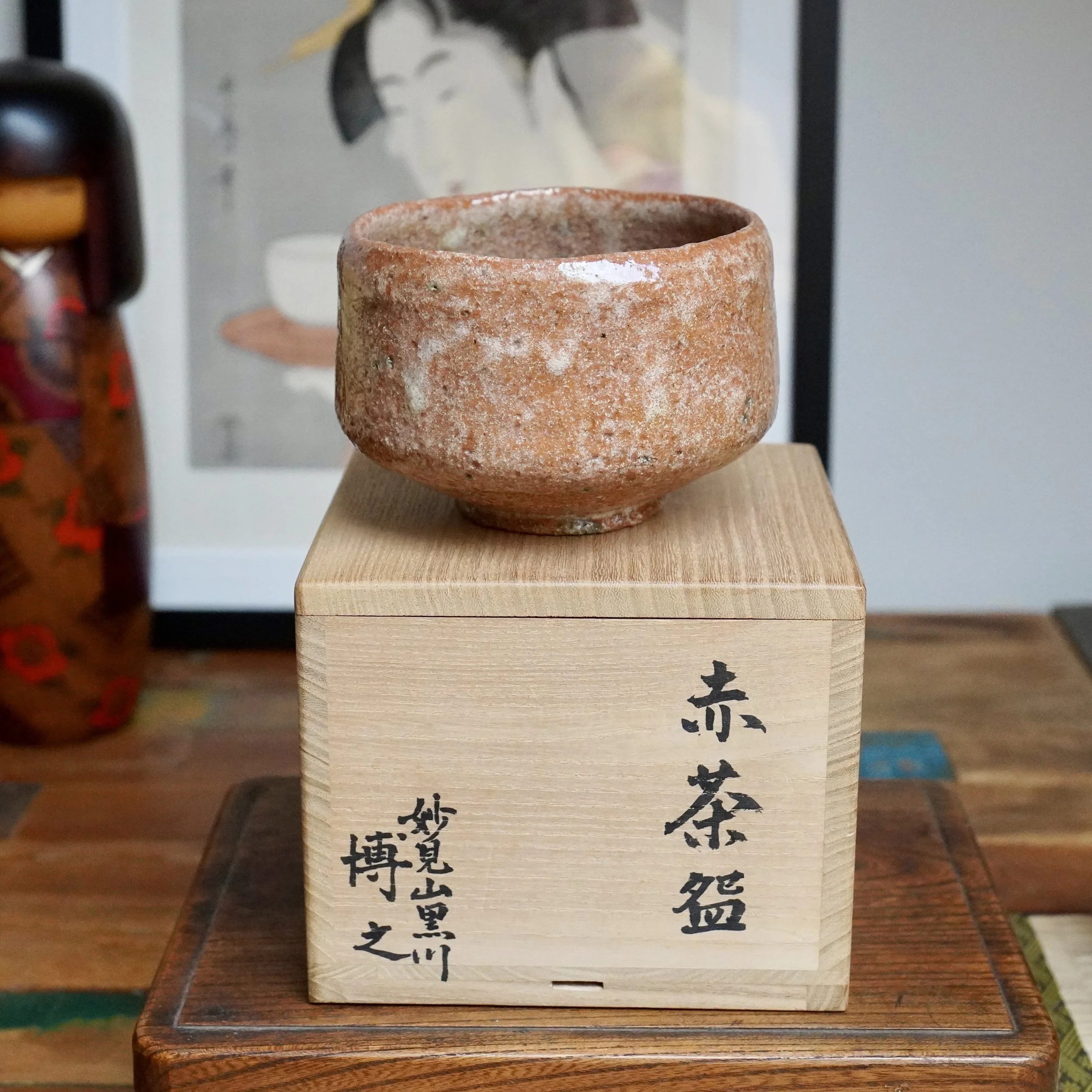
The pale drip of glaze down the side is what makes this aka-raku bowl unmistakable. Around it the surface is rugged, sandy and pitted, with glossy patches where the glaze has gathered, and the soft white run cuts across all of it.
Sawada Hiroyuki has spent decades on raku, the ware most closely tied to the tea ceremony, at his own kiln in the hills of Hyōgo, and his work has been shown in the department store galleries of Osaka. This bowl comes with the original box, written by hand with the name of his kiln village and his given name.
This chawan is aka-raku (赤楽): red raku. In the tradition of the tea bowls first made in Kyoto in the sixteenth century. A raku bowl is shaped by hand from a lump of clay, pinched and raised without a wheel, then refined with a spatula. It is glazed and fired at around 800 to 900 °C depending on the source, and lifted out of the kiln while still hot. In aka-raku the red comes from iron rich clay showing through a clear glaze. Sawada is a raku specialist and this bowl is consistent with the tradition.
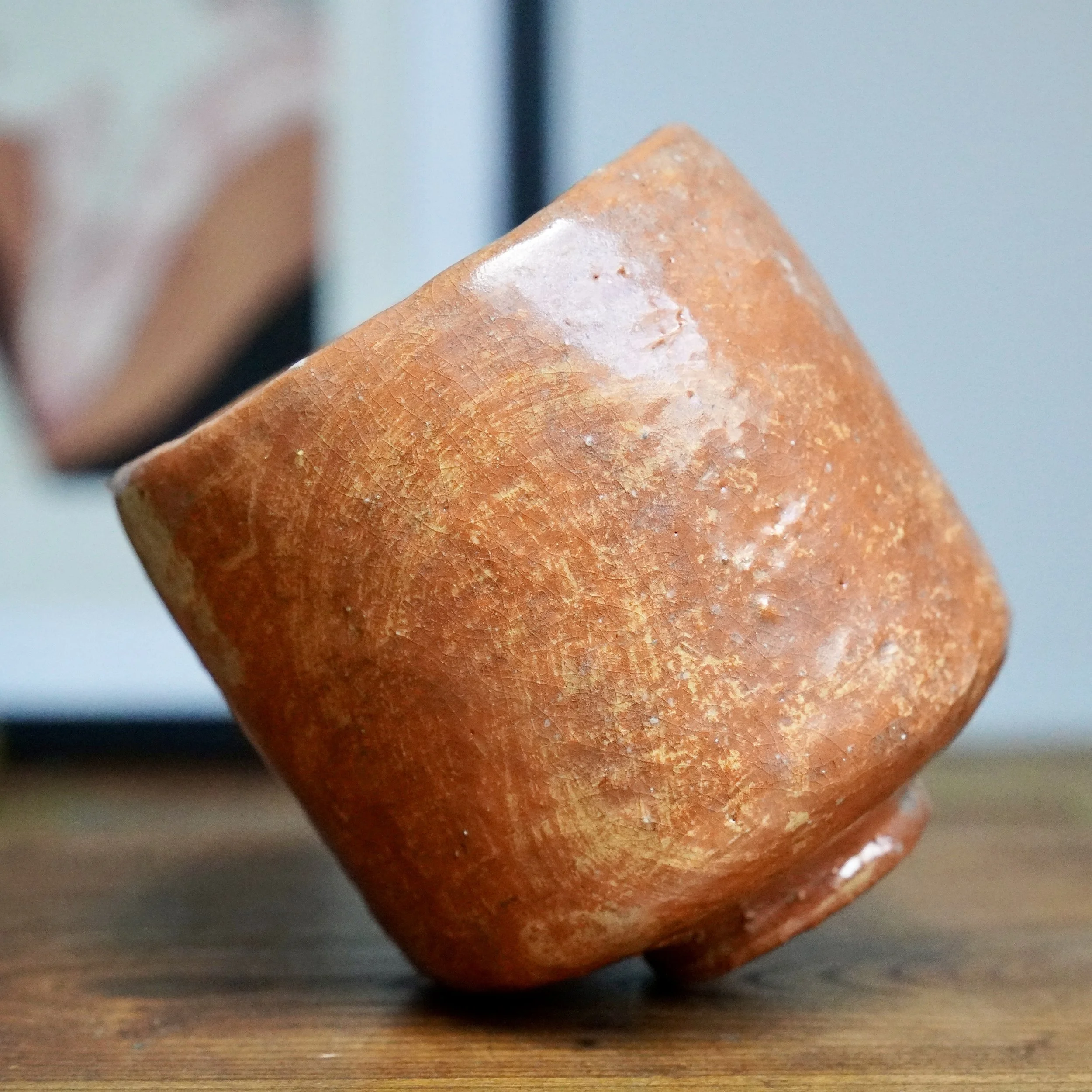
A tall, straight sided tsutsu shape bowl the colour of terracotta after rain, standing on a small foot as if lifted. Cream marks cross the surface like quick brushstrokes, and on one side a white glaze runs down from the rim and fades halfway. It is as high as it is wide, about 10 cm each way, so it fills both hands the way a winter tea bowl should.
It comes in a box stamped and sealed by the Hioki Nanshū kiln in Kagoshima. The kiln is still active today, on the site of the Daijō-ji, the family temple of the Hioki Shimazu family.
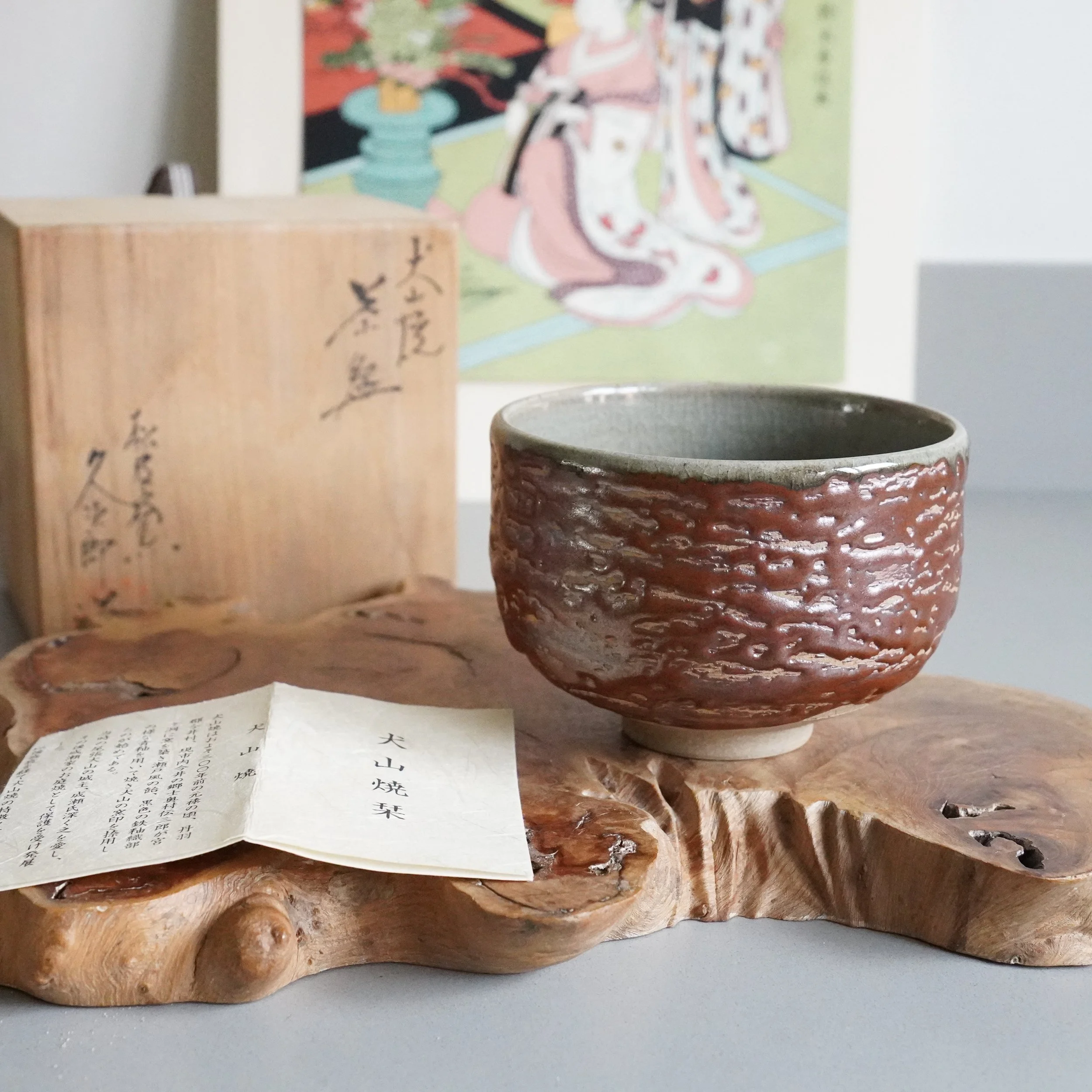
The glaze does the talking before anything else does. Uneven brown breaks across the exterior like bark peeling off a trunk, dark where it pools thick, almost gold where it thins, smooth and glossy to the touch despite all that movement. Turn the bowl in your hands and the surface catches the light differently every few centimetres. Inside, all of that noise drops away: a quiet grey-green settles at the base, still and cool against the storm outside.
This bark-textured glaze, matsukawa-yaki, has its own story. It was developed at a small kiln in Inuyama, Aichi Prefecture, now known simply as Matsukawa-gama after the technique that made it locally famous. The kiln has worked continuously for over a century, and this particular glaze earned its reputation the slow way: refined over two generations and shown at exhibitions across Japan until the public gave the workshop its name.
New to chawan and wondering what to look for? Read about why size and weight change everything in my journal.
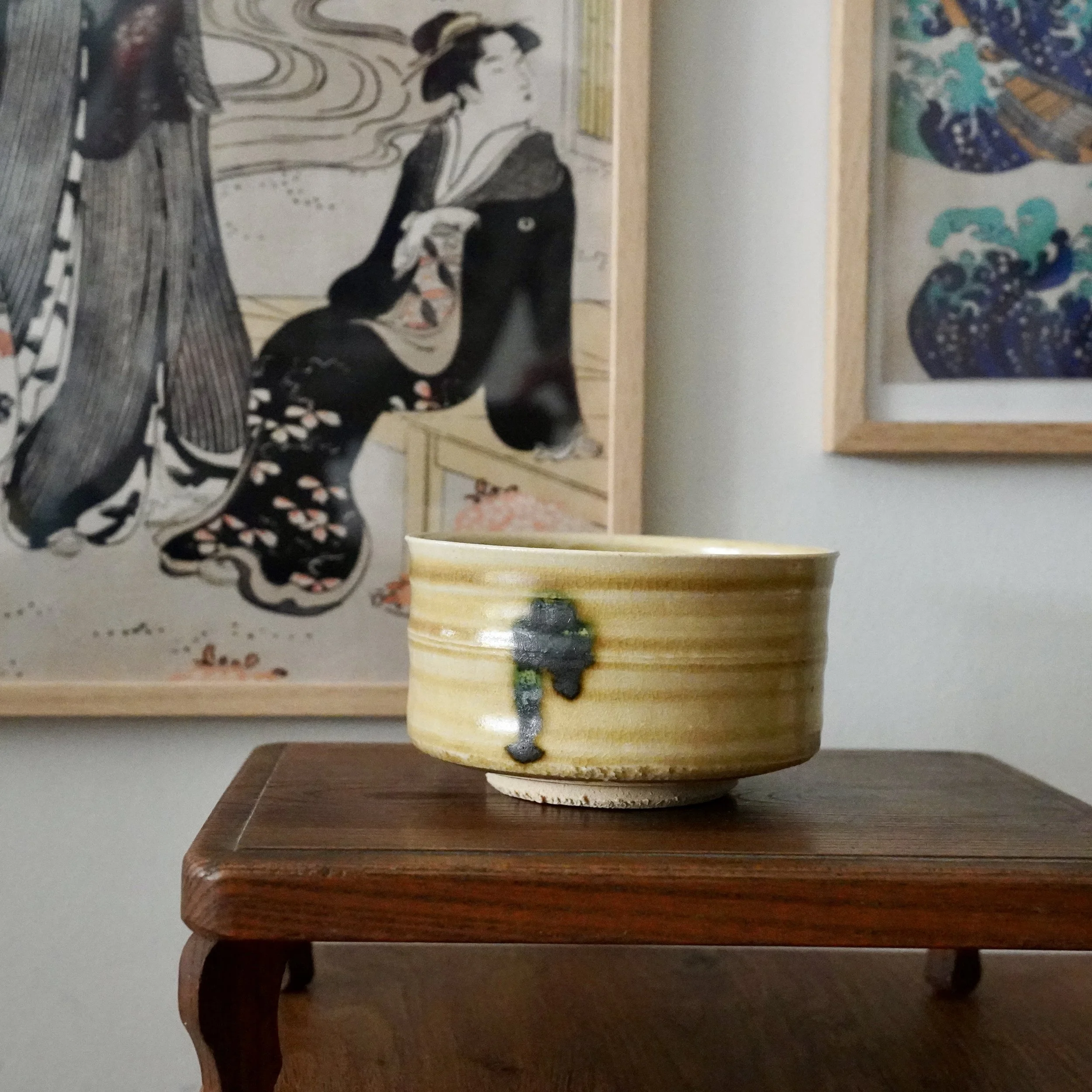
Low, straight-sided and steady, this bowl sits like a small drum. Ridge after ridge circles its mustard-yellow body from rim to foot, and three drips of green run down one side as if they could not wait for the kiln to cool.
It was made by Yasuda Masahiro (安田全宏), a Kyoto-born potter who trained under Kiyomizu Rokubei and rose to councillor of the Nitten, Japan's leading national art exhibition. He received the Prime Minister's Prize at the Japan Contemporary Arts and Crafts Exhibition, and his work is held by the Shiga Museum of Art. Here he takes up Ki-Seto, the yellow tea ware of sixteenth-century Mino, and makes it his own: a bowl from a potter who knew both the tea room and the museum gallery.
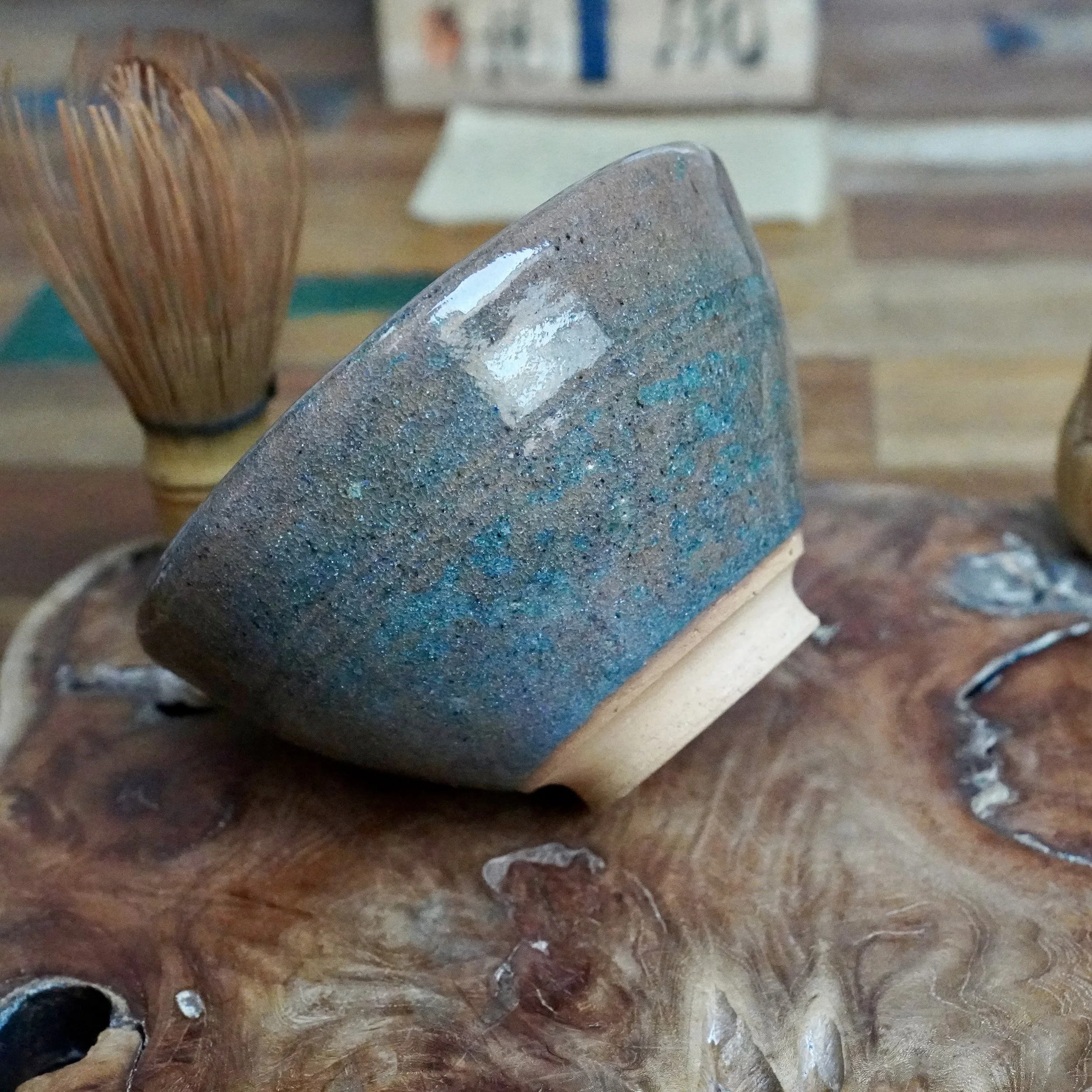
The glaze is what stops you first: smooth under the light, dense with fine blue speckling that seems to change as you turn the bowl, flaring brighter in some angles and settling quieter in others. Run a finger across the surface and it glides.
This bowl comes from a kiln you will not find in any reference book. Mizushima Jirō built it himself at the foot of Kagurao, a hill near an old castle ruin outside Tsuyama, in Okayama Prefecture, and named the ware after the mountain itself.
The ruin belonged to Kagurao Castle, a hilltop fortress whose founding date is undated but which stood active through the Muromachi period, into the late sixteenth century. In his own handwritten shiori, he describes using local clay and firing with red pine, the same wood traditionally used to fire Bizen ware in the same prefecture, chasing a glaze effect he calls a "unique melting field," one he admits he was still trying to master.
He called his own work raku-yaki, and the bowl itself, dense, high fired stoneware with a hard, unglazed foot, tells a story closer to a personal, self-taught practice than to the soft, low fired tradition the word usually points to. Owning this piece means owning one individual potter's own account of his materials and process, in his own hand, with nothing added or assumed beyond it.
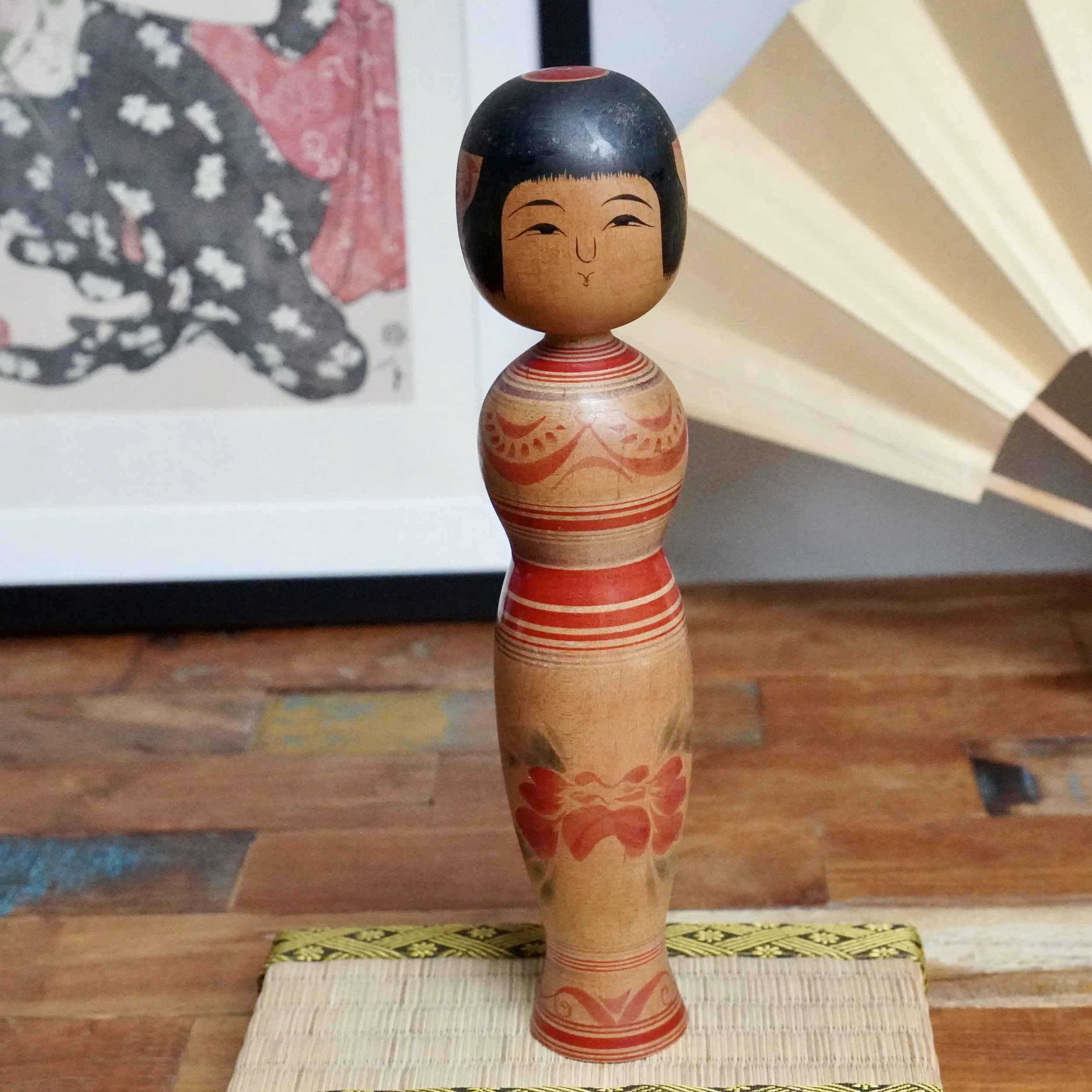
The waist gives it away before anything else does. Where most kokeshi run in one continuous column, this one pulls in sharply below the shoulders, then widens again toward the base, an hourglass silhouette you will not find anywhere else among the eleven dentō traditions. A large, loosely brushed peony spreads across the front of the body in red and deep plum, painted with a freer, more painterly hand than the tightly repeated florals of the older Miyagi lines. The head and body are turned from a single piece of wood, no seam at the neck, the whole figure carrying itself with an easy, almost sculptural confidence.
Tsugaru is the youngest of the eleven recognised kokeshi traditions, only reaching back to the 1920s, born once adults rather than children became the main buyers of kokeshi as hot spring souvenirs, and freed from the older, stricter toy-shaped conventions as a result. It is made using a genuinely difficult reverse-lathe technique, a method every other line has largely abandoned. This piece is signed by Sasamori Junichi, born 1954, a maker working within the Nuruyu style associated with the tradition's founder, Mori Hidetarō. The peony carries real weight here: it is the crest of the Tsugaru clan itself, not simply a decorative flower, which makes this a piece that carries the region's own history on its body, not just a pattern borrowed from elsewhere.
→ Wondering where Tsugaru fits among the eleven kokeshi traditions? Here's the full picture.
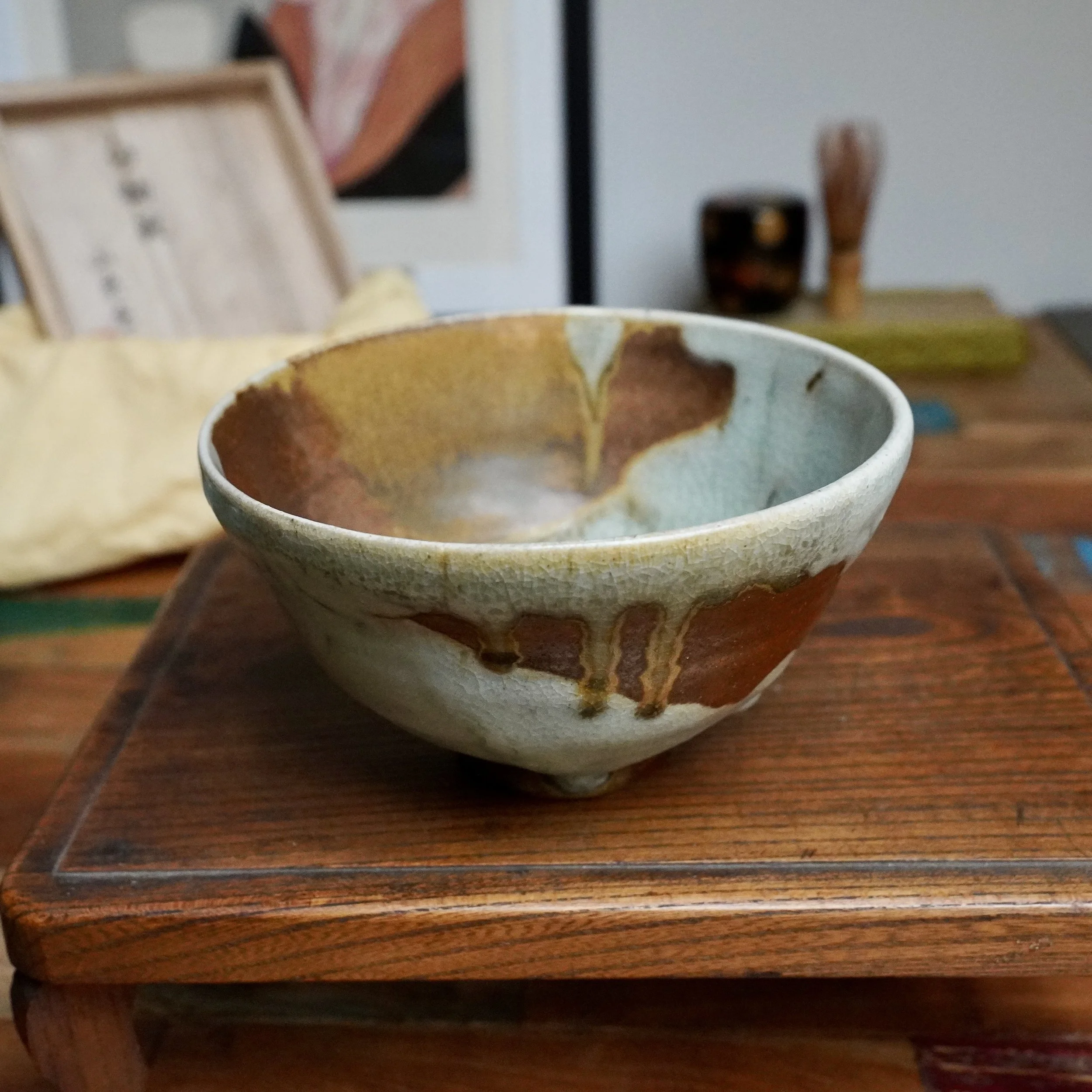
The glaze on this one shifts from a pale, crackled blue-grey into a deep, warm rust-brown that spills down one whole side like something poured rather than painted. Streaks of ochre yellow brown run through the transition, and the unglazed foot beneath it all is a rich, earthy red-brown, left bare so the clay can speak for itself.
This chawan comes with its original tomobako, signed and sealed 山桑庵 (Sansōan), a studio potter’s workshop name. It has the kind of glaze variation that rewards turning it slowly in the hand before you drink from it.
→ Curious to know why the size and weight of your chawan makes a difference when drinking tea from it? Read more in my journal.
→ Want to see this bowl meeting the early morning sunlight? Here it is on my Instagram.
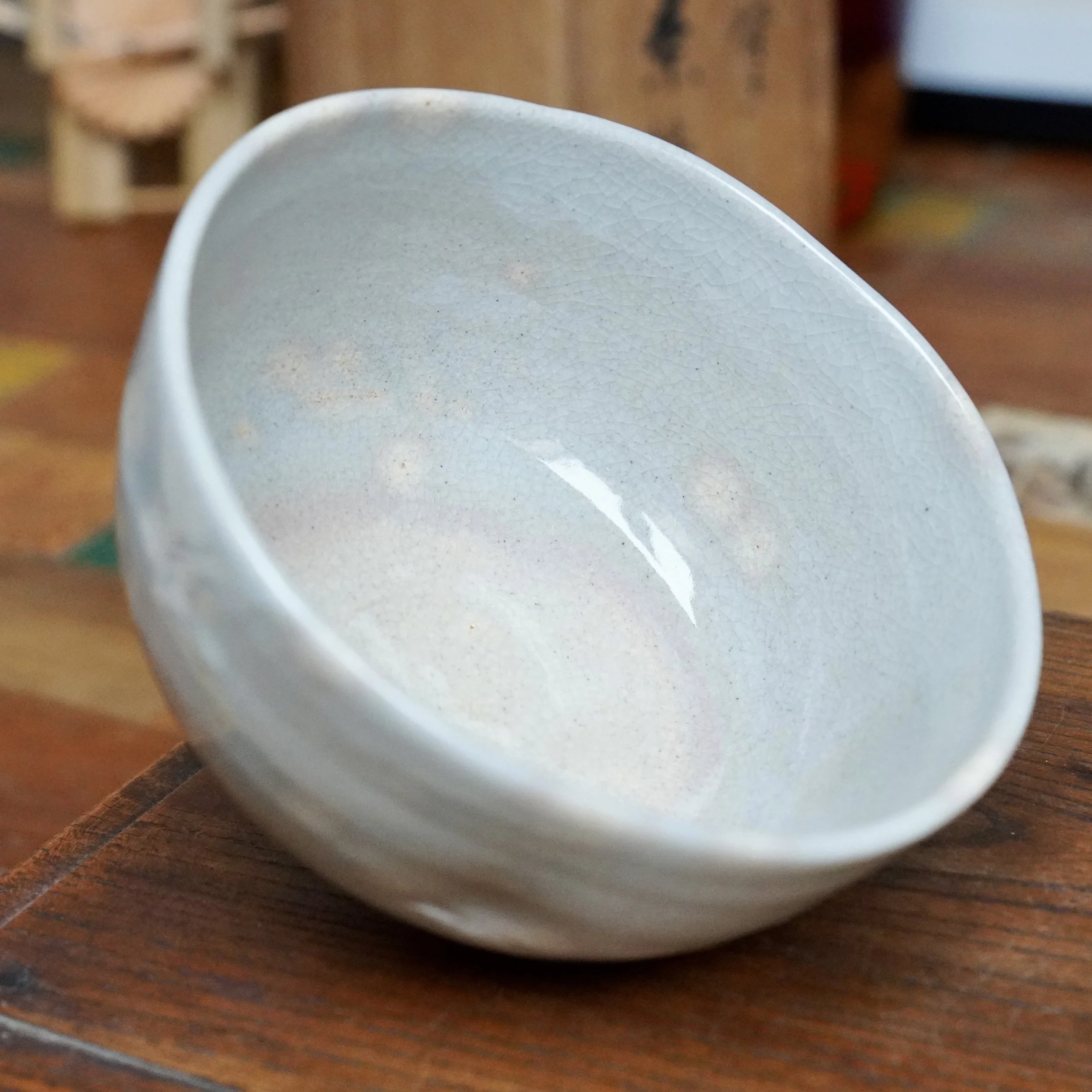
Pick this bowl up and the shape answers a question before you ask it. One side of the rim sits straighter than the rest, a shallow, deliberate press into the wall that meets your fingers exactly where a hand naturally rests. The glaze is a soft grey-blue, smooth under the fingertips, and where it catches the light around scattered pinholes a faint pink blush shows through, the same warm pink that spreads openly across the whole interior. Fine crackle runs over every surface, the kind that only comes from decades of tea passing through it.
This bowl carries the signature of Nagasawa Minoru, third generation head of Izushi-gama, the Nagasawa family workshop that has worked in Izushi, Hyōgo Prefecture, since 1907. Minoru trained at the Kyoto Municipal Ceramics Training Institute before turning to painting under Akamatsu Unrei in Osaka, and went on to win the Hokuto Prize at the Nitten exhibition, serve as a Nitten judge, and receive Japan's National Yellow Ribbon Medal in 1974. Izushi-gama is best known for pure white porcelain, but Minoru was the generation who also worked in local clay, and this bowl, with its Hagi-like crackle and blush, is a rare piece of evidence of that side of his work.
Those small pinholes in the glaze aren't unique to Hagi and Shino wares alone. Curious what causes them, and why tea masters have prized them for centuries? Read more about su-ana, the "nest holes" of Japanese glaze here.
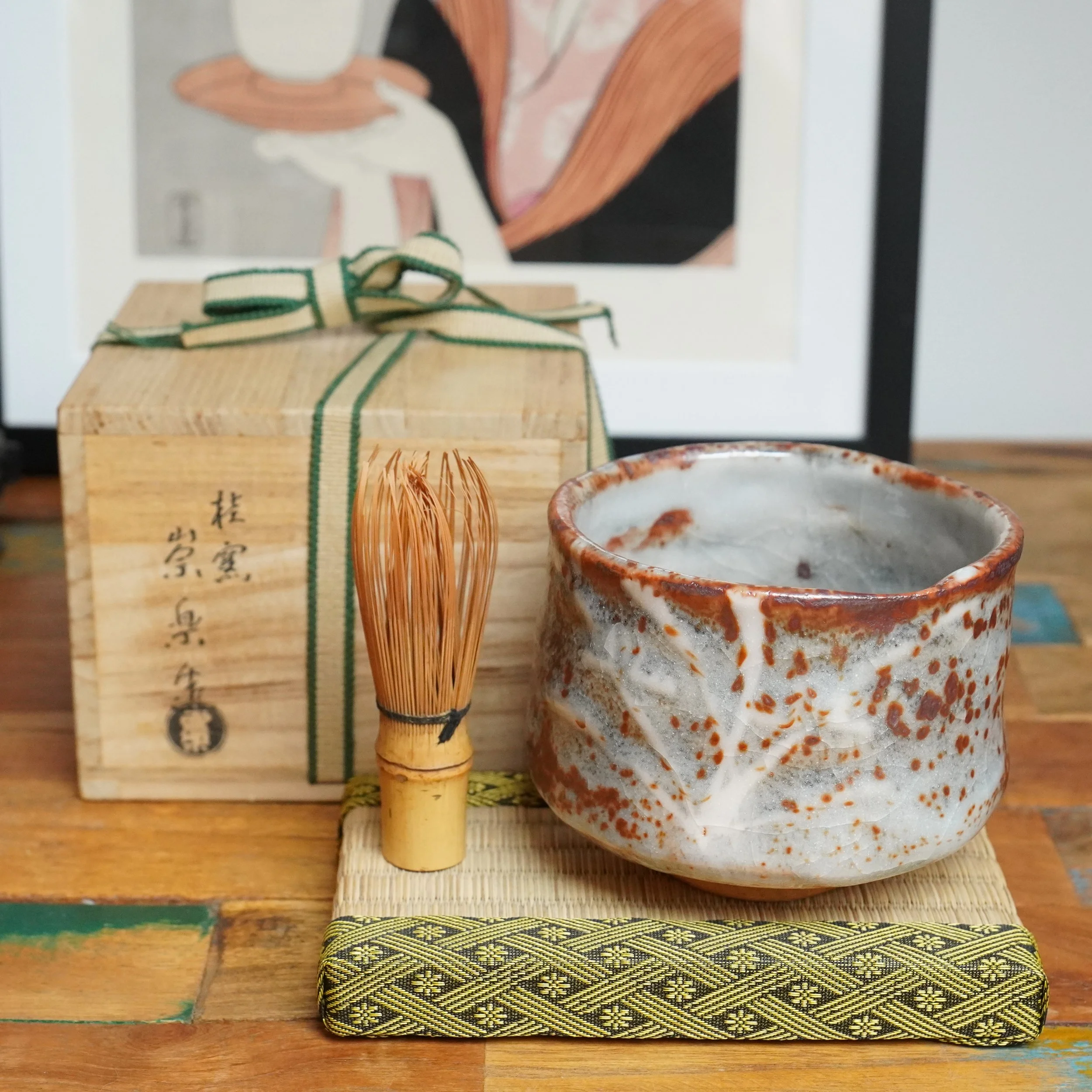
Pick this winter chawan up and you understand immediately why it exists: a thick, heavy matcha bowl built for cold hands around a hot drink.
The glaze runs white to pale grey, broken everywhere by deep red speckles that catch a faint metallic glint when the light moves across them, and a single pale, branch-like line traces down one side like frost on a window. Inside, the glaze has cracked into a fine web, delicate as broken ice.
This is not a bowl you sip from one-handed. It asks to be held in both palms, the way you would hold something you did not want to put down too soon, which makes it the kind of chawan that earns its keep on the coldest mornings.
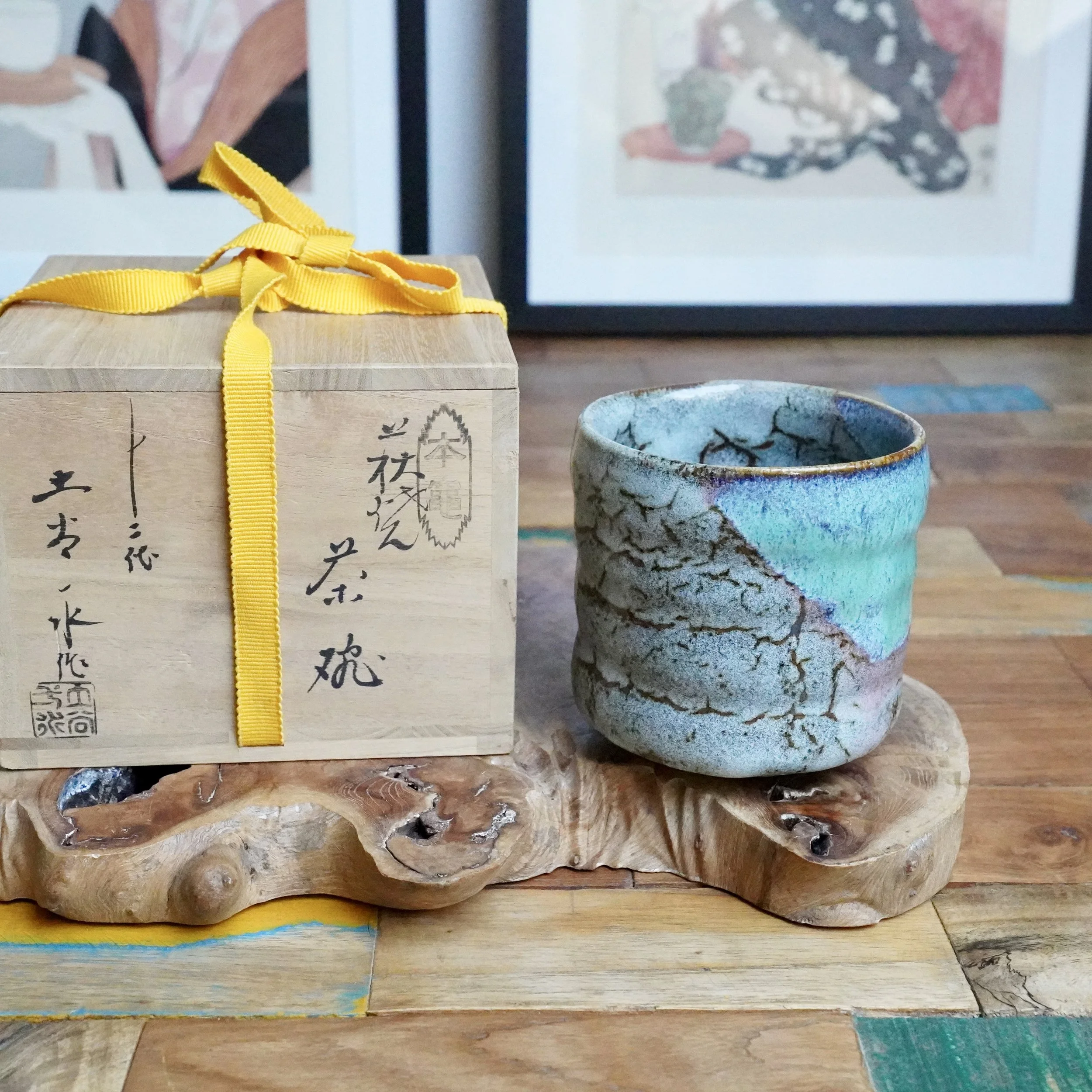
Tall and straight-walled, this tsutsu shaped chawan holds its heat the way it holds attention, a shape traditionally reached for in the colder months. It hols a substantial, satisfying weight in the hand. The glaze pools into a clear turquoise on one side, breaking into a soft, speckled grey field, with warm brown lines tracing all over the body. It is a bowl that draws the eye before it ever reaches your hands.
This chawan comes with a wooden tomobako inscribed with the name of a Hagi-yaki maker. The glaze and form of the bowl itself are not typical of Hagi-yaki, so I can't confirm this is its original box. Japan has an enormous number of studio potters, each with their own variations, so I'm not ruling it out either. The box reads: Tsuchiya Issui (土屋一翠), 12th generation, Hongama kiln (main/head kiln) and Hagi-yaki. Either way, it's a genuine wooden box and comes included. It keeps the cup safe in your home.
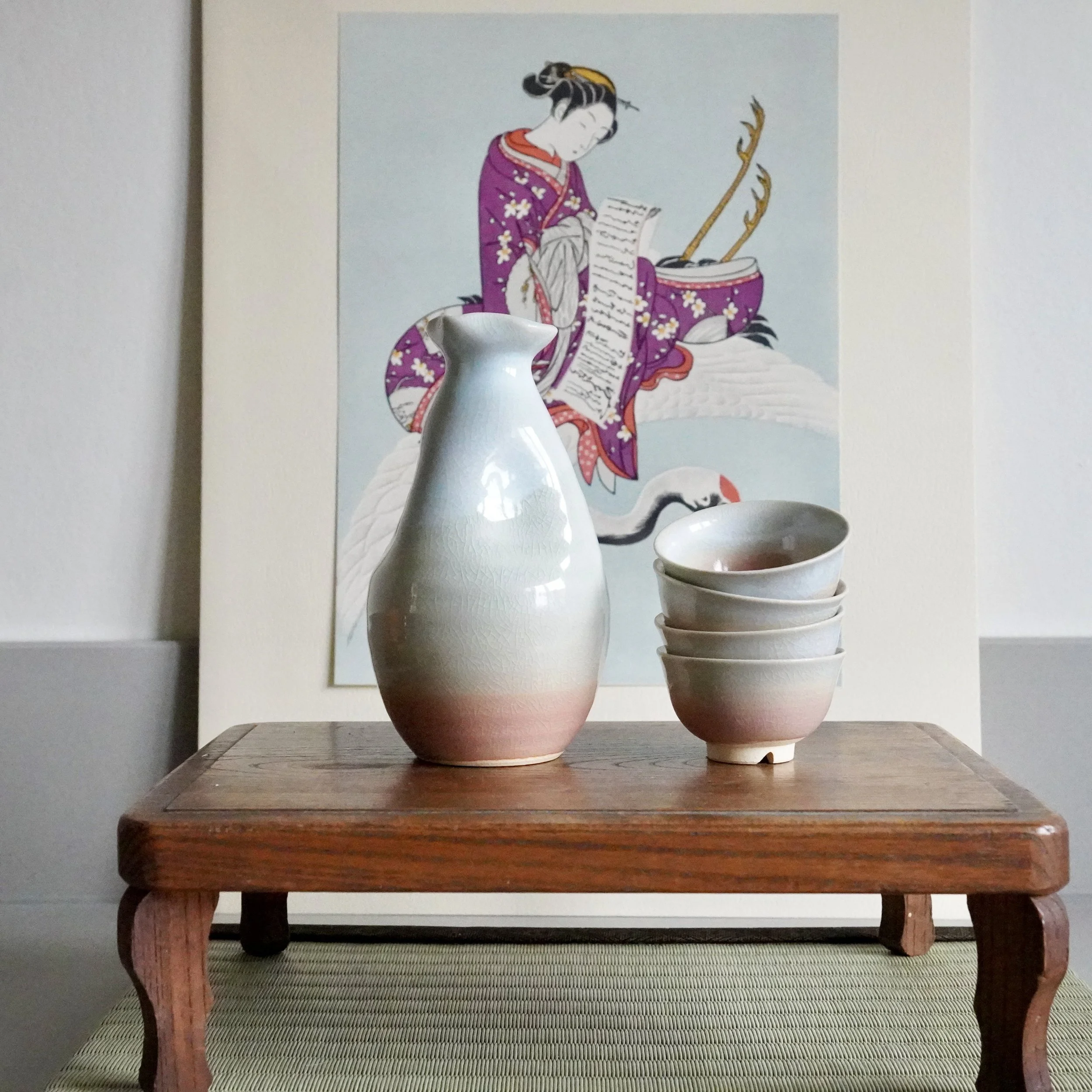
The gradient is the first thing that stands out A soft blush at the base, the colour of a winter sunset, rising into a cool pale blue-grey at the rim, as though the glaze caught its breath halfway through. One tokkuri and four ochoko, every piece moving through the same shift of colour, every piece a slightly different temperature when you hold it.
Hagi-yaki stands just behind Raku in the old hierarchy of Japanese ceramics, and its reputation rests on one quality: the clay is porous. Over years of use, sake works its way slowly into the surface and the colours shift. The Japanese call this shichibake, the seven transformations. For sake ware, this is not wear; it is the point. This set bears a kiln stamp pressed into the unglazed foot of each piece.
Pour sake into this set once and you have started something. Hagi clay is porous, so every cup you drink from leaves a trace: a slow, quiet shift in colour that the Japanese have a name for. Nobody can rush it, and no two sets change in quite the same way. I wrote about what actually happens inside the clay, why the crazing matters, and how to help the change along instead of fighting it. Read the full story.

Two tea cups in a pale grey-green glaze, each with large iron-brown patches breaking through the surface in irregular shapes. The glaze has fine craquelé throughout and a darker iron line at the rim. On one side of each cup, yellow dots in overglaze enamel sit among white areas where the iron recedes, forming a loosely painted ume blossom. The ribbed throwing lines are visible under the glaze and the form tapers slightly toward a small raised foot. These are cups that reward looking at closely.
The glazing follows the Karatsu tradition: a feldspathic base with iron-oxide patches applied before firing, the two glazes pooling and bleeding against each other in the kiln. Seto potters have worked in this style since the Edo period, producing teaware in which each piece comes out differently from the one fired beside it.
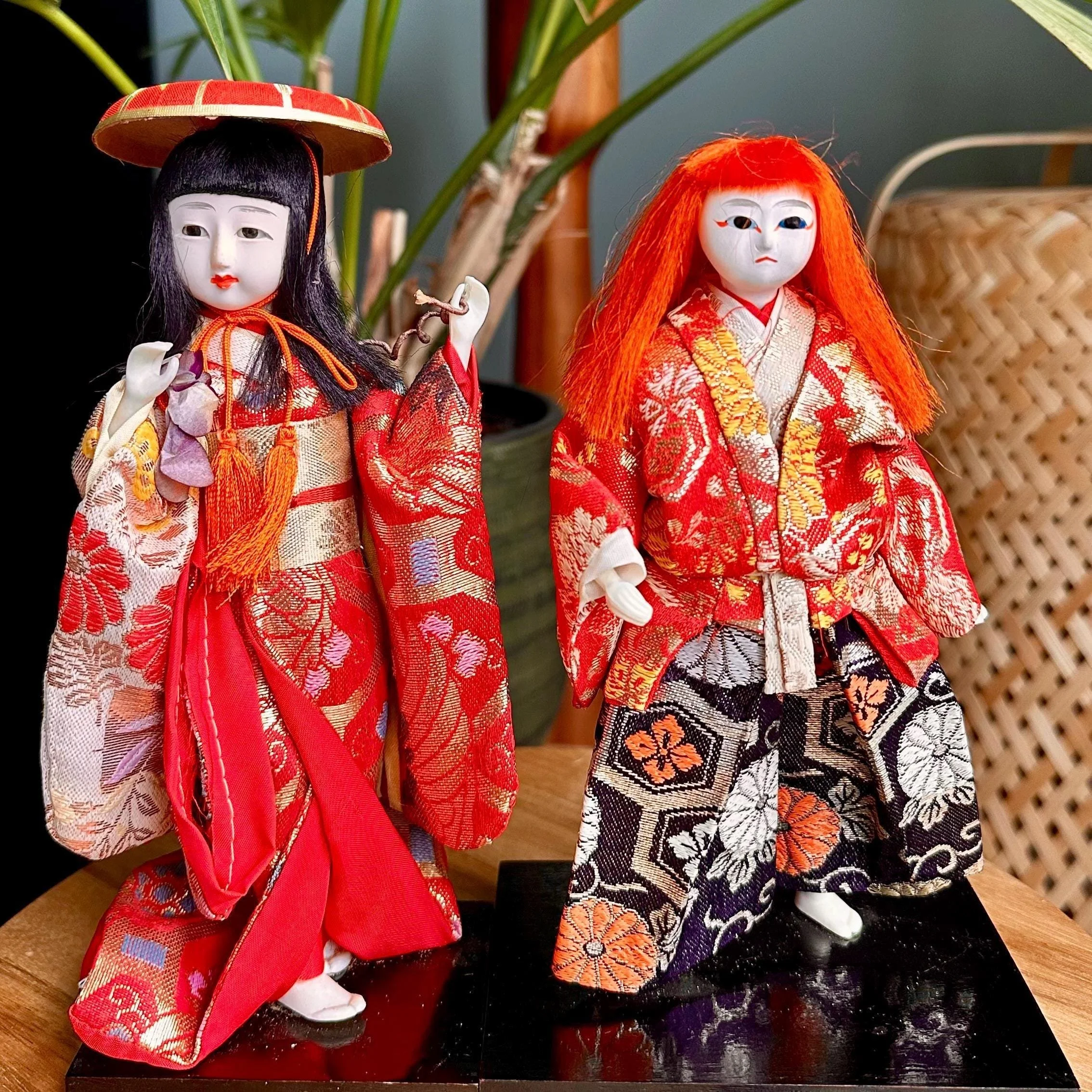
Two dolls, two colours of hair, one story. The figure on the left has black hair, a small ceremonial hat, and the composed bearing of a court lady. The one on the right has wild orange-red hair that falls loosely around the shoulders, a wider stance, and a presence that is not quite still. They are in matching reds and golds, on matching black lacquered bases, and they belong together in a way that is immediately clear even before you know why.
These two figures represent characters from Kagamijishi, one of the most celebrated dances in the Kabuki repertoire. The lady-in-waiting Yayoi dances with a lion-head mallet at the New Year. The lion spirit takes hold of her. The performance that follows is among the most spectacular in Japanese theatrical tradition: a transformation from stillness to wildness, from restraint to pure expression. These dolls hold both moments at once.
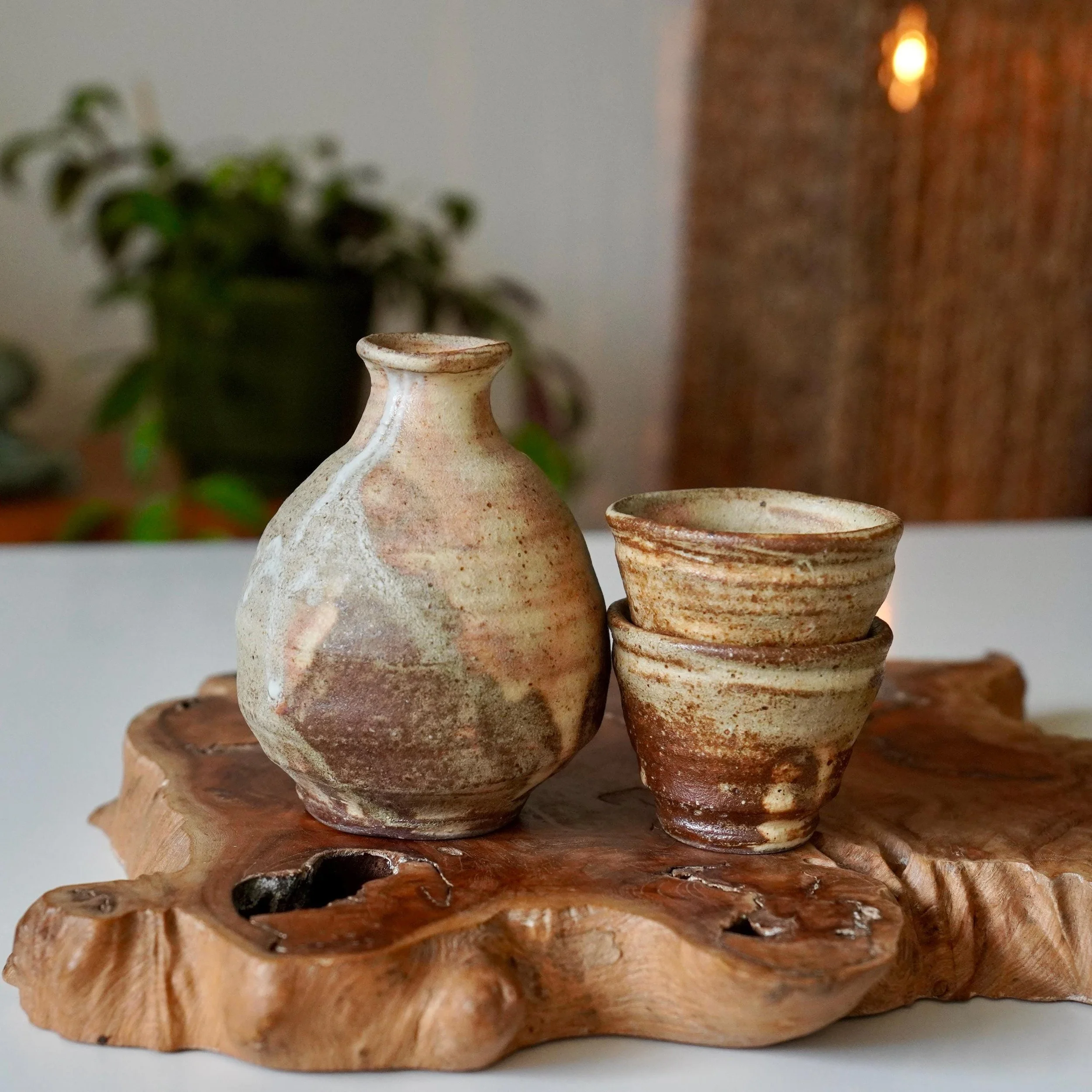
Three pieces, one fire. Three pieces that look like they came out of the same fire. The tokkuri sits low and round, rising to a narrow neck with a folded rim, its surface shifting from cream and pale sand to patches of salmon pink and russet. The two guinomi match it without being identical: same rough clay, same warm blush, same quiet irregularity. It is a set for someone who wants texture and warmth on the table, not polish.
Natural ash glaze is not applied. It happens. During wood firing, ash from the kiln settles on the clay and melts at high temperature, creating a surface that no two pieces share in exactly the same way. The warm pinkish tones, the sandy patches, the places where the fire moved differently, these are all direct records of the kiln at work.
This set is consistent with the wood-firing tradition of central Japan, where stoneware has been produced for over a thousand years known for exactly this kind of rugged, flame-marked surface. The set is signed, this was made by someone who wanted to be known for it.
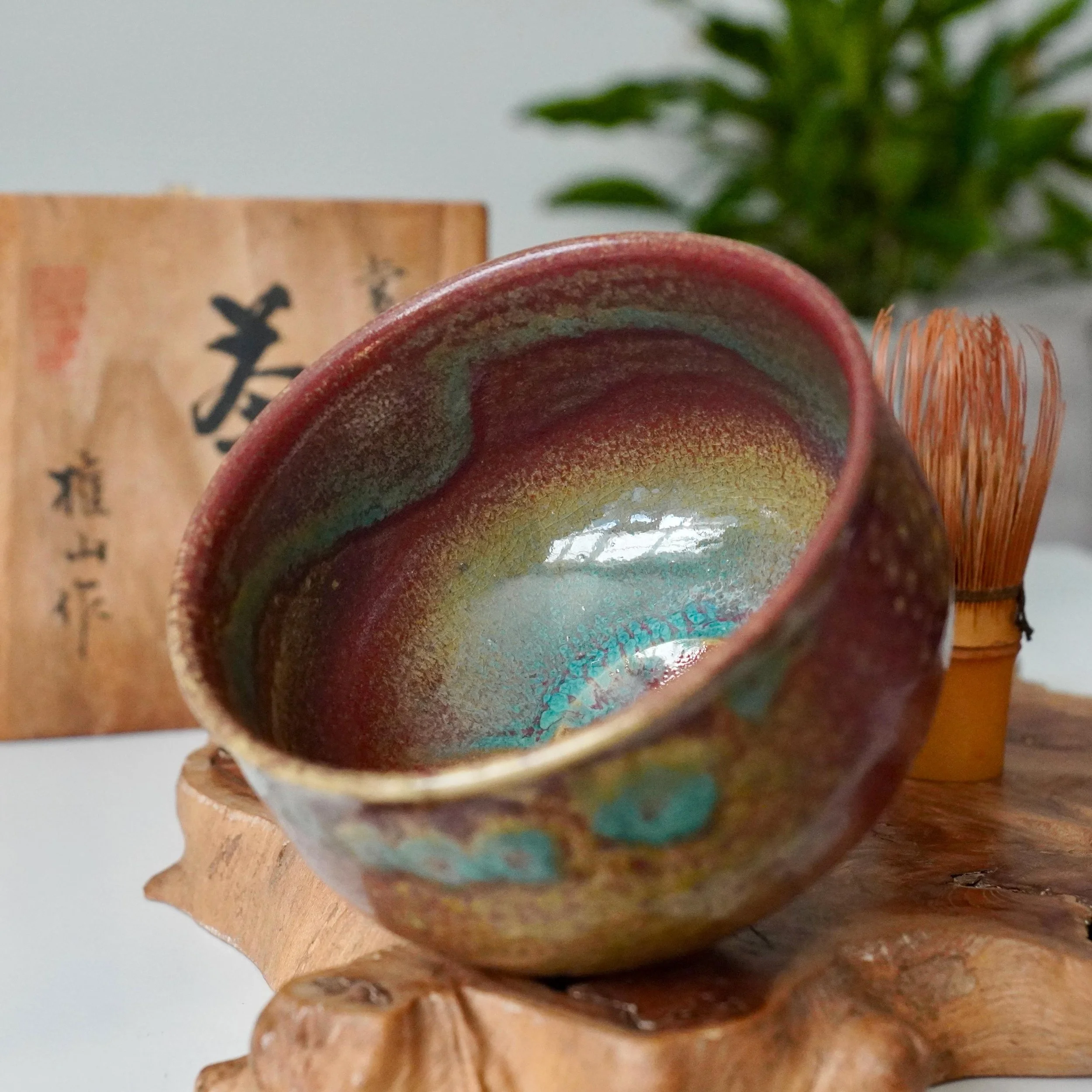
The glaze moves like something still in motion. Deep ruby red pools into turquoise and gold where the heat pulled it during firing, no two patches settling the same way twice. This chawan sits low and asymmetrical in the hand, the shape giving it a slight, deliberate lean rather than a perfect circle.
Around the shoulder runs a row of turquoise blossoms, each with a red heart, set into turquoise and olive gold like petals that have landed on the glaze. Inside these blossoms continue their journey in the glaze. The blue glaze pools towards the bottom.
Tokoname is one of Japan's oldest kiln cities, a place where potters have been working the same iron-rich clay for over nine centuries. Kenzan (権山) is a studio potter from that tradition, working not in the unglazed red clay Tokoname is best known for, but in glazed, fire-transformed surfaces that show what that tradition can do when a maker pushes it somewhere unexpected.
He signed this piece and wrote sakura-bana-mon (桜花文 (cherry blossom pattern) written on the tomobako lid beside the kiln name: a maker confident enough to let the kiln decide where the color would go.
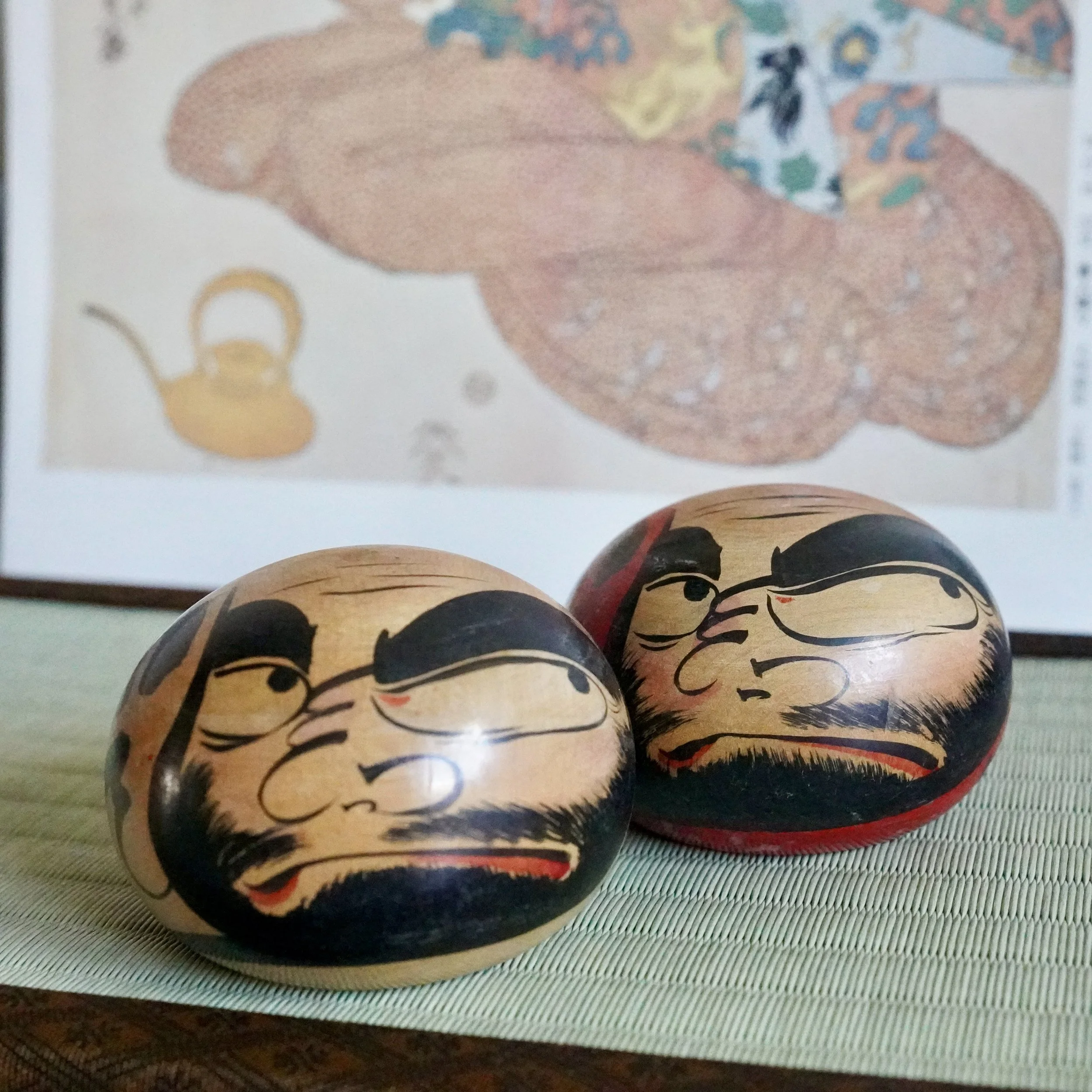
Two round, hand painted faces, caught mid scowl, sit side by side like they have been arguing for decades. One wears a red collar around its base, the other is left in plain wood, and both carry the same fierce eyebrows and downturned mouth carved from a single turn of the lathe. There is no seam anywhere on either piece, just one continuous curve from crown to base, the kind of shape that only comes from a craftsman who has made this exact form hundreds of times before.
Both are signed on the base with the place name Nuruyu and the name Satō Zenji, one of the two craftsmen credited with keeping the Tsugaru kokeshi tradition alive in the town of Kuroishi after the war. He learned the trade from master Mori Hidetarō starting in 1955, then spent years travelling to department stores across Japan to demonstrate the craft in person, building an audience for a doll making style that had nearly disappeared. Owning a signed pair like this means owning a small, physical piece of that revival.
Curious where the daruma shape itself comes from, arms and legs withered away through nine years of meditation? I stood among a thousand of them on a hillside in Osaka. Read about it in my journal.
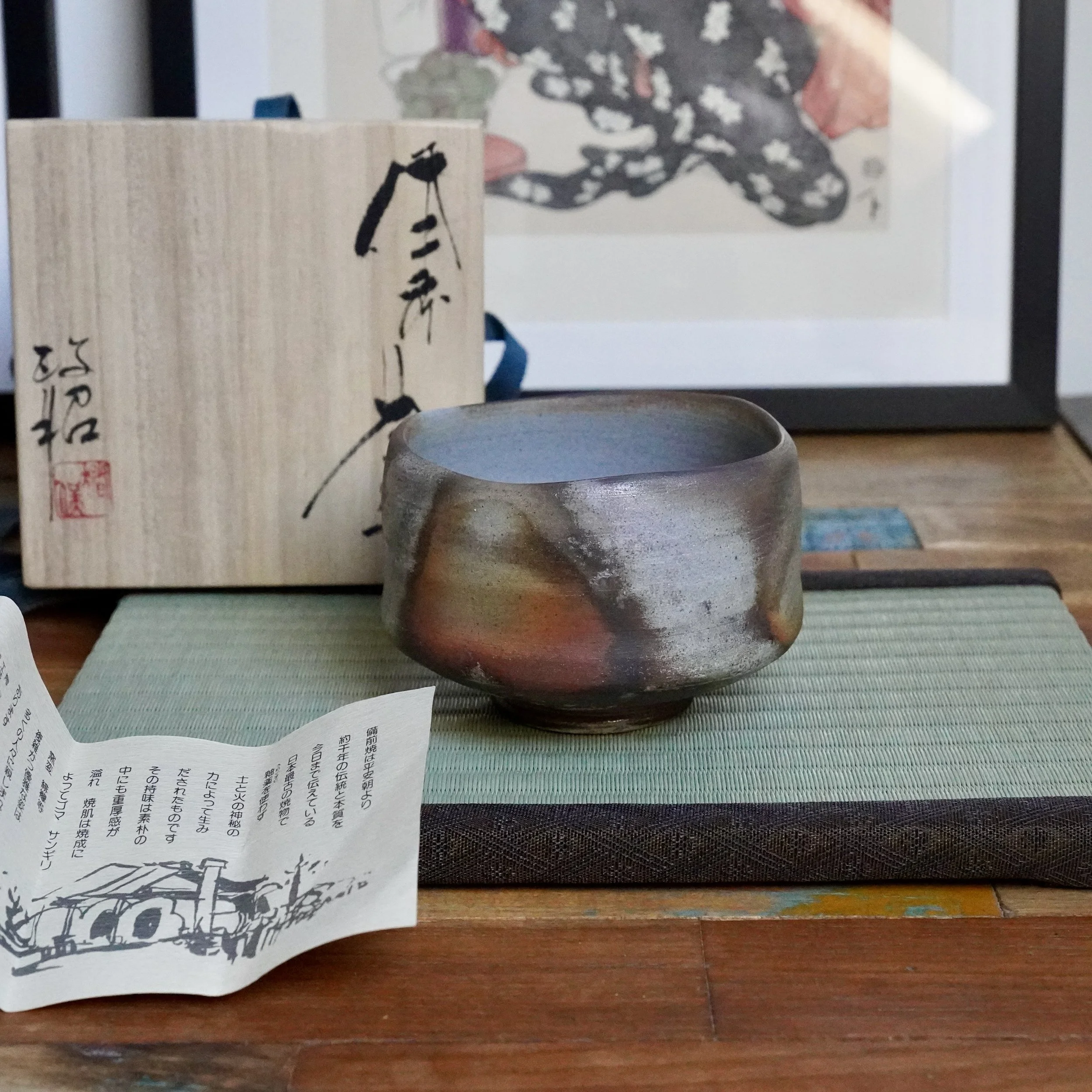
The clay tells you everything before you even touch it. One side has gone the colour of embers still holding heat, deep rust and burnt orange bleeding into ash grey where the flames never quite reached, and across the rim that grey turns almost silver, dusted like the first frost on a window. No glaze was ever applied here. Every mark, every shift in tone, is the direct signature of ten days or more inside a wood fired kiln, clay and flame negotiating the surface between them.
This bowl carries the seal of Inomata Masaaki, a Bizen potter based at the Saizōbō kiln in Okayama prefecture and one of the region's certified Dentō Kōgeishi, a formally recognised Traditional Craftsman title awarded by the prefecture. He built his own climbing kiln and became independent in 1975, after training under a respected Bizen workshop, and has spent the decades since inside a tradition that dates back over a thousand years to Japan's oldest surviving pottery kilns. A chawan carrying his signature is not a stylistic guess. It is a documented piece from a working master within one of the Six Ancient Kilns of Japan.
→ Fourteen days, one fire: what it actually takes to fire a Bizen kiln. A visit to Shibaoka Tōsendō during an active firing, standing at the kiln mouth while the family read the fire by eye and ear alone. Read the full visit in my journal.
There is a lot happening on this kokeshi, and none of it by accident. Every leaf covering her body was cut into the wood first, the paint only added after, red, near black, green and yellow layered so vivid it is still bright after all these years. She is small enough to hold in one hand, but she carries the real weight due to her appearance.
Yuji Kawase’s decoration follows the same unconventional order as his shaping: the motif, whether autumn maple leaves, dandelions, camellias or origami cranes, is carved into the wood first, and colour is added afterwards into the carved relief. The result is decoration with real texture rather than a flat painted surface, something you can feel as much as see.
→ What draws you to a kokeshi is rarely the name on the base. Read more about how makers like Sekiguchi carve rather than paint their signature detail in my journal.