
 Image 1 of 12
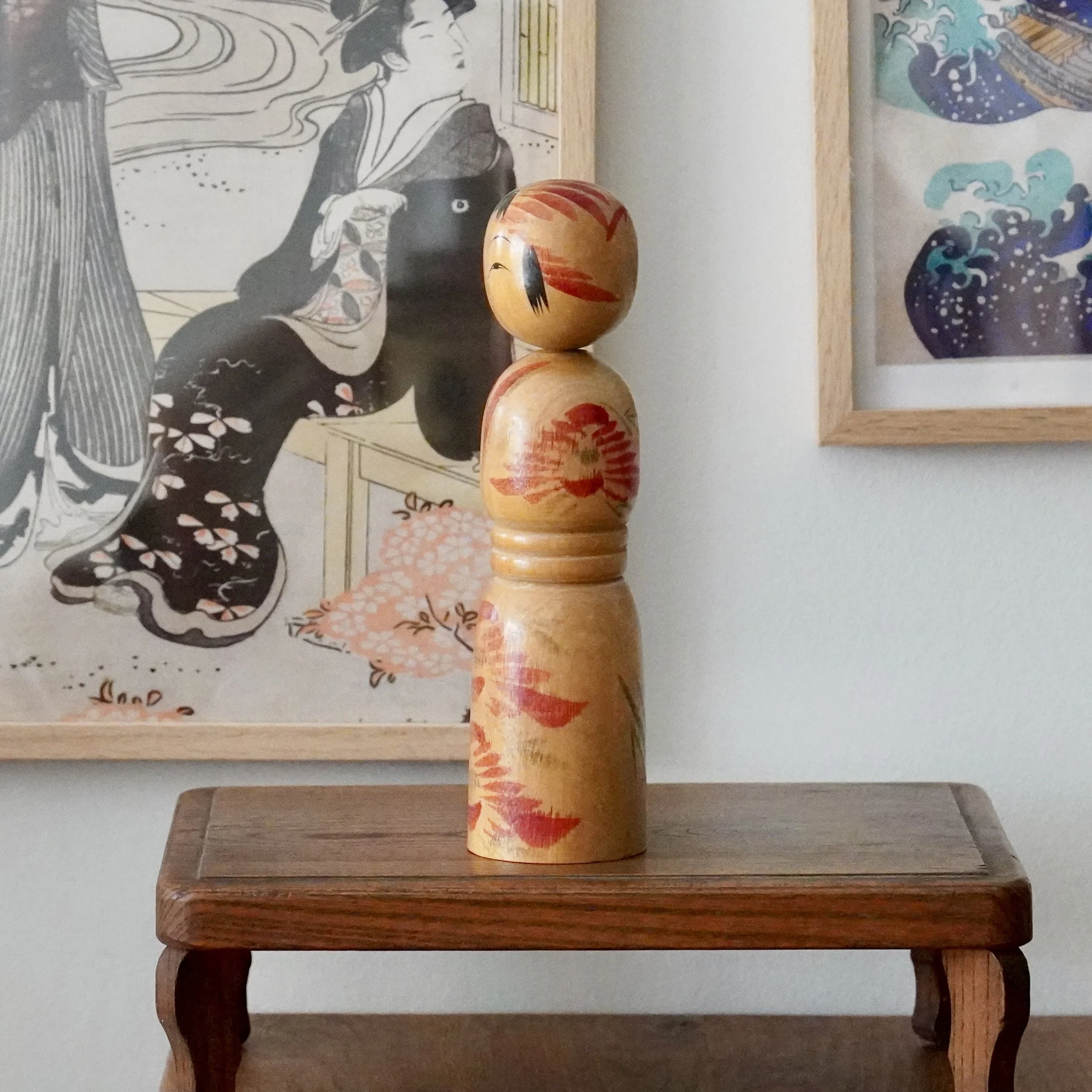 Image 2 of 12
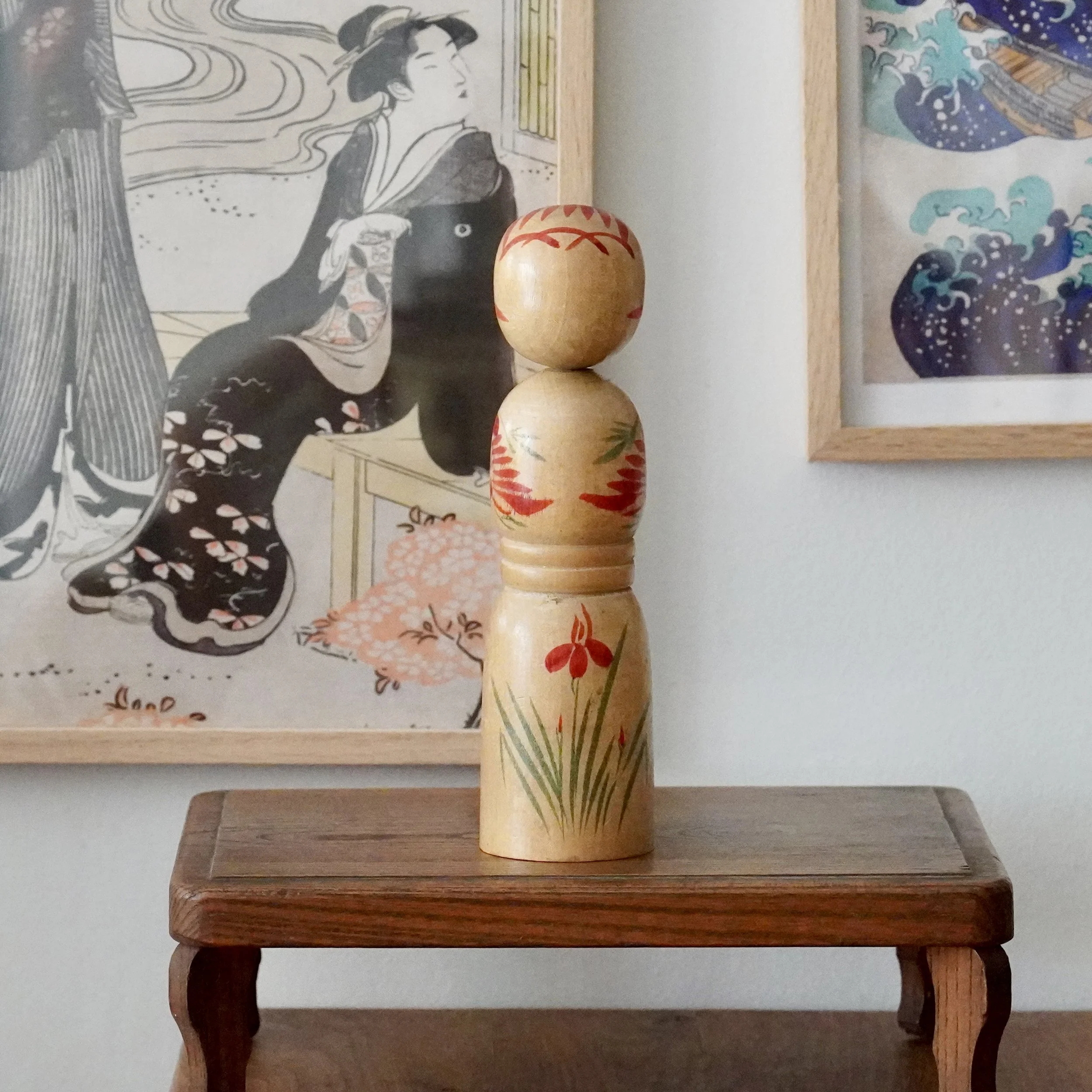 Image 3 of 12
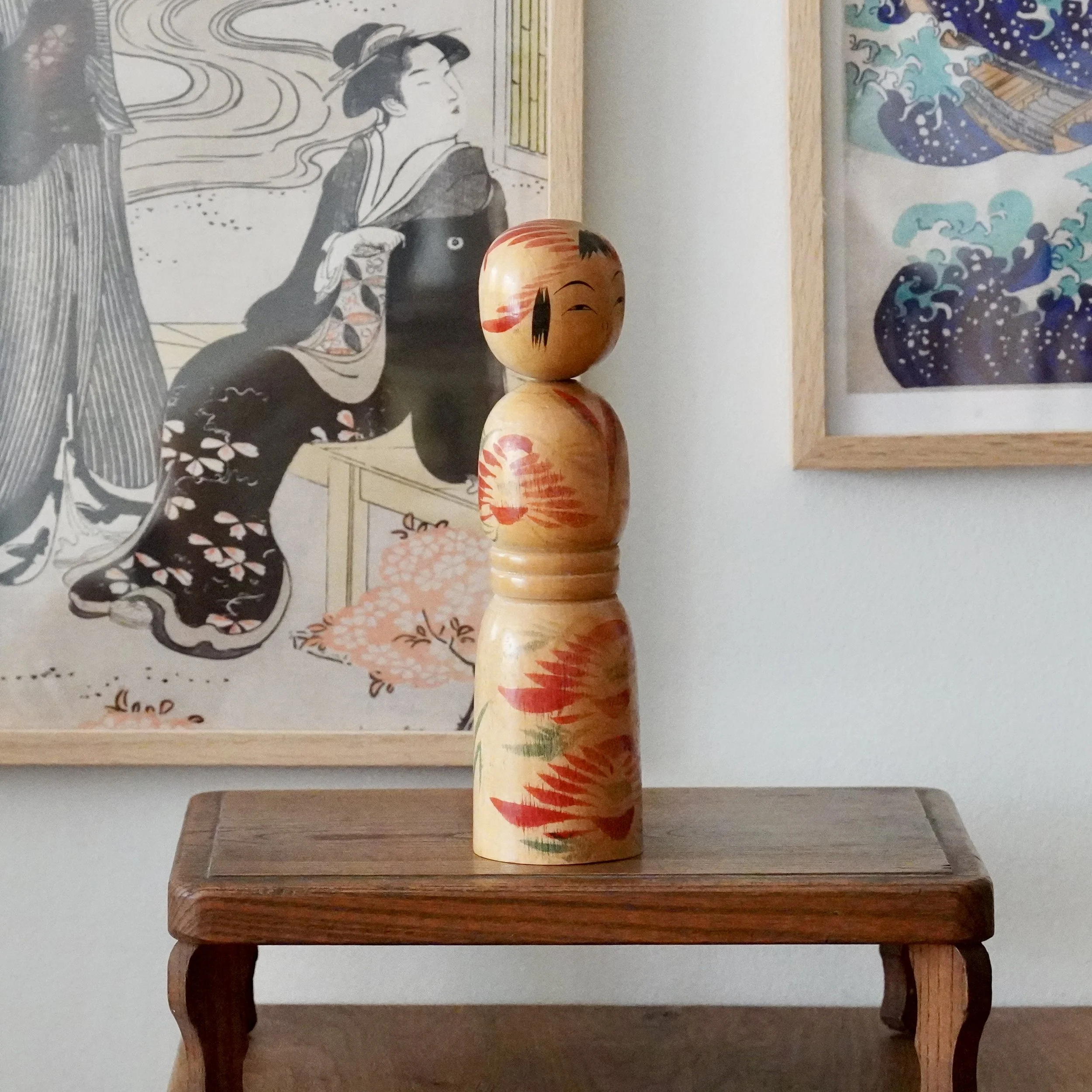 Image 4 of 12
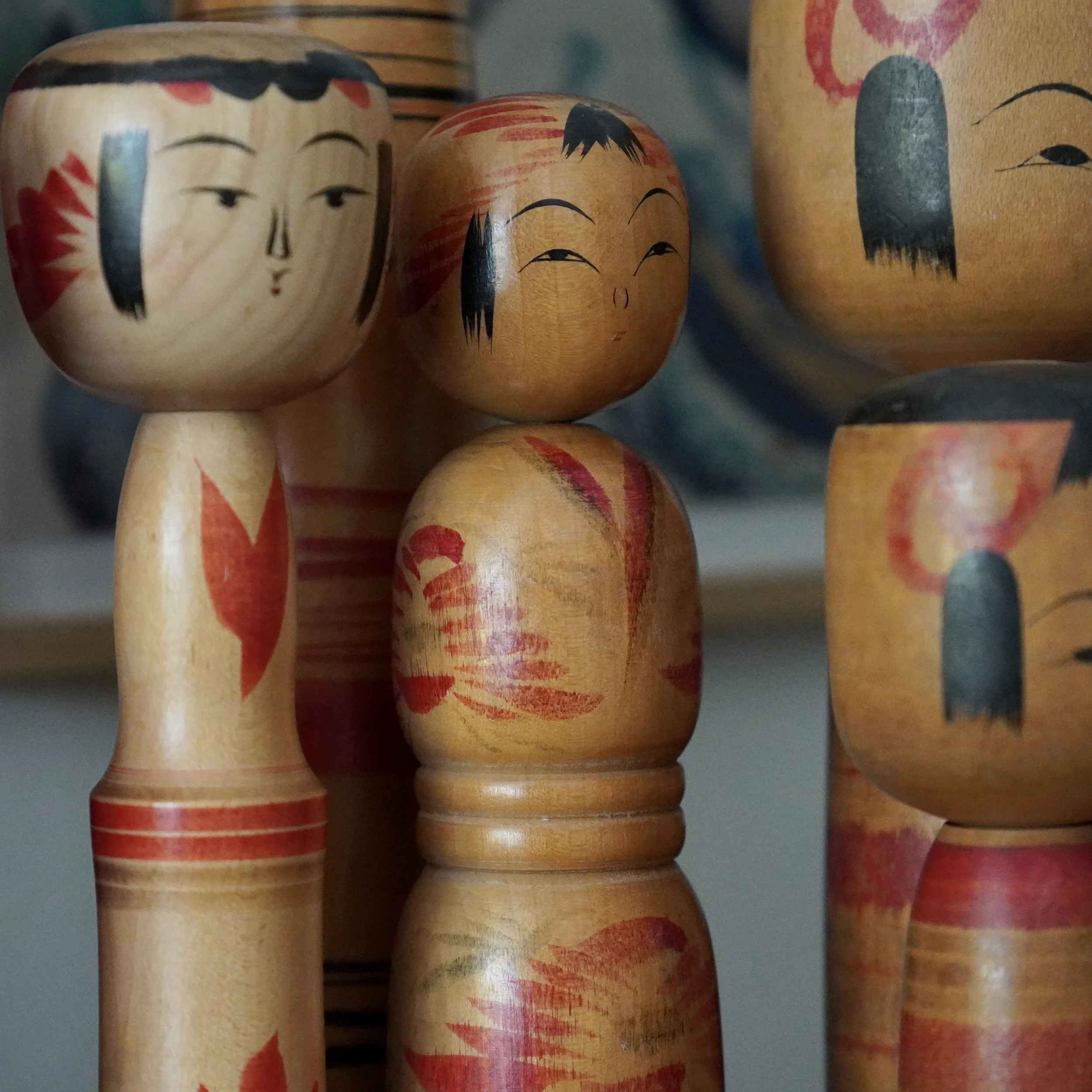 Image 5 of 12
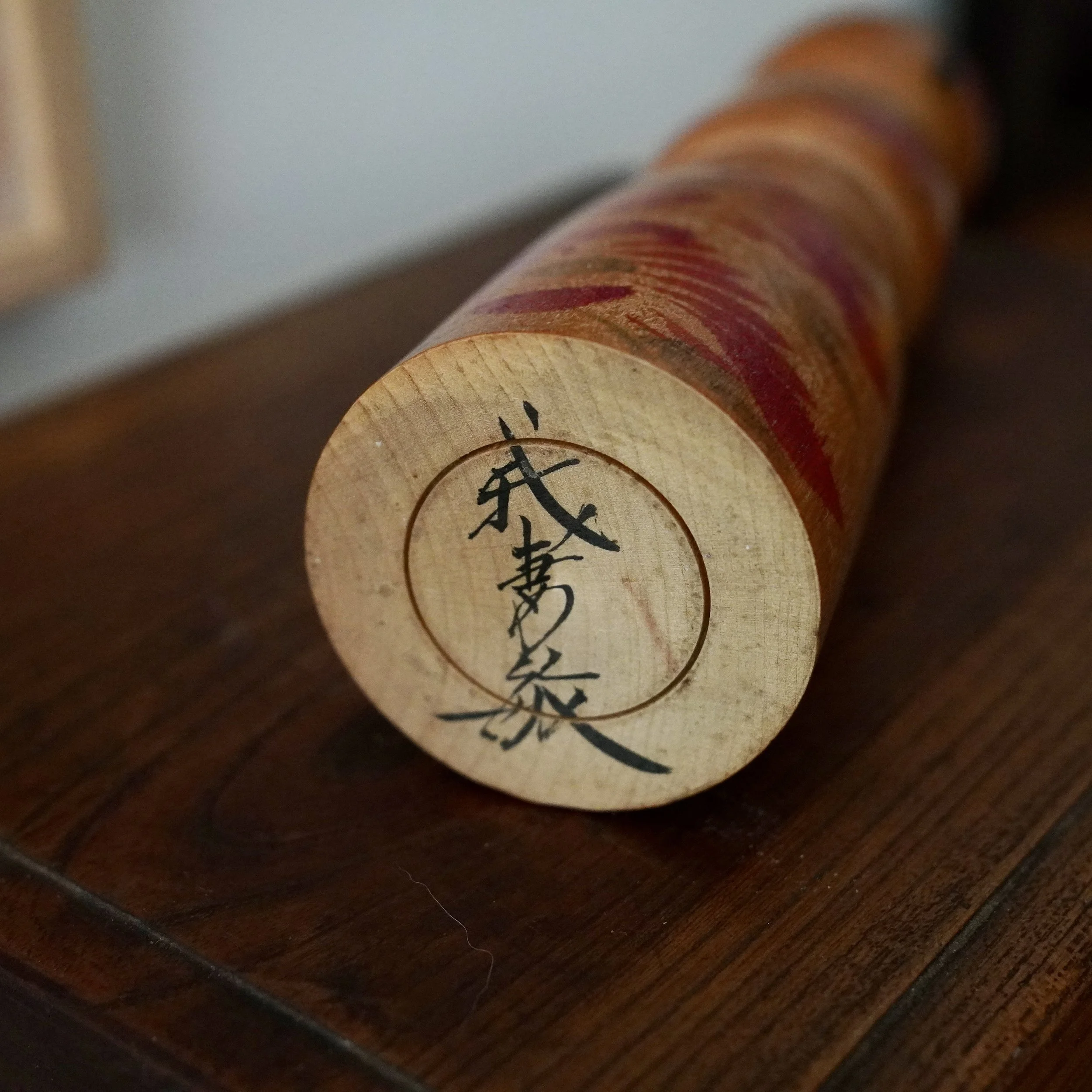 Image 6 of 12
Image 7 of 12
Image 6 of 12
Image 7 of 12
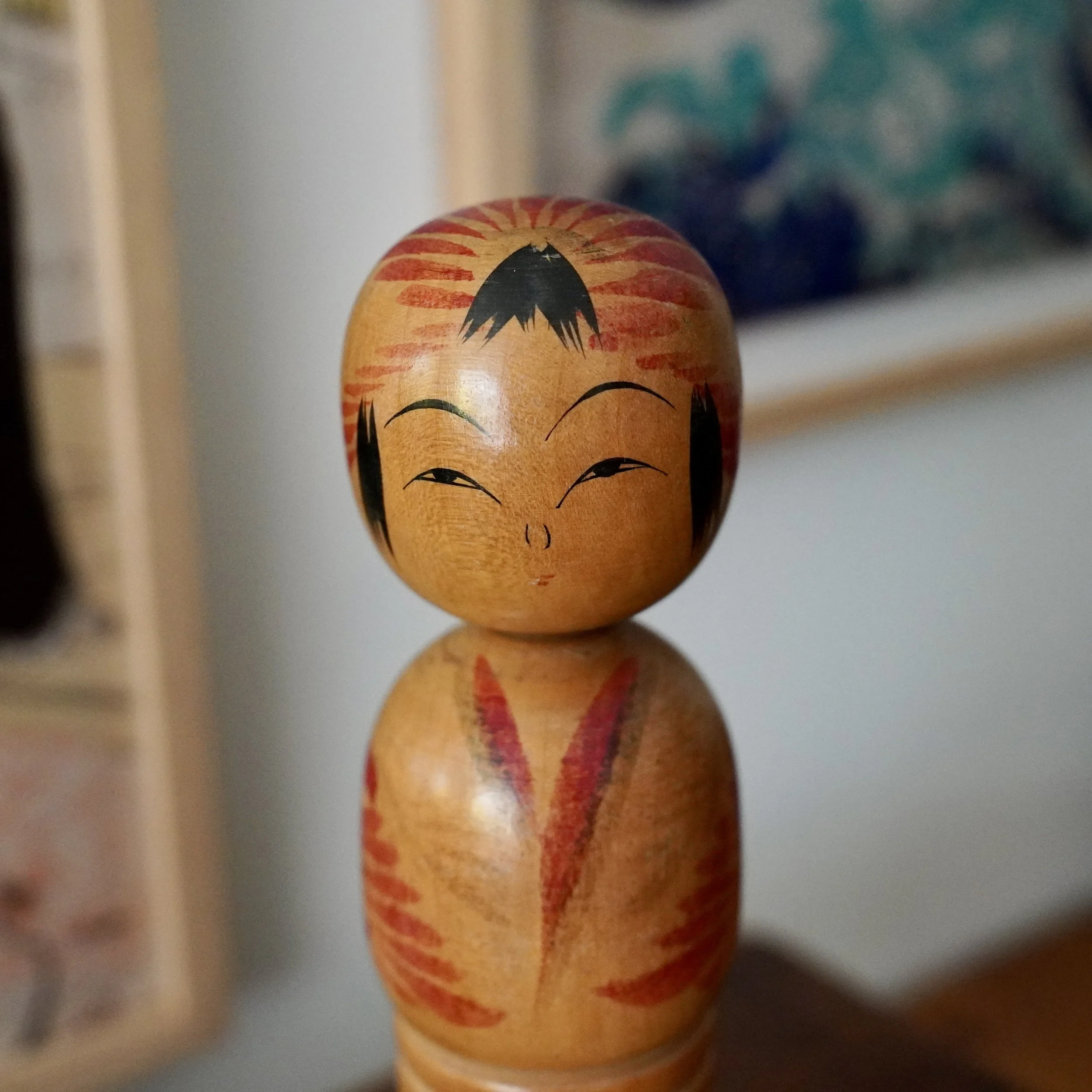 Image 8 of 12
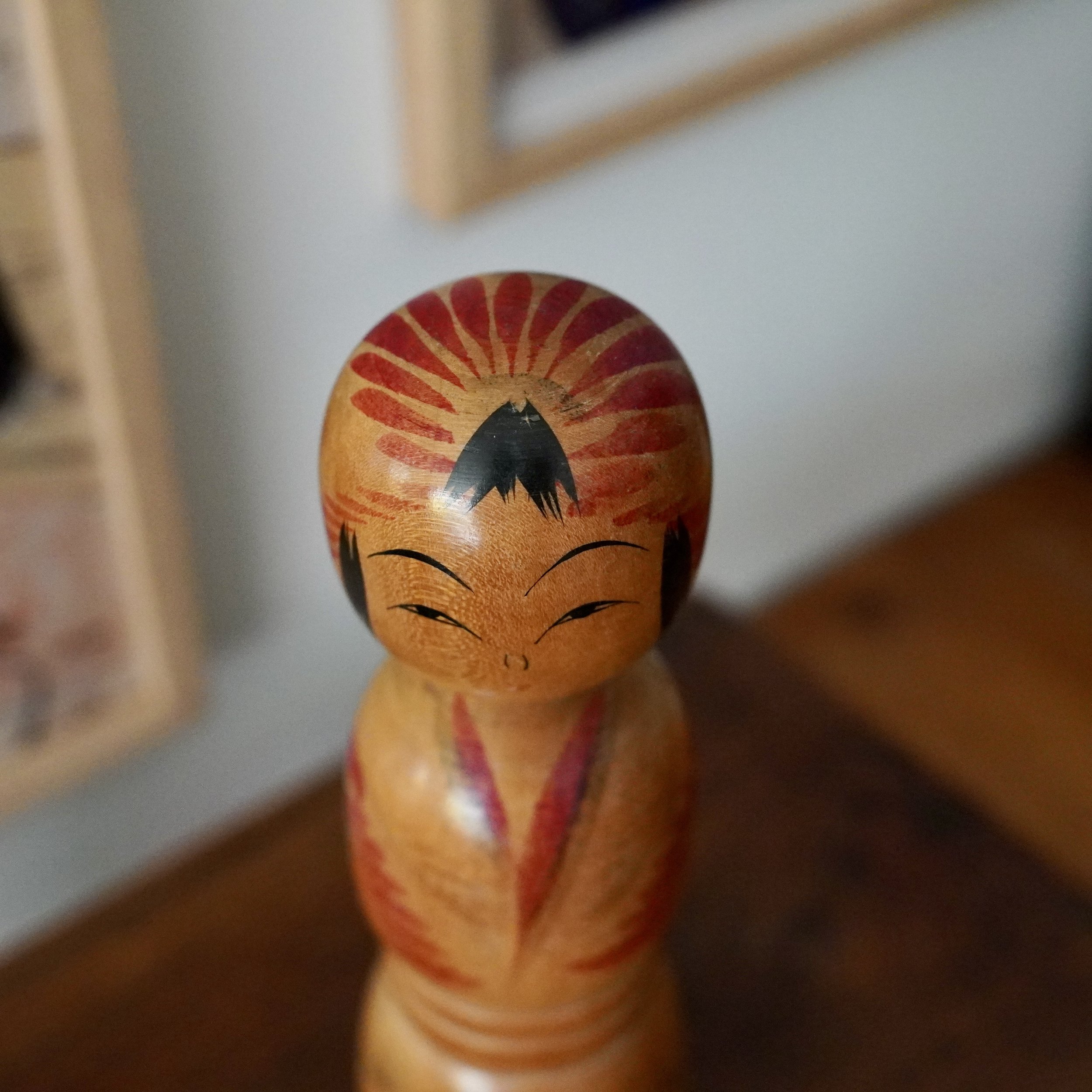 Image 9 of 12
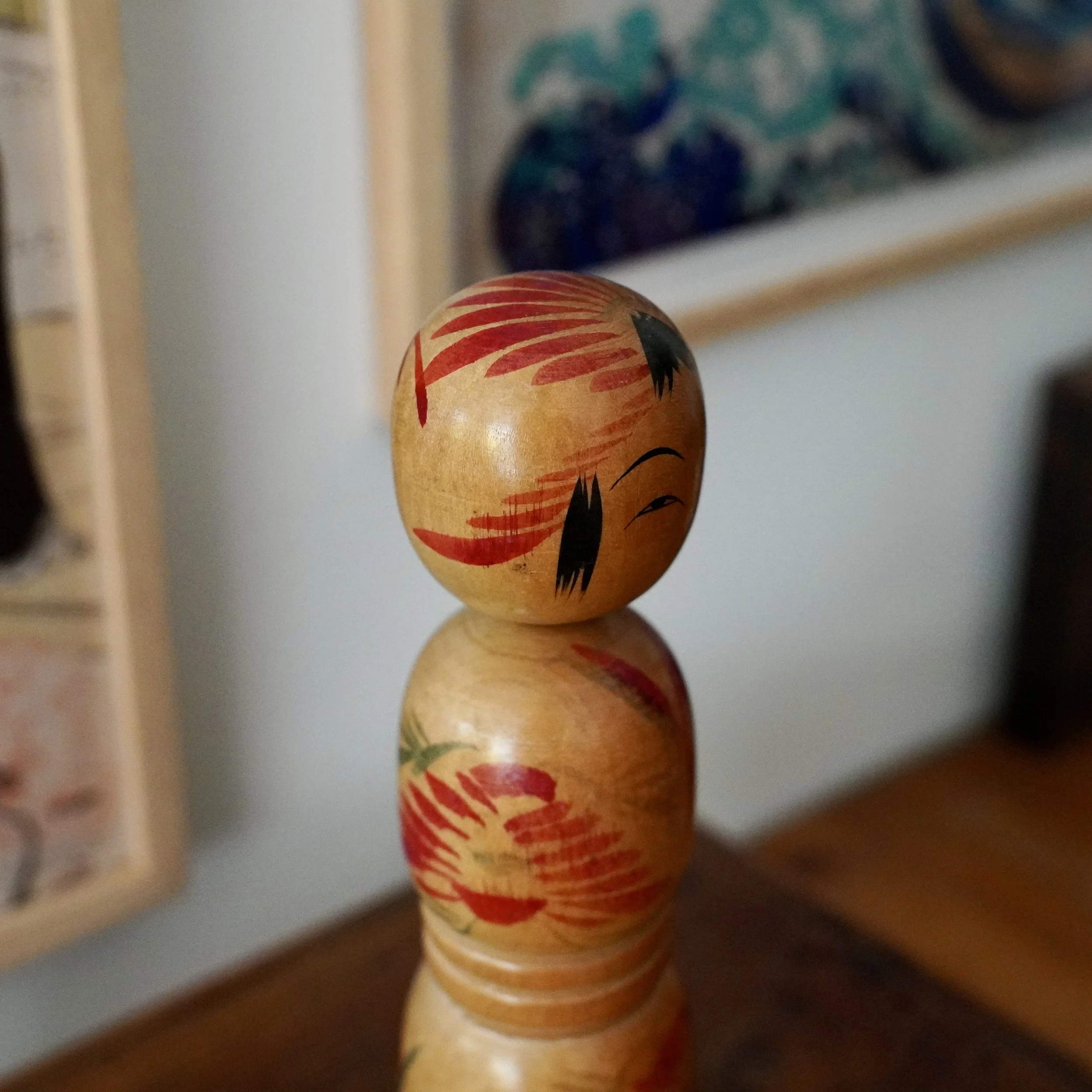 Image 10 of 12
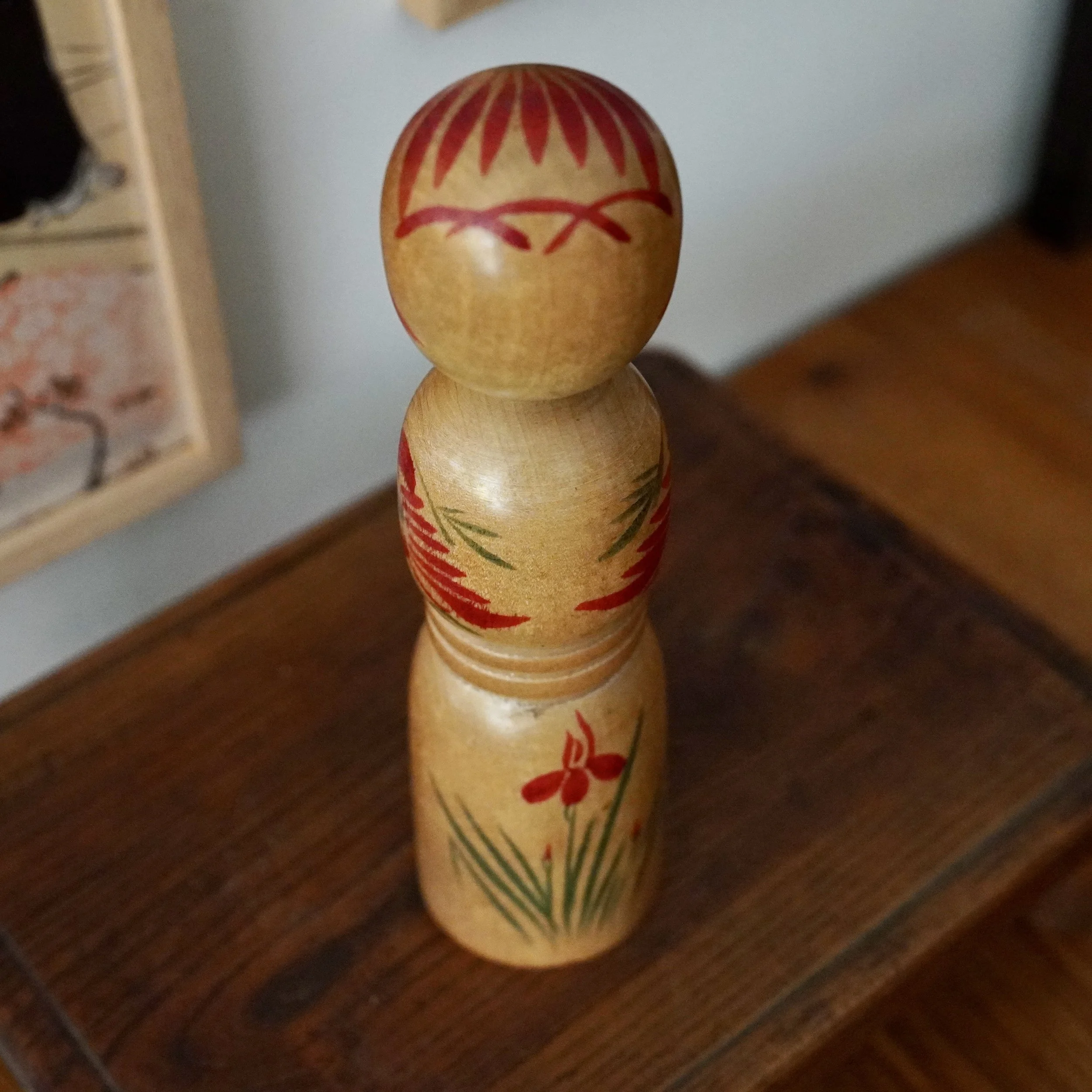 Image 11 of 12
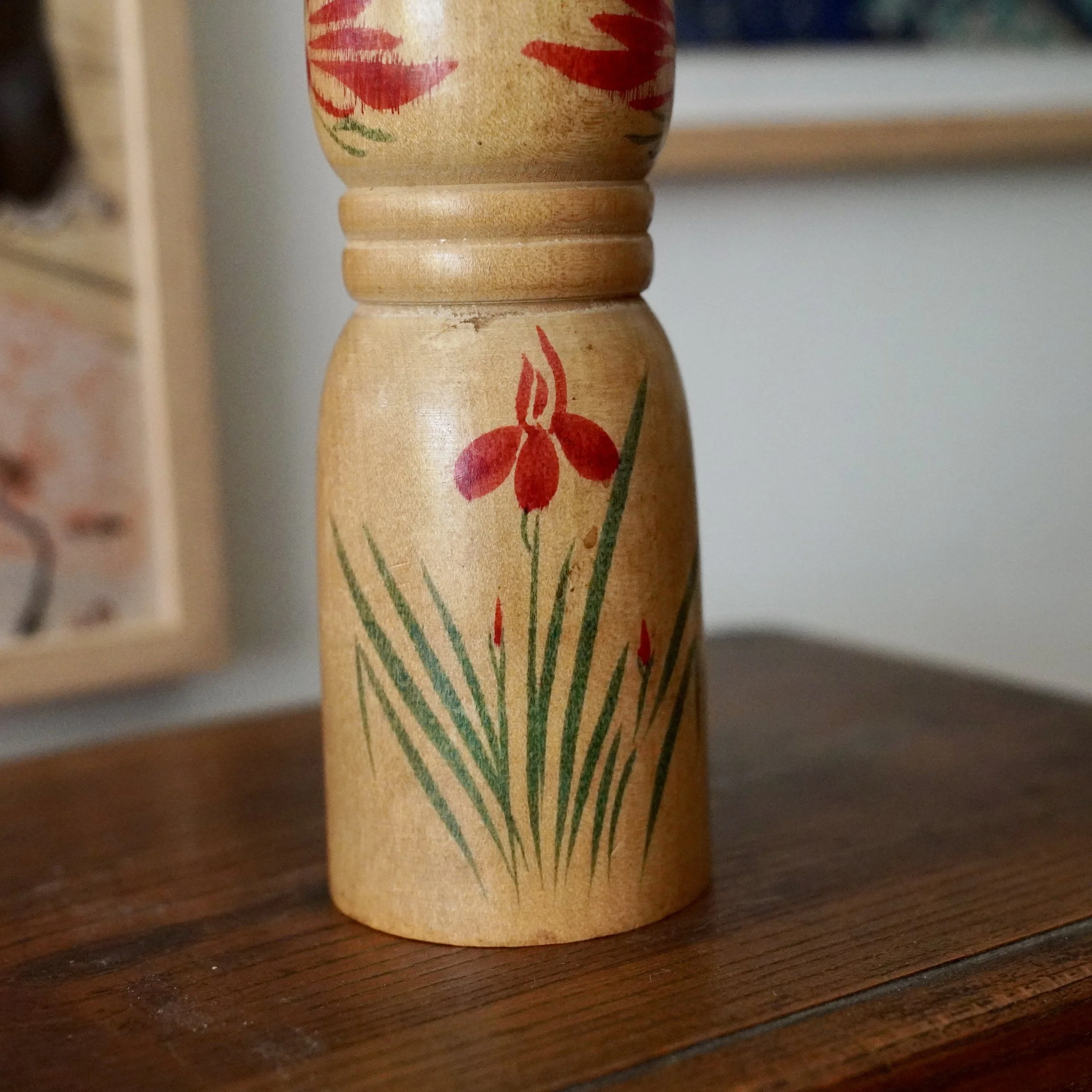 Image 12 of 12
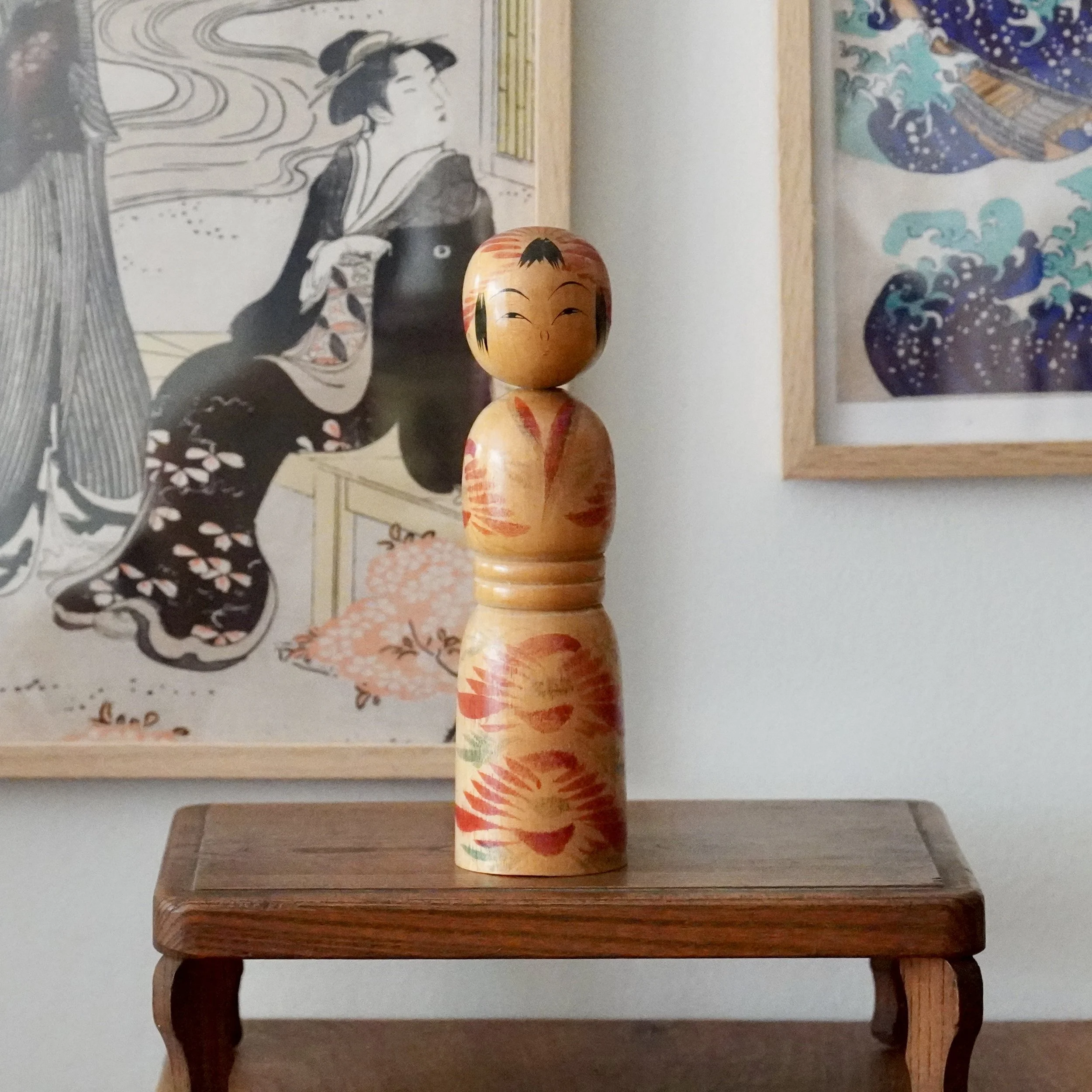
Togatta kokeshi signed by Agatsuma Satoshi with iris motif from Miyagi, Shōwa period
The face draws you in first: half-moon eyes, a small closed mouth, and a confident hairline in black. From there, red radiating lines sweep across the entire head in the unmistakable Togatta sunburst. The body carries a hand-painted iris in deep red with long green leaves, each petal laid down in a single fluid stroke. No outlines, no corrections.
Togatta kokeshi come from the Zao area of Miyagi Prefecture, one of the oldest kokeshi-producing regions in Japan. The tradition began with craftsmen at mountain hot spring resorts making simple wooden toys for visitors, and grew, across generations, into a living folk art with its own distinct vocabulary of forms and markings. A signed piece from a craftsman registered in that lineage is not decoration. It is a record of continuity.
The face draws you in first: half-moon eyes, a small closed mouth, and a confident hairline in black. From there, red radiating lines sweep across the entire head in the unmistakable Togatta sunburst. The body carries a hand-painted iris in deep red with long green leaves, each petal laid down in a single fluid stroke. No outlines, no corrections.
Togatta kokeshi come from the Zao area of Miyagi Prefecture, one of the oldest kokeshi-producing regions in Japan. The tradition began with craftsmen at mountain hot spring resorts making simple wooden toys for visitors, and grew, across generations, into a living folk art with its own distinct vocabulary of forms and markings. A signed piece from a craftsman registered in that lineage is not decoration. It is a record of continuity.
What makes this kokeshi special
The look and feel up close
The wood has the warm, slightly golden tone of natural Japanese wood that has settled gently over decades. The sunburst on the head is painted in fine red lines radiating outward from the crown, each line even and deliberate.
The iris on the body is rendered in a deep vermilion, with arching green leaves that follow the curve of the cylinder naturally. The overall surface has the quiet smoothness of age-worn lacquer: not a rough grain, but a slight softness in the hand, as if the wood has been handled many times and remembers it.
Charming details
Look at the flower on the body: it is an iris, ayame in Japanese, a flower with a specific meaning in Japanese culture. The iris is associated with strength and the ability to push through difficulty, which is why it traditionally appeared on objects made for Boys' Day celebrations in May. Finding it on a kokeshi is not unusual, but it is intentional. The craftsman who chose this motif was not just filling space. The iris on this doll carries a wish forward, quietly.
-
Made by Agatsuma Satoshi (我妻聡). Born 1950.
Second-generation Togatta kokeshi craftsman, Zao area, Miyagi Prefecture.
Registered in the official register of traditional kokeshi craftsmen maintained by the Japan Kokeshi Association.
He signed the base.
-
Zao area, Miyagi Prefecture, Japan.
Late Shōwa period, ca. 1970 to 1980.
-
Height: ca. 19 cm
Weight: approx. 176 gr
-
Vintage. Beautiful patina with the warm tone of age-settled wood.
Light surface wear consistent with period and use.
No chips, cracks or repairs.
-
Kokeshi are made from natural wood and should be kept away from direct sunlight, radiators and damp environments, as these cause cracking and warping over time.
Dust with a soft dry cloth.
Do not use water or cleaning products on the surface.
*Decorative items such as the whisk and plank are for styling
and scale purposes only and not included in the sale
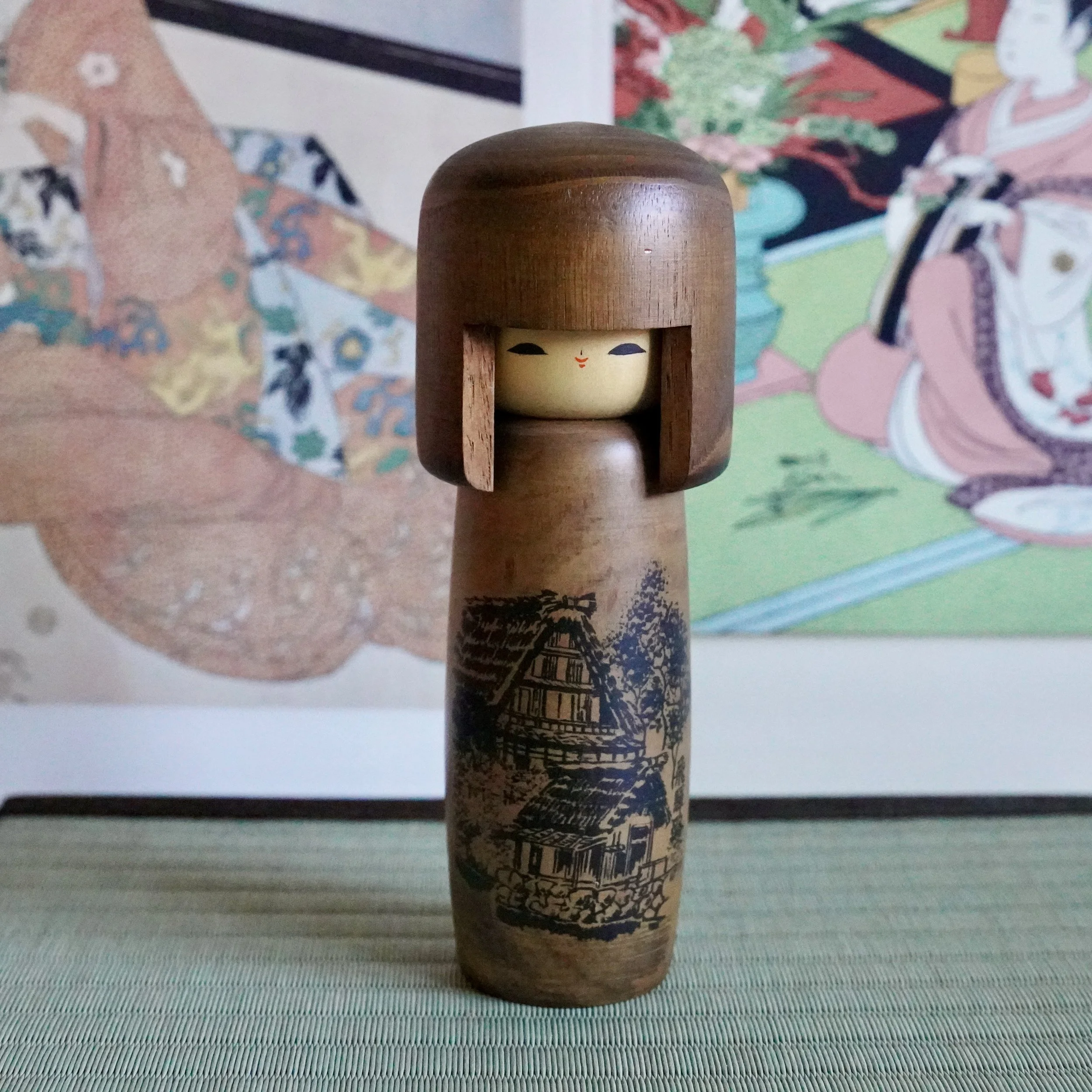
She looks out from under a heavy dark bob, two sliding wooden panels framing a small painted face with the calm, slightly downturned eyes typical of a well made kokeshi. Turn her around and the whole story changes: her body carries a painted scene, thatched farmhouse roofs rising steeply against a stand of trees, rendered in dark ink tones against the warm honey wood, like a print laid straight onto the grain.
Usaburō Kokeshi was founded by Okamoto Usaburō in Shinto Village, Gunma Prefecture, in 1950. Rather than following the strict regional patterns of traditional kokeshi, his workshop became known for sōsaku kokeshi, free in subject and form. Sometimes painting real places travellers had visited directly onto the wood. This particular scene depicts the Hida road, the old route through the mountains of Gifu Prefecture that leads to Takayama and the thatched villages of Shirakawa-go, a well loved keepsake from one of Japan's classic postwar travel routes.
Interested to read more about the woodworking on kokeshi like Usaburo? I wrote about it in my journal.
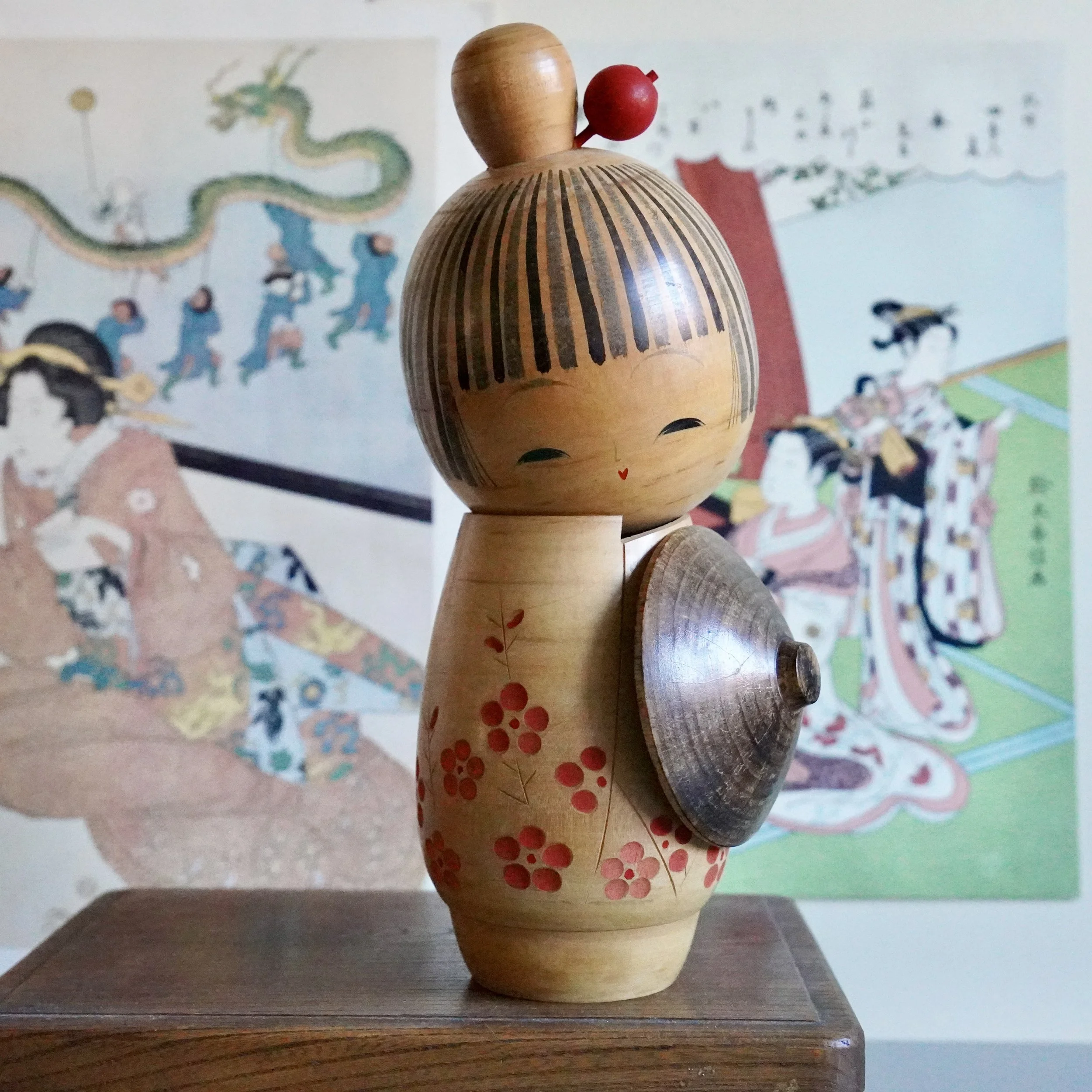
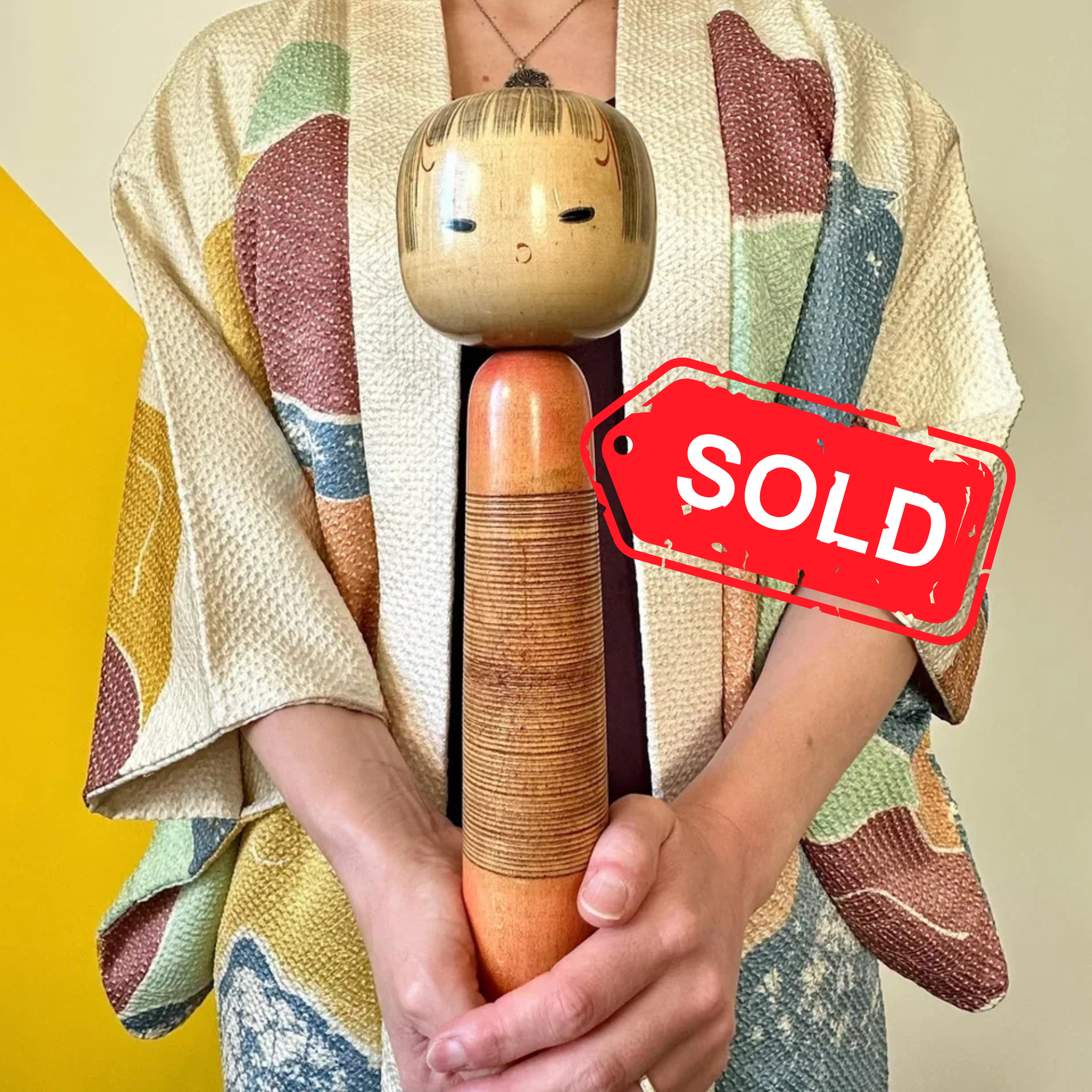
She stands taller than most kokeshi you will come across, and heavier too, with real weight settling into your palm the moment you pick her up. The head is covered edge to edge in fine combed striping, dark lines cut close together into a rounded cap, with a single red wooden bead perched at the crown like a stray plum bud. Sprays of red plum blossom trail down the body, each one carved first and filled with pigment after, and held against her side is a separately turned wooden kasa, a wide travel hat, raised the way a Heian noblewoman would once have lifted hers to shield her face on the road. Nothing about the proportions is timid: this is a maker working at full scale and full confidence.
The base carries the brush signature of Suigai, a painter who found his real language in wood. He spent a lifetime letting plants speak for people, plum blossom especially, always returning to it the way you return to a word that still means something. That instinct is what earned him Japan's Prime Minister's Award, but it is also simply what makes this particular figure feel considered rather than decorative. You are not buying a doll. You are buying the version of plum blossom one specific person kept coming back to, and decided, of everything he could have painted, this was worth painting again.
Interested to read more about the woodworking on kokeshi like these? I wrote about it in my journal.
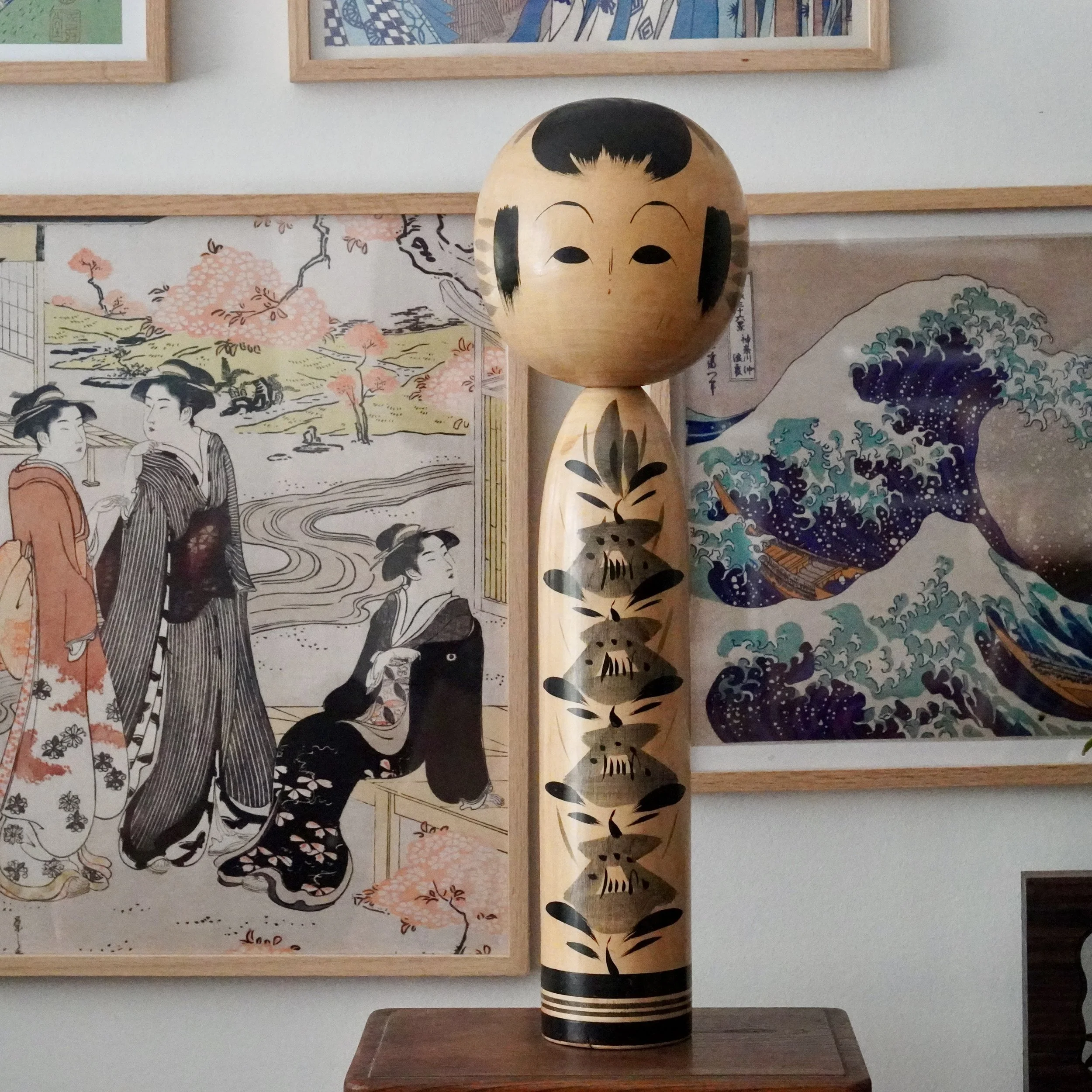
He looks caught mid turn. One section of his dark hair is brushed back in short, dry streaks, as if just ruffled, while the rest sits in a neat round cap above a calm, half lowered gaze. Down the long cylinder of his body, four flowers stack in grey and black, each bloom slightly different from the one above it, hanging leaves drifting between them. There is a stillness to him that a mass produced kokeshi rarely has, the kind that comes from a hand working without a template.
At 46.5 centimetres, this is not a doll you tuck onto a shelf and forget, it commands a room the way only a handful of vintage kokeshi can. The name on the base, Tetsuen, belongs to a small, tightly knit Shiraishi workshop where a style was considered worth keeping alive even after its maker was gone. Female kokeshi maker Chiyoko Hamatsu picked up the brush in her brother in law's memory and kept his flowers blooming for another four decades. Owning a piece like this means owning both the scale and the story, a kokeshi large enough to anchor a room and old enough to carry a small piece of a family's determination not to let something disappear.
Want to understand the difference between dentō and sōsaku kokeshi? I wrote about it, with a trip through Fukushima along the way.
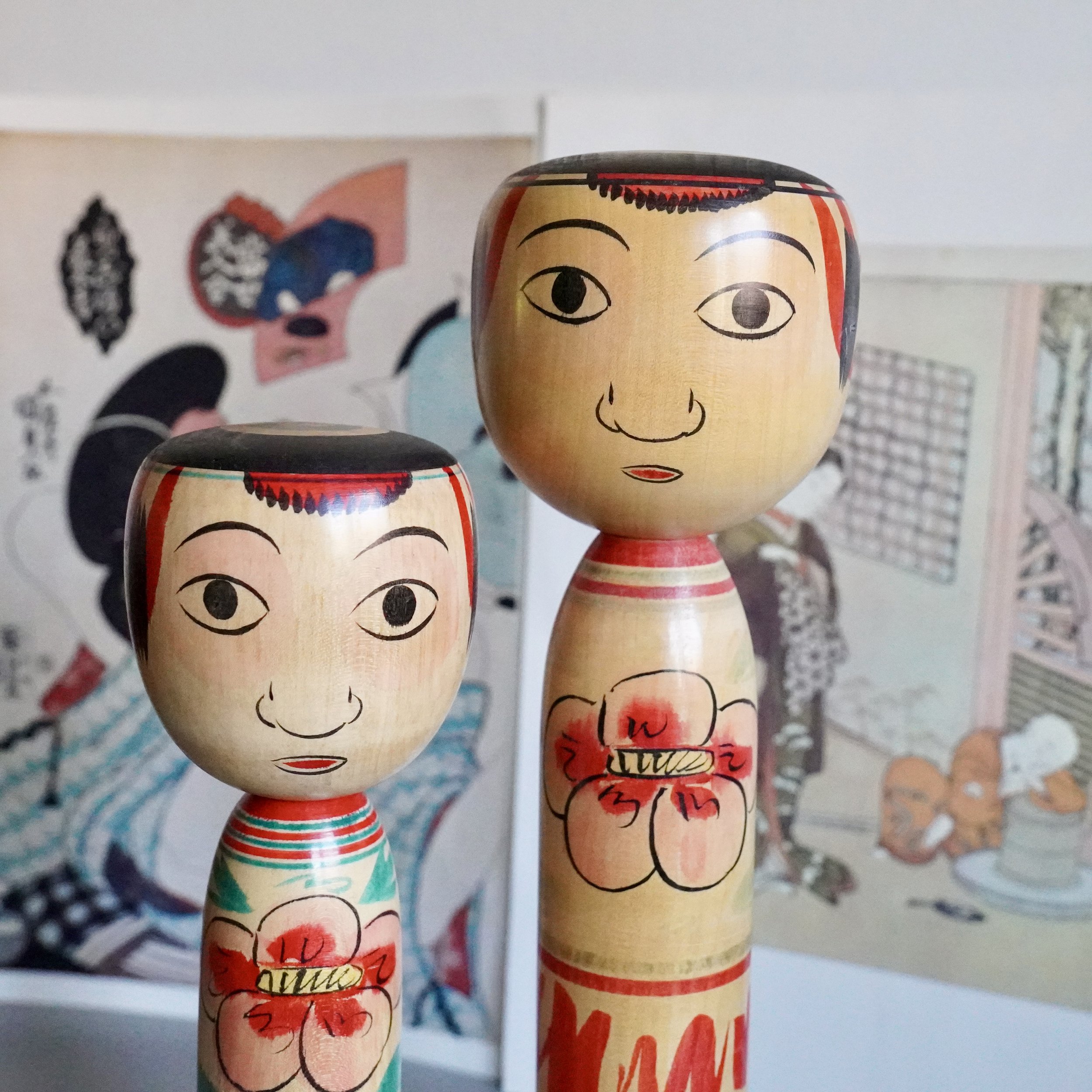
Two takobozu kokeshi standing shoulder to shoulder, the way they were clearly made to be seen. Both have that unmistakable oversized round head and the wide, startled eyes rimmed in red that give this Nakanosawa style its nickname, octopus priest.
This is not two random old kokeshi that happen to look similar. They come from one hand, a hand trained directly by Iwamoto Yoshizo, the man who carried this exact design forward after his father invented it. Tokuju spent the rest of his life protecting that design rather than putting his own spin on it. That is rare enough to be worth a spot on a shelf where you will actually see it every day, not tucked away as an investment. A signed pair like this, from a maker specialists still name when they talk about this style, is not something you will come across twice.
Want to understand the difference between dentō and sōsaku kokeshi? I wrote about it, with a trip through Fukushima along the way.
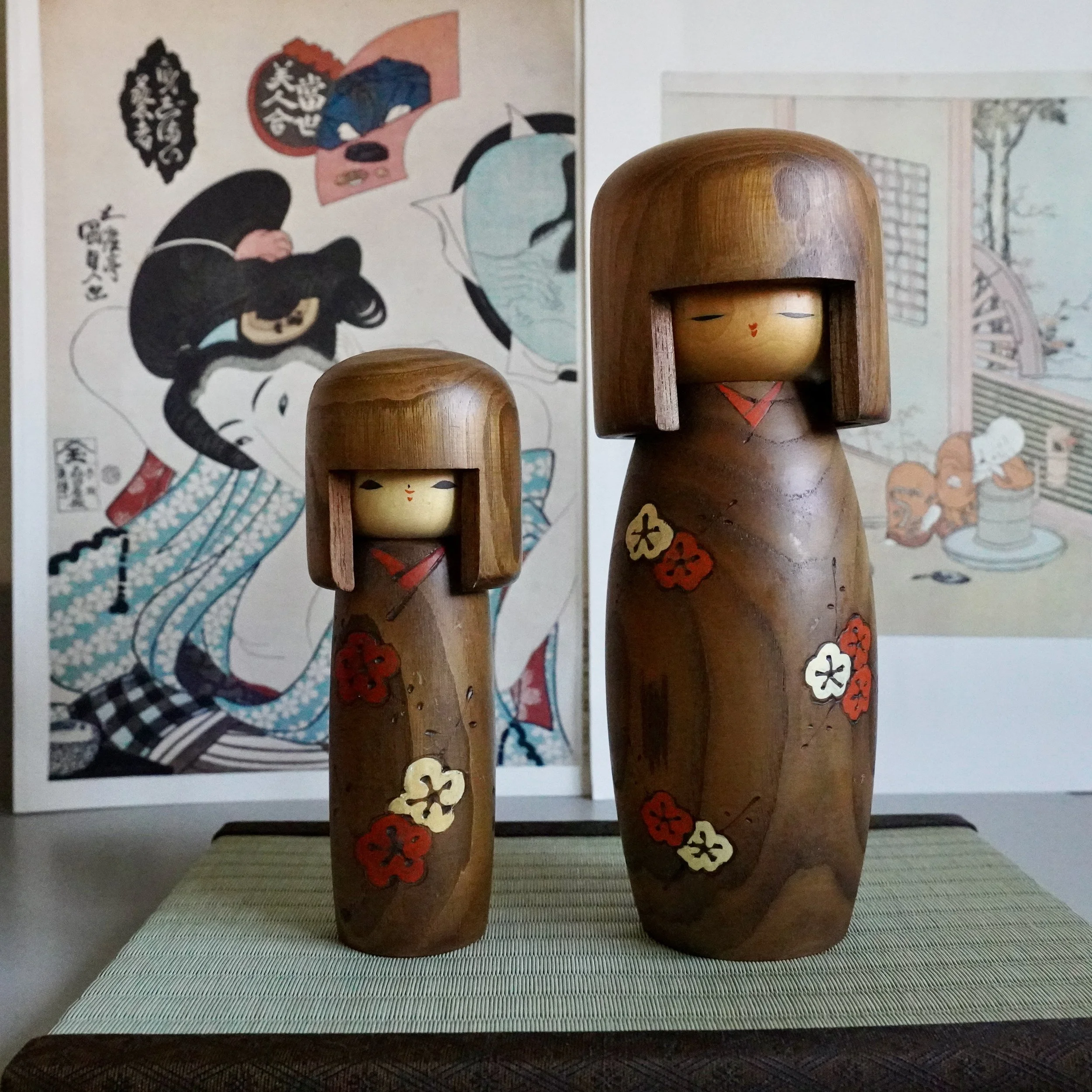
The hair on these two is the first thing you notice, and the last thing you expect. No black lacquer, no painted bob. Just the wood itself, left to show its own colour and grain, warm and pale where the light catches it. Below, plum blossoms scatter across both figures in red and cream, unhurried, some caught mid-branch as if the painter simply stopped when the flower looked right. The larger figure stands with quiet composure, the smaller one echoes her almost exactly, a pair clearly made to be seen together.
Usaburo's studio built its reputation on the opposite of this: a glossy black bob that became so recognisable it is often the first thing collectors associate with the name. This pair by Yuji Okamoto, second generation of the workshop, does something quieter. Leaving the natural wood exposed where paint would usually go asks the material to carry the character instead of colour doing it for him. It is the same hand and the same studio you find behind some of the most awarded creative kokeshi in Japan, working here in a lower key.
Interested to read more about the woodworking on kokeshi like these? I wrote about it in my journal.
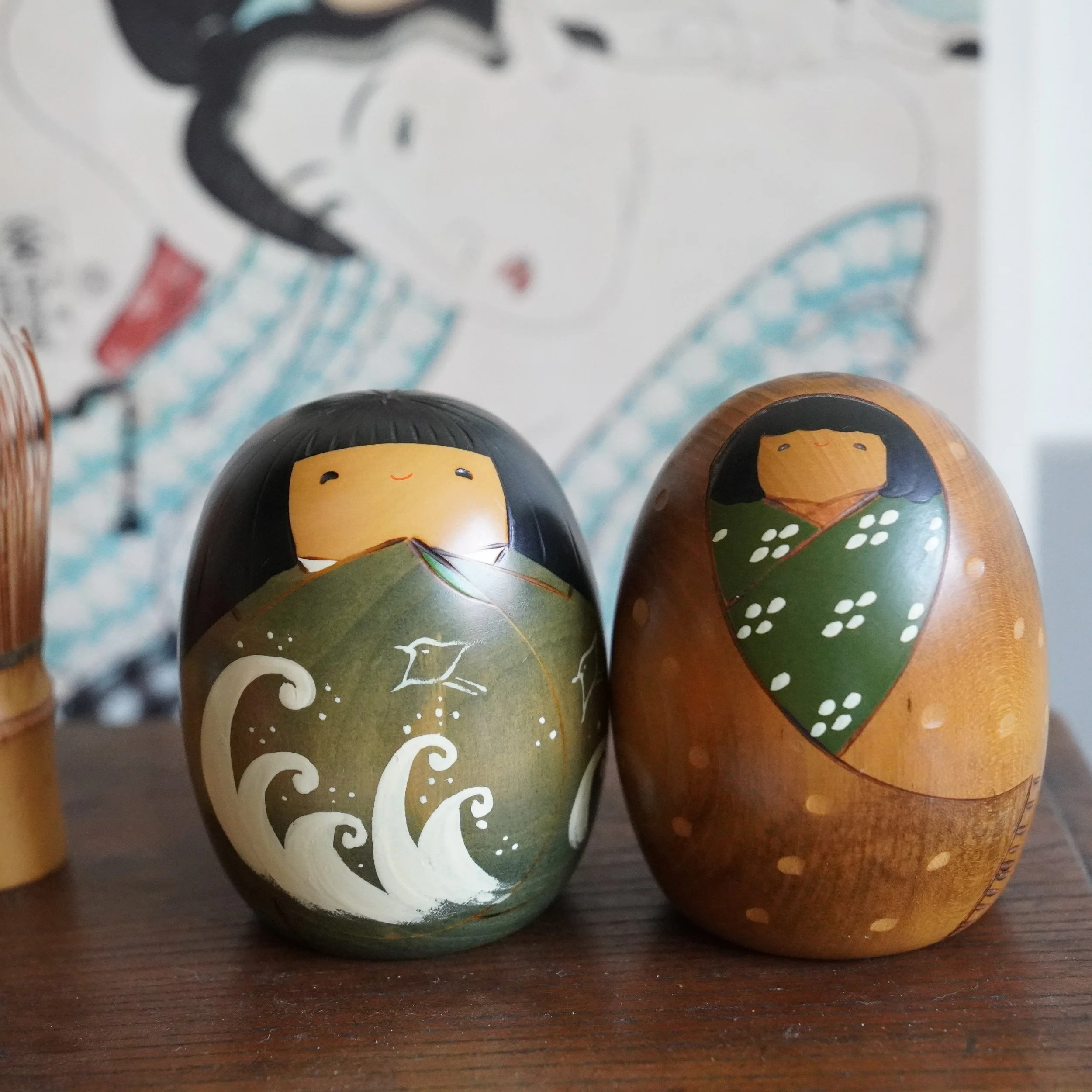
Two small egg-shaped figures, standing no taller than a teacup, each carrying its own season on its body. One is wrapped in soft olive waves that curl toward a pair of birds caught mid-flight. The other is scattered with dozens of white, snow-like specks that spill straight onto the kimono without a break. Side by side they hold a kind of quiet balance, warm summer green against honey-brown winter, two halves of the same idea standing a hand's width apart.
These two belong to Okamoto Usaburō's "Shiki no Uta," (Poem of the Four Seasons) a design created for his workshop at the foot of Mount Haruna in Gunma. Usaburō spent his career developing carving and burning techniques that let wood carry more expression than kokeshi traditionally allowed, work that eventually reached the collection of Emperor Shōwa.
This pair represents summer and winter from his four-part seasonal design, and the softer linework and gentle surface patina on both place them earlier in the workshop's long production history, well before the cleaner, more uniform look of the pieces made today.
Interested to read more about the woodworking on kokeshi like these? I wrote about it in my journal.
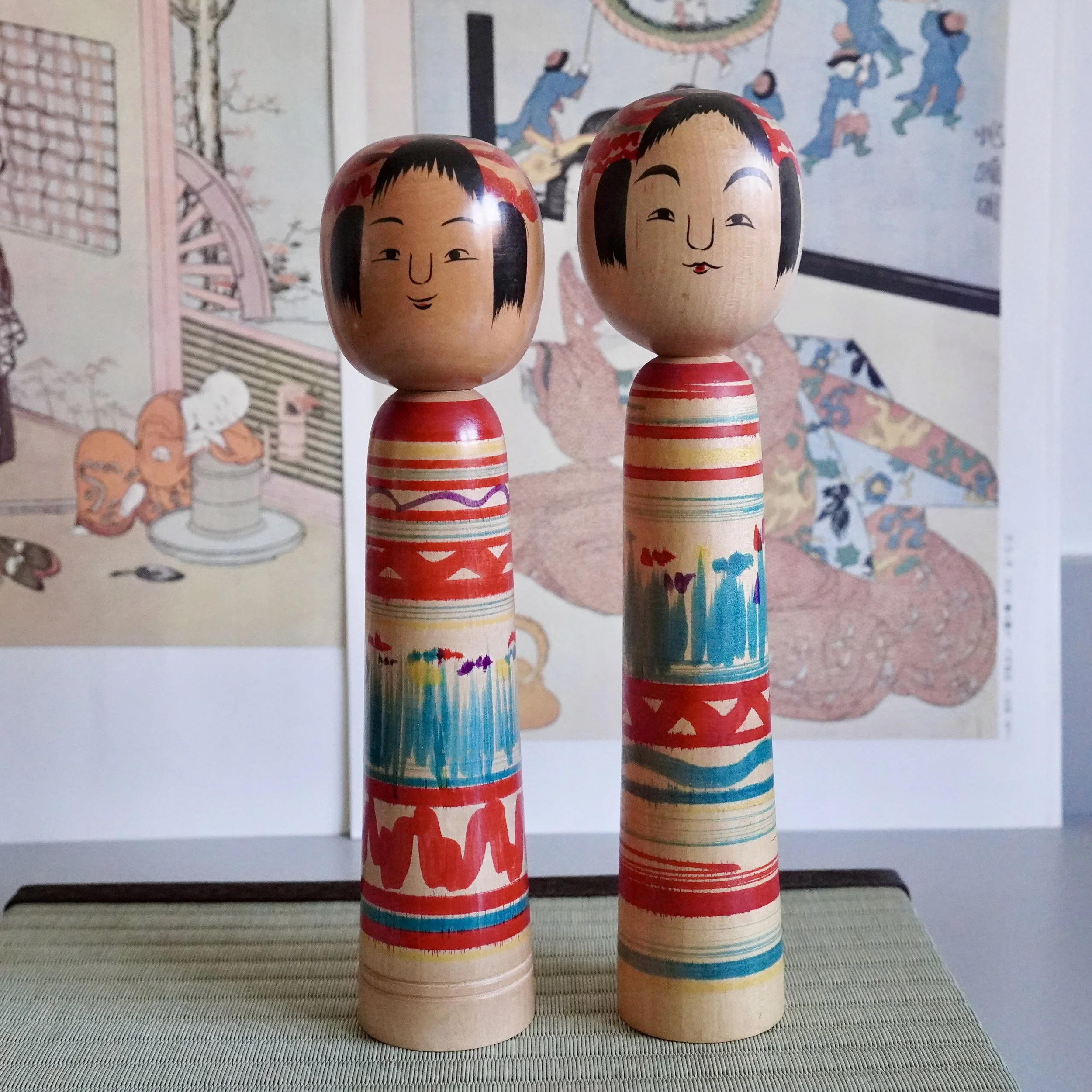
Two faces, nearly identical at first glance and then not at all. One laughs with its mouth open, a flash of red catching the light like a hint of tongue. The other's mouth is small, round and pursed, closer to a kiss than a laugh. Tilt either head and it turns with a small resistance and a soft squeak, the same trick Tsuchiyu makers have used for generations. Both dolls are signed on the base by Jinnohara Kazunori (陳野原和紀). More info on the makers page.
Where they differ further is the hand that painted the bodies. One carries a busier decoration, a looping purple line, a wider red band, a restless zigzag near the base, the wood warmer and more time worn. The other stays quieter, its red kept narrow and calm. The motif itself, a scatter of grass and small flowers, traces back to Kazunori's lifelong reconstruction of the historic Kumematsu style.
Want to understand the difference between dentō and sōsaku kokeshi? I wrote about it, with a trip through Fukushima along the way.
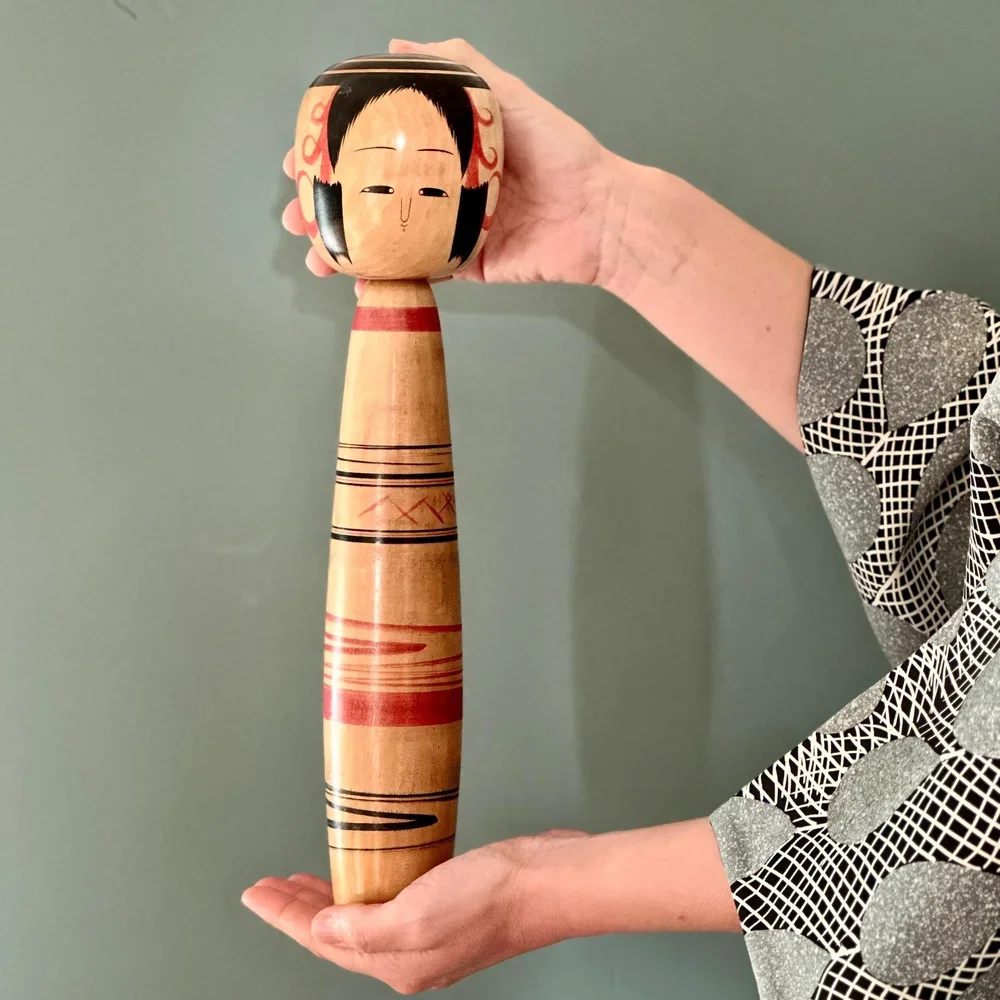
At 37 centimetres this kokeshi commands rather than decorates. The body tapers from a broad shoulder down to a narrow base in one long, uninterrupted line, and the proportions are exactly right: it reads taller than it measures. The banding is bold, red and black on pale natural wood, with small painted crosses breaking the rhythm of the stripes just enough to hold the eye. This is a piece that works from across the room.
Tilt her head and she answers back, a soft, hollow squeak from the loose-fitting joint where the head meets the body, the same trick every Tsuchiyu maker has used for generations. What marks this particular piece is the banding itself: a zigzag line dotted with small crosses partway down the body, breaking from the plain horizontal stripes typical of the tradition, followed by a single sweeping red arc lower on the torso, a freer, more painterly touch than the usual strict rings.
Want to understand the difference between dentō and sōsaku kokeshi? I wrote about it, with a trip through Fukushima along the way.
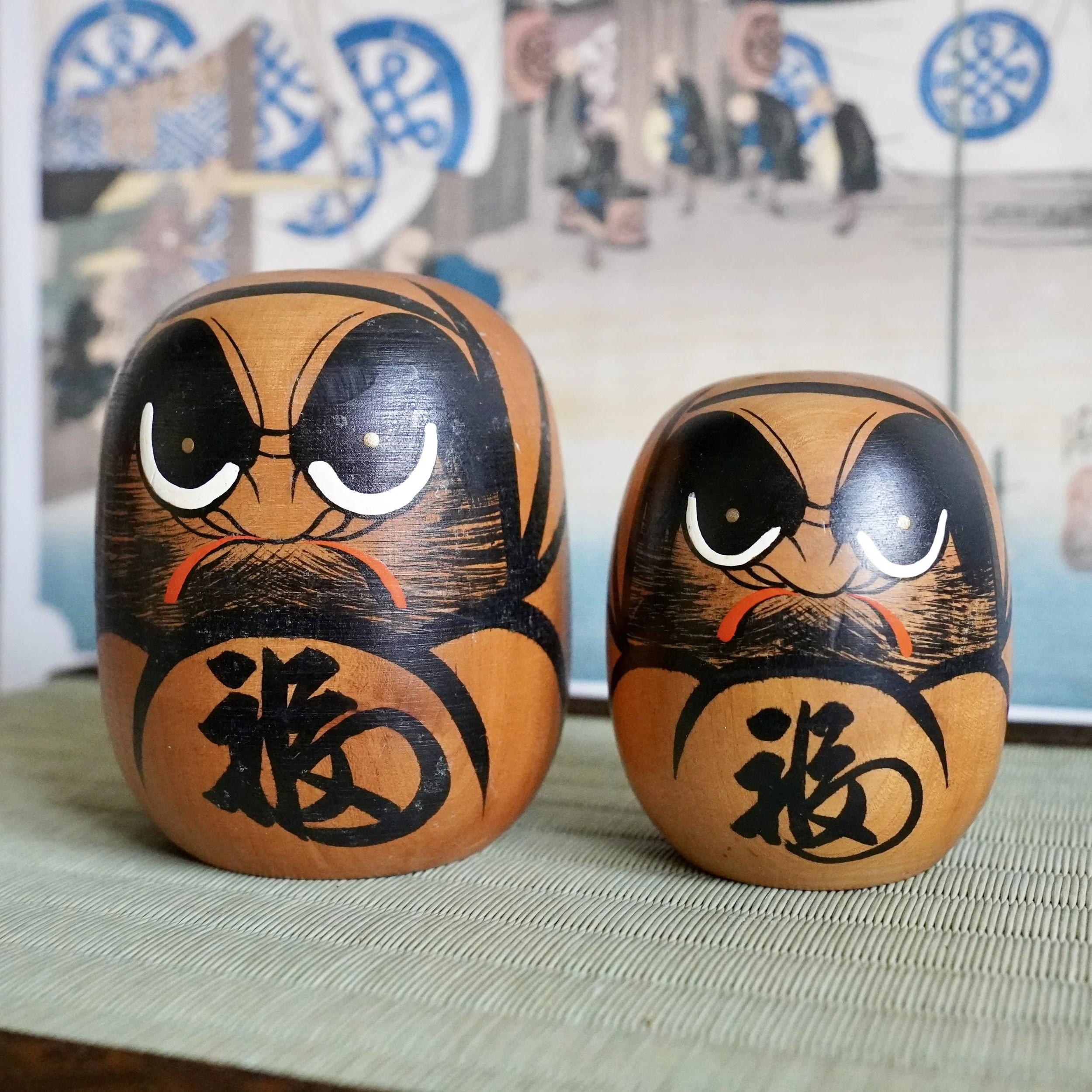
Two daruma sit together like a small, watchful family: one broad and full, the other its smaller echo. Both wear the same fierce expression, thick black brows drawn in a single confident stroke, eyes rimmed white around a dark centre, a short orange mustache below. On the belly of each, the character for fortune sits in solid black. Nothing about them is dainty. They look like they mean it.
Daruma dolls carry one of the most recognisable stories in Japanese folk craft: the wish made, the goal set, the eye left blank until the promise is kept. Pieces like this pair were turned on a lathe by the same craftsmen who shaped kokeshi, in the onsen towns of Tōhoku where wood was the material at hand and every visitor wanted something to bring home. No maker signed this pair. What they carry instead is smaller and more personal: a handwritten date on the underside, someone once marking the day this pair came into their life.
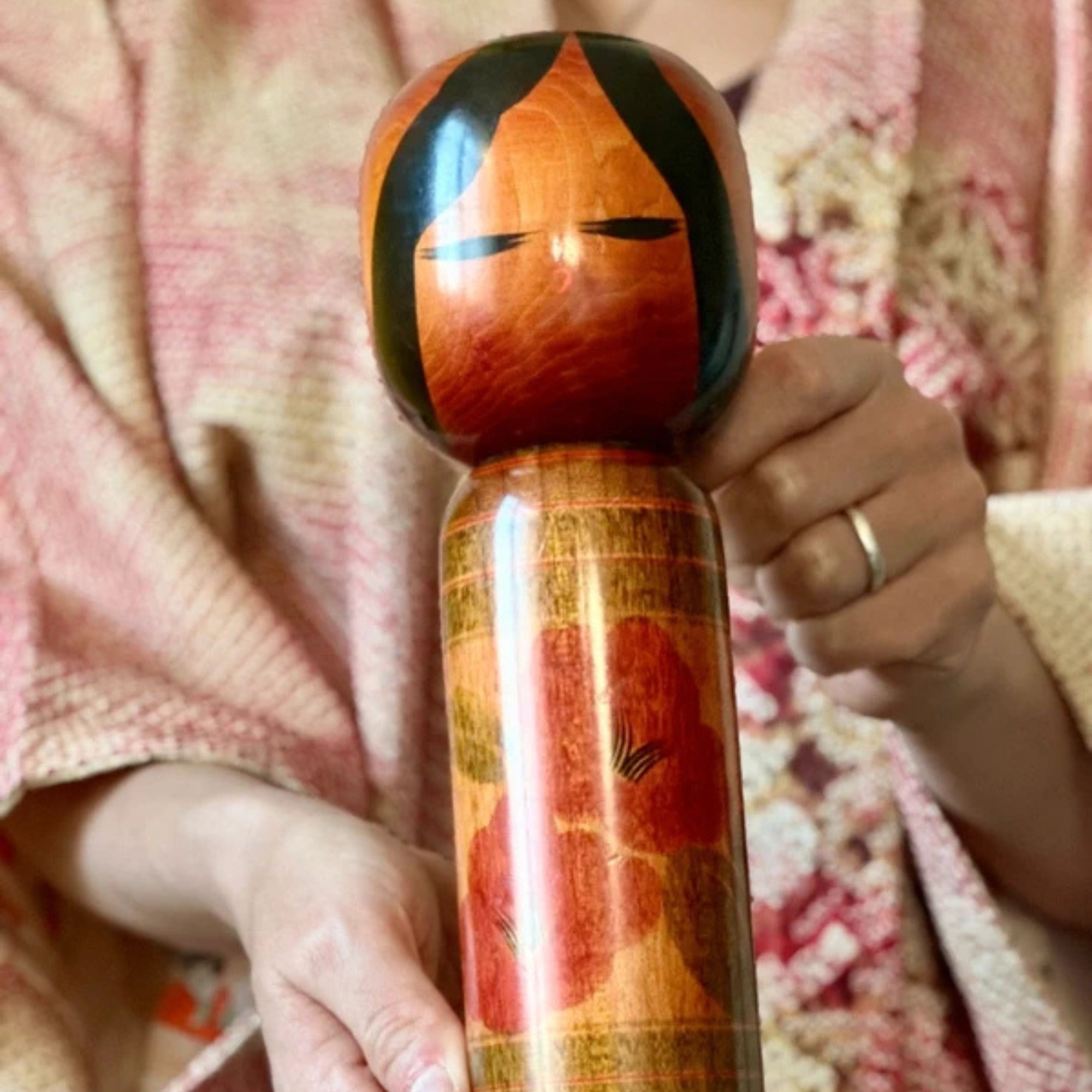
The half-dark head is what stops you. One side deep black, the other the warm reddish glow of the wood grain itself, and between them a face with heavy-lidded almond eyes that looks both ancient and entirely contemporary. Below it, two large camellia flowers in deep red fill almost the entire body.
Tsubaki Musume, Camellia Girl, is one of the most recognized designs in the sōsaku kokeshi tradition, and Tamura Noboru one of its most celebrated makers. He won the Prime Minister Award during his career and his work is collected internationally. This piece is signed on the base in his characteristic brushwork.
Tamura Noboru works from Studio Tamura Kogei, a creative kokeshi studio in Shibukawa, Gunma Prefecture. The same studio is also home to his wife: female kokeshi maker Tamura Chie, whose work under the name Chiei Saku has its own devoted following among collectors. More info on their makers page.
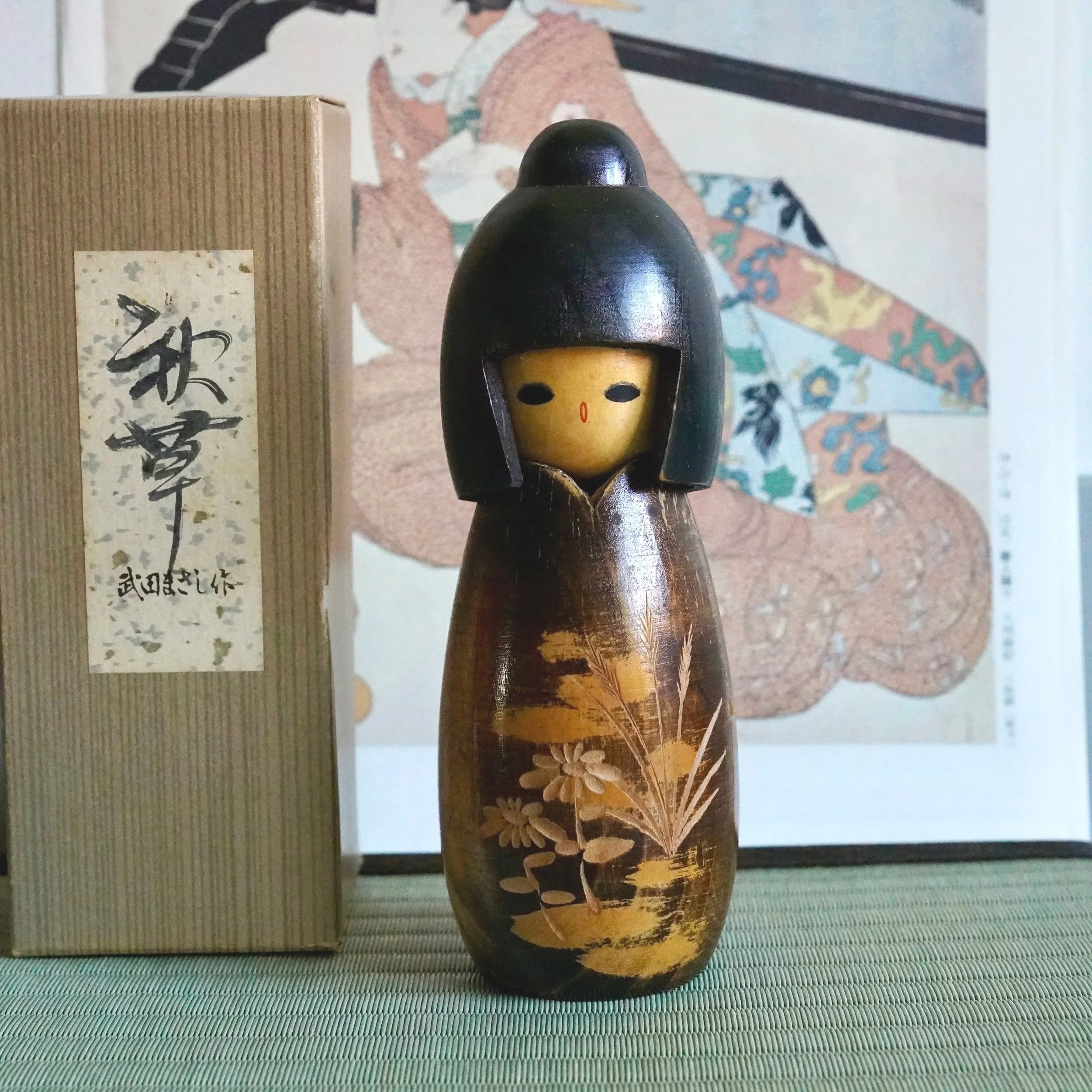
The body is deep lacquered brown, the colour of old teak in low light. Across the torso, autumn grasses and chrysanthemums are carved in low relief and left in their natural wood tone, so the decoration glows against the dark ground. The head sits directly on the shoulders, smooth and pure black, no neck, no detail. From across the room it reads as a single dark silhouette. Move closer, and the flowers appear.
This piece comes from the hand of Takeda Masashi (武田まさし, 1930 to 2015), one of the most recognised names in sōsaku kokeshi. Masashi worked from Zaō in Yamagata, a mountain region that became a quiet centre for creative kokeshi making in the mid-twentieth century. His studio was known for exactly this: dark lacquered bodies, carved naturalistic relief, and a formal restraint that sets his work apart from the brighter painted styles of other kokeshi traditions.
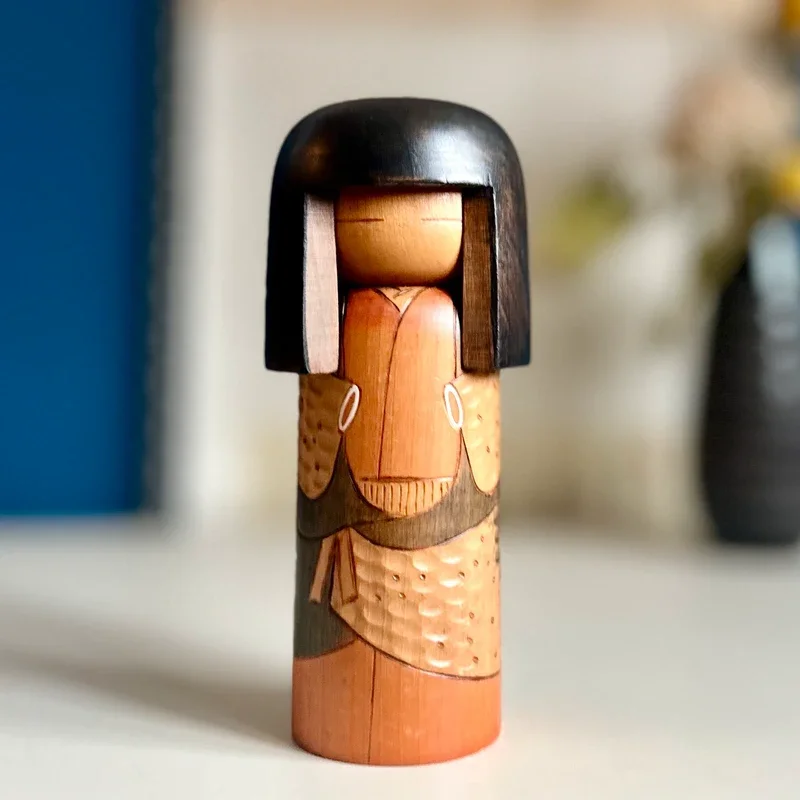
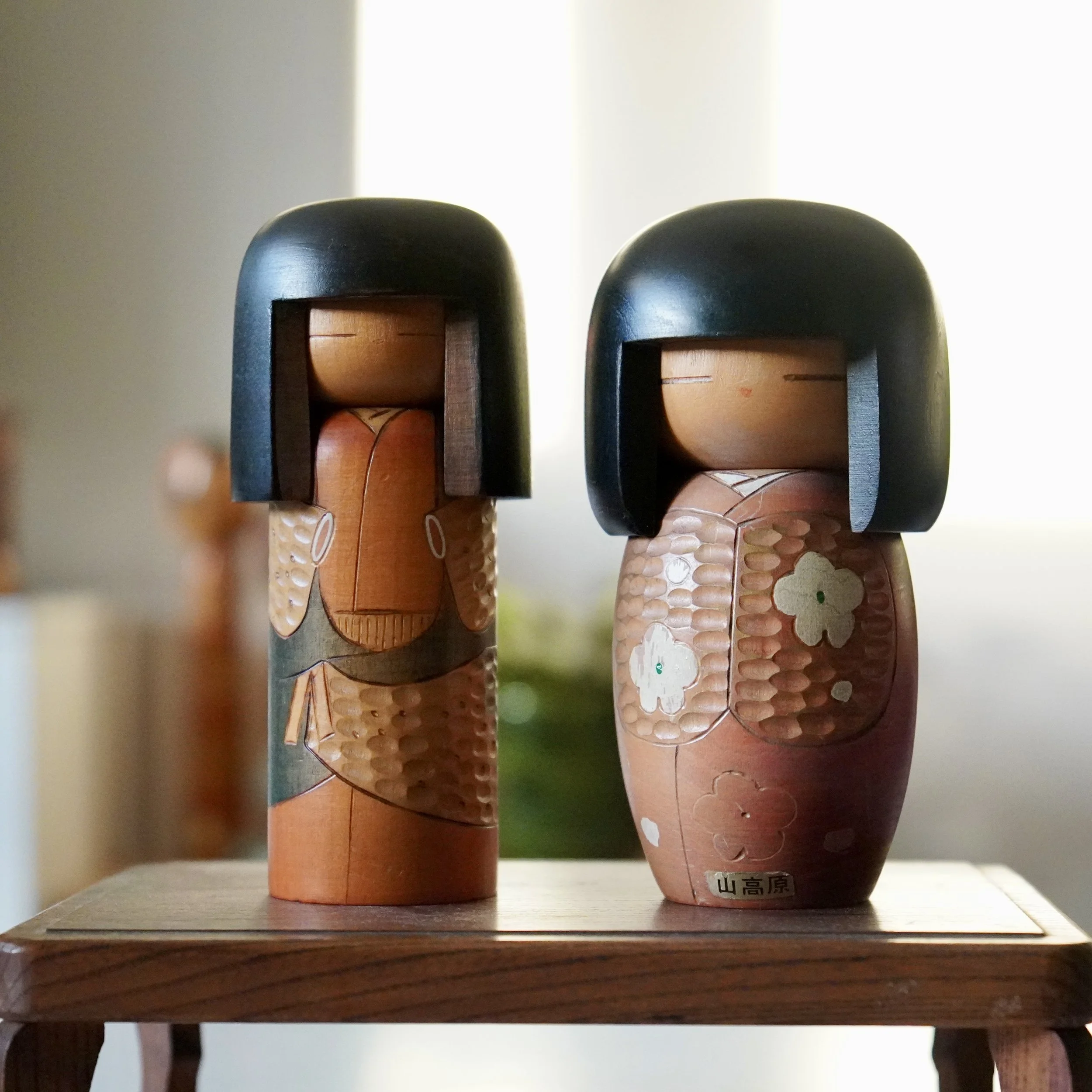
She stops you because of the detail. The dark outer kimono falls open at the sides to reveal a warmer inner robe, and each layer carries its own incised pattern: broad sleeves with carved surface texture, a lower section in dense relief that reads like heavy woven cloth. The face is minimal, the dark hair close and smooth, and none of it competes with what is happening on the body. She is a figure that rewards a second look and a third.
Kisaku (喜作) was active in the sōsaku tradition through the 1960s and 1970s, and his carved pieces are consistently sought by collectors for the quality and restraint of the cutting. What makes this figure technically demanding is the layering: each area of the kimono is treated differently, the transitions between inner and outer robe carved cleanly without losing the sense of depth. The signature is brushed in ink directly onto the base.
She has a sister: a second Kisaku figure from the same period, rounder in form and decorated with incised ume plum blossoms. Both are available separately. You can find her here.
Interested to read more about the woodworking on kokeshi like these? I wrote about it in my journal.
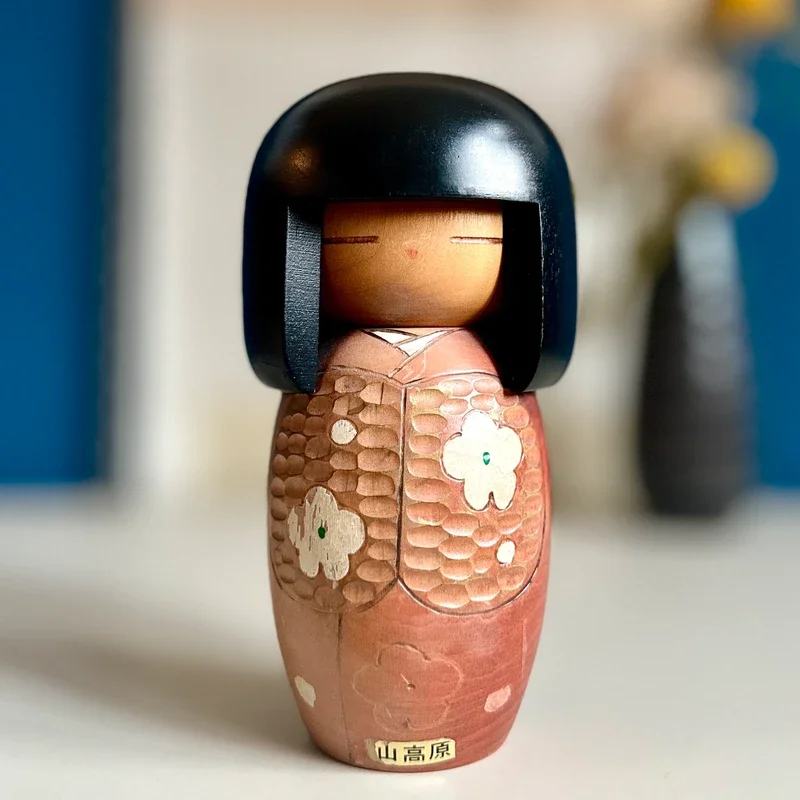
She is rounder and softer than most sōsaku figures of this size, the terracotta ground warm against the white of the carved plum blossoms. The flowers sit in shallow relief across her body, petals cut directly into the wood with white pigment worked into the recesses, each one slightly different from the next. The dark hair is smooth and close, the face simple and settled. She is the kind of object that reads clearly from across a room and rewards you further when you pick her up.
Kisaku (喜作) worked in the sōsaku tradition through the 1960s and 1970s, and his carved pieces are consistently sought by collectors for the quality and restraint of the cutting. The ume plum blossom is among the most traditional motifs in Japanese decorative craft, and placing it on a kokeshi in this form, incised rather than painted, without additional ornament, is a choice that relies entirely on the maker's confidence in the technique. Signed with the red hanko on the base.
She has a sister: a second Kisaku figure from the same period, taller and more angular, her outer kimono carved with broad sleeves and layered incised textile patterns. Both are available separately. You can find her here.
Read more about the woodworking on kokeshi in my journal.
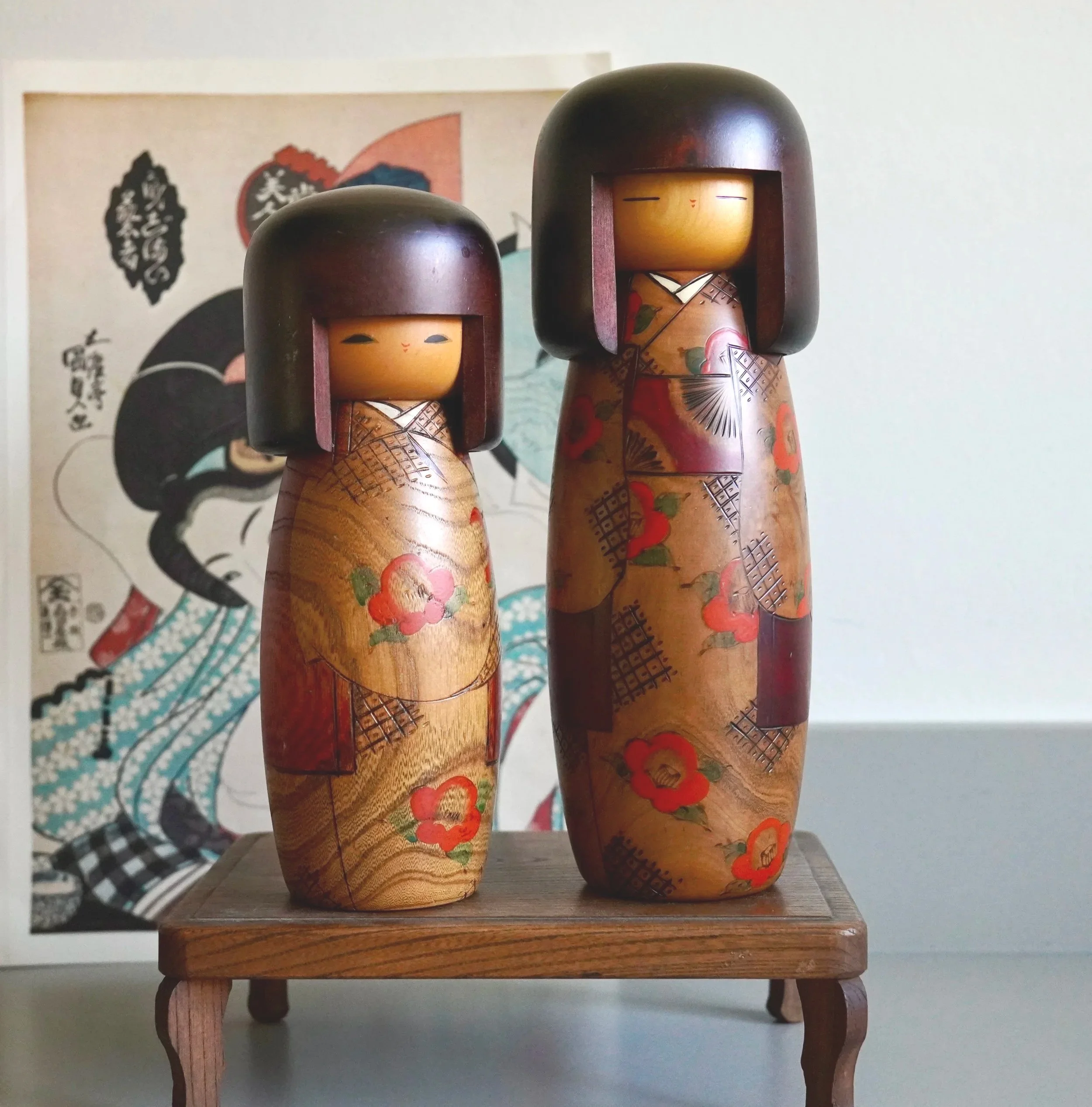
The zelkova grain runs through the entire body of this kokeshi like a landscape, visible beneath the painted camellia flowers and the yakie-burned fan and lattice decoration of the kimono. The dark upper section of the body, a deep burgundy against the warm honey of the wood below, is not paint covering the material. It is the material, treated and turned until it reached that colour. The proportions are generous: broad at the shoulder, tapering at the base, heavier in the hand than you expect.
Usaburo Kokeshi was founded in 1950 in Shinto Village, Gunma Prefecture, by Okamoto Usaburo, the craftsman who introduced the yakie burning technique to sōsaku kokeshi and worked with zelkova and chestnut at a time when most makers dismissed these woods as unsuitable. His studio went on to win the Minister of International Trade and Industry Award at the All-Japan Kokeshi Competition, one of the most significant government recognitions in Japanese craft.
The sticker on the larger of these two pieces carries exactly that award. The zelkova grain visible beneath the kimono decoration is central to what Usaburo built his reputation on: the wood is not hidden, it is part of the design.
Interested to read more about the woodworking on kokeshi like these? I wrote about it in my journal.
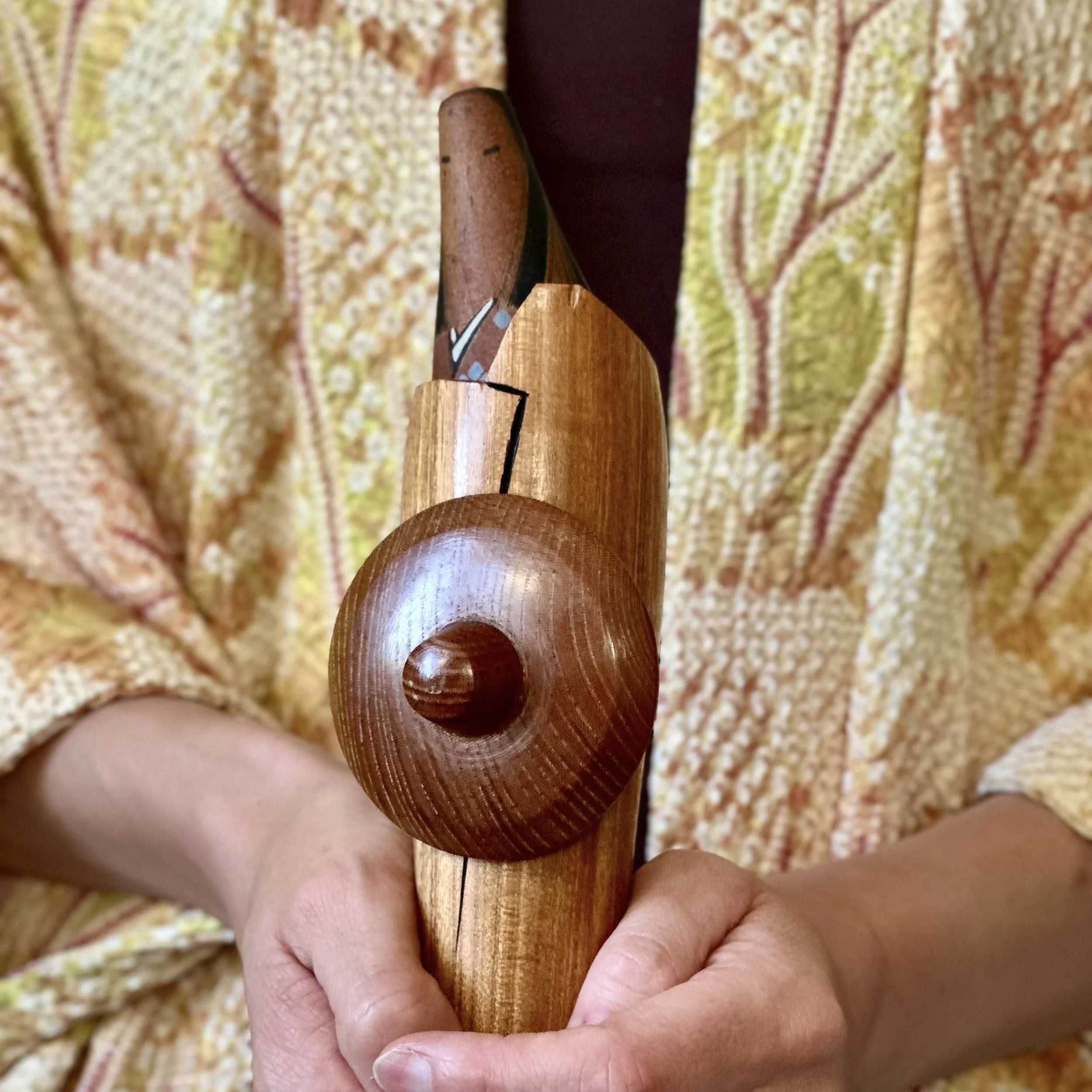
The first thing you notice is the hat. It stops you before you understand what you are looking at. Below it, the body is built from rings of different wood, each one a slightly different tone of amber and chestnut, pressed together in warm tiers. At the very top, a painted face, small and precise.
Someone thought carefully before they made it.
Seiju Kon, whose given name is Kon Akira, was born in 1931 in the Yamagata area and studied under master woodworker Hasegawa Tatsuo. His work is rooted in the Tsugaru kokeshi tradition and he returned, throughout his career, to a small set of subjects: figures from Noh theatre, women of the Heian court, characters from the world of classical Japanese performance and rank.
She is one of those. She belongs to a series he made across decades, and it is immediately recognizable to anyone who has seen his work before.
Interested to read more about the woodworking on kokeshi like these? I wrote about it in my journal.
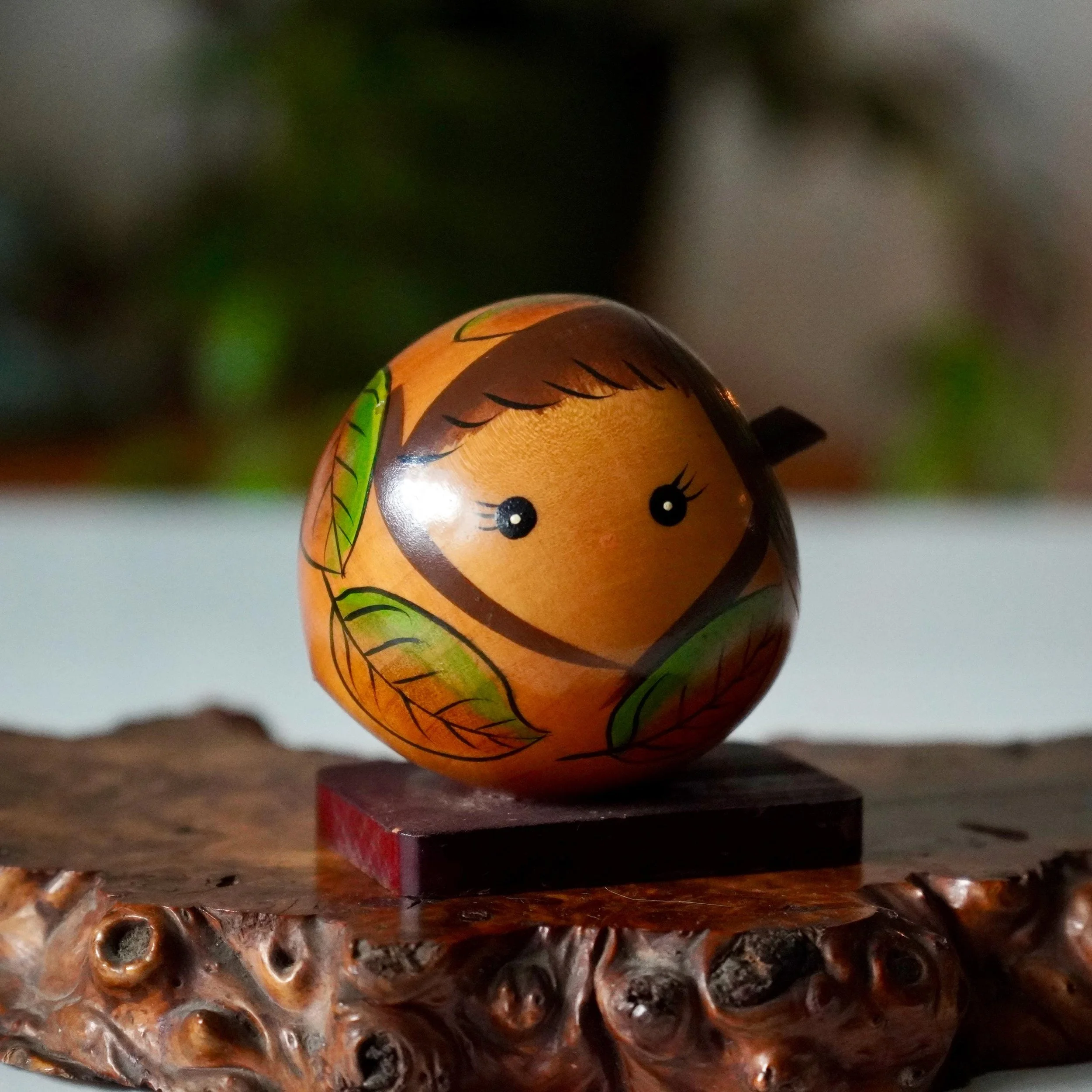
She sits in your hand like a small warm stone. The form is a single unbroken sphere, no neck, no waist, no separation between head and body, just one continuous round shape with a tiny stem at the top and a face tucked quietly into the side. Two round eyes with lashes look out from between painted autumn leaves.
Her maker Chie is one of the few widely recognised female masters in the sōsaku tradition. She is known for translating natural forms directly into wood, and this piece is exactly that: not a doll holding a leaf motif, but a doll that is the thing itself, an acorn that became a girl, or a girl that became an acorn.
Tamura Chie works from Tamura Kogei, a creative kokeshi studio in Shibukawa, Gunma Prefecture. The same studio is also home to her husband Tamura Noboru, one of the most celebrated names in sōsaku kokeshi and a Prime Minister Award winner.
Interested to read more about the woodworking on kokeshi like these? I wrote about it in my journal.
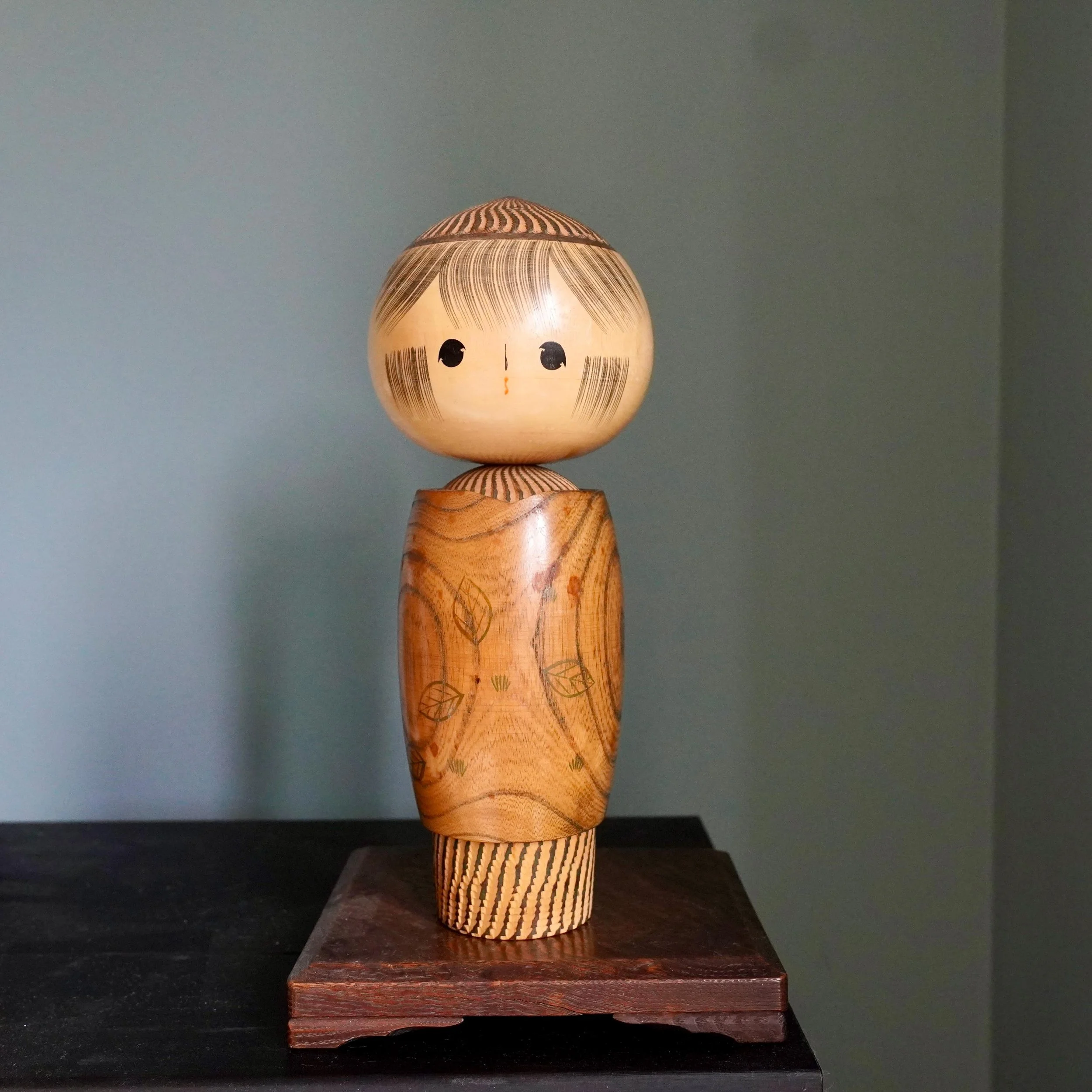
The grain of the wood is doing most of the work here. Tamura Noboru turned this piece of keyaki so the annual rings wrap around the body in concentric arcs, one layer visible through the next, the whole surface reading as landscape rather than material. The leaf motifs painted on the body sit inside that grain rather than over it. The burnt stripes at the collar, head and base mark the transitions the way a line drawing marks a contour.
Tamura Noboru is one of the most recognised names in sōsaku kokeshi, the tradition of creative artist-made kokeshi that emerged in the mid-twentieth century as makers began working outside the strict regional styles. He received multiple awards across his career, including the Prime Minister Award, Japan's highest recognition in traditional craft.
Noboru works from Studio Tamura Kogei, a creative kokeshi studio in Shibukawa, Gunma Prefecture. The same studio is also home to female kokeshi maker Tamura Chie, whose work under the name Chiei Saku has its own devoted following among collectors. I have kokeshi from her as well, you’ll find it under this page among the related items.
Interested to read more about the woodworking on kokeshi like these? I wrote about it in my journal.
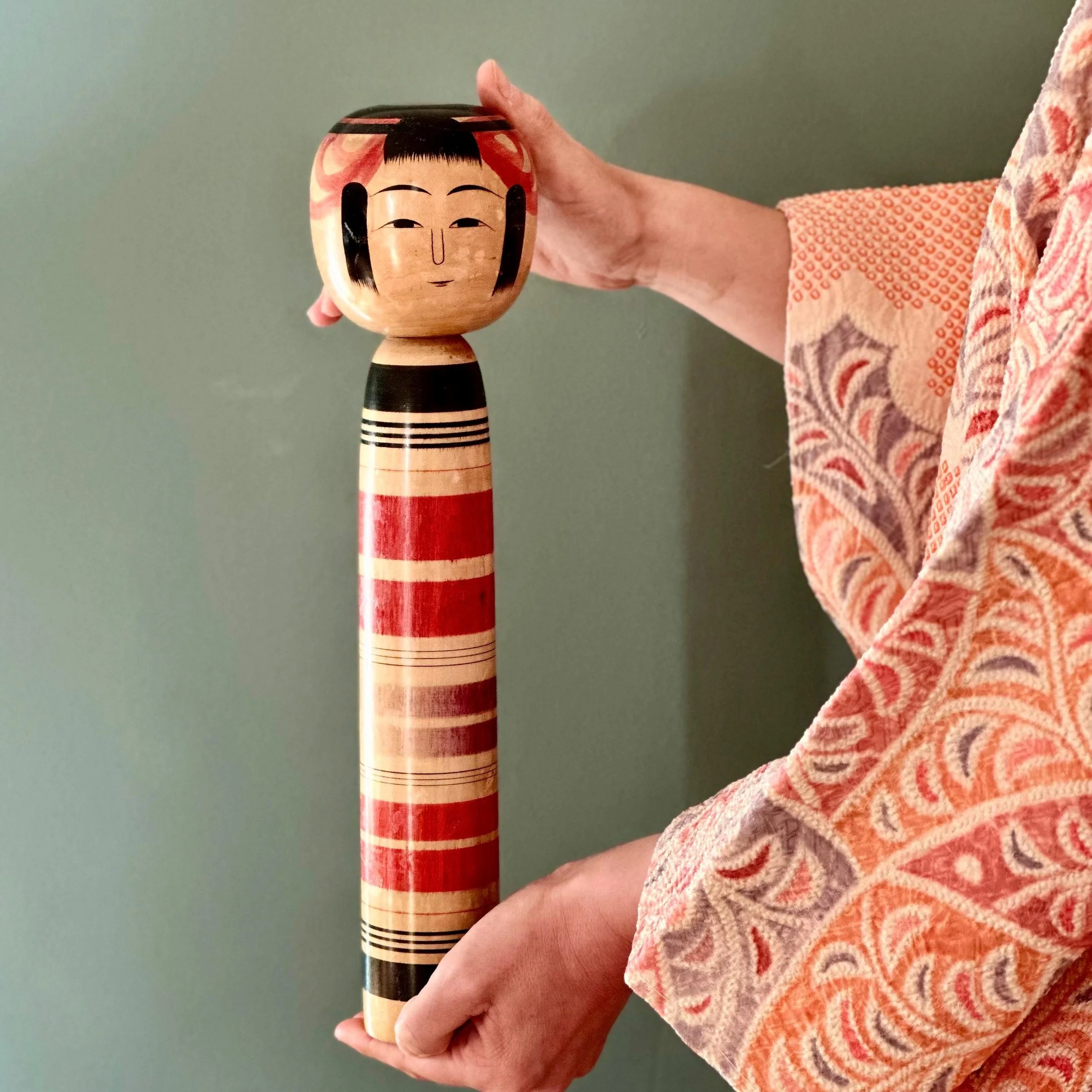
The banding on a standard Tsuchiyu body runs in red, black and natural wood. This doll adds a fourth color: discrete purple bands sit alongside the red, painted in the same lathe technique but in a different pigment. It is not a common choice in the Tsuchiyu tradition and it gives this particular piece a quieter, cooler register than the typical warm red. Small decisions in the color palette are one of the ways a maker like Ichirō marked individual pieces within the constraints of a traditional style.
Abe Ichirō (阿部一郎, 1925 to 2000) trained under his father Abe Shinjirō, one of the central figures of the Tsuchiyu lineage in Fukushima Prefecture, and spent his career both making kokeshi and passing the woodturning tradition to the next generation. The rokuro-moyo pattern, painted while the wood spins on the lathe, is one of the defining marks of the Tsuchiyu style. On this piece the color has held particularly well.
The head turns and produces a soft squeak when rotated. In Japanese this is called the cry of a child, and it is one of the quiet surprises of traditional Tsuchiyu kokeshi.
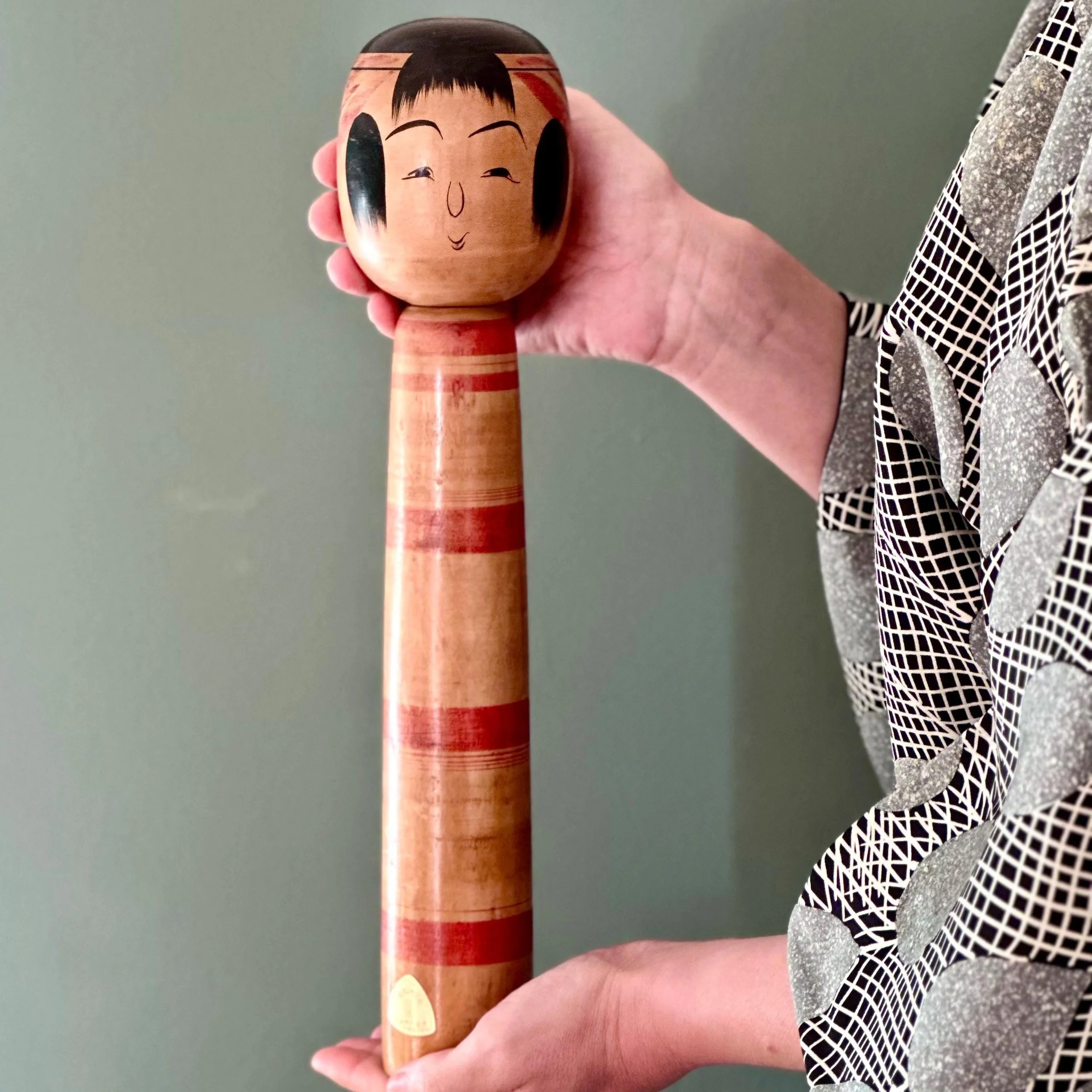
She stands 36 cm tall and takes up space the way a confident object does, not aggressively, but with presence. The red rokuro-moyo bands circle the body in clean horizontal lines, painted while the wood turned on the lathe, each one slightly varying in width and intensity. The face is the kind you remember: a long brushstroke for the nose, eyes that hold more expression than the minimal style usually allows.
Tilt her head and she answers back, a soft, hollow squeak from the loose-fitting joint where the head meets the body.
This rotating head is not a decorative feature. It is a technical standard: in traditional Tsuchiyu kokeshi, the head and body are turned separately on the lathe and fitted together with a slight friction joint that allows rotation. A head that turns correctly is evidence that the proportions are right and the wood has been worked to tolerance. Collectors use it as one of the first checks when assessing a piece. This one still moves as it should.
Want to understand the difference between dentō and sōsaku kokeshi? I wrote about it, with a trip through Fukushima along the way.

The first thing you notice is the hair: dark chestnut wood turned over a pale cream body, the two tones meeting in a clean line. Below it, red and white ume blossoms move across the body with the ease of a maker who has painted this hundreds of times.
She is small enough to hold in one hand and considered enough to keep looking at.
Tanaka Kōjō (田中晃常) made sōsaku kokeshi in Gunma during the Shōwa period, and his "Haru no Yume" series, Dream of Spring, is among his most recognised work.
The ume blossom motif was not a decorative choice: it is the first flower of the Japanese year, blooming before the cold has left, and the symbol of the tea ceremony season's opening. He made this kokeshi to live beside the tea bowl, not apart from it.
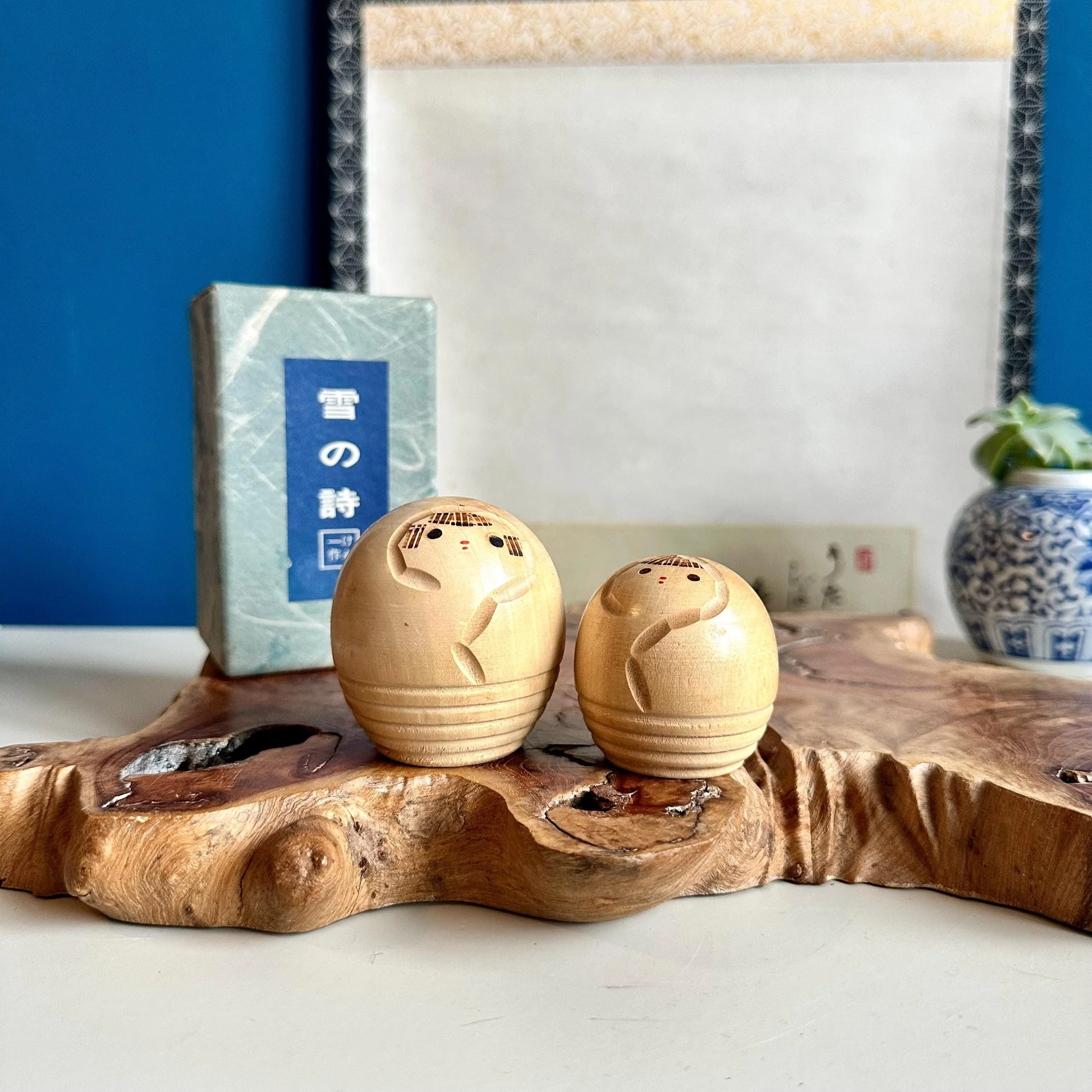
Two figures, almost perfectly round, with the smallest possible faces. Each one is a child pulled so deep into a winter coat that almost nothing is left visible: two small eyes, a nose, and just enough of a chin to know there is a face at all. The rest is wood, pale and smooth, the natural grain running in quiet lines across the surface. Put them together and they look like they are waiting for something to stop.
Murakami Kenichi came to kokeshi through oil painting, and that shows in how he thought about a subject. Where other makers added decoration, he removed it. These two pieces are among his most recognizable work, a winter child so bundled in a coat that almost nothing human remains visible, and the entire point of the making is that restraint. What you are holding is not a simplified figure. It is a figure from which everything unnecessary has been taken away.
Comes with original tomobako box inscribed 雪の詩 (Yuki no Uta, Poem of Snow).
Read more about the woodworking on kokeshi in my journal.
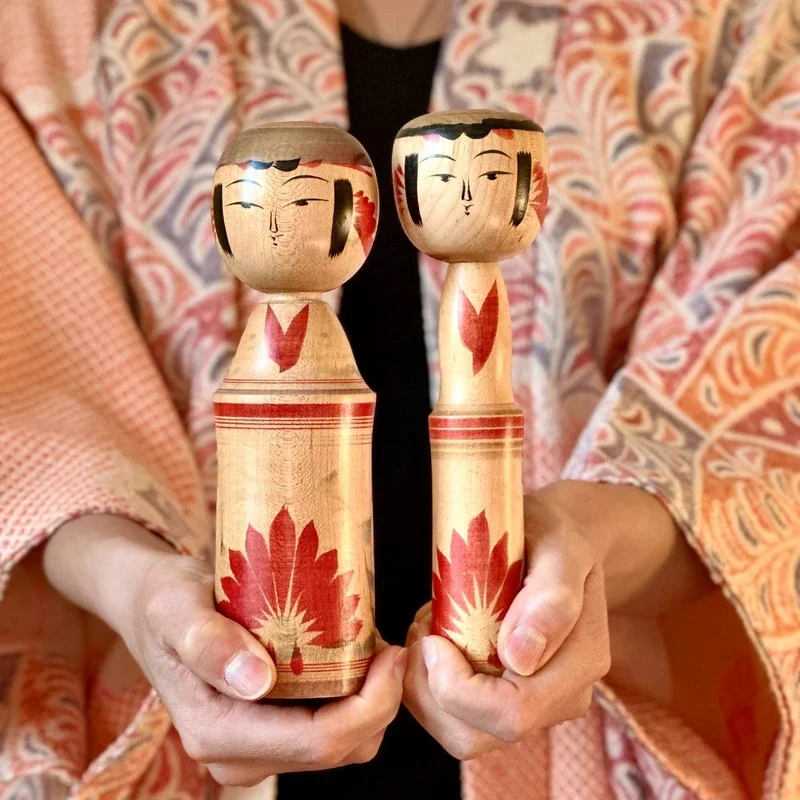
Two figures, held together in one hand. They clearly belong to each other, and yet if you look at them side by side something is slightly different in each face, a line placed a fraction differently, an expression that is almost but not quite the same. The chrysanthemum on each body is bold and graphic, a wide explosion of red petals that fills most of the torso. At a distance it reads as decoration. Close up it is a very confident hand.
Inoue Harumi learned to make kokeshi from her parents. Her mother Yukiko was herself trained within the Yajiro lineage, and if you look at Harumi's faces you can see where they came from: the same careful restraint, the same particular placement of the features. This is what craft knowledge that passes through families actually looks like. Not a copied style but a sensibility absorbed over years, made visible in every brushstroke.
Want to understand the difference between dentō and sōsaku kokeshi? I wrote about it, with a trip through Fukushima along the way.
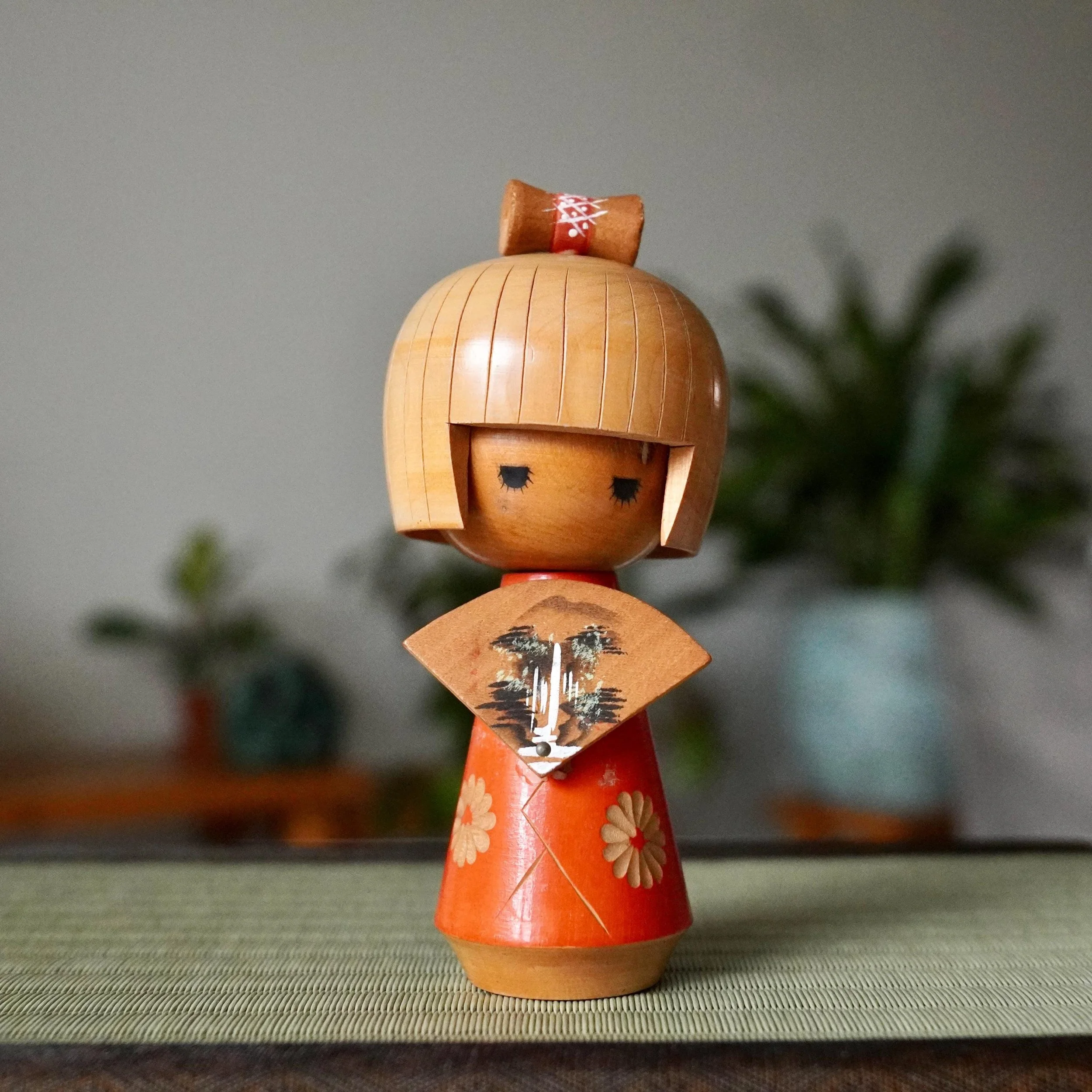
She stops you because of the fan. It sits in front of her like she is mid-performance, a separate piece of wood painted with an ink landscape of mountains and mist. Everything else about her is warm and composed: the orange-red kimono, the natural wood face tipped slightly forward, the painted fringe falling in neat vertical strokes. She is small enough to hold in one hand and substantial enough to stay exactly where you put her.
Kojo is a well known kokeshi maker in Gunma Prefecture with several kokeshi competition wins to his name, known specifically for figures that carry objects and for the technique of incising motifs directly into the lacquered surface so the natural grain shows through. This piece shows that clearly.
The chrysanthemum forms on her kimono are not painted but carved, each petal catching light differently depending on where she stands.
The face draws you in first: half-moon eyes, a small closed mouth, and a confident hairline in black. From there, red radiating lines sweep across the entire head in the unmistakable Togatta sunburst. The body carries a hand-painted iris in deep red with long green leaves, each petal laid down in a single fluid stroke. No outlines, no corrections.
Togatta kokeshi come from the Zao area of Miyagi Prefecture, one of the oldest kokeshi-producing regions in Japan. The tradition began with craftsmen at mountain hot spring resorts making simple wooden toys for visitors, and grew, across generations, into a living folk art with its own distinct vocabulary of forms and markings. A signed piece from a craftsman registered in that lineage is not decoration. It is a record of continuity.
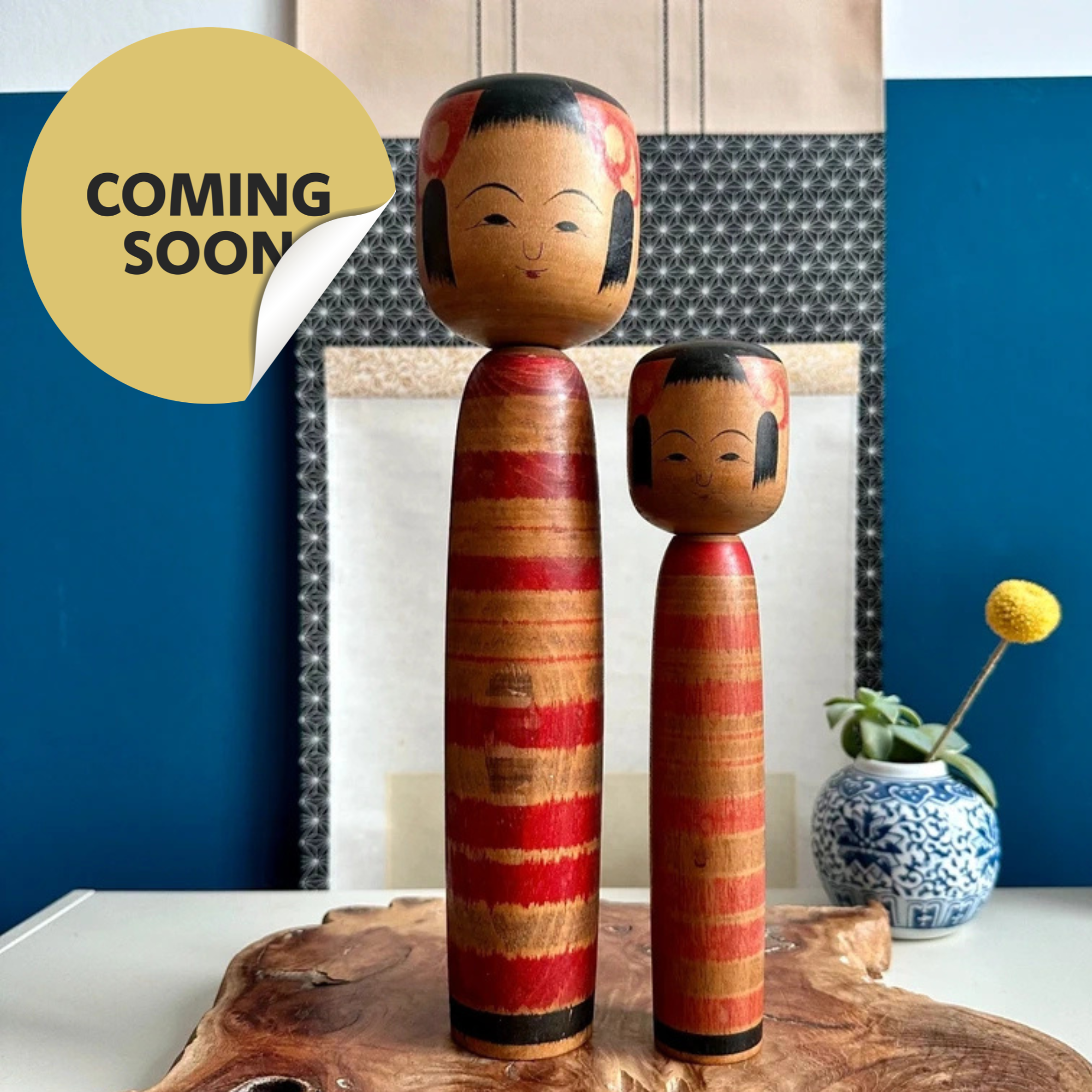
I work through my finds in small batches as each piece takes time to research, photograph and write properly. But some items are too good to sit invisible in the backlog, and if you have been looking for a signed pair of Tsuchiyu kokeshi by a documented master maker, I want you to know this one exists.
This pair of traditional Tsuchiyu kokeshi was made by Sato Sashima (佐藤佐志馬, 1907 to 1985), one of the central figures in the Tsuchiyu kokeshi tradition from Tsuchiyu Onsen in Fukushima Prefecture. The two figures stand at ca. 31 and 23 cm, their bodies decorated with the characteristic red rokuro-sen banding applied on the lathe, and both signed on the base. The larger piece shows some age-related wear to the red pigment consistent with its Shōwa period origin.
The full listing, photographs and price will follow. Want to know the moment it goes live? Scroll down.
👇
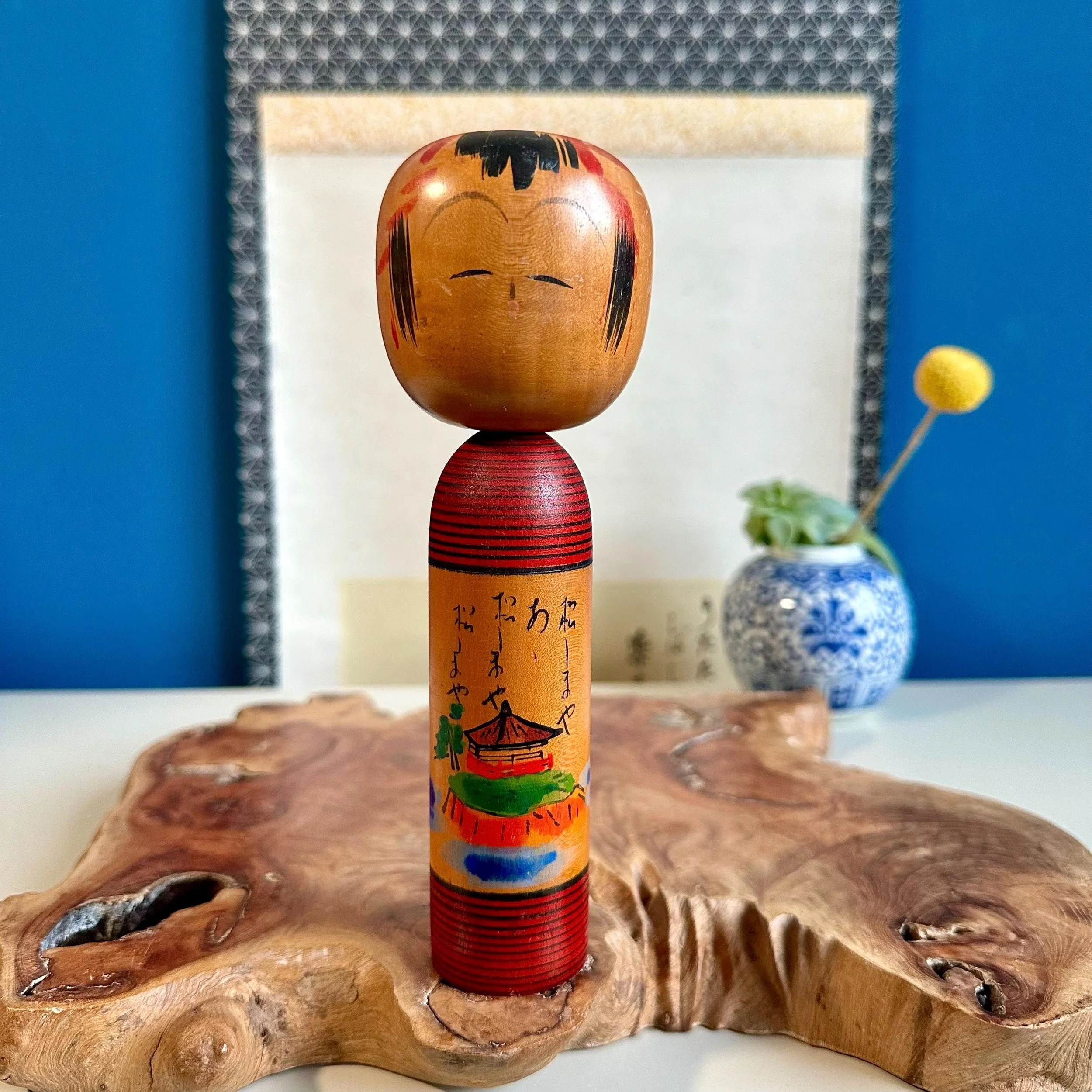
The body of this dentō kokeshi is not decorated with flowers or a kimono pattern. It carries a poem. Three lines, each ending in ya: the Japanese exclamatory particle that sits somewhere between a cry and a held breath.
The painted panel beneath the poem shows a pavilion rising above green foliage and still water: the Godaidō temple on its small island in Matsushima Bay, one of Japan's three most celebrated views. The red turning stripes above and below frame the scene like a stage curtain. This is a kokeshi that tells you exactly where it comes from and why that place mattered.
The poem on this kokeshi (Matsushima ya / aa Matsushima ya / Matsushima ya) is one of the most quoted verses in Japan, widely associated with Matsuo Bashō, the seventeenth-century haiku master who visited Matsushima during his famous northern journey. Scholars have long debated the true authorship, but the poem's hold on Japanese cultural memory is undisputed. The maker chose to carry that weight in wood and paint, and signed his work on the base.
Want to understand the difference between dentō and sōsaku kokeshi? I wrote about it, with a trip through Fukushima along the way.
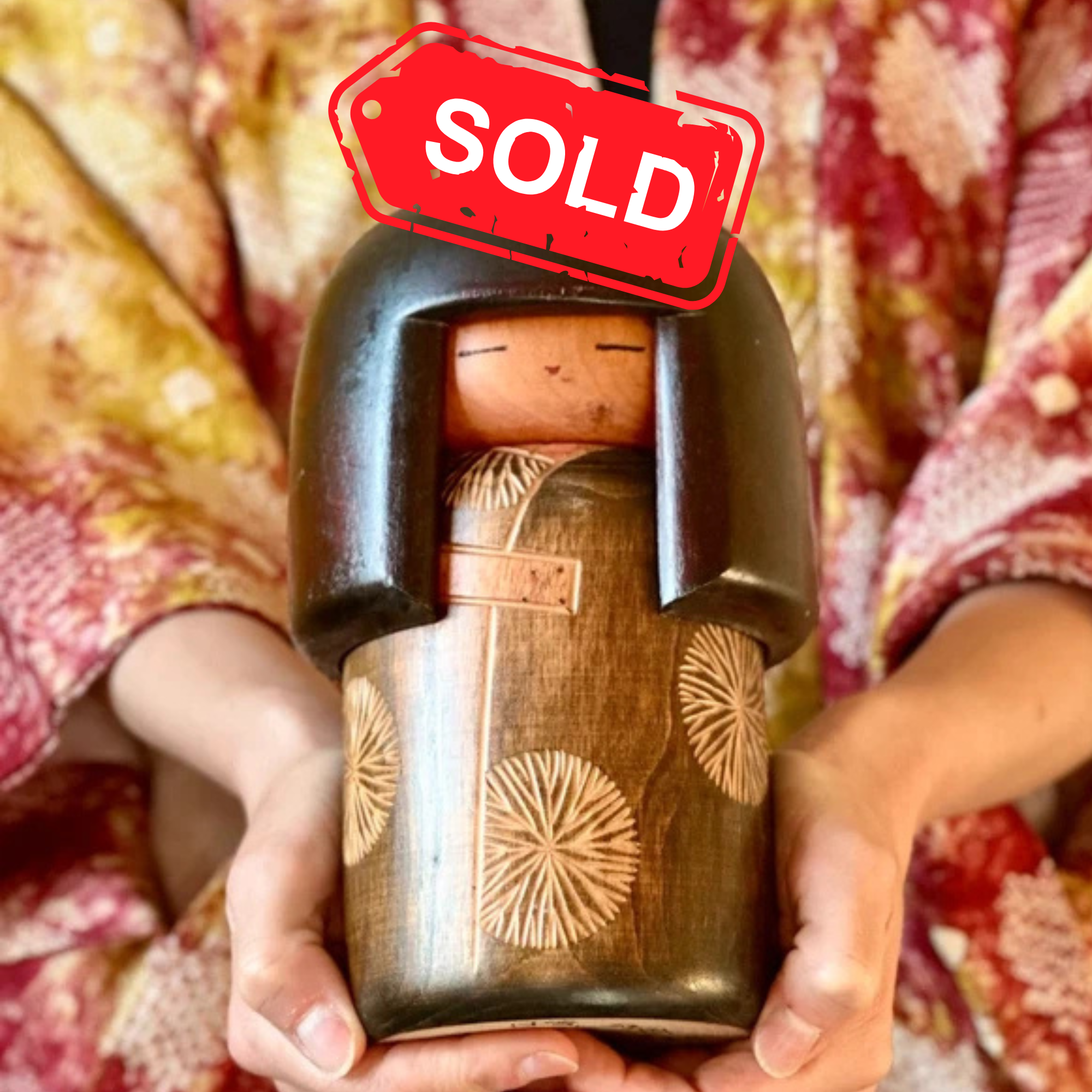
Notice: This kokeshi has found a new home. If you are looking for something similar, scroll down.
Item details
A creative kokeshi by Sekiguchi Sansaku (関口三作, 1925 to 2018), titled Dojo (童女, young girl), Shōwa period, Japan, ca. 1979. The figure stands 21 cm tall in dark lacquered wood, with a carved chrysanthemum kimono, a calm half-hidden face beneath swept dark hair, and a carved obi at the waist. Weight 1176 grams.
Sekiguchi Sansaku was the only kokeshi artist formally recognised by the Japanese government as Master of Creative Kokeshi, with work held in museum collections internationally. The base carries his signature 三作 (Sansaku) alongside a dedication in brushwork recording that this piece was gifted in January 1979 by the employees of the credit department of the Matsumoto branch, most likely a bank. A gift with a specific occasion and named givers is uncommon, and gives this kokeshi a documented social history alongside its artistic one.
Vintage condition, light surface wear consistent with age. Shōwa period, creative kokeshi tradition.
Notice: This kokeshi has found a new home. If you are looking for something similar, scroll down.
Item details
Sōsaku kokeshi titled 紅輪 (Kōrin, "Red Ring") by Takanashi Hanpushi (高梨 半風子), Yamagata Prefecture. The body is decorated with warm red rokusenbiki rings applied on a lathe, a precise and deliberate design that gives this doll its name. Tōgatta-influenced silhouette with lacquer finish, signed on the side alongside the title. Late Shōwa period, ca. 1970s, approx. 31 cm, 542 g. Takanashi made a limited number of kokeshi before leaving the craft entirely, which makes signed pieces like this one rare among collectors.
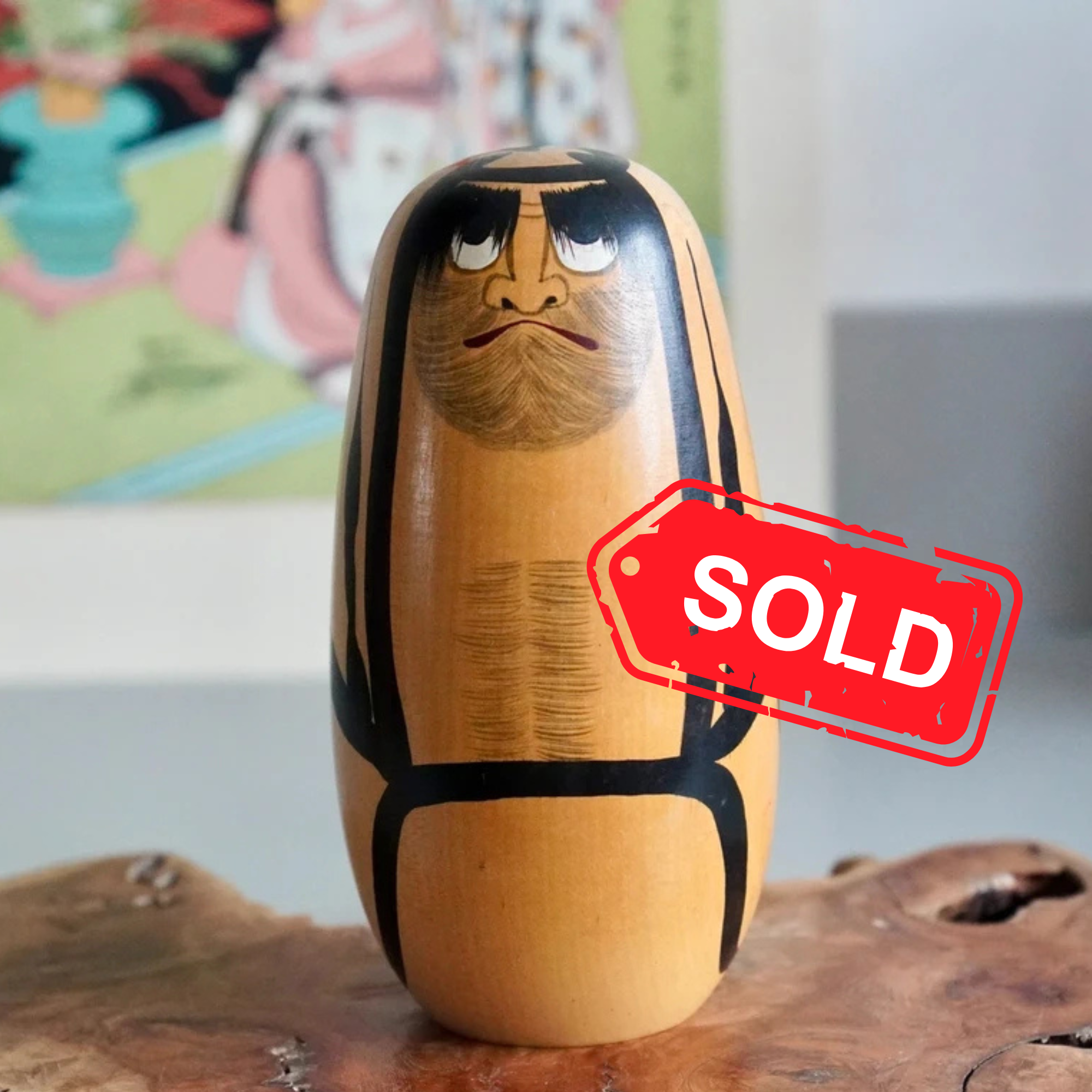
Notice: This daruma has found a new home. If you are looking for something similar, scroll down.
Item details
A wooden daruma figure from the Shōwa period, lathe-turned and hand-painted, marked 南元だるま (Nanten daruma) on the base with a red maker's seal. Nanten refers to nandina domestica, the heavenly bamboo plant, whose Japanese name carries the homophonic meaning of "turning misfortune" (難転), making it one of the most layered good luck symbols in Japanese domestic life.
Unlike the common papier-mâché daruma, this one is carved from solid wood and shows a warm natural grain through the painted surface. Height 17.5 cm, weight 556 g. Very good vintage condition.
Items you may also like
Questions before you buy?
Since my items are one-of-a-kind pieces, I want to ensure they reach you perfectly.
Questions about the history or condition?
Need a custom shipping quote or shipping outside the EU?
Prefer to see more detailed photos or a video?
Reach out to me directly. I'm here to help you find the perfect piece for your home.
✉️ hello@kaikoandco.com
💬 Instagram DM: @bykaikoandco
Pages from my journal
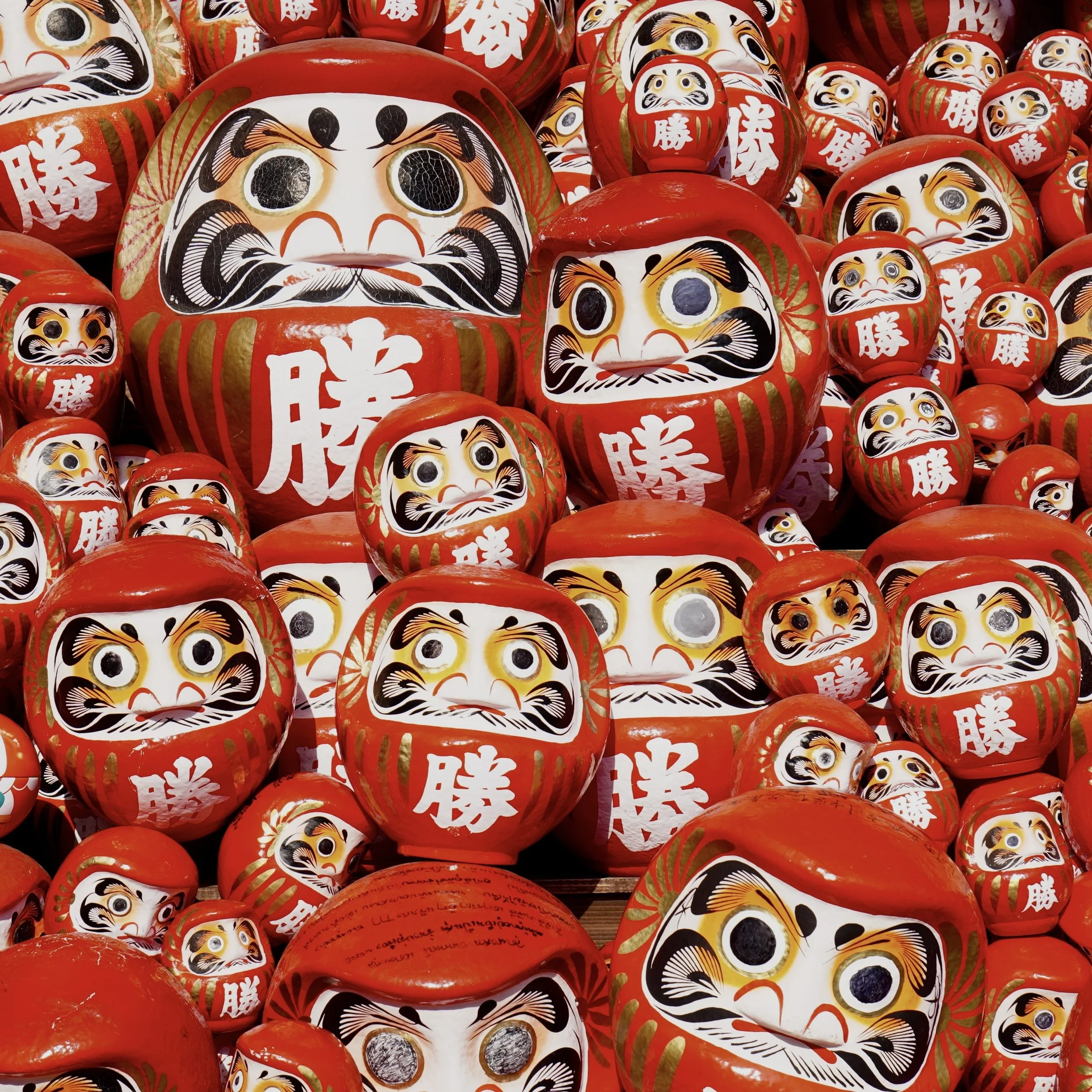
Perched in the forested hills of Minoh, Katsuo-ji is known throughout Japan as the Daruma Temple, thousands of red daruma cascading down its steps, each one carrying someone's wish. A visit that changed how I see the wooden daruma in our own collection.
Every temple I visit in Japan has the same quality of quiet, and it starts with three things: scent, sound, and a presence that holds the space. Here is how to bring that same intention home, starting with a single kōro and the concept of ma.
Urushi looks fragile and behaves like the opposite, until it meets a sunny windowsill or a winter radiator. Here is what actually damages lacquerware, what does not, and the handful of habits that keep a piece looking the way it did the day it was finished.
A kokeshi asks for very little once it has found the right spot. Grouped in threes on a shelf, alone on a windowsill out of direct sun, or standing next to something entirely unrelated, like a stack of books or a single dried branch. Here is what I have learned about placing them so they actually get looked at, instead of disappearing into a room.
Every ceramic piece I bring home has already been through decades of hands before mine. A chawan changes colour with tea over the years, a vase collects mineral marks if you let it, and neither of those things is damage. Here is what actually matters when you look after one.
A week in the heartland of kokeshi: Fukushima. From climbing Mount Bandai before sunrise to studying the unique facial expressions in the work of masters like Ichiro and Sato Fumio. Discover how the landscape and deep-rooted woodcarving traditions shape these authentic vintage treasures.
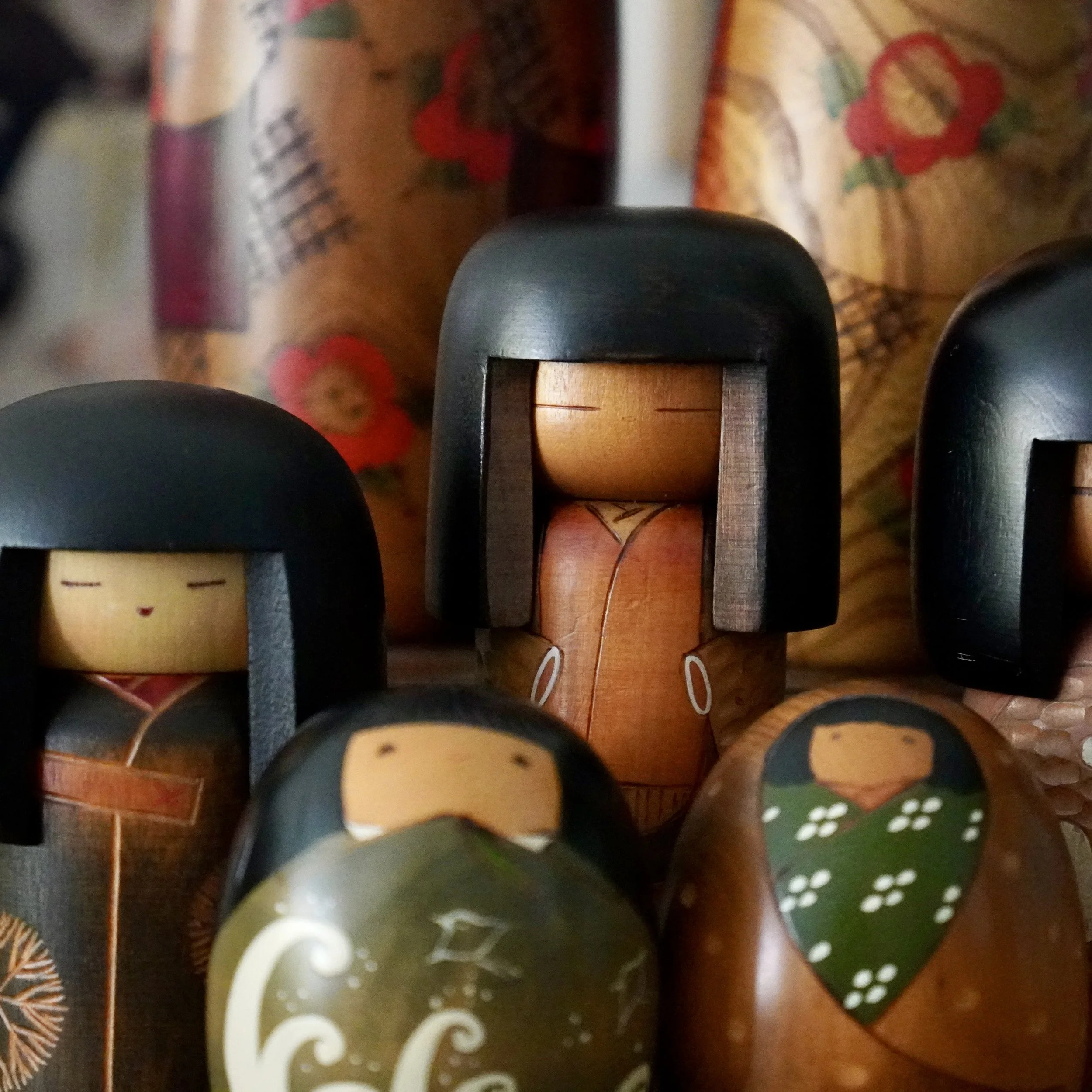
What draws you to a kokeshi is rarely the name on the base. It is the grain showing through the dark wood, the mark the tool left, and the two lines that somehow become a face. A close look at how makers like Usaburo and Sansaku Sekiguchi work with and against the wood itself.
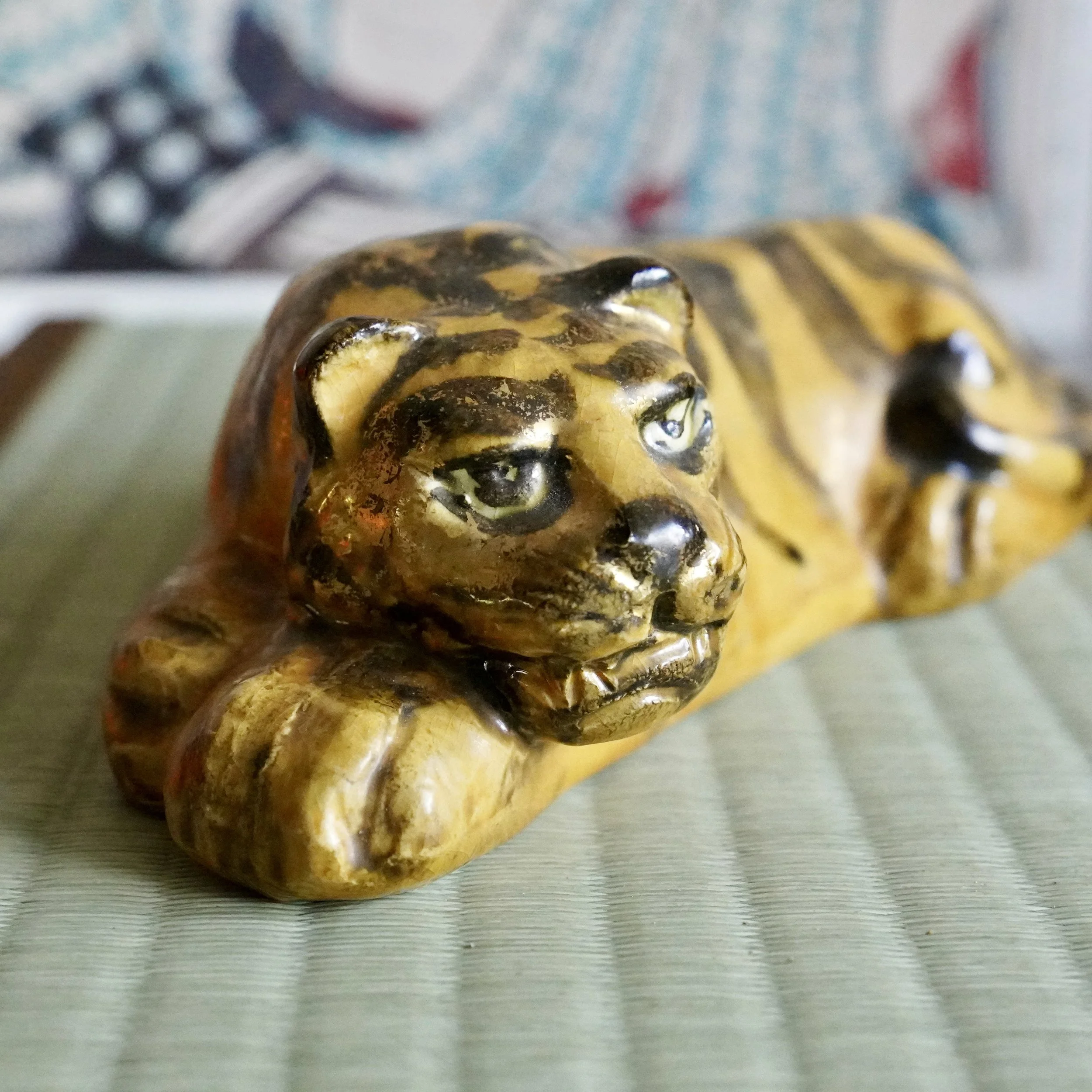
There is a small tiger on my desk with gold worn down to almost nothing on its ears and shoulders. It was made for a Year of the Tiger, in Kyoto, by a kiln lineage going back to 1771. The wear is not damage. It is exactly what the gold was always going to do.
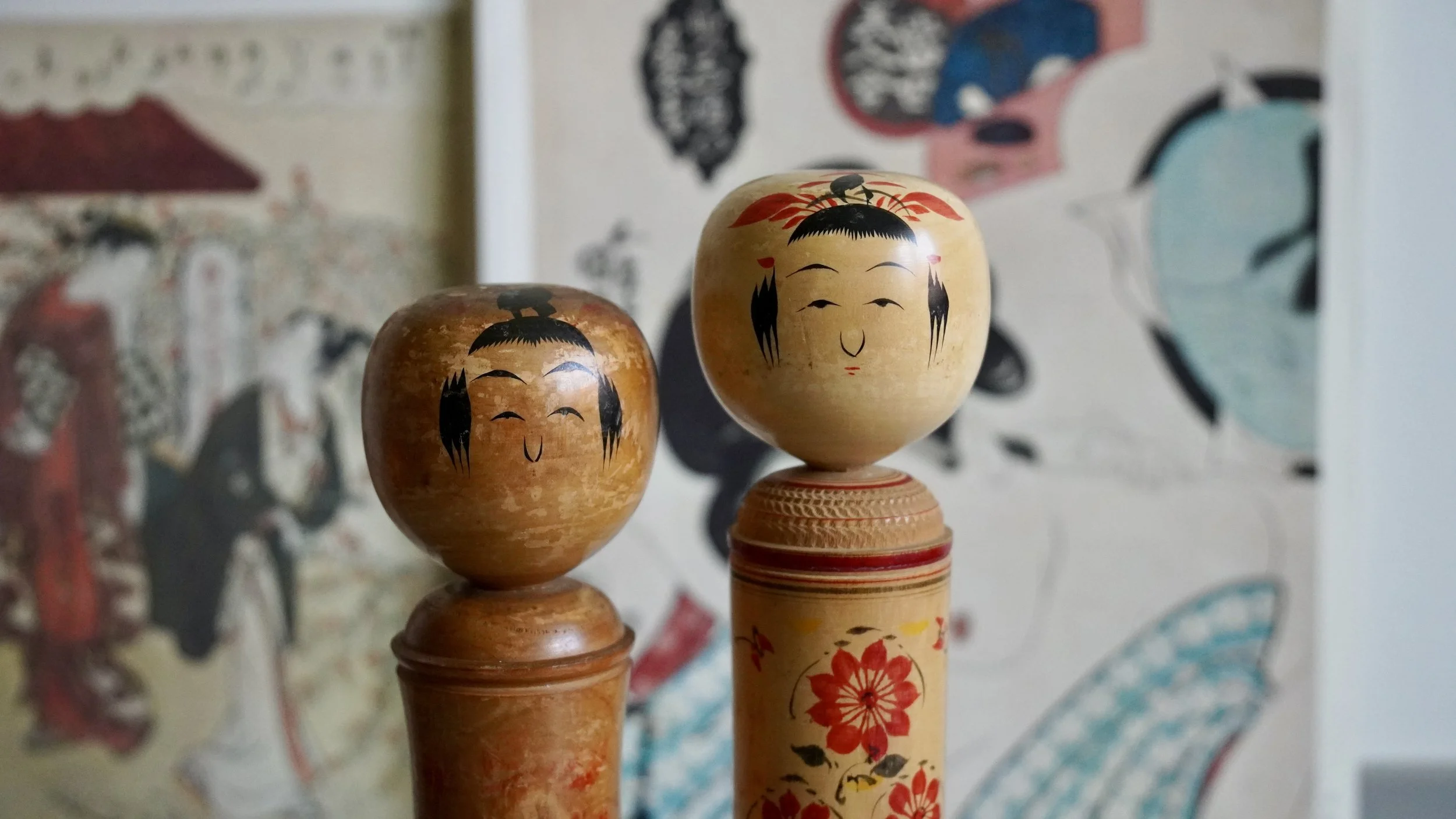
Two kokeshi, eighty years apart. Same face, different hands. The story of the Sakurai family and five generations of Naruko tradition.
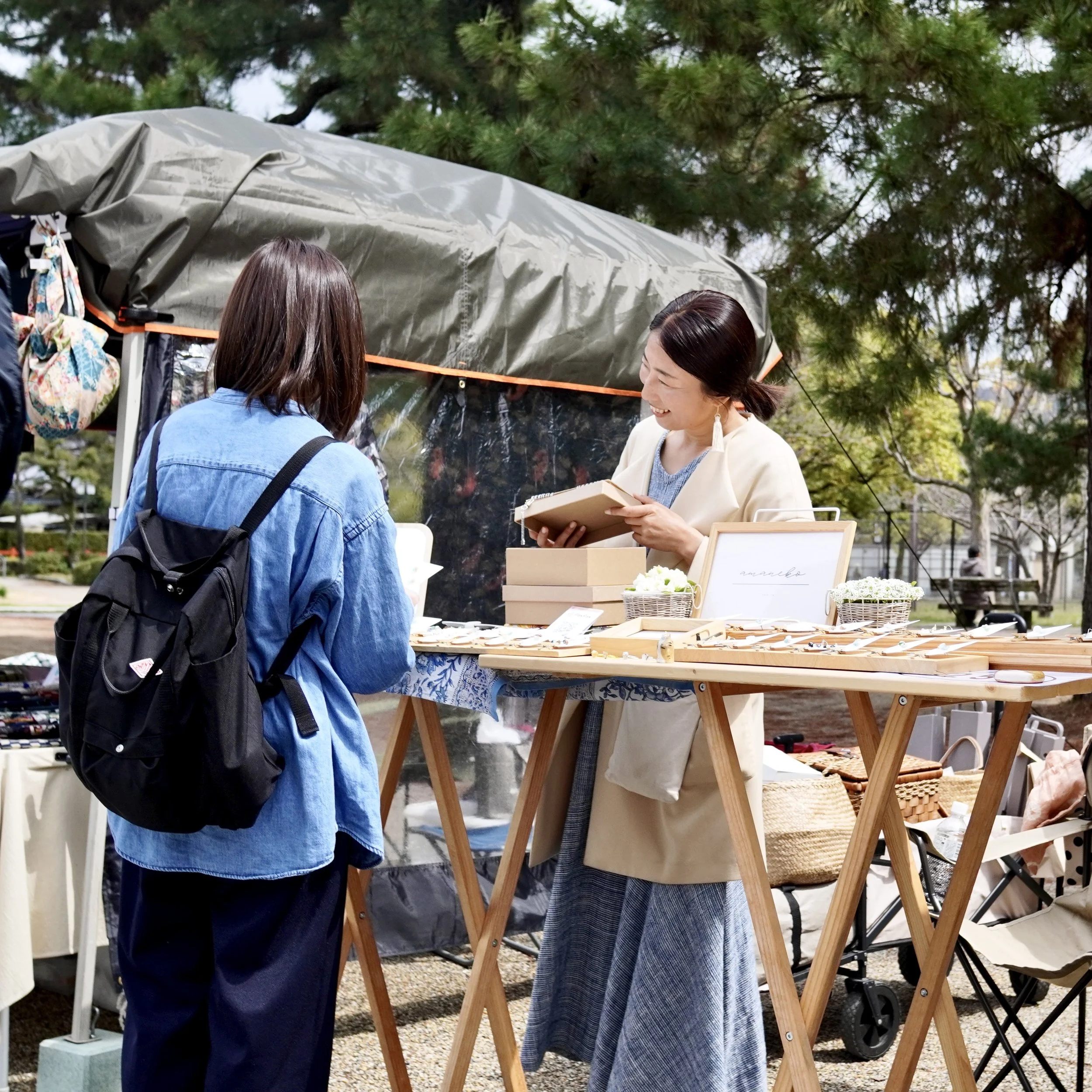
This is where the week begins. A early morning flight, a heavy bag, and the first market of the trip: Kobo-san at Toji Temple, Kyoto, at 5:30 in the morning. Day one of my Sourcing Week in Japan series in Kyoto and Okayama.
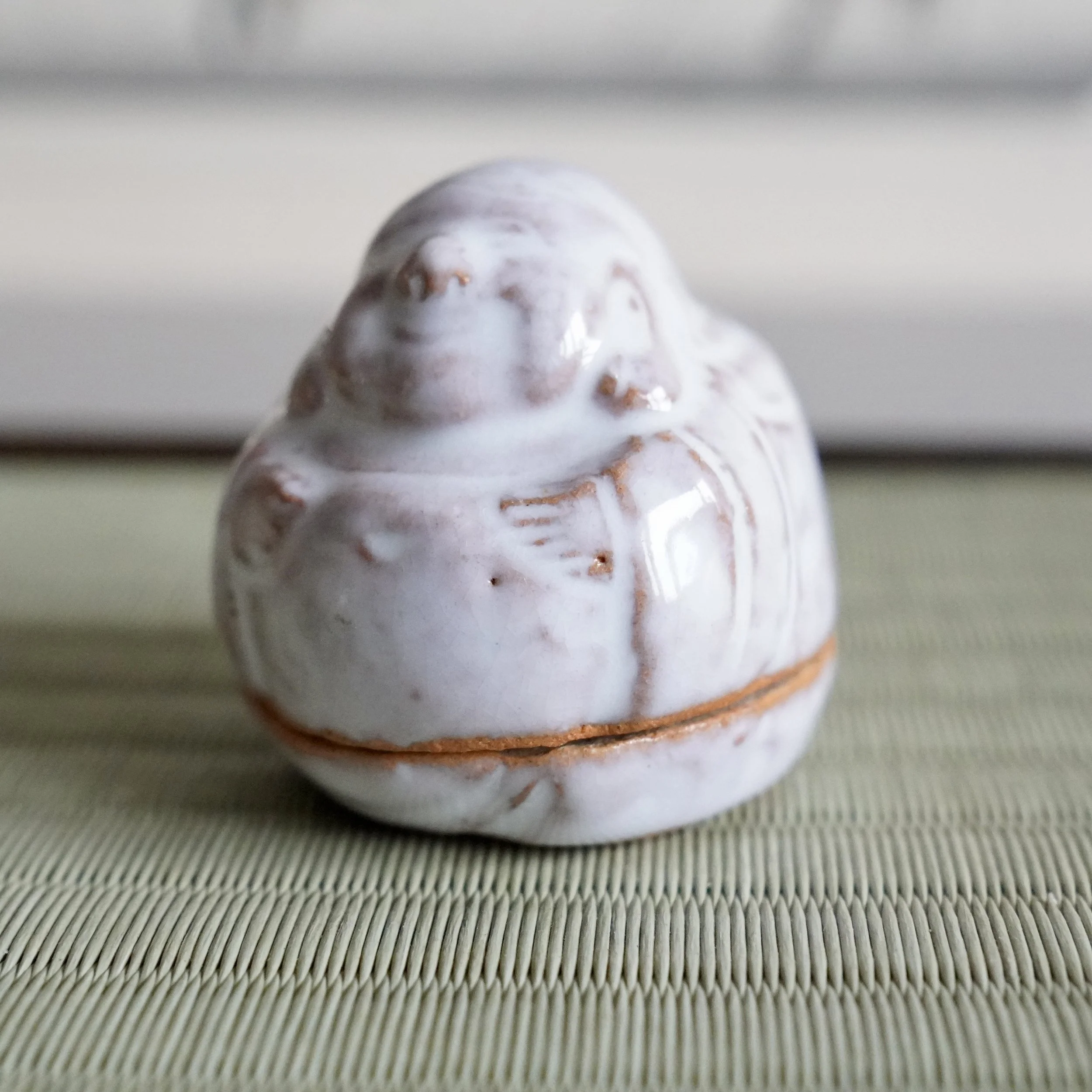
This is Hotei, the laughing god of contentment, made in soft Hagi-yaki. Hagi ware made by the hand of potter Okada Yutaka. He holds a single piece of incense. After that piece is placed near the charcoal, he sits empty for the rest of the session. Japan put its finest craft into this moment of emptying, and then into the silence after.
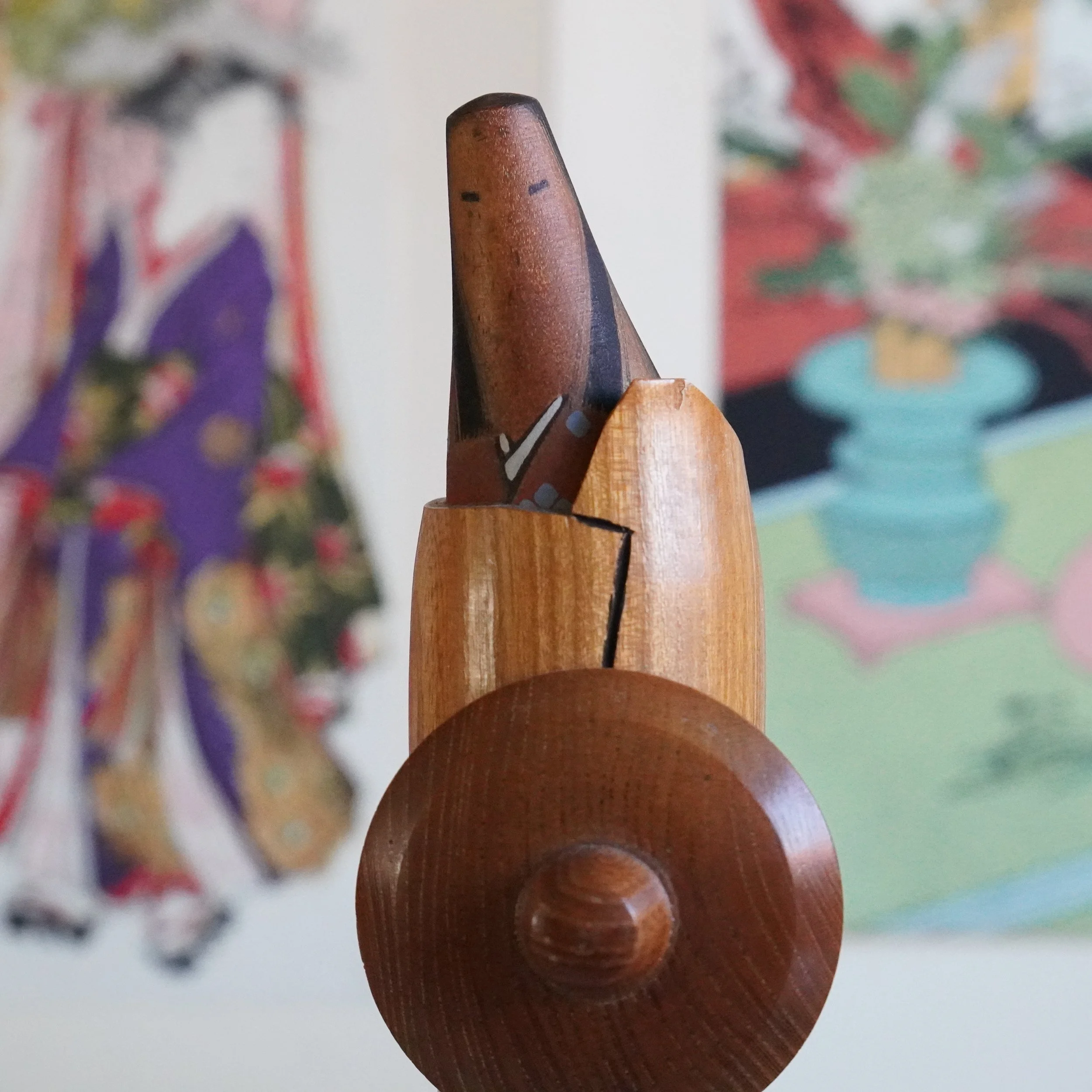
A kokeshi placed well in a room is more powerful than five grouped without thought. Here is what I have learned about height, background, and the quiet effect of giving one figure enough space to simply stand.
They look down with the kind of stillness that takes a moment to place, heavy lidded eyes under thick brushed eyebrows on the larger figure, the same sharp piercing eyes on the smaller one. A full beard is painted strand by strand rather than filled in flat, while vermilion lacquer sweeps around him in one unbroken line, giving way to a dark, almost black hood at the crown. Beside him, the smaller daruma that carries an deep warm lacquer worn into a darker tone where beside the decades of handling he still holds his shine.
Both take the armless, legless form associated with Bodhidharma, the monk said to have meditated so long in stillness that his limbs withered away, leaving only the seated shape carried in his memory ever since.
Both made by different well-known woodworkers. The larger daruma has a black seal pressed at its base, belonging to Shido Shozan, a Yamagata carver known chiefly for his sōsaku kokeshi rather than daruma like this one. The smaller daruma is made by Seifu Gono. A mingei craftsman known for turning keyaki, the slow growing Japanese zelkova prized for its depth of grain, into figures exactly like this one. Keyaki is not an easy wood to source, it takes centuries to mature, and Gono treated every piece as something meant to outlast him.
Curious where this expression comes from in the flesh? I found a thousand versions of it on one hillside in Osaka. Read about it in my journal.